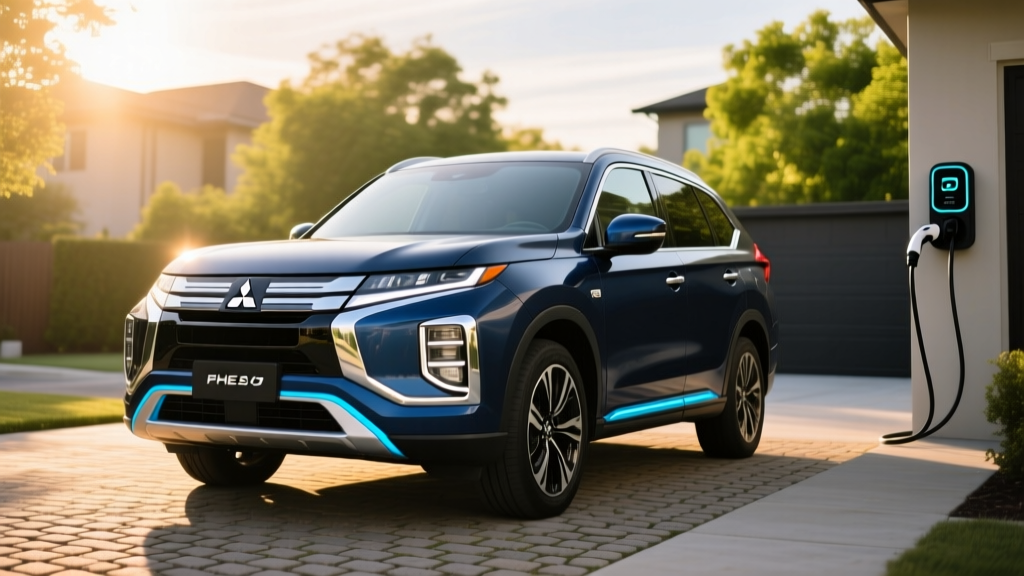
The Mitsubishi Outlander PHEV occupies a specific niche in the electrified-SUV market: a three-row, plug-in hybrid crossover that undercuts rivals like the Toyota RAV4 Prime and Hyundai Tucson PHEV on price while offering something neither does — DC fast charging. For 2026, the Outlander PHEV continues with its 2.4-liter four-cylinder engine paired with twin electric motors and a 20.0 kWh battery, delivering an EPA-estimated 38 miles of electric-only range and 64 MPGe combined. If you're researching the Outlander PHEV hybrid for your next family vehicle, here's every number you need — from real-world range expectations to battery replacement cost.
Quick Verdict: Who the Outlander PHEV Hybrid Is For
The Outlander PHEV is the right call if you want a plug-in hybrid SUV with three rows, can charge at home nightly, and want DC fast-charge capability for road-trip flexibility — all starting under $36,000. It's less ideal if you prioritize electric-only range above all else (the RAV4 Prime offers 42 miles) or need a sporty driving experience. Think of it as the practical, value-oriented PHEV in the compact-SUV segment.
Pros
- 38 miles EPA electric-only range covers most commutes
- Standard DC fast charging (rare for PHEVs)
- Three-row seating in a compact footprint
- Standard AWD via twin-motor S-AWC system
- Competitive starting price (~$35,445)
- 10-year/100,000-mile powertrain warranty
Cons
- Third row is tight — best for small children only
- Highway fuel economy drops once battery depletes
- Modest 227 combined hp feels adequate, not quick
- No Level 3 / hands-free driver-assist system
- Interior materials lag behind Hyundai and Kia rivals
HEV vs PHEV: Understanding the Outlander's Powertrain
Before we get into the numbers, it's worth clarifying what makes the Outlander PHEV different from a conventional hybrid (HEV). A standard hybrid — like the Toyota Highlander Hybrid — uses a small battery (typically 1-2 kWh) that charges exclusively through regenerative braking and the engine. You never plug it in. A plug-in hybrid (PHEV) like the Outlander has a substantially larger battery (20.0 kWh usable) that you charge via a wall outlet or charging station, giving it meaningful electric-only driving range before the gasoline engine engages.
| Attribute | Conventional Hybrid (HEV) | Plug-In Hybrid (PHEV) |
|---|---|---|
| Battery Size | ~1-2 kWh | 20.0 kWh (Outlander PHEV) |
| Plug-In Required | No | Yes (for full benefit) |
| Electric-Only Range | 1-2 miles at low speed | 38 miles EPA |
| After Battery Depletes | N/A (always hybrid) | Operates like a conventional hybrid |
| DC Fast Charging | No | Yes (Outlander PHEV) |
| Federal Tax Credit | No | Up to $3,750 (see details below) |
If you never plug the Outlander PHEV in, it still functions as a hybrid — but you'll forfeit its biggest advantage: 38 miles of zero-gasoline commuting. Think of a PHEV as a "daily EV, weekend hybrid." Plug in nightly, and many owners go months between fill-ups.
Range, MPGe, and Fuel Economy Numbers
The EPA rates the 2026 Outlander PHEV at 64 MPGe combined when operating on electricity (miles-per-gallon-equivalent, which converts kWh consumption into a gasoline-comparable figure). Once the battery is depleted, it operates as a conventional hybrid rated at 25 MPG combined. Here's the full breakdown from fueleconomy.gov:
| Metric | EPA Estimate |
|---|---|
| Electric-Only Range | 38 miles |
| MPGe (Combined, Electric Mode) | 64 MPGe |
| MPG Combined (Gas, Battery Depleted) | 25 MPG |
| MPG City (Gas Mode) | 25 MPG |
| MPG Highway (Gas Mode) | 26 MPG |
| Total Combined Range (Electric + Gas) | ~400 miles |
| Energy Consumption (Electric) | 52 kWh/100 mi |
Real-World MPG vs. EPA: What to Actually Expect
EPA estimates are a baseline, not a guarantee. In real-world testing, the Outlander PHEV's electric-only range is sensitive to temperature and driving style. In mild weather (50-75°F) with moderate city driving, expect to see 35-40 miles on a full charge — right around the EPA sticker. In cold weather (below 30°F), plan for 25-30 miles of electric range due to cabin heating demand and reduced battery efficiency. On the highway at 75+ mph, electric range drops to roughly 28-32 miles even in mild conditions.
Once the battery depletes, the 25 MPG combined figure holds up reasonably well in mixed driving. However, sustained highway driving at high speeds can drop this to 22-23 MPG. City driving in hybrid mode can actually exceed the EPA estimate, with some owners reporting 27-28 MPG in stop-and-go traffic where regenerative braking is most effective.
Powertrain Specs: Engine, Motors, and Horsepower
The Outlander PHEV pairs a 2.4-liter Atkinson-cycle four-cylinder engine with two electric motors — one on each axle — to deliver Mitsubishi's S-AWC (Super All-Wheel Control) all-wheel drive system.
| Specification | Value |
|---|---|
| Engine | 2.4L 4-cylinder Atkinson cycle |
| Front Motor | 85 kW (114 hp) |
| Rear Motor | 100 kW (134 hp) |
| Combined System Output | 227 hp / 283 lb-ft torque |
| Battery Capacity | 20.0 kWh (usable, lithium-ion NMC) |
| Drivetrain | S-AWC AWD (twin-motor) |
| 0-60 mph | ~7.1 seconds |
| Towing Capacity | 1,500 lbs |
The 227 combined horsepower is adequate for daily driving and highway merging but won't win any stoplight drag races. The twin-motor AWD system provides confident traction in rain and light snow without the mechanical complexity of a traditional driveshaft. The 1,500-pound towing capacity is modest — enough for a small utility trailer but not a boat or camper.
Charging: Level 1, Level 2, and DC Fast Charge Times
The Outlander PHEV is one of the few plug-in hybrids on the market that supports DC fast charging — a meaningful advantage if you're taking road trips and want to top up the battery at a highway charging station. Here are the charge times by level:
| Charging Level | Power / Voltage | Time (0-100%) | Miles Added per Hour |
|---|---|---|---|
| Level 1 (Standard Outlet) | 1.4 kW / 120V | ~14 hours | ~3 miles/hr |
| Level 2 (Home/Public AC) | ~3.3 kW / 240V | ~6.5 hours | ~6 miles/hr |
| DC Fast Charge (CHAdeMO) | Up to 22 kW | ~38 min (0-80%) | N/A (quick top-up) |
Important connector note: The Outlander PHEV uses a CHAdeMO connector for DC fast charging, not the CCS1 or NACS standard found on most modern EVs. CHAdeMO stations are still available at many Electrify America and independent locations, but the network is shrinking as the industry standardizes on NACS/CCS. For home Level 2 charging, the Outlander uses the standard J1772 connector, which is universal across all non-Tesla plug-in vehicles.
The onboard AC charger is limited to 3.3 kW, which means even if you plug into a 7.2 kW or 11.5 kW Level 2 station, the Outlander will only draw 3.3 kW. This makes overnight home charging perfectly practical (6.5 hours covers most sleep schedules), but you won't benefit from installing a higher-amperage Level 2 circuit specifically for this vehicle.
Pricing, Trims, and Tax Credit Eligibility
The 2026 Mitsubishi Outlander PHEV starts at approximately $35,445 (ES trim, including destination). Here's the trim-level pricing breakdown:
| Trim | MSRP (est.) |
|---|---|
| ES | $35,445 |
| SE | $38,145 |
| SEL | $41,345 |
| SEL Touring | $44,845 |
Does the Outlander PHEV Qualify for a Federal Tax Credit?
Under current IRS §30D clean vehicle credit rules, the Outlander PHEV is eligible for a partial federal tax credit of up to $3,750 — not the full $7,500. This is because the vehicle's battery meets some but not all of the critical-mineral and battery-component sourcing requirements that determine credit tier. Key eligibility conditions:
- MSRP Cap: Vehicle must have an MSRP at or below $80,000 (SUVs/vans) — all Outlander PHEV trims qualify.
- Buyer Income Cap: Adjusted gross income must not exceed $150,000 (single), $225,000 (head of household), or $300,000 (joint filers).
- Point-of-Sale Transfer: You can transfer the credit to the dealer at purchase for an immediate price reduction, or claim it on your tax return.
- Partial Credit ($3,750): Outlander PHEV meets either the critical minerals or battery component requirement, but not both for 2026.
Always verify current-year eligibility with your tax professional before purchasing. IRS sourcing requirements tighten annually, and the credit amount can change between model years. Some states also offer additional PHEV incentives — check your state energy office or the AFDC state incentive database for local programs.
Battery Warranty, Lifespan, and Replacement Cost
Mitsubishi backs the Outlander PHEV's high-voltage battery with a strong warranty, and the broader powertrain coverage is among the best in the segment.
• High-Voltage Battery: 10 years / 100,000 miles (capacity retention warranty)
• Powertrain (engine, motors, transmission): 10 years / 100,000 miles
• Basic Bumper-to-Bumper: 5 years / 60,000 miles
• Roadside Assistance: 5 years / unlimited miles
The battery warranty guarantees that the pack will retain a minimum percentage of its original capacity (typically 70%) over the 10-year/100,000-mile period. If it falls below that threshold, Mitsubishi will repair or replace it at no cost.
How Long Will the Battery Last?
Modern PHEV batteries are designed for longevity. The Outlander PHEV's 20.0 kWh NMC (nickel-manganese-cobalt) pack uses a conservative charge buffer — Mitsubishi doesn't allow the battery to charge to a true 100% or discharge to a true 0%, which significantly extends cycle life. Based on data from earlier Outlander PHEV generations (which have been on the road since 2014 globally), most packs retain 85-90% of original capacity after 100,000 miles and 8-10 years of use. Degradation is typically front-loaded (2-3% in the first year) and then levels off to roughly 1% per year thereafter.
Battery Replacement Cost
If your battery does need replacement outside of warranty coverage, expect a cost in the range of $6,000 to $9,000 including parts and labor at a Mitsubishi dealer. This is a worst-case scenario and relatively uncommon given the warranty coverage and observed longevity of these packs. Individual module replacement (if only a few cells are degraded) can reduce this cost significantly.
Outlander PHEV vs. Rivals: How It Stacks Up
The compact PHEV SUV segment has several strong competitors. Here's how the Outlander PHEV compares on the numbers that matter:
| Spec | Mitsubishi Outlander PHEV | Toyota RAV4 Prime | Hyundai Tucson PHEV |
|---|---|---|---|
| Electric-Only Range | 38 mi | 42 mi | 33 mi |
| Combined MPGe | 64 | 94 | 80 |
| Gas MPG (Depleted) | 25 | 38 | 35 |
| Combined HP | 227 | 302 | 261 |
| 0-60 mph | ~7.1s | ~5.7s | ~6.5s |
| Battery (kWh) | 20.0 | 18.1 | 13.8 |
| DC Fast Charge | Yes (CHAdeMO) | No | No |
| Third Row | Yes | No | No |
| Starting MSRP | ~$35,445 | ~$43,690 | ~$38,325 |
| Federal Tax Credit | Up to $3,750 | Up to $7,500 | Up to $7,500 |
The RAV4 Prime wins on electric range, MPGe, and horsepower — but it costs nearly $8,000 more and is often subject to dealer markups due to high demand. The Tucson PHEV offers a strong balance of range and power but lacks the Outlander's third row and DC fast charging. If three-row seating and a sub-$36K starting price are priorities, the Outlander PHEV stands alone.
Outlander PHEV vs. Full EV vs. Gas Car: Which Fits You?
- You can charge at home (garage or driveway with a 120V or 240V outlet)
- Your daily commute is under 35 miles round-trip
- You take road trips and don't want to plan around charging stations
- You need three rows occasionally but don't want a minivan
- You want lower fuel costs without full EV commitment
- You have reliable home charging and your daily drive is under 250 miles
- You want zero gasoline expenses and minimal maintenance
- You want the full $7,500 federal tax credit
- You're comfortable with public DC fast charging for road trips
- You cannot charge at home (apartment, street parking)
- You want better fuel economy without changing your habits
- You want the lowest possible purchase price
- You drive very few miles annually (under 5,000 — the fuel savings won't offset the premium)
- You're buying used on a tight budget
Frequently Asked Questions
How many MPG does the Outlander PHEV hybrid get?
The 2026 Outlander PHEV achieves 64 MPGe combined in electric mode and 25 MPG combined (25 city / 26 highway) once the battery is depleted. In real-world city driving with regular plug-in charging, many owners report using very little gasoline for daily commuting. Without plugging in, expect 22-28 MPG depending on driving conditions.
How far can the Outlander PHEV go on electric only?
The EPA rates the Outlander PHEV at 38 miles of electric-only range. In real-world conditions, expect 35-40 miles in mild weather city driving, 28-32 miles at highway speed, and 25-30 miles in cold weather (below 30°F). The gasoline engine seamlessly takes over once the battery depletes, so you're never stranded.
Does the Outlander PHEV qualify for a tax credit?
Yes, the Outlander PHEV qualifies for a partial federal tax credit of up to $3,750 under current §30D rules. Eligibility depends on your income (single filers: under $150K AGI; joint: under $300K) and the vehicle must be under the $80K MSRP cap for SUVs. You can transfer the credit to the dealer for an immediate price reduction. Check IRS.gov for current rules.
Is the Outlander PHEV reliable?
Mitsubishi's PHEV powertrain has a strong track record — the Outlander PHEV has been sold globally since 2013 with no widespread battery failure issues. Mitsubishi backs it with a 10-year/100,000-mile powertrain and battery warranty, among the longest in the industry. Independent reliability surveys (Consumer Reports, J.D. Power) rate Mitsubishi as average to slightly above average for the segment.
What does an Outlander PHEV battery replacement cost?
Out-of-warranty battery replacement runs approximately $6,000-$9,000 at a Mitsubishi dealer. However, this is rarely needed — the 10-year/100,000-mile warranty covers capacity loss below ~70%, and real-world data shows most packs retain 85-90% capacity well past 100,000 miles.
Can I charge the Outlander PHEV at home with a regular outlet?
Yes. A standard 120V household outlet (Level 1) will fully charge the Outlander PHEV in about 14 hours. For most owners who drive 30-40 miles daily and plug in overnight, this is sufficient. A 240V Level 2 home charger reduces that to about 6.5 hours and is recommended if you have a 240V circuit available.
Does the Outlander PHEV have three rows of seating?
Yes, the Outlander PHEV includes a third-row seat standard across all trims. However, the third row is compact — suitable for children or occasional short-trip adult passengers. If you regularly need to carry adults in the third row, consider a larger SUV like the Kia Sorento PHEV.
Do I have to plug in the Outlander PHEV?
No — the Outlander PHEV will operate as a conventional hybrid if you never plug it in. However, you'll lose the 38 miles of electric-only range and the associated fuel savings. To get the full value from a PHEV, nightly home charging is strongly recommended. Without plugging in, you're paying for battery capacity you're not using.