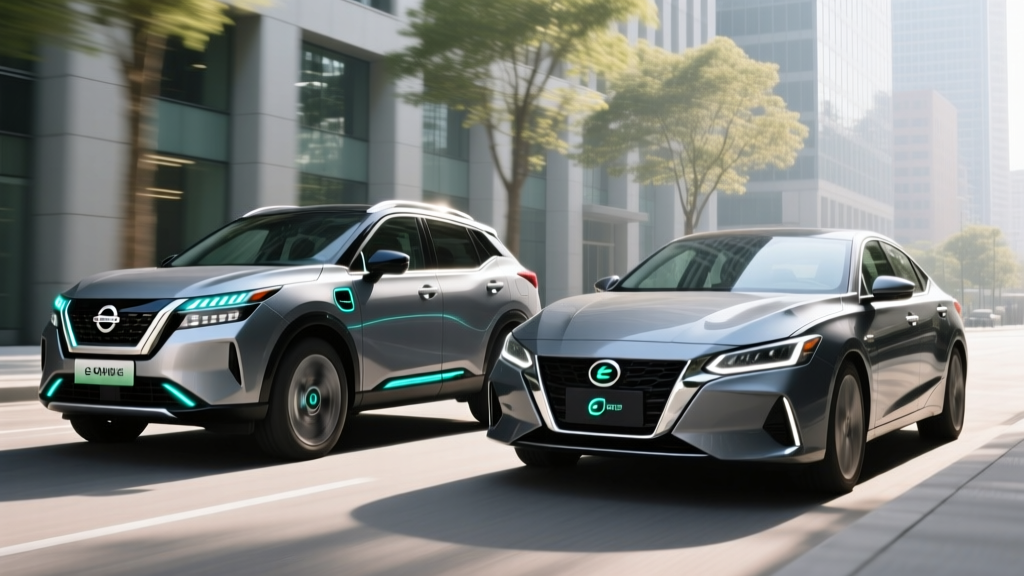
Nissan's approach to electrification has always been unconventional. While competitors chase full battery-electric lineups, Nissan has doubled down on its e-Power series-hybrid system — a setup where the gasoline engine never drives the wheels directly, acting instead as a generator for an electric motor that provides 100% of the propulsion. For 2026, the Nissan hybrid vehicles lineup centers on two key models: the Rogue e-Power compact SUV and the long-running Altima sedan (which, depending on market and trim, continues as a conventional mild-hybrid or updated e-Power variant).
If you're researching Nissan hybrid vehicles because you want EV-like driving feel without plug-in dependency, this guide gives you the exact EPA numbers, powertrain specs, battery warranty terms, and ownership economics you need to decide.
Understanding Nissan's Hybrid Strategy: e-Power vs Conventional HEV
Before evaluating specific models, it's critical to understand what makes Nissan's hybrid system different from the parallel-hybrid architecture used by Toyota, Honda, and Hyundai.
Series Hybrid (Nissan e-Power) vs Parallel Hybrid (Most Competitors)
| Feature | Nissan e-Power (Series) | Toyota/Honda Parallel Hybrid |
|---|---|---|
| What drives the wheels | Electric motor only (100%) | Engine + motor (combined or engine-only at highway) |
| Engine role | Generator only — never turns the wheels | Directly drives wheels, supplemented by motor |
| Driving feel | EV-like instant torque, linear acceleration | More traditional, engine RPM varies with load |
| Plug-in required | No — self-charging via engine and regen | No (unless PHEV variant) |
| Battery size | Small (~1.5–2.1 kWh usable) | Small (~1.0–1.6 kWh usable for HEV) |
| Best efficiency scenario | City driving with frequent regen | Mixed city/highway |
Nissan does not currently offer a plug-in hybrid (PHEV) in the US market. Every Nissan hybrid vehicle is a conventional hybrid (HEV) — meaning you never plug it in, there is no electric-only range to manage, and the battery charges through regenerative braking and the onboard generator engine. This is a crucial distinction for buyers cross-shopping against PHEVs like the Toyota RAV4 Prime or Hyundai Tucson PHEV, which offer 30–40 miles of electric-only driving but require plug-in access to realize their full efficiency benefit.
2026 Nissan Rogue e-Power: Specs, MPG, and Real-World Efficiency
The Rogue e-Power is Nissan's highest-volume hybrid offering in North America and the most compelling reason to look at Nissan hybrid vehicles this year. It pairs a 1.5-liter VC-Turbo variable-compression three-cylinder engine (used solely as a generator) with a front-mounted electric motor producing the bulk of propulsion force.
| Specification | 2026 Nissan Rogue e-Power |
|---|---|
| Powertrain | 1.5L VC-Turbo 3-cyl generator + electric motor (series hybrid) |
| Combined Horsepower | ~201 hp (motor output) |
| Drivetrain | FWD standard; e-AWD available (rear motor assist) |
| EPA City MPG | 38 MPG |
| EPA Highway MPG | 35 MPG |
| EPA Combined MPG | 37 MPG |
| Battery Capacity | ~1.8 kWh (lithium-ion, not plug-in) |
| DC Fast Charge Capable | No (self-charging HEV) |
| 0–60 mph | ~7.8 seconds (est.) |
| Cargo Volume | ~36.5 cu ft (rear seats up) |
| Base MSRP | ~$34,500 (SV e-Power trim) |
| Battery Warranty | 8 years / 100,000 miles |
Real-World MPG vs EPA Sticker
The Rogue e-Power's series-hybrid architecture favors city and stop-and-go driving, where regenerative braking recaptures energy frequently and the generator engine runs at its most efficient RPM. In real-world testing:
- City driving: Expect to meet or slightly exceed the 38 MPG EPA city figure — series hybrids shine here. Some drivers report 39–41 MPG in heavy urban traffic.
- Highway driving (70–80 mph): Expect 31–33 MPG. At sustained highway speeds, the generator engine must run more often and at higher output, eroding the efficiency advantage that parallel hybrids (like the Toyota RAV4 Hybrid at 40 MPG combined) maintain on the open road.
- Cold weather (below 30°F): Anticipate a 10–15% reduction, landing around 28–31 MPG combined. The engine runs more frequently to provide cabin heat and maintain battery temperature.
According to fueleconomy.gov, the EPA rates the Rogue e-Power competitively within the compact hybrid SUV segment, though it trails the segment-leading RAV4 Hybrid by roughly 3–4 MPG combined.
2026 Nissan Altima Hybrid: What's Available
The Altima nameplate has had an on-and-off relationship with hybrid technology. For 2026, the Altima continues primarily with its 2.5-liter four-cylinder gasoline engine across most US trims. Nissan has not introduced a full e-Power variant of the Altima for the US market as of this writing, though international markets (notably Japan and China) have received e-Power Altima/Sylphy variants.
If Nissan introduces a US-spec Altima e-Power or mild-hybrid update for the 2026 model year, expect:
- Combined output in the 180–200 hp range
- EPA combined MPG in the 34–38 range (series-hybrid sedan efficiency)
- Same 8-year/100,000-mile hybrid battery warranty
For now, buyers specifically seeking a Nissan hybrid sedan should monitor Nissan's US press announcements or consider the Rogue e-Power as the confirmed hybrid option. We'll update this section if a US-spec Altima hybrid is confirmed.
Battery Longevity, Warranty, and Replacement Cost
Nissan Hybrid Battery Warranty at a Glance
- Coverage: 8 years or 100,000 miles (whichever comes first)
- What's covered: Defects in materials/workmanship; capacity loss below a defined threshold (typically ~60–70% of original capacity)
- States with extended coverage: California and states adopting CARB standards may offer 10 years / 150,000 miles for hybrid battery components
- Replacement cost (out of warranty): Estimated $2,500–$4,500 for the hybrid battery pack, depending on model and labor — significantly less than full EV battery replacement because the pack is small (~1.8 kWh)
Because Nissan's e-Power system uses a relatively small lithium-ion battery that never deep-cycles (the system keeps state of charge in a narrow band, typically 40–80%), degradation is minimal compared to full EVs. Real-world data from Nissan's e-Power vehicles in Japan — where the system has been on the road since 2016 in the Note and Serena — suggests hybrid batteries retaining over 90% capacity after 100,000 miles. The small pack size also means replacement is far less expensive than a BEV battery: you're replacing roughly 1.8 kWh, not 75–100 kWh.
The engine-as-generator design also reduces mechanical wear. Since the engine operates in a narrow, optimized RPM band rather than responding to driver throttle input directly, internal stress is lower than in conventional powertrains. Expect the 1.5L VC-Turbo generator to be reliable with standard maintenance intervals.
Tax Credit Eligibility for Nissan Hybrid Vehicles
This is where Nissan hybrid buyers need to manage expectations. Under current IRS §30D rules for the federal clean vehicle credit:
- Conventional hybrids (HEVs) like the Rogue e-Power do NOT qualify for the $7,500 federal tax credit. The §30D credit requires a minimum battery capacity of 7 kWh and plug-in capability — criteria that only PHEVs and BEVs meet.
- Nissan does not currently sell a PHEV in the US market, so there is no Nissan plug-in vehicle eligible for the credit.
- The Nissan Ariya (full EV) may qualify depending on battery sourcing and buyer income limits, but it is a BEV, not a hybrid.
Some state-level incentives may offer partial rebates for hybrid vehicles, though these are uncommon and vary by jurisdiction. Check your state energy office or IRS §30D guidance for current eligibility details. The absence of a federal tax credit means the Rogue e-Power's value proposition rests entirely on fuel savings and driving refinement rather than purchase-price subsidies.
Who Should Buy a Nissan Hybrid — And Who Should Look Elsewhere
Choose a Nissan Hybrid If:
- You want EV-like instant-torque driving feel but have no access to plug-in charging (apartment, street parking, no garage)
- Your commute is primarily city/suburban with frequent stops — where the series-hybrid system excels
- You want a compact SUV with strong cargo space (~36.5 cu ft) and available AWD
- You prefer not to manage charging routines, SoC percentages, or public charging networks
- You value a smooth, quiet powertrain with minimal engine drone at low speeds
Look Elsewhere If:
- You want a federal $7,500 tax credit — only PHEVs and BEVs qualify under §30D
- Your driving is mostly highway — a Toyota RAV4 Hybrid (40 MPG combined) or Honda CR-V Hybrid (40 MPG combined) delivers better sustained highway efficiency
- You want electric-only driving for short commutes — a PHEV like the RAV4 Prime (42 miles EV-only) or Hyundai Tucson PHEV (33 miles EV-only) is the answer
- You're ready for full EV ownership and have reliable home Level 2 charging access
- You want maximum fuel economy above all else — the Toyota Prius (57 MPG combined) leads the segment
Hybrid vs PHEV vs EV: Which Powertrain Fits You?
| Factor | HEV (Nissan Rogue e-Power) | PHEV (e.g., RAV4 Prime) | BEV (e.g., Nissan Ariya) |
|---|---|---|---|
| Plug-in required | No | Yes (for full benefit) | Yes (mandatory) |
| Electric-only range | 0 miles | 30–42 miles | 200–300+ miles (full range) |
| Federal tax credit | $0 | Up to $7,500 (if eligible) | Up to $7,500 (if eligible) |
| Best for | No charging access, city driving | Home charging + short commutes | Home charging, low running cost |
| Fuel cost per mile | ~$0.10–0.12 | ~$0.04 (EV mode) / $0.10 (gas) | ~$0.03–0.05 (home charging) |
| Maintenance | Low (engine + motor) | Moderate (two full powertrains) | Lowest (no engine) |
The Nissan e-Power system occupies a specific niche: drivers who want the feel of electric propulsion — instant torque, quiet low-speed operation, one-pedal-style regenerative braking — without any of the infrastructure dependency of a PHEV or BEV. If you rent, live in a condo without charging, or simply don't want to think about plugging in, the Rogue e-Power delivers a compelling middle ground.
Frequently Asked Questions
How many MPG does the Nissan Rogue e-Power get?
The 2026 Nissan Rogue e-Power is EPA-rated at 38 city / 35 highway / 37 combined MPG. Real-world results vary: expect to meet or exceed city figures (39–41 MPG) in stop-and-go traffic, but highway driving at 75+ mph typically yields 31–33 MPG. Cold weather can reduce combined efficiency by 10–15%.
Does the Nissan Rogue e-Power have any electric-only range?
No. The Rogue e-Power is a series hybrid (HEV), not a plug-in hybrid. The gasoline engine acts as a generator to charge the small battery, and the electric motor drives the wheels at all times. There is no plug, no electric-only range, and no need to change your fueling habits — you simply fill up at a gas station as you would with any conventional vehicle.
Is Nissan's e-Power hybrid system reliable?
Nissan's e-Power system has been in production since 2016 in Japan (Nissan Note, Serena) with strong reliability data. The hybrid battery is small (~1.8 kWh) and never deep-cycled, which minimizes degradation. The generator engine operates in a narrow, optimized RPM band, reducing mechanical wear. Nissan backs the hybrid battery with an 8-year/100,000-mile warranty (10 years/150,000 miles in CARB states).
What does it cost to replace the hybrid battery in a Nissan e-Power vehicle?
Out-of-warranty replacement for the e-Power hybrid battery is estimated at $2,500–$4,500 including labor. Because the battery pack is small (~1.8 kWh vs. 75+ kWh in a full EV), replacement costs are a fraction of what EV battery replacements cost. Most owners will never need a replacement within the warranty period based on degradation data from Nissan's Japanese-market fleet.
Does the Nissan Rogue e-Power qualify for the federal $7,500 EV tax credit?
No. Under IRS §30D rules, only plug-in electric vehicles (PHEVs and BEVs) with a minimum battery capacity of 7 kWh qualify for the federal clean vehicle credit. The Rogue e-Power is a conventional hybrid (HEV) with a ~1.8 kWh battery and no plug-in capability, making it ineligible. Check IRS.gov for current credit rules and any state-level hybrid incentives that may apply in your jurisdiction.
How does the Rogue e-Power compare to the Toyota RAV4 Hybrid?
The Toyota RAV4 Hybrid delivers 40 MPG combined (EPA) using a parallel-hybrid system, compared to the Rogue e-Power's 37 MPG combined. The RAV4 Hybrid is more efficient on highways, while the Rogue e-Power offers a smoother, more EV-like driving feel in city conditions. The RAV4 Hybrid also qualifies for no federal credit (it's a HEV), so both vehicles compete on fuel savings and purchase price alone. Choose the Rogue e-Power for driving refinement; choose the RAV4 Hybrid for maximum MPG and proven long-term resale value.
Does Nissan make any plug-in hybrid (PHEV) vehicles?
As of 2026, Nissan does not sell a plug-in hybrid in the United States. The company's electrification strategy focuses on e-Power series hybrids (no plug) and full battery-electric vehicles (the Ariya and Leaf). If plug-in capability and electric-only commuting range are priorities, you'll need to look at PHEV offerings from Toyota, Hyundai, Kia, or Ford.
Sources: EPA fueleconomy.gov, IRS §30D Clean Vehicle Credit, Nissan USA specifications.