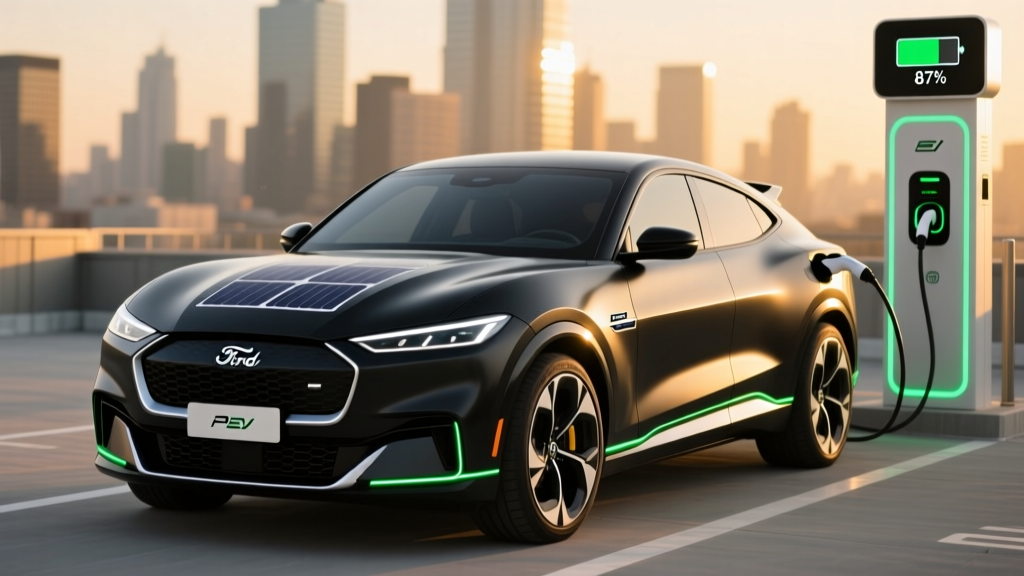
If you've been searching for a Mustang Mach-E hybrid, you're not alone — the query pulls steady interest from buyers who love the Mach-E's styling and performance but aren't ready to commit to a fully electric vehicle. Here's the definitive answer upfront: Ford does not offer the Mustang Mach-E as a hybrid (HEV) or plug-in hybrid (PHEV) in the 2026 model year. The Mach-E is, and has always been, a battery-electric vehicle (BEV) only.
That doesn't mean Ford has abandoned the hybrid shopper. The automaker's electrified lineup includes the Escape PHEV, the Maverick hybrid, and the F-150 PowerBoost hybrid — all strong choices for buyers who want electric-adjacent efficiency without range anxiety. This guide breaks down why the Mach-E is EV-only, what Ford's actual hybrid options look like, and how to decide whether a BEV, PHEV, or conventional hybrid fits your driving life.
Why There's No Mustang Mach-E Hybrid
The Mustang Mach-E rides on Ford's dedicated BEV platform (internally called GE2), which was engineered from the ground up for battery-electric propulsion. There is no internal combustion engine bay designed into the architecture, no transmission tunnel for a hybrid drivetrain, and no packaging space for both a large battery pack and a gasoline engine.
Converting a dedicated BEV platform into a PHEV would require an entirely new vehicle program — essentially building a different car. Automakers typically reserve PHEV powertrains for vehicles that share platforms with gasoline models, like the Ford Escape, which offers a conventional hybrid, a PHEV, and formerly an ICE-only version on the same C2 architecture.
Ford's strategy has been clear: the Mach-E competes as a pure electric crossover against the Tesla Model Y, Hyundai Ioniq 5, and Kia EV6. For buyers who want the Blue Oval badge with a plug and a gas tank, Ford points to the Escape PHEV.
HEV vs PHEV vs BEV: What's the Difference?
Before we compare Ford's actual hybrid offerings to the Mach-E, let's clarify the three electrified powertrain types. This distinction matters enormously for fuel costs, charging needs, and tax credit eligibility.
Conventional Hybrid (HEV)
How it works: A small battery (typically 1–2 kWh) and electric motor assist a gasoline engine. The battery recharges through regenerative braking and the engine — you never plug it in.
Example: Ford Maverick Hybrid, Toyota RAV4 Hybrid
Electric-only driving: Very limited, usually under 1 mile at low speeds
Plug-in Hybrid (PHEV)
How it works: A larger battery (typically 12–25 kWh) and more powerful electric motor provide meaningful electric-only range (25–50 miles). You plug it in to recharge, but a gasoline engine kicks in for longer trips.
Example: Ford Escape PHEV, Toyota RAV4 Prime
Electric-only driving: 25–50 miles EPA-rated, then operates as a conventional hybrid
Battery Electric Vehicle (BEV)
How it works: A large battery (60–100+ kWh) powers electric motors exclusively. No gasoline engine, no tailpipe. You must plug in to recharge.
Example: Ford Mustang Mach-E, Tesla Model Y
Electric-only driving: 100% electric, 230–320+ miles EPA range
The 2026 Mustang Mach-E: BEV Specs at a Glance
Since the Mach-E is a BEV, here are the actual specs for the current model year. These figures are relevant if you're deciding whether to go fully electric or pivot to a Ford hybrid instead.
| Spec | Select (RWD) | Premium (AWD) | GT (AWD) |
|---|---|---|---|
| Battery (usable) | 72 kWh (LFP) | 91 kWh (NMC) | 91 kWh (NMC) |
| EPA Range | 250 mi | 290 mi | 280 mi |
| Horsepower | 266 hp | 346 hp | 480 hp |
| 0–60 mph | 6.3 sec | 5.1 sec | 3.3 sec |
| Max DC Fast Charge | ~115 kW | ~150 kW | ~150 kW |
| 10–80% DC Charge | ~33 min | ~36 min | ~36 min |
| MPGe (combined) | 101 MPGe | 98 MPGe | 84 MPGe |
| Base MSRP | ~$39,995 | ~$46,995 | ~$57,995 |
Real-world range note: EPA range figures assume mixed driving at moderate temperatures. In our experience, highway-heavy trips at 75+ mph reduce range by roughly 10–15%, and cold weather (below 30°F) can cut range by 20–30% depending on cabin heating use. A Premium AWD rated at 290 miles EPA may deliver closer to 245–260 miles on a winter road trip.
Ford's Actual Hybrid Option: The Escape PHEV
If the idea of a Ford crossover with a plug appeals to you but you need a gas-engine safety net, the Ford Escape PHEV is the closest product to a "Mustang Mach-E hybrid" that actually exists. Here's how it stacks up.
| Spec | Value |
| Powertrain | 2.5L 4-cyl + electric motor (210 hp combined) |
| Battery (usable) | 14.4 kWh (NMC lithium-ion) |
| Electric-Only Range (EPA) | 37 miles |
| Total Combined Range | ~430 miles |
| MPGe (electric mode) | 105 MPGe |
| MPG (gas hybrid mode) | 40 city / 37 highway / 39 combined |
| Level 2 Charge Time (0–100%) | ~3.5 hours at 3.3 kW |
| DC Fast Charging | Not available |
| Base MSRP | ~$38,500 |
Real-world MPG insight: Conventional hybrids and PHEVs in hybrid mode often exceed their EPA city ratings in real-world stop-and-go driving, where regenerative braking recaptures the most energy. The Escape PHEV's 40 mpg city EPA rating may stretch to 42–45 mpg in moderate-temperature urban commuting. Highway efficiency is typically lower — expect 35–37 mpg at 70 mph. Source: fueleconomy.gov
Tax Credit Eligibility: Mach-E vs Escape PHEV
Federal tax credit rules under IRS §30D treat BEVs and PHEVs differently, and eligibility depends on battery sourcing, MSRP caps, and buyer income limits. Here's the 2026 landscape:
- Ford Mustang Mach-E (BEV): Depending on battery component and critical mineral sourcing compliance, the Mach-E may qualify for up to $7,500 in federal tax credits. Since 2024, buyers can elect to transfer the credit to the dealer at point of sale, reducing the purchase price directly. Eligibility is subject to MSRP caps ($80,000 for SUVs) and buyer income limits ($300,000 joint / $150,000 single modified AGI). Check the latest IRS guidance and the specific VIN's sourcing status at the time of purchase.
- Ford Escape PHEV: PHEVs with battery capacity of at least 7 kWh are eligible for up to $7,500 under the same §30D rules, subject to identical MSRP caps ($80,000 for SUVs), income limits, and sourcing requirements. The Escape PHEV's 14.4 kWh battery exceeds the minimum threshold. However, sourcing compliance varies by model year and production batch — verify with your dealer before assuming the full credit.
Neither vehicle qualifies for the used EV credit (§25E) when purchased new. State-level incentives vary widely — consult your state energy office or a tax professional for local rebates.
Battery Warranty and Longevity: What Hybrid Buyers Need to Know
Battery Warranty Comparison
Ford Mustang Mach-E (BEV): 8 years / 100,000 miles — battery must retain at least 70% of original capacity for warranty coverage.
Ford Escape PHEV: 8 years / 100,000 miles on hybrid/EV battery components (in CARB states, coverage extends to 10 years / 150,000 miles).
Conventional Ford Hybrids (Maverick, F-150 PowerBoost): 8 years / 100,000 miles on high-voltage battery.
Battery degradation in PHEVs is generally modest because the battery is smaller and the vehicle's software maintains a buffer — you rarely charge to true 100% or discharge to true 0%. Most PHEV batteries outlast the vehicle's useful life. Replacement cost for an Escape PHEV battery, should it ever be needed out of warranty, typically falls in the $6,000–$9,000 range including labor, based on current dealer pricing.
The Mach-E's larger BEV battery is more expensive to replace — estimates run $15,000–$22,000 out of warranty — but BEV batteries tend to degrade more slowly in percentage terms because daily use cycles are shallower relative to total capacity. Ford's LFP battery option (available on Select trim) offers superior cycle life and less degradation over time compared to NMC chemistry, though at a lower energy density (hence the shorter range).
Who Should Choose What: A Decision Framework
Choose the Mustang Mach-E (BEV) if:
- You can install a Level 2 home charger (240V, 32–48A)
- Your daily commute is under 200 miles round-trip
- You want maximum performance (up to 480 hp, 3.3-sec 0–60)
- You want the lowest per-mile "fuel" cost (electricity at $0.14/kWh ≈ $0.04/mile)
- You take road trips 3–5 times per year and can plan DC fast-charging stops
Choose the Escape PHEV if:
- You want 37 miles of electric-only commuting but need gas-engine freedom for longer trips
- You lack reliable access to DC fast chargers or live in a charging desert
- You want a single vehicle that handles a 500-mile road trip without route planning
- You can charge at home overnight but can't always rely on public charging
- You prefer the lower complexity of a smaller battery with a gas backup
Choose a Conventional Hybrid (HEV) like the Maverick if:
- You cannot plug in at all (no garage, no driveway outlet, apartment living)
- You want better MPG than a gas car without any behavioral change
- You want the lowest purchase price among electrified vehicles
- Your priority is simplicity — no charging cables, no range calculations
Pros and Cons at a Glance
Mach-E BEV — Pros
- Up to 290 miles EPA range
- Instant torque, up to 480 hp
- Lowest fuel cost per mile
- Minimal maintenance (no oil, spark plugs, exhaust)
- Eligible for up to $7,500 federal credit
- Ford BlueCruise hands-free highway driving available
Mach-E BEV — Cons
- Requires home charging setup ($500–$2,000 install)
- Road trips require DC fast-charge planning
- Cold weather reduces range 20–30%
- No gas-engine backup for emergencies
- Higher insurance premiums in many states
- DC charging tapers significantly above 80% SoC
Escape PHEV — Pros
- 37 miles electric-only covers most commutes
- 430+ miles total range — no range anxiety
- 39 mpg combined in hybrid mode
- No DC fast-charging dependency
- Eligible for up to $7,500 federal credit
- Lower battery replacement cost vs BEV
Escape PHEV — Cons
- Less power (210 hp vs 266–480 hp)
- No DC fast charging — 3.5 hr on Level 2
- Still requires oil changes, spark plugs, exhaust maintenance
- Smaller cargo area than Mach-E
- Less engaging driving dynamics
- Electric-only mode limited to ~80 mph
Frequently Asked Questions
Is there a Mustang Mach-E hybrid or PHEV?
No. The Ford Mustang Mach-E is exclusively a battery-electric vehicle (BEV) across all trims. Ford has not announced any plans for a hybrid or plug-in hybrid variant. Its dedicated EV platform was not designed to accommodate an internal combustion engine.
What Ford SUV comes closest to a "Mustang Mach-E hybrid"?
The Ford Escape PHEV is the closest analogue: a Ford crossover SUV with a plug, 37 miles of electric-only range, and a gasoline engine for longer trips. It starts around $38,500 and qualifies for potential federal tax credits up to $7,500 under §30D.
How many MPG does the Escape PHEV get?
In hybrid mode (after the battery is depleted), the Escape PHEV is EPA-rated at 40 city / 37 highway / 39 combined MPG. In electric mode, it achieves 105 MPGe. Real-world city driving often yields 42–45 mpg thanks to regenerative braking; highway mileage tends to run 35–37 mpg at sustained speeds. (Source: fueleconomy.gov)
Does the Escape PHEV qualify for a tax credit?
The Escape PHEV's 14.4 kWh battery exceeds the §30D minimum of 7 kWh, making it potentially eligible for up to $7,500 in federal tax credits. However, eligibility depends on battery component and critical mineral sourcing compliance, buyer income limits ($300,000 joint / $150,000 single), and the MSRP cap ($80,000 for SUVs). Verify the specific vehicle's sourcing status with your dealer and consult a tax professional. (Source: IRS.gov)
How long will the Escape PHEV battery last?
Ford covers the Escape PHEV's high-voltage battery for 8 years / 100,000 miles (10 years / 150,000 miles in CARB states). Real-world data from similar PHEVs suggests the battery will retain 85–90% of its original capacity at the 100,000-mile mark under normal use. Full replacement, if needed out of warranty, typically costs $6,000–$9,000.
Can I charge the Escape PHEV at a DC fast charger?
No. The Escape PHEV supports Level 1 (120V, ~12 hours for a full charge) and Level 2 (240V, ~3.5 hours at 3.3 kW) AC charging only. It does not have a DC fast-charging port. This is typical for PHEVs — the smaller battery doesn't justify the cost and weight of DC charging hardware.
BEV vs PHEV vs HEV — which is right for me?
If you can charge at home and your daily driving stays under 200 miles, a BEV like the Mach-E delivers the lowest operating cost and strongest performance. If you want electric commuting but need gas-engine freedom for road trips or unreliable charging access, a PHEV like the Escape is the practical bridge. If you can't plug in at all, a conventional hybrid like the Maverick gives you better MPG with zero lifestyle change.