Why Mitsubishi PHEVs Still Matter in 2026
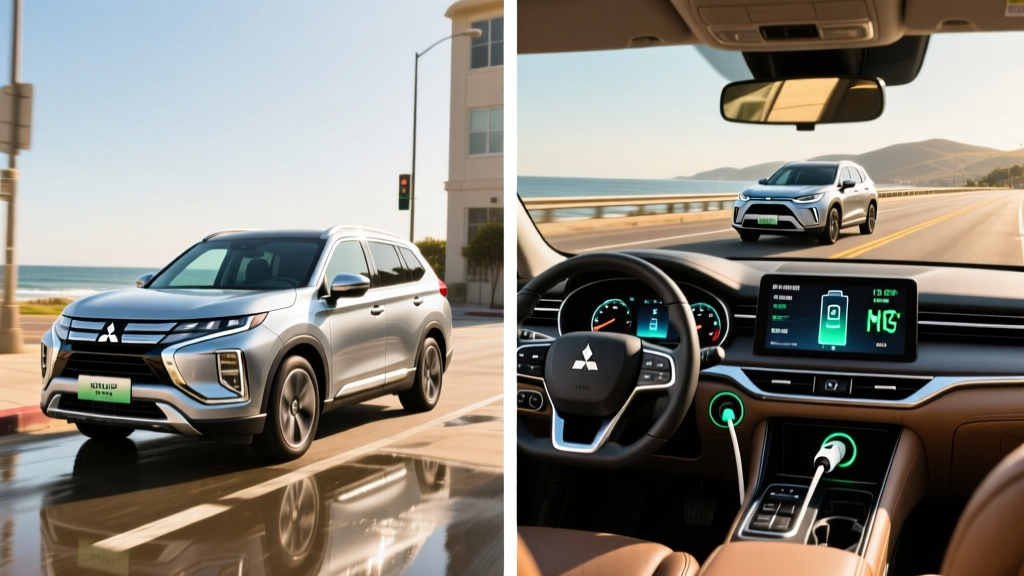
While much of the auto industry has pivoted to full battery-electric vehicles, Mitsubishi continues to refine its plug-in hybrid strategy with two core models: the three-row Outlander PHEV and the compact Eclipse Cross PHEV. For buyers who need electric-only commuting capability but aren't ready to rely solely on public charging infrastructure, a Mitsubishi PHEV offers a pragmatic middle ground — plug in at home for daily driving, burn gas on road trips without range limitations.
Mitsubishi was an early PHEV pioneer in the US market, launching the original Outlander PHEV stateside for the 2018 model year. The current-generation Outlander PHEV (redesigned for 2023, refreshed through 2026) rides on the Renault-Nissan-Mitsubishi Alliance CMF-CD platform shared with the Nissan Rogue, while the Eclipse Cross PHEV carries over its proven twin-motor architecture with incremental battery and software updates.
HEV vs PHEV: What Mitsubishi Actually Offers
Conventional Hybrid (HEV)
A standard hybrid like the Toyota RAV4 Hybrid uses regenerative braking and engine power to charge a small battery (~1-2 kWh). You never plug it in. It improves fuel economy — typically 35-41 MPG combined — but offers no meaningful electric-only driving. Mitsubishi does not currently sell a conventional HEV in the US market; their electrified lineup is exclusively plug-in.
Plug-In Hybrid (PHEV)
A PHEV carries a much larger battery (13-20 kWh usable) that you charge via a wall outlet, Level 2 home charger, or public station. This enables 24-38 miles of pure electric driving before the gasoline engine engages. Once the battery depletes, the vehicle operates as a conventional hybrid, blending engine and motor power. You get EV-like commuting with gas-car road trip freedom.
If you can charge at home — even on a standard 120V outlet — a PHEV's electric range covers most daily commutes. If you cannot charge at home or in an apartment building, a PHEV's value proposition drops significantly since you'd be paying for battery capacity you rarely use in electric mode.
2026 Mitsubishi Outlander PHEV: Specs, Range & Efficiency
The Outlander PHEV remains Mitsubishi's flagship electrified vehicle and one of the few PHEVs offering three-row seating. Here's the full spec breakdown for the current model year:
| Specification | Value |
|---|---|
| EPA Electric-Only Range | 38 miles |
| Total Combined Range (EV + Gas) | ~420 miles |
| EPA Combined MPGe (electric + gas) | 64 MPGe |
| Gas-Only Combined MPG (charge-depleted) | 26 MPG combined (25 city / 27 highway) |
| Battery Capacity (gross / usable) | 20.0 kWh / ~17.5 kWh usable |
| Battery Chemistry | Lithium-ion (NMC) |
| Combined System Horsepower | 248 hp |
| Engine | 2.4L Atkinson-cycle 4-cylinder (126 hp) |
| Front Motor | 85 kW (114 hp) |
| Rear Motor | 100 kW (134 hp) |
| Drivetrain | Twin-motor AWD (S-AWC) |
| Level 2 AC Charging (0-100%) | ~3.8 hours at 7.2 kW |
| DC Fast Charging (CHAdeMO) | ~38 min (0-80%) at up to 22 kW |
| 0-60 mph | ~7.0 seconds |
| Battery Warranty | 10 years / 100,000 miles |
| Starting MSRP | $42,495 (ES trim, incl. destination) |
Real-World Electric Range Expectations
The EPA rates the Outlander PHEV at 38 miles electric-only. In real-world testing, expect 32-36 miles during mixed suburban/highway driving in mild weather. Cold temperatures (below 35°F) reduce electric range by 15-25%, bringing it down to roughly 27-32 miles. Highway-only driving at 70+ mph also cuts electric range to approximately 28-30 miles due to higher aerodynamic drag. These figures are consistent with most PHEVs in this class and remain sufficient for the average American commute of ~16 miles each way.
Charging the Outlander PHEV at Home and On the Go
The Outlander PHEV charges via a J1772/CCS-compatible inlet for AC Level 1 and Level 2 charging. On a standard 120V household outlet (Level 1, ~1.4 kW), a full charge takes approximately 14 hours — practical for overnight replenishment if your daily electric driving stays under 30 miles. On a 240V Level 2 home charger at 7.2 kW, the battery reaches full in roughly 3.8 hours, meaning you can easily top up between morning and evening commutes.
One of the Outlander PHEV's distinguishing features is its CHAdeMO DC fast charging capability — increasingly rare among PHEVs. While the peak rate of ~22 kW is modest compared to full EVs, it adds roughly 15-18 miles of electric range in 15 minutes. The trade-off: CHAdeMO connectors are being phased out at most public charging networks in favor of CCS and NACS, so availability may be limited depending on your region.
2026 Mitsubishi Eclipse Cross PHEV: The Compact Alternative
For buyers who don't need three rows, the Eclipse Cross PHEV offers similar twin-motor AWD architecture in a smaller, more affordable package:
| Specification | Value |
|---|---|
| EPA Electric-Only Range | 24 miles |
| Total Combined Range | ~320 miles |
| EPA Combined MPGe | 74 MPGe |
| Gas-Only Combined MPG | 25 MPG combined (24 city / 26 highway) |
| Battery Capacity (gross / usable) | 13.8 kWh / ~12.0 kWh usable |
| Combined System Horsepower | 188 hp |
| Engine | 2.4L Atkinson-cycle 4-cylinder (126 hp) |
| Front Motor | 60 kW (80 hp) |
| Rear Motor | 70 kW (94 hp) |
| Level 2 AC Charging (0-100%) | ~3.5 hours at 3.7 kW |
| DC Fast Charging | Not available |
| Battery Warranty | 10 years / 100,000 miles |
| Starting MSRP | $38,495 (SEL trim, incl. destination) |
The Eclipse Cross PHEV's 24-mile electric range covers shorter commutes but falls short of the Outlander's 38 miles. Its onboard AC charger maxes out at 3.7 kW (compared to the Outlander's 7.2 kW), and it lacks DC fast charging entirely. For apartment dwellers who rely on overnight Level 1 charging, the smaller battery actually works in its favor — a full charge on 120V takes about 9 hours versus the Outlander's 14 hours.
Fuel Economy Deep Dive: Real-World MPG vs. EPA Stickers
| Model | EPA City | EPA Highway | EPA Combined | Real-World Observed |
|---|---|---|---|---|
| Outlander PHEV (charge-depleted, gas only) | 25 MPG | 27 MPG | 26 MPG | 24-28 MPG* |
| Eclipse Cross PHEV (charge-depleted, gas only) | 24 MPG | 26 MPG | 25 MPG | 23-27 MPG* |
| Outlander PHEV (blended EV+gas, charged daily) | 64 MPGe combined | Varies by charging frequency | ||
*Real-world MPG varies based on driving style, terrain, temperature, and how frequently you charge. Owners who plug in daily and drive under 35 miles rarely engage the gasoline engine, achieving effective "infinite" MPG on weekdays. Those who never charge operate as a ~26 MPG conventional hybrid — still better than most gas-only compact SUVs, but not class-leading.
According to fueleconomy.gov, the Outlander PHEV's charge-depleted fuel economy of 26 MPG combined is lower than rivals like the Toyota RAV4 Prime (35 MPG gas-only) because Mitsubishi prioritizes twin-motor AWD performance and a heavier battery pack over pure efficiency once the battery is depleted. If you regularly drive beyond the 38-mile electric range without recharging, the Outlander's fuel costs will exceed a conventional hybrid's. The PHEV math only works if you charge consistently.
Pricing, Trims & Federal Tax Credit Eligibility
| Model / Trim | MSRP (incl. destination) |
|---|---|
| Outlander PHEV ES | $42,495 |
| Outlander PHEV SE | $45,995 |
| Outlander PHEV SEL | $48,495 |
| Eclipse Cross PHEV SEL | $38,495 |
| Eclipse Cross PHEV SEL Touring | $41,495 |
Federal Tax Credit: Does a Mitsubishi PHEV Qualify?
Under the IRS §30D Clean Vehicle Credit, plug-in hybrids with at least 7 kWh of battery capacity are eligible for up to $7,500 — but only if they meet strict battery component sourcing, critical minerals, MSRP caps, and buyer income limits. As of the 2026 tax year:
- MSRP cap: SUVs must be priced at or below $80,000. Both Mitsubishi PHEVs clear this threshold at all trims.
- Buyer income cap: Modified adjusted gross income must not exceed $150,000 (single), $225,000 (head of household), or $300,000 (married filing jointly).
- Battery sourcing requirements: A percentage of battery components must be manufactured or assembled in North America, and a percentage of critical minerals must be sourced from the US or FTA partners. These thresholds tighten annually.
- Point-of-sale transfer: Eligible buyers can transfer the credit to the dealer at purchase, reducing the vehicle's price directly rather than waiting to claim it on their tax return.
- Final assembly: The vehicle must undergo final assembly in North America.
Current status: Mitsubishi PHEVs have faced challenges meeting the progressively tightening battery sourcing requirements. The Outlander PHEV is assembled in Japan (Okazaki plant), which disqualifies it from the §30D credit as final assembly must occur in North America. The Eclipse Cross PHEV is also Japan-assembled. This means neither current Mitsubishi PHEV qualifies for the $7,500 federal tax credit under 2026 rules.
However, some states offer their own PHEV incentives — typically $1,000-$2,500 for plug-in hybrids — that are independent of federal sourcing rules. Check your state's energy office or AFDC state incentive database for current local programs. Always consult a tax professional before making purchase decisions based on credit eligibility.
Battery Longevity, Warranty & Replacement Cost
Mitsubishi PHEV Battery Warranty
Both the Outlander PHEV and Eclipse Cross PHEV carry Mitsubishi's 10-year / 100,000-mile lithium-ion battery warranty — one of the longest in the industry. This warranty covers battery capacity loss below 70% of original capacity, as well as defects in materials and workmanship. The powertrain (engine, motors, transaxle) is also covered for 10 years / 100,000 miles.
Expected Battery Degradation
PHEV batteries experience less stress than full-EV batteries because they operate in a narrower state-of-charge window — Mitsubishi's battery management system maintains a buffer at the top and bottom to prevent deep cycling. Based on long-term data from 2018-2022 Outlander PHEV owners, typical degradation after 5 years / 60,000 miles is approximately 8-12%, meaning a vehicle originally rated for 38 electric miles might deliver 33-35 miles after five years. This is well within the warranty threshold.
Battery Replacement Cost
If a Mitsubishi PHEV battery requires full replacement outside of warranty, expect a cost in the range of $8,000-$12,000 including parts and labor at a Mitsubishi dealership. This figure is based on current OEM pricing for the 20 kWh Outlander pack and dealer labor rates. Independent hybrid battery specialists may offer refurbished replacements for $5,000-$7,000. Given the 10-year warranty and observed degradation rates, most original owners will never face this expense — but it's relevant for buyers considering a used Mitsubishi PHEV near or beyond the warranty window.
Reliability Track Record
Mitsubishi's PHEV powertrain has proven durable over multiple model years. The twin-motor AWD system (which Mitsubishi calls S-AWC, or Super All-Wheel Control) has no conventional transmission — the engine drives the front wheels through a single-speed reduction gear and can connect via a clutch at highway speeds. This simplicity reduces failure points compared to multi-speed automatic transmissions.
The 2.4L Atkinson-cycle engine is a carryover design with a long service history. Common maintenance items remain standard: oil changes every 7,500-10,000 miles, coolant service, and brake fluid. One advantage of PHEV ownership: regenerative braking significantly extends brake pad life, with many owners reporting original pads lasting 80,000+ miles.
According to NHTSA records, the Outlander PHEV has not been subject to major battery-related recalls. Mitsubishi's 10-year/100,000-mile warranty coverage provides additional peace of mind for long-term ownership.
Mitsubishi PHEV vs. Full EV vs. Gas Car: Which Is Right for You?
Choose a Mitsubishi PHEV If:
- You can charge at home (Level 1 or Level 2) and your daily commute is under 35 miles
- You need AWD capability for snow or light off-road use
- You regularly take road trips exceeding 200 miles and don't want to plan around DC fast chargers
- You want three-row seating with electrified capability (Outlander PHEV is nearly unique here)
- You're not ready to commit to a full EV due to apartment living or unreliable public charging in your area
Choose a Full EV Instead If:
- You have reliable home Level 2 charging and rarely drive more than 250 miles in a day
- You want to eliminate gasoline purchases and engine maintenance entirely
- You prioritize lower per-mile fuel costs (~$0.04-0.06/mile on electricity vs. ~$0.12-0.15/mile on gasoline)
- You want access to the full $7,500 federal tax credit (available on qualifying EVs like the Tesla Model Y, Hyundai Ioniq 5, or Ford Mustang Mach-E)
Choose a Conventional Hybrid (HEV) Instead If:
- You cannot charge at home or at work
- You want simpler ownership with no charging cables or plug-in routine
- You prioritize maximum gas-only fuel economy (the Toyota RAV4 Hybrid achieves 39 MPG combined vs. the Outlander PHEV's 26 MPG when the battery is depleted)
- You want a lower purchase price — conventional hybrids typically cost $3,000-$5,000 less than their PHEV counterparts
Pros & Cons at a Glance
Pros
- 38-mile electric range (Outlander) covers most daily commutes
- Twin-motor AWD with no mechanical driveshaft — excellent traction in snow
- Three-row seating available (Outlander PHEV) — rare for any PHEV
- 10-year / 100,000-mile battery and powertrain warranty
- CHAdeMO DC fast charging (Outlander) — unusual PHEV capability
- Proven, mature powertrain with years of real-world reliability data
- Vehicle-to-load (V2L) capability for powering devices during outages
Cons
- Does not qualify for the $7,500 federal tax credit (Japan-assembled)
- 26 MPG gas-only (Outlander) trails rival PHEVs like the RAV4 Prime (35 MPG)
- CHAdeMO connector is declining in availability at public chargers
- Eclipse Cross PHEV limited to 24-mile electric range and no DC fast charging
- Higher base price than non-electrified compact SUV competitors
- Modest 3.7 kW onboard charger (Eclipse Cross) slows Level 2 replenishment
Frequently Asked Questions
How many MPG does the Mitsubishi Outlander PHEV get?
When the battery is depleted and the vehicle operates on gasoline alone, the EPA rates the 2026 Outlander PHEV at 25 city / 27 highway / 26 combined MPG. When charged regularly and driven within its 38-mile electric range, it achieves 64 MPGe. Real-world gas-only MPG typically ranges from 24-28 depending on conditions. Owners who charge daily and commute under 35 miles may go weeks without using gasoline.
How far can the Mitsubishi PHEV go on electric only?
The 2026 Outlander PHEV delivers an EPA-rated 38 miles of electric-only range. The Eclipse Cross PHEV provides 24 miles. Real-world electric range is typically 5-15% lower than EPA in mixed driving and 15-25% lower in cold weather (below 35°F). Highway driving at sustained speeds above 70 mph also reduces electric range due to aerodynamic drag.
Can I charge a Mitsubishi PHEV at home on a regular outlet?
Yes. Both models support Level 1 charging on a standard 120V household outlet. The Outlander PHEV (20 kWh battery) takes approximately 14 hours for a full charge, while the Eclipse Cross PHEV (13.8 kWh) takes about 9 hours. For most owners, overnight charging on Level 1 is sufficient to replenish a day's electric driving. A 240V Level 2 home charger reduces Outlander charge time to ~3.8 hours.
Does the Mitsubishi PHEV qualify for any tax credit?
As of 2026, neither the Outlander PHEV nor the Eclipse Cross PHEV qualifies for the $7,500 federal §30D Clean Vehicle Credit because both are assembled in Japan, and the credit requires North American final assembly. Some state-level incentives for PHEVs may still apply — check your state energy office or the AFDC state incentive database for current programs. Always verify eligibility with a tax professional before purchasing.
Is the Mitsubishi PHEV battery reliable and what does replacement cost?
Mitsubishi's PHEV battery has demonstrated strong longevity, with typical degradation of 8-12% over 5 years / 60,000 miles based on owner data. The 10-year / 100,000-mile battery warranty covers capacity loss below 70%. Full battery replacement outside warranty costs approximately $8,000-$12,000 at a dealer, or $5,000-$7,000 through independent hybrid specialists. Given the warranty length and degradation trends, most original owners will not face this cost.
Hybrid vs PHEV vs EV — which should I buy?
A conventional hybrid (HEV) is best if you cannot charge at home and want better fuel economy without changing habits. A PHEV like the Mitsubishi Outlander is ideal if you can charge at home, commute under 35 miles daily, but also need gas-engine flexibility for road trips. A full EV makes sense if you have reliable home charging, rarely exceed 250 miles between stops, and want the lowest operating costs and zero tailpipe emissions. The right choice depends entirely on your charging access and driving patterns.
Does the Outlander PHEV have DC fast charging?
Yes — the Outlander PHEV includes a CHAdeMO DC fast charging port capable of up to ~22 kW, reaching 80% in approximately 38 minutes. However, CHAdeMO is being phased out at most US charging networks in favor of CCS and NACS connectors. Verify CHAdeMO availability at chargers along your routes before relying on DC fast charging. The Eclipse Cross PHEV does not offer DC fast charging.