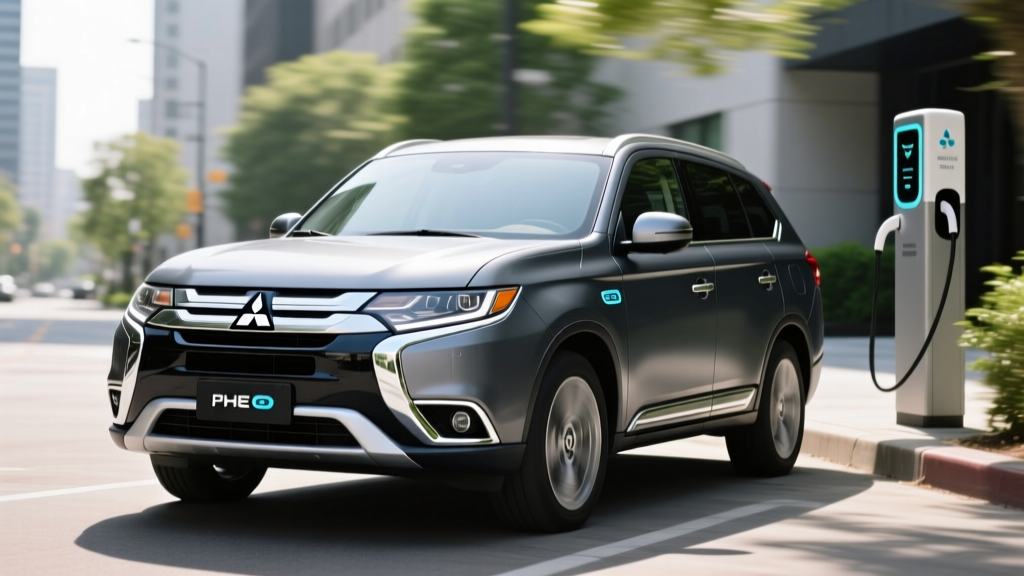
The Mitsubishi Outlander PHEV occupies a specific niche: a three-row plug-in hybrid SUV that promises electric commuting with gasoline backup. But buyers searching for the Mitsubishi Outlander PHEV MPG on petrol are asking the right question — what happens when the battery is depleted and you're running on the 2.4-liter gasoline engine alone? The answer matters for road trips, apartment dwellers who can't charge at home, and anyone weighing whether a PHEV actually saves fuel in their driving pattern.
This guide breaks down the Outlander PHEV's efficiency across every scenario — electric-only, hybrid charge-sustaining, and real-world mixed driving — with exact EPA figures, battery specs, charging data, and ownership costs you need before signing a deal.
Outlander PHEV Fuel Economy: EPA Numbers vs Real-World Petrol MPG
The EPA rates the current-generation Mitsubishi Outlander PHEV at 64 MPGe combined when operating in electric mode (factoring in electricity consumption converted to gasoline-equivalent), and 26 MPG combined when running purely on petrol after the battery is depleted. Here's the full breakdown from fueleconomy.gov:
| Mode | City | Highway | Combined |
|---|---|---|---|
| Charge-Depleting (EV + hybrid blend) | — | — | 64 MPGe |
| Charge-Sustaining (petrol only) | 25 MPG | 27 MPG | 26 MPG |
For context, the conventional gas-only Mitsubishi Outlander (non-hybrid, 2.5L 4-cylinder with CVT) achieves 24 city / 31 highway / 27 combined MPG. The PHEV's petrol-only efficiency is slightly lower because it carries approximately 500 lbs of additional battery and electric motor weight. The PHEV advantage only materializes when you regularly charge the battery and drive within its electric range.
Electric-Only Range and Total Driving Range
The Outlander PHEV delivers an EPA-rated 38 miles of electric-only range on a full charge. This is sufficient for most American commutes — the US Census Bureau reports the average one-way commute is roughly 16 miles, meaning a round trip falls well within the electric envelope.
When the battery depletes, the 2.4-liter Atkinson-cycle gasoline engine engages seamlessly, and the vehicle operates as a series-parallel hybrid. The 14.8-gallon fuel tank combined with the remaining battery charge yields a total combined range of approximately 420-440 miles, depending on driving conditions.
| Metric | Value |
|---|---|
| EPA Electric-Only Range | 38 miles |
| Real-World EV Range (mild weather, city) | 34-38 miles |
| Real-World EV Range (highway, 70 mph) | 28-32 miles |
| Real-World EV Range (cold weather, below 30°F) | 24-30 miles |
| Gas Tank Capacity | 14.8 gallons |
| Total Range (EV + petrol, mixed driving) | ~420-440 miles |
The battery pack is a 20.0 kWh lithium-ion unit (approximately 18.8 kWh usable, with the remainder reserved as a buffer to protect long-term battery health). Mitsubishi uses an NMC (nickel-manganese-cobalt) chemistry optimized for energy density and cycle life in a PHEV application where the battery undergoes shallower, more frequent cycles than a full BEV.
Charging Specs: Level 1, Level 2, and DC Fast Charging
One of the Outlander PHEV's strongest differentiators in the plug-in hybrid segment is DC fast-charge capability — a feature most PHEVs in its price range lack. Here's the full charging profile:
| Charging Level | Power (kW) | Time (0-100%) | Connector |
|---|---|---|---|
| Level 1 (120V household outlet) | ~1.4 kW | ~14 hours | J1772 |
| Level 2 (240V home/public) | ~3.3 kW (onboard charger limit) | ~6.5 hours | J1772 |
| DC Fast Charge (CHAdeMO) | Up to 22 kW peak | ~38 minutes (0-80%) | CHAdeMO |
A few practical notes on charging the Outlander PHEV:
- CHAdeMO is a legacy connector. The Outlander PHEV uses CHAdeMO for DC fast charging, while the broader US charging infrastructure is migrating to NACS (Tesla's standard) and CCS1. CHAdeMO chargers are becoming less common at new installations, though Electrify America and some regional networks still maintain them. If DC fast charging is important to you, verify CHAdeMO availability along your typical routes.
- The 3.3 kW onboard charger is modest. Level 2 charging at 3.3 kW means a full charge takes about 6.5 hours — fine for overnight charging, but slower than PHEVs with 6.6 kW or 7.2 kW onboard chargers. If you plug in at a public Level 2 station during a shopping trip, expect roughly 10-12 miles of range added in a 30-minute stop.
- Level 1 charging is viable for low-mileage drivers. At 1.4 kW, a standard 120V outlet adds about 4-5 miles of range per hour. If you drive 20 miles per day and plug in for 10 hours overnight, you'll recover most of your daily electric range without installing a Level 2 charger.
Powertrain: Engine, Motors, and Combined Output
The Outlander PHEV uses Mitsubishi's twin-motor AWD system paired with a 2.4-liter Atkinson-cycle four-cylinder engine. The powertrain operates in multiple modes depending on speed, battery state of charge, and driver demand:
| Component | Specification |
|---|---|
| Gasoline Engine | 2.4L Atkinson-cycle 4-cylinder, 126 hp / 147 lb-ft |
| Front Electric Motor | 114 hp / 188 lb-ft |
| Rear Electric Motor | 134 hp / 144 lb-ft |
| Combined System Output | 248 hp / 332 lb-ft (peak, not sustained) |
| Battery Pack | 20.0 kWh total / ~18.8 kWh usable, NMC lithium-ion |
| Drivetrain | AWD (electric rear axle, no mechanical driveshaft) |
| Transmission | Single-speed reduction gear (no traditional transmission) |
| 0-60 mph | ~7.1 seconds |
| Towing Capacity | 1,500 lbs (braked) |
The system is more complex than it appears. At low speeds and moderate loads, the Outlander PHEV runs as a pure EV using its front and rear motors. When the battery depletes or you demand hard acceleration, the gasoline engine engages — initially as a generator (series hybrid mode) to feed electricity to the motors, and at highway speeds it can directly drive the front wheels through a clutch (parallel hybrid mode). This series-parallel architecture is similar to the approach used by Toyota and Honda, and it's proven effective for balancing efficiency and performance.
The S-AWC (Super All-Wheel Control) system uses the rear electric motor to provide torque to the rear axle independently, giving the Outlander PHEV genuine AWD capability without a mechanical connection between the engine and rear wheels. This is a meaningful advantage over front-wheel-drive-only PHEVs in snow and rain.
HEV vs PHEV vs EV: Which Powertrain Fits Your Driving?
The Outlander PHEV sits between a conventional hybrid (like the Toyota Highlander Hybrid) and a full battery-electric vehicle. Here's a decision framework:
Conventional Hybrid (HEV)
Best for: Drivers who can't charge at home, high-mileage commuters, those who want simplicity.
Example: Toyota Highlander Hybrid (35 MPG combined)
Trade-off: No electric-only range; always burns petrol.
Plug-in Hybrid (PHEV)
Best for: Drivers with home charging who commute under 40 miles daily but take longer road trips.
Example: Mitsubishi Outlander PHEV (38 mi EV + petrol backup)
Trade-off: Must charge regularly to realize savings; petrol MPG is average when depleted.
Full Battery EV (BEV)
Best for: Home chargers with predictable routes, those who want to eliminate petrol entirely.
Example: Tesla Model Y (310 mi range), Hyundai Ioniq 5 (303 mi range)
Trade-off: Road trips require DC fast-charge planning; higher upfront cost.
Pricing, Trims, and Tax Credit Eligibility
The 2025/2026 Mitsubishi Outlander PHEV starts at approximately $41,640 MSRP (ES trim, including destination) and ranges up to roughly $50,000 in fully loaded SEL Touring or Platinum Edition trims. Here's the approximate trim structure:
| Trim | Approx. MSRP | Key Features |
|---|---|---|
| ES | $41,640 | Base AWD, 18" wheels, 8" touchscreen, heated front seats |
| SE | $44,140 | 20" wheels, power liftgate, synthetic leather, wireless CarPlay |
| SEL | $47,240 | Genuine leather, panoramic sunroof, Bose audio, heated steering wheel |
| SEL Touring / Platinum | ~$49,500-$50,500 | Two-tone paint, premium package, advanced driver assists |
Federal Tax Credit: §30D Eligibility
The Outlander PHEV may qualify for up to $7,500 under the IRS §30D Clean Vehicle Credit, but eligibility depends on multiple factors that change frequently:
- MSRP Cap: SUVs must have an MSRP at or below $80,000 — the Outlander PHEV clears this easily.
- Buyer Income Cap: Modified adjusted gross income must not exceed $150,000 (single), $225,000 (head of household), or $300,000 (joint filers).
- Battery Sourcing Requirements: The credit is split into two halves — $3,750 for critical minerals sourcing and $3,750 for battery component manufacturing. The Outlander PHEV's eligibility for each half depends on current-year supply chain compliance, which Mitsubishi updates periodically. Verify current eligibility on the IRS clean vehicle credit page or with your dealer before purchase.
- Point-of-Sale Transfer: As of 2024, qualifying buyers can transfer the credit to the dealer at purchase, reducing the out-of-pocket price immediately rather than waiting for a tax refund.
Many states also offer additional PHEV incentives (rebates, HOV lane access, reduced registration fees), but these vary by jurisdiction. Check your state energy office or the Alternative Fuels Data Center for local programs.
Reliability, Battery Warranty, and Long-Term Ownership
Mitsubishi provides one of the stronger battery warranties in the PHEV segment, which matters given that battery replacement is a top concern for hybrid and PHEV buyers:
- High-Voltage Battery: 10 years / 100,000 miles (whichever comes first), covering defects and capacity loss below 70% of original capacity
- Powertrain (engine, motors, reduction gear): 10 years / 100,000 miles
- Bumper-to-Bumper (basic): 5 years / 60,000 miles
- Roadside Assistance: 5 years / unlimited miles
The 10-year/100,000-mile battery warranty is a significant ownership advantage. Mitsubishi's PHEV system has been in production since 2012 (first in the Japanese-market Outlander PHEV), giving it over a decade of field data. The 20.0 kWh NMC battery pack is designed for PHEV duty cycles — shallower depth-of-discharge than a full BEV, which generally supports longer cycle life.
Battery replacement cost: If the battery fails outside warranty coverage, a replacement pack currently costs approximately $8,000-$12,000 including labor, based on dealer parts pricing. This is lower than most full BEV replacements (which can exceed $15,000-$20,000) because the PHEV pack is smaller. However, actual out-of-warranty replacements remain rare — PHEV batteries in normal use typically retain 80-85% of original capacity at 150,000 miles.
General reliability: Mitsubishi as a brand scores mid-pack in long-term reliability surveys. The Outlander PHEV's powertrain is its most proven component; areas where owners report issues tend to involve infotainment software, interior trim materials, and wind noise rather than the hybrid system itself. The Insurance Institute for Highway Safety (IIHS) rates the current-generation Outlander well in crashworthiness tests.
Pros, Cons, and Final Verdict
Pros
- Standard AWD with electric rear axle — genuine all-weather capability
- 38-mile EV range covers most daily commutes without petrol
- DC fast charging (CHAdeMO) — rare for PHEVs in this price range
- Three-row seating (compact third row, but available)
- 10-year / 100,000-mile battery warranty
- Potential $7,500 federal tax credit (verify eligibility)
- S-AWC system with torque vectoring improves handling confidence
Cons
- 26 MPG petrol-only is unremarkable — no better than the gas Outlander
- CHAdeMO DC connector is being phased out in favor of NACS/CCS
- 3.3 kW onboard charger is slow for Level 2 public charging
- Third row is tight — suitable for small children only
- Premium over gas Outlander only pays back with regular plug-in charging
- Cabin noise under hard acceleration (engine drone at high RPM)
- Infotainment and interior materials lag behind competitors at this price
Frequently Asked Questions
How many MPG does the Mitsubishi Outlander PHEV get on petrol alone?
The EPA rates the Outlander PHEV at 26 MPG combined (25 city / 27 highway) when operating in charge-sustaining mode — meaning the battery is depleted and the gasoline engine is providing all propulsion. In real-world driving, expect 23-25 MPG on the highway and 26-28 MPG in city traffic where regenerative braking recovers energy.
How far can the Outlander PHEV go on electric only?
The EPA-rated electric-only range is 38 miles on a full charge. Real-world results vary: expect 34-38 miles in mild city driving, 28-32 miles at highway speeds, and 24-30 miles in freezing temperatures where battery efficiency drops and cabin heating draws power.
Does the Mitsubishi Outlander PHEV qualify for the $7,500 federal tax credit?
It may qualify for up to $7,500 under IRS §30D, depending on your income (must be below $150K single / $300K joint), the vehicle's MSRP (must be under $80K for SUVs — the Outlander PHEV qualifies), and current-year battery sourcing requirements. Eligibility for the full $7,500 vs. a partial $3,750 credit changes as supply chains shift. Verify with your dealer or the IRS clean vehicle credit page before purchasing.
Is the Outlander PHEV battery reliable and what does replacement cost?
Mitsubishi covers the high-voltage battery for 10 years / 100,000 miles against defects and capacity loss below 70%. The PHEV system has been in production since 2012 with a strong track record. Out-of-warranty battery replacement costs approximately $8,000-$12,000, though actual replacements remain uncommon — most PHEV batteries retain 80-85% capacity at 150,000 miles.
Should I buy the Outlander PHEV or the gas-only Outlander?
Choose the PHEV if: you can charge at home (Level 1 or Level 2), your daily driving is under 38 miles, and you want to minimize petrol consumption on weekdays. Choose the gas-only Outlander if: you lack home charging access, you drive more than 40 miles daily (you'll deplete the battery and run on petrol anyway), or the $6,000-$8,000 PHEV premium doesn't justify the fuel savings in your mileage pattern. The gas Outlander's 27 MPG combined is competitive with the PHEV's 26 MPG charge-sustaining figure.
Can the Outlander PHEV charge at Tesla Superchargers?
No. The Outlander PHEV uses a J1772 connector for Level 1/2 AC charging and CHAdeMO for DC fast charging. Tesla Superchargers use the NACS connector. While adapters exist for J1772-to-NACS on some networks, the Outlander PHEV's CHAdeMO DC connector is not compatible with Tesla's NACS DC standard, and no reliable adapter currently bridges this gap for DC fast charging.