If you're researching the Mitsubishi Outlander PHEV mileage, you're likely weighing a midsize plug-in hybrid SUV against full electric alternatives and conventional gas crossovers. The Outlander PHEV occupies a specific niche: it offers enough electric-only range to cover most daily commutes without burning a drop of gasoline, yet it retains a gasoline engine for road trips where charging infrastructure remains sparse. For 2026, Mitsubishi continues to refine the formula with a 20.0 kWh battery pack, standard all-wheel drive, and three rows of seating — a combination that's hard to find at its price point.
This guide covers everything you need to know about Outlander PHEV fuel economy, electric range, charging logistics, real-world efficiency, and total ownership costs. We'll also clarify the critical differences between conventional hybrids (HEVs) and plug-in hybrids (PHEVs) so you can make the right choice for your driving pattern.
Outlander PHEV Mileage at a Glance: EPA Numbers
The EPA rates the 2026 Mitsubishi Outlander PHEV using two metrics: MPGe (miles per gallon equivalent) when operating on battery power, and standard MPG when the gasoline engine takes over. Here's the official breakdown from fueleconomy.gov:
| Metric | City | Highway | Combined |
|---|---|---|---|
| Electric Mode (MPGe) | — | — | 64 MPGe |
| Gas-Only Mode (MPG) | 25 MPG | 27 MPG | 26 MPG |
| Electric-Only Range | 38 miles | ||
| Total Combined Range | ~420 miles | ||
HEV vs. PHEV: What's the Difference and Why It Matters
Before diving deeper into the Outlander, it's essential to understand what separates a conventional hybrid (HEV) from a plug-in hybrid (PHEV). The Outlander is sold only as a PHEV in the U.S. — there is no conventional hybrid version. But many shoppers cross-shop it against HEVs like the Toyota Highlander Hybrid, so here's the distinction:
| Feature | Conventional Hybrid (HEV) | Plug-In Hybrid (PHEV) |
|---|---|---|
| Plug-in charging? | No — charges via regenerative braking and engine | Yes — plug in to access full electric range |
| Battery size | 1–2 kWh (small) | 12–25 kWh (much larger) |
| Electric-only range | 0–2 miles at low speed | 20–50 miles (model-dependent) |
| Federal tax credit | Not eligible | Potentially eligible (§30D, up to $7,500) |
| Best for | Drivers who can't charge at home | Drivers with home charging and short commutes |
The Outlander PHEV's 20.0 kWh battery is the key differentiator. If you plug it in nightly, a 20-mile round-trip commute could be completed entirely on electricity, meaning you might visit a gas station only a handful of times per year. If you never plug it in, it functions as a heavy hybrid — still getting 26 MPG combined, but you're carrying around 400+ pounds of battery you're not utilizing.
Powertrain, Battery, and Charging Specs
The 2026 Outlander PHEV pairs a 2.4-liter four-cylinder Atkinson-cycle engine with two electric motors (one front, one rear) to deliver Mitsubishi's S-AWC (Super All-Wheel Control) system. Here are the hard numbers:
| Specification | Value |
|---|---|
| Engine | 2.4L 4-cylinder Atkinson-cycle |
| Combined system horsepower | 248 hp |
| Combined system torque | 332 lb-ft |
| Battery capacity (gross / usable) | 20.0 kWh / ~17.5 kWh usable |
| Battery chemistry | Lithium-ion (NMC) |
| Drivetrain | Standard AWD (twin-motor) |
| 0–60 mph | ~7.2 seconds |
| Towing capacity | 1,500 lbs |
Charging Times and Connector Details
One of the Outlander PHEV's most notable features is DC fast-charging capability — rare among PHEVs, which typically max out at Level 2 AC charging. The Outlander uses a CHAdeMO connector for DC fast charging, which is increasingly uncommon as the industry shifts to NACS (Tesla's standard) and CCS. Here's what to expect:
| Charging Level | Power | Time (0–100% or 0–80%) | Notes |
|---|---|---|---|
| Level 1 (120V household) | ~1.4 kW | ~14 hours (full charge) | Emergency/trickle only |
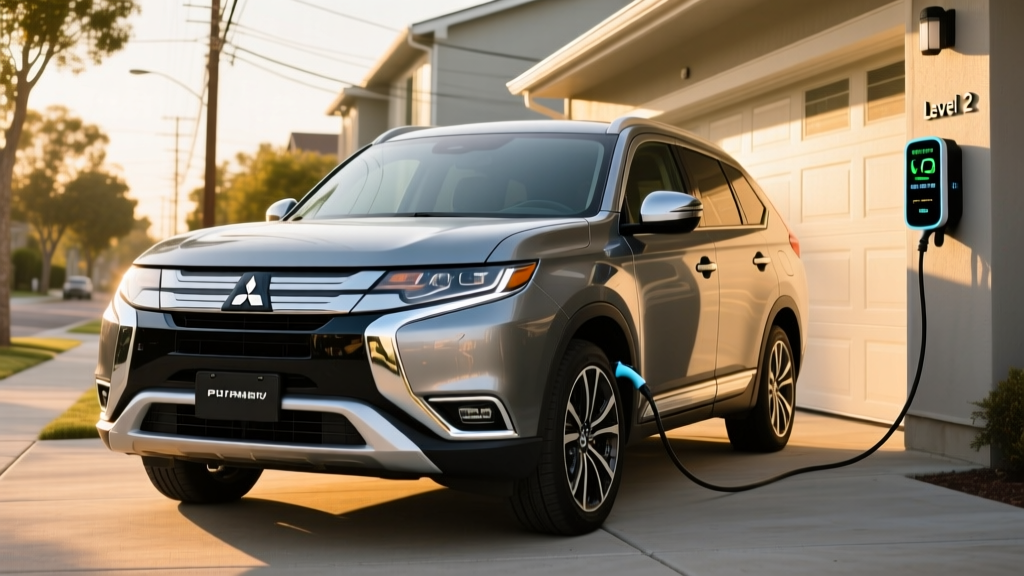
| Level 2 (240V home/public) | ~3.8 kW (J1772) | ~5.5 hours (full charge) | Overnight home charging |
| DC Fast Charge | ~22 kW peak (CHAdeMO) | ~38 min (0–80%) | Useful on road trips; CHAdeMO stations are declining |
Real-World MPG vs. EPA: What Owners Actually See
The EPA's 64 MPGe combined and 26 MPG gas-only figures are useful baselines, but PHEV fuel economy depends entirely on how often you charge. Here's how real-world Outlander PHEV mileage breaks down by driving pattern:
Scenario 1: Daily charger, short commute (under 35 miles round-trip)
You'll burn almost zero gasoline on weekdays. Over a year of 12,000 miles, you might use 50–80 gallons total for occasional long trips. Effective annual fuel cost: $150–$250 (electricity + minimal gas).
Scenario 2: Occasional charger, mixed commute (40–60 miles round-trip)
You'll use the electric range on the first portion of your commute, then the engine kicks in. Expect an effective blended rate of 40–50 MPG over the year, depending on your gas-to-electric ratio. Annual fuel cost: $600–$900.
Scenario 3: Never plugged in, gas-only operation
The Outlander PHEV reverts to its 26 MPG combined rating. You're paying for a battery you're not using and carrying extra weight. Annual fuel cost at 12,000 miles: ~$1,385 (at $3.00/gal). This is worse than a conventional hybrid like the Toyota Highlander Hybrid (35 MPG combined).
The takeaway: PHEV mileage is a spectrum. The more you charge, the higher your effective MPG climbs. If you can't or won't plug in regularly, a conventional HEV is a better financial choice.
Pricing, Trims, and Federal Tax Credit Eligibility
The 2026 Mitsubishi Outlander PHEV starts at $41,640 (ES trim, including destination) and ranges up to approximately $50,000 for the top-tier SEL Platinum Edition. Here's the trim-level breakdown:
| Trim | MSRP (incl. destination) | Key Features |
|---|---|---|
| ES | $41,640 | Base AWD, 8-inch display, heated front seats |
| SE | $44,440 | Power liftgate, synthetic leather, 9-inch display |
| SEL | $47,140 | Leather, panoramic sunroof, Bose audio, MI-PILOT Assist |
| SEL Platinum Edition | ~$50,000 | Exclusive styling, premium interior, all SEL features |
Federal §30D Tax Credit: Does the Outlander PHEV Qualify?
Under the IRS §30D Clean Vehicle Credit, plug-in hybrids with sufficient battery capacity can qualify for up to $7,500 — split into two halves: $3,750 for critical minerals sourcing and $3,750 for battery component manufacturing. However, eligibility depends on several factors that change periodically:
- MSRP cap: SUVs must be priced at or below $80,000 (all Outlander PHEV trims qualify)
- Buyer income cap: Modified AGI must not exceed $150,000 (single), $225,000 (head of household), or $300,000 (joint)
- Battery sourcing requirements: Critical minerals and battery components must meet phased-in domestic/content thresholds — these tighten annually
- Point-of-sale transfer: As of 2024, eligible buyers can transfer the credit to the dealer for an immediate price reduction at purchase
Battery Warranty, Reliability, and Replacement Cost
PHEV buyers consistently rank battery longevity as a top concern. Mitsubishi backs the Outlander PHEV's high-voltage battery with competitive warranty terms:
Battery & Powertrain Warranty Coverage
- High-voltage battery: 10 years / 100,000 miles (capacity retention warranty — typically guaranteed above 70% of original capacity)
- Powertrain (engine + motors): 10 years / 100,000 miles
- Bumper-to-bumper: 5 years / 60,000 miles
- Roadside assistance: 5 years / unlimited miles
The 10-year/100,000-mile battery warranty is among the best in the segment and should cover most first- and second-owners against premature degradation.
Reliability Track Record
The current-generation Outlander PHEV (introduced for 2023, sharing the Renault-Nissan-Mitsubishi Alliance CMF-CD platform) is still relatively new, so long-term reliability data is limited. Mitsubishi's brand-level reliability ratings from Consumer Reports and J.D. Power have historically landed in the middle of the pack — neither class-leading nor problematic. The previous-generation Outlander PHEV (2018–2022) demonstrated solid battery durability, with most owners reporting minimal degradation over 5+ years of use.
Battery Replacement Cost
If the high-voltage battery fails outside warranty, replacement cost is the big question. Based on current industry data for PHEV battery packs in the 20 kWh range, expect a replacement cost of $6,000–$9,000 including parts and labor. This is significantly less than full EV battery replacements (which can exceed $15,000 for 75+ kWh packs) because the PHEV battery is much smaller. However, it's still a substantial expense — another reason the 10-year warranty matters.
Outlander PHEV vs. the Competition
The midsize PHEV SUV segment has grown, and the Outlander faces direct rivals. Here's how it stacks up on the metrics that matter:
| Model | EV Range | Gas MPG | Combined HP | Starting MSRP | 3rd Row? |
|---|---|---|---|---|---|
| Mitsubishi Outlander PHEV | 38 mi | 26 MPG | 248 hp | $41,640 | Yes |
| Toyota RAV4 Prime | 42 mi | 38 MPG | 302 hp | $44,885 | No |
| Hyundai Tucson PHEV | 33 mi | 35 MPG | 261 hp | $39,440 | No |
| Kia Sportage PHEV | 34 mi | 35 MPG | 261 hp | $40,590 | No |
The Outlander's standout advantage is its third-row seat — it's the only PHEV in this price bracket offering seven-passenger capacity. The trade-off is lower gas-only MPG (26 vs. 35–38 for competitors) and less electric range than the RAV4 Prime. If you need three rows and PHEV capability, the Outlander is essentially your only option without jumping to luxury brands like the Volvo XC90 Recharge ($70,000+).
✓ Pros
- Only PHEV SUV with a third row under $50K
- Standard AWD with capable twin-motor system
- DC fast charging (rare for PHEVs)
- 10-year/100K-mile battery warranty
- Competitive starting price
✗ Cons
- Gas-only MPG (26) trails rivals significantly
- CHAdeMO DC connector is a dying standard
- Third row is very tight — best for small children
- Level 2 AC charging limited to 3.8 kW (slow for overnight)
- CVT-like driving feel under hard acceleration
Who Should Buy the Outlander PHEV — and Who Shouldn't
Decision Framework
Choose the Outlander PHEV if:
- You need three rows of seating but don't want a minivan or full-size SUV
- You can charge at home nightly (Level 1 or Level 2)
- Your daily commute is under 35 miles round-trip
- You take 2–4 road trips per year where charging infrastructure is uncertain
- You want AWD standard without a fuel-economy penalty on short trips
Look elsewhere if:
- You can't charge at home or work — a conventional HEV (Toyota Highlander Hybrid, 35 MPG) will save you more fuel
- You don't need a third row — the RAV4 Prime offers better MPG, more EV range, and more power
- You want a pure EV experience — consider the Hyundai Ioniq 5, Tesla Model Y, or Kia EV6 for lower running costs and zero tailpipe emissions
- DC fast charging on road trips is essential — the CHAdeMO connector limits your options as CCS/NACS dominate
Frequently Asked Questions
How many MPG does the Mitsubishi Outlander PHEV get?
The EPA rates the 2026 Outlander PHEV at 64 MPGe combined when operating on battery power and 26 MPG combined (25 city / 27 highway) when running on gasoline only. Your real-world fuel economy depends entirely on how often you plug in — daily chargers with short commutes may use almost no gasoline, while those who never charge will see 26 MPG consistently.
How far can the Outlander PHEV go on electric only?
The EPA rates it at 38 miles of electric-only range. In real-world conditions, expect 32–36 miles in moderate weather and 25–28 miles in cold weather or at sustained highway speeds. That's sufficient for most daily commutes but shorter than the Toyota RAV4 Prime's 42-mile rating.
Does the Outlander PHEV qualify for a federal tax credit?
It may qualify for up to $7,500 under the IRS §30D Clean Vehicle Credit, subject to buyer income limits ($150K single / $300K joint), MSRP caps ($80K for SUVs — all trims qualify), and battery sourcing requirements that change annually. Always verify current eligibility on fueleconomy.gov and consult a tax professional before purchasing.
Is the Outlander PHEV reliable and what does a battery replacement cost?
Mitsubishi provides a 10-year/100,000-mile warranty on the high-voltage battery and powertrain, which is among the best in the industry. Out-of-warranty battery replacement is estimated at $6,000–$9,000. Long-term reliability data for the current generation (2023+) is still accumulating, but the previous generation showed solid battery durability.
Should I get the Outlander PHEV or a full electric vehicle?
Choose the PHEV if you regularly drive beyond 200+ miles where charging is sparse, or if you lack reliable home charging access for longer trips. Choose a full EV (like the Tesla Model Y or Hyundai Ioniq 5) if you have home charging, your daily driving is predictable, and you want the lowest possible per-mile energy cost (typically $0.03–$0.05/mile on home electricity vs. $0.08–$0.15/mile on gasoline).
Can I charge the Outlander PHEV at a Tesla Supercharger?
Not directly. The Outlander PHEV uses a J1772 connector for Level 2 AC charging and CHAdeMO for DC fast charging. Tesla Superchargers use the NACS connector. You would need a J1772-to-NACS adapter for Level 2 Tesla destination chargers, and there is currently no widely available CHAdeMO-to-NACS adapter for DC fast charging. Plan your road-trip charging around Electrify America, EVgo, or other networks that still support CHAdeMO.