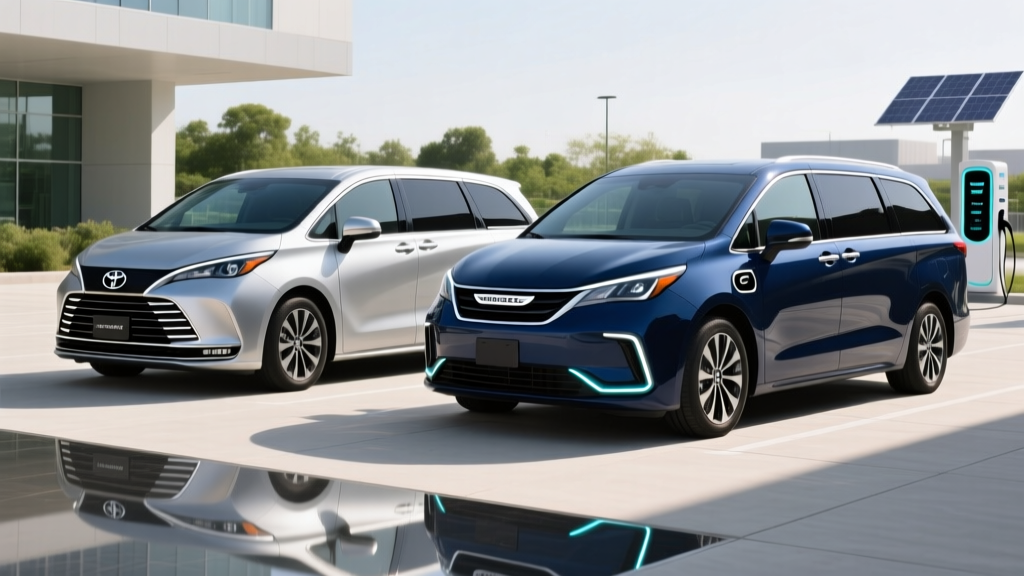
If you need three rows, sliding doors, and a way to cut fuel costs without range anxiety, minivan hybrid vehicles are the sweet spot. For 2026, the segment boils down to two fundamentally different approaches: the Toyota Sienna, a conventional hybrid (HEV) that never needs a plug, and the Chrysler Pacifica Plug-In Hybrid (PHEV), which offers genuine electric-only commuting before its gas engine kicks in. Both deliver outstanding efficiency for vehicles this size — but they solve different problems for different families.
This guide breaks down the exact specs, real-world fuel economy, battery longevity, tax-credit eligibility, and ownership economics of every hybrid minivan you can buy in the US for the 2026 model year, so you can pick the right one with confidence.
The Only Two Hybrid Minivans You Can Buy in 2026
The hybrid minivan market is small but well-defined. Toyota and Stellantis (Chrysler) are the only automakers offering electrified minivans for the US market. Honda discontinued the hybrid variant of the Odyssey in North America, and Kia/Hyundai have not introduced hybrid versions of the Carnival or its successors. Here's how the two contenders stack up at a glance:
| Spec | Toyota Sienna (HEV) | Chrysler Pacifica Plug-In Hybrid |
|---|---|---|
| Powertrain Type | Conventional Hybrid (HEV) | Plug-In Hybrid (PHEV) |
| Engine | 2.5L 4-cyl + 2 electric motors | 3.6L V6 + 2 electric motors |
| Combined Horsepower | 245 hp | 260 hp |
| Battery (usable) | ~1.6 kWh NiMH (self-charging) | 16 kWh lithium-ion |
| EPA Electric-Only Range | N/A (no plug-in) | 32 miles |
| EPA Combined MPG (gas) | 36 MPG | 30 MPG (after battery depleted) |
| EPA MPGe (PHEV combined) | N/A | 82 MPGe |
| Total Range | ~630 miles | ~520 miles (elec + gas) |
| Drivetrain | FWD or AWD (eAWD) | FWD only |
| 0–60 mph | ~7.1 sec | ~7.5 sec |
| Towing Capacity | 3,500 lbs | 3,600 lbs |
| Starting MSRP | $39,285 (LE) | $51,995 (Limited) |
| Federal Tax Credit (§30D) | Not eligible | Up to $7,500* |
*Pacifica PHEV credit eligibility depends on buyer income, battery critical-mineral sourcing, and MSRP caps per IRS §30D rules. Verify current-year eligibility before purchase.
HEV vs PHEV: Which Hybrid Type Fits Your Family?
The single biggest decision when shopping hybrid minivan vehicles is whether you want a conventional hybrid (HEV) or a plug-in hybrid (PHEV). These are not interchangeable terms — they describe fundamentally different systems.
HEV vs PHEV — The Key Differences
| Factor | Conventional Hybrid (HEV) | Plug-In Hybrid (PHEV) |
|---|---|---|
| Plug in to charge? | No — charges via regenerative braking and engine | Yes — plug in for full electric range |
| Electric-only driving | Brief, low-speed only (~1 mi) | Full highway-capable range (32 mi) |
| Battery size | Small (~1–2 kWh) | Larger (12–20 kWh typical) |
| Home charging needed | No | Yes, for maximum benefit |
| Best for | Drivers who can't charge at home | Drivers with home charging + short commutes |
| Federal tax credit | Not eligible under §30D | Eligible (up to $7,500, subject to rules) |
Choose the Sienna HEV if you don't have access to home or workplace charging, you want maximum simplicity, or you regularly take long road trips and value AWD. Choose the Pacifica PHEV if you can plug in at home nightly, your daily driving is under ~30 miles, and you want to run most errands on electricity alone.
Fuel Economy Breakdown: Real-World MPG vs EPA Stickers
Hybrid minivans consistently beat their EPA city estimates in real-world stop-and-go driving, where regenerative braking recaptures the most energy. Highway efficiency is typically closer to — or slightly below — the sticker number because the electric motor assists less at sustained high speeds.
| Metric | Toyota Sienna HEV | Chrysler Pacifica PHEV |
|---|---|---|
| EPA City MPG | 36 MPG | 29 MPG (charge-sustaining) |
| EPA Highway MPG | 36 MPG | 30 MPG (charge-sustaining) |
| EPA Combined MPG | 36 MPG | 30 MPG (gas) / 82 MPGe (elec+gas) |
| Real-World City (owner-reported) | 37–40 MPG | 28–31 MPG (gas-only mode) |
| Real-World Highway | 33–35 MPG | 28–30 MPG (gas-only mode) |
| Cold-Weather Impact | ~2–4 MPG drop in winter | Electric range drops ~20–30% in freezing temps |
The Sienna's 36 MPG combined is remarkable for a 4,500-pound vehicle. Owners on fueleconomy.gov frequently report averaging 37–40 MPG in suburban and city driving, where the hybrid system cycles between engine and electric motor most frequently. Highway cruising at 75+ MPH brings that closer to 33–34 MPG.
The Pacifica PHEV's efficiency story is more nuanced. If your daily driving stays within the 32-mile electric window and you charge nightly, you may use almost no gasoline for weeks. Once the battery depletes, the V6 and smaller battery operate as a conventional hybrid at 30 MPG combined — still excellent for a V6 minivan, but notably less efficient than the Sienna's four-cylinder system.
Pacifica PHEV Deep Dive: Electric Range, Charging, and Battery
The Chrysler Pacifica PHEV's 32 miles of EPA-rated electric-only range is the headline feature. For a family whose school run, grocery trips, and commute total under 30 miles round-trip, this means near-EV daily operation with a gas-engine safety net for road trips.
Charging Specs and Times
| Charging Method | Power Level | 0–100% Time | Notes |
|---|---|---|---|
| Level 1 (120V household outlet) | ~1.4 kW | ~14 hours | Overnight top-up; may not fully recharge depleted battery in one night |
| Level 2 (240V home charger) | ~6.6 kW (onboard charger) | ~2 hours | Recommended for daily use; full recharge before bed |
| DC Fast Charging | Not supported | N/A | No DC fast-charge port on Pacifica PHEV |
The Pacifica PHEV uses a J1772 connector for Level 1 and Level 2 AC charging. The 6.6 kW onboard charger is adequate for overnight replenishment — most PHEV owners plug in when they get home and wake up to a full battery. The lack of DC fast charging is standard for PHEVs; the battery is too small to benefit from high-power DC infrastructure.
Battery Details
The Pacifica PHEV uses a 16 kWh lithium-ion battery pack (approximately 13–14 kWh usable, with a buffer to protect longevity). Chrysler's hybrid battery warranty covers 10 years or 150,000 miles in CARB states and 8 years or 100,000 miles in non-CARB states — with a capacity retention threshold typically set at 70% of original capacity. Full battery replacement out of warranty runs approximately $7,000–$9,000 including labor, though widespread failures before 150,000 miles are uncommon based on current owner data.
Toyota Sienna Hybrid: The Efficiency-First Approach
The Sienna has been hybrid-only since the 2021 model year — there is no gas-only version. Toyota's fourth-generation hybrid system pairs a 2.5-liter Atkinson-cycle four-cylinder engine with two front-mounted electric motor-generators, producing a combined 245 horsepower. An available electronic AWD (eAWD) adds a rear electric motor for all-weather traction without a mechanical driveshaft.
Why the Sienna's Hybrid System Works
Toyota's Hybrid Synergy Drive is one of the most proven electrified powertrains in the world, with over 20 million units on the road globally. The system uses a planetary gearset (eCVT) that seamlessly blends engine and motor power without the shift-shock of a traditional transmission. The ~1.6 kWh nickel-metal hydride battery is small by design — it buffers energy from regenerative braking and assists during acceleration, not for sustained electric driving.
The trade-off is clear: you get no electric-only range and no plug-in capability, but you also get no charging hassle, no home electrical work, and a system that's essentially maintenance-free beyond standard oil changes. The Sienna's hybrid battery warranty covers 10 years or 150,000 miles in all 50 states, which is among the best in the industry.
Sienna Pros
- 36 MPG combined — best-in-class for any minivan
- No plug-in charging required
- Available eAWD for snow/rain climates
- Lower starting price ($39,285)
- 10-year/150k hybrid battery warranty
- Proven Toyota hybrid reliability
Sienna Cons
- No electric-only driving range
- Modest 245 hp — adequate but not quick
- Not eligible for federal EV tax credit
- Engine drone under hard acceleration (eCVT character)
- AWD only on select trims
Pacifica PHEV Pros
- 32 miles electric-only — covers most daily driving
- Eligible for up to $7,500 federal tax credit*
- 260 hp V6 — more power for merging and towing
- Near-silent electric operation around town
- Stow 'n Go seating (2nd row still folds with PHEV)
Pacifica PHEV Cons
- Higher base price ($51,995) before credit
- FWD only — no AWD option
- Requires home Level 2 charging for best experience
- 30 MPG gas-only — less efficient than Sienna on road trips
- No DC fast charging
Pricing, Tax Credits, and Total Cost of Ownership
The price gap between these two hybrid minivans narrows significantly once you factor in federal tax credits and five-year fuel savings.
| Cost Factor | Toyota Sienna (LE, $39,285) | Pacifica PHEV (Limited, $51,995) |
|---|---|---|
| MSRP (before credit) | $39,285 | $51,995 |
| Federal Tax Credit (§30D) | $0 | Up to $7,500* |
| Effective Purchase Price | $39,285 | ~$44,495 |
| 5-Year Fuel Cost (est.) | ~$7,500 (gas only) | ~$3,800 (elec + gas, assuming nightly charging) |
| Home Charger Install | $0 | ~$500–$1,200 (Level 2) |
| 5-Year Maintenance (est.) | ~$2,800 | ~$2,600 |
| Estimated 5-Year Total | ~$49,585 | ~$52,095 |
Fuel cost estimates based on $3.40/gal gasoline and $0.14/kWh electricity (national averages). Actual costs vary by region and driving patterns. Tax credit per IRS §30D — subject to income caps ($150K single / $300K joint), MSRP caps ($80K for vans/SUVs), and battery critical-mineral sourcing requirements. Consult a tax professional.
The Sienna wins on pure upfront affordability. The Pacifica PHEV closes the gap substantially if you qualify for the full $7,500 credit and charge at home regularly, where its per-mile energy cost drops to roughly 4–5 cents per mile on electricity versus the Sienna's ~10 cents per mile on gas.
Hybrid Minivan vs Full EV vs Gas: Which Is Right for You?
Deciding between a hybrid minivan, a fully electric vehicle, or a conventional gas minivan comes down to three variables: charging access, daily mileage, and budget.
Decision Framework
Choose a hybrid minivan (Sienna HEV) if: You lack home charging, you drive more than 300 miles regularly, you want the lowest purchase price, and you prioritize fuel efficiency without behavioral changes.
Choose a PHEV minivan (Pacifica PHEV) if: You have a garage or driveway with a 240V outlet, your daily trips are under ~30 miles, you want to drive on electricity most days but need gas flexibility for road trips, and you qualify for the federal credit.
Choose a full EV (e.g., upcoming electric minivans or a 3-row EV SUV) if: You have reliable home charging, your daily driving is predictable, you want zero tailpipe emissions, and you're comfortable planning around DC fast charging on road trips. Note: as of 2026, no fully electric minivan is widely available in the US market — the closest alternatives are 3-row electric SUVs like the Kia EV9 or Rivian R1S.
Stick with a gas minivan (Honda Odyssey, gas Pacifica) if: You drive very few miles annually (under 8,000), fuel savings won't offset the hybrid premium in your ownership period, or you need the absolute lowest entry price.
Reliability, Battery Lifespan, and What Happens When It Degrades
Hybrid battery anxiety is the top concern for first-time hybrid buyers — and it's largely overblown based on two decades of real-world data.
Toyota's hybrid system has been in continuous production since 1997 (Prius). The Sienna's hybrid battery is a carryover of a system that has demonstrated failure rates well below 2% within the warranty period. Chrysler's Pacifica PHEV battery, introduced for the 2017 model year and refreshed in subsequent years, has shown solid durability, though with a smaller sample size. Per NHTSA recall data, neither vehicle has had widespread hybrid battery failure campaigns.
| Item | Toyota Sienna HEV | Chrysler Pacifica PHEV |
|---|---|---|
| Battery Warranty (non-CARB) | 10 yr / 150,000 mi | 8 yr / 100,000 mi |
| Battery Warranty (CARB states) | 10 yr / 150,000 mi | 10 yr / 150,000 mi |
| Capacity Retention Threshold | ~60% of original | ~70% of original |
| Full Replacement Cost (out of warranty) | ~$3,000–$4,500 | ~$7,000–$9,000 |
| Typical Degradation at 100k mi | Minimal (<5% loss) | ~8–12% range loss |
For context, a Sienna hybrid battery replacement is comparable in cost to a transmission rebuild on a conventional vehicle — and far less likely to be needed. The Pacifica PHEV's larger lithium-ion pack is more expensive to replace but is also more robustly cooled and managed. Most PHEV owners will sell or trade the vehicle before the battery approaches end of life.
Frequently Asked Questions
How many MPG does the Toyota Sienna hybrid get?
The 2026 Toyota Sienna hybrid is EPA-rated at 36 MPG city, 36 highway, and 36 combined for FWD models. AWD models drop slightly to 35 MPG combined. Real-world owners commonly report 37–40 MPG in city and suburban driving, with highway cruising at 75+ MPH yielding 33–34 MPG. Source: fueleconomy.gov.
How far can the Chrysler Pacifica PHEV go on electric only?
The Pacifica PHEV delivers an EPA-rated 32 miles of electric-only range. In mild weather with moderate speeds, some owners report 34–36 miles. In freezing temperatures or at sustained highway speeds above 65 MPH, expect the electric range to drop to roughly 22–26 miles. Once the battery is depleted, the Pacifica operates as a conventional hybrid at 30 MPG combined.
Does the Toyota Sienna hybrid qualify for a federal tax credit?
No. The Sienna is a conventional hybrid (HEV), not a plug-in hybrid or battery-electric vehicle. IRS §30D credits apply only to plug-in vehicles with battery capacities of at least 7 kWh. The Sienna's ~1.6 kWh battery does not qualify. Some states or utilities may offer small rebates for hybrid purchases — check your local programs.
Does the Chrysler Pacifica PHEV qualify for the $7,500 tax credit?
The Pacifica PHEV has historically qualified for up to $7,500 under §30D, but eligibility for 2026 depends on current-year battery sourcing rules (critical minerals and battery component manufacturing requirements), buyer income limits ($150,000 single / $300,000 joint AGI), and the $80,000 MSRP cap for vans/SUVs. The credit can now be transferred to the dealer as a point-of-sale discount. Verify eligibility at fueleconomy.gov's tax credit tool and consult a tax professional.
Is a hybrid minivan reliable long-term?
Yes. Toyota's hybrid system has been refined over 25+ years with millions of units on the road. The Sienna's hybrid components (battery, inverter, motor-generators) are covered for 10 years/150,000 miles. The Pacifica PHEV has a shorter track record but Chrysler's hybrid system has shown solid reliability since its 2017 introduction. Both vehicles' hybrid batteries rarely require replacement within the warranty period.
Do I need to plug in the Toyota Sienna hybrid?
No. The Sienna is a conventional hybrid. Its small battery charges automatically through regenerative braking and the gasoline engine. You fuel it like a normal vehicle — there is no plug, no charging cable, and no home electrical work required.
Can I tow with a hybrid minivan?
Yes. The Sienna is rated to tow up to 3,500 pounds (with the tow prep package), and the Pacifica PHEV can tow up to 3,600 pounds. Towing will reduce fuel economy by roughly 20–30% in both vehicles. For the Pacifica PHEV, towing will also deplete the battery faster, reducing electric-only range when pulling a trailer.