The Only Two Minivan Hybrids That Matter in 2026
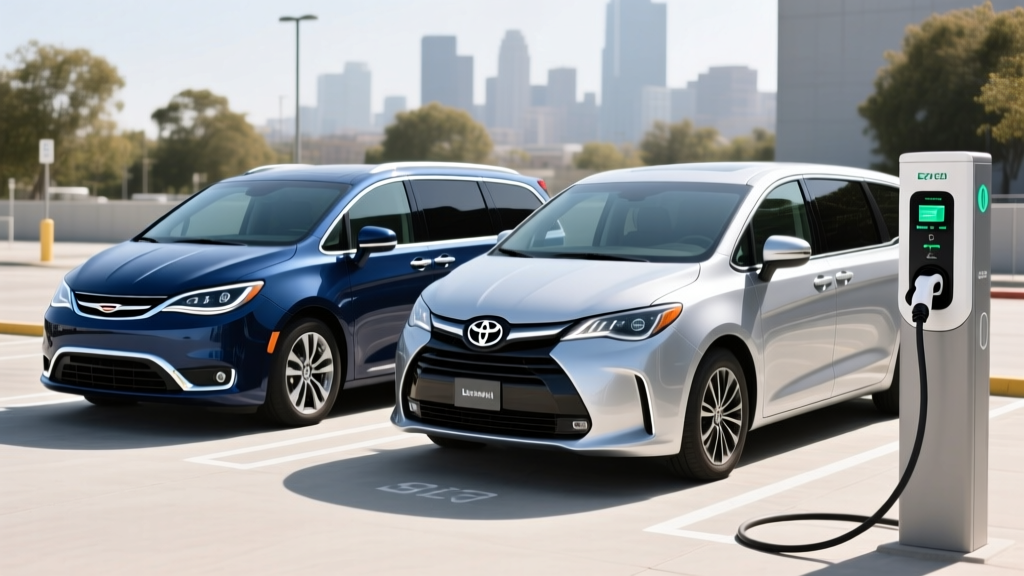
The family-hauler segment has narrowed to exactly two electrified minivans: the Chrysler Pacifica Plug-In Hybrid (a PHEV you plug in) and the Toyota Sienna Hybrid (a conventional HEV you simply fuel). Despite similar badge promises — better mileage, less guilt, the same 7-seat utility — they solve very different problems. One prioritizes zero-emission school runs; the other prioritizes set-it-and-forget-it fuel sipping. Choosing the wrong one costs you thousands over five years in either wasted capability or missed savings.
This guide breaks down every number that matters — EPA MPG, real-world fuel economy, electric-only range, battery warranty, powertrain output, MSRP, and federal tax credit eligibility — so you can match the right minivan hybrid to your actual driving life.
HEV vs PHEV: The Fundamental Split
Conventional Hybrid (HEV) — Toyota Sienna
- You never plug it in. The battery recharges via regenerative braking and the gasoline engine.
- Small battery (~1.9 kWh) assists the engine; no electric-only driving beyond brief low-speed creep.
- Fuel economy is consistent regardless of charging habits — you just drive it like a normal car.
- No federal tax credit eligibility.
Plug-In Hybrid (PHEV) — Chrysler Pacifica
- You plug it in to a Level 1 or Level 2 charger to fill a much larger battery (~16 kWh usable).
- Delivers meaningful electric-only range (32 EPA miles) before the gas engine starts.
- Once the battery depletes, it operates as a conventional hybrid with slightly lower MPG than a dedicated HEV.
- Potentially eligible for the §30D federal tax credit — with caveats on sourcing, income, and MSRP caps.
The wrong choice here is the expensive one. If you can't charge at home or work, the Pacifica PHEV's biggest advantage disappears and you're hauling 600+ lbs of dead battery weight on gas. If you can charge nightly and your daily driving stays under ~30 miles, the Sienna HEV leaves real savings on the table.
Fuel Economy: EPA Numbers and Real-World MPG
| Metric | Toyota Sienna (HEV) | Chrysler Pacifica PHEV |
|---|---|---|
| EPA City MPG | 36 MPG | 29 MPG (hybrid mode) |
| EPA Highway MPG | 36 MPG | 30 MPG (hybrid mode) |
| EPA Combined MPG | 36 MPG | 30 MPG (hybrid mode) |
| MPGe (electric mode) | N/A | 82 MPGe |
| EV-Only Range | N/A | 32 miles (EPA) |
| Total Combined Range | ~630 miles | ~520 miles (EV + gas) |
| Fuel Tank | 14.5 gal | 14.0 gal |
Real-world MPG reality check: Toyota Sienna owners routinely report 34–38 MPG combined on fueleconomy.gov's My MPG tracker, with city-heavy drivers sometimes exceeding the EPA estimate thanks to the hybrid system's regenerative braking strength. Highway-only driving at 75+ mph drops it to roughly 32–33 MPG. The Pacifica PHEV, once the battery is depleted, typically returns 27–29 MPG combined in real-world use — a penalty from its heavier curb weight (roughly 5,100 lbs vs the Sienna's ~4,600 lbs). Per the EPA's official listing, the Pacifica PHEV's combined gas-only figure sits at 30 MPG, but expect the lower end when carrying a full family and cargo.
Powertrain, Battery, and Charging Specs
| Specification | Toyota Sienna Hybrid | Chrysler Pacifica PHEV |
|---|---|---|
| Engine | 2.5L 4-cyl Atkinson cycle | 3.6L Pentastar V6 |
| Electric Motors | 2 (front); 3 with AWD | 2 integrated in transaxle |
| Combined Horsepower | 245 HP | 260 HP |
| Drivetrain | FWD or AWD (AWD adds rear motor) | FWD only |
| Transmission | eCVT | eCVT (Si-EVT) |
| Battery Chemistry | NiMH (hybrid) | Lithium-ion (NMC) |
| Battery Capacity | ~1.9 kWh | 16 kWh (usable) |
| Level 1 Charge (120V) | N/A | ~14 hours (0–100%) |
| Level 2 Charge (240V) | N/A | ~2 hours (0–100%) |
| DC Fast Charging | N/A | Not supported |
| 0–60 mph | ~7.1 sec | ~6.8 sec |
| Towing Capacity | 3,500 lbs | 3,600 lbs |
The Pacifica's lack of DC fast charging is a common complaint, but for a PHEV with 16 kWh of usable capacity, it's largely irrelevant — Level 2 at home or work tops it up fully in about 2 hours, which covers overnight and daytime parking. The bigger limitation is no AWD option on the PHEV. If you need all-wheel drive and hybrid efficiency, the Sienna is currently the only minivan that delivers both (AWD is standard on some trims, optional on others).
Pricing, Trims, and Tax Credit Eligibility
| Toyota Sienna | Chrysler Pacifica PHEV |
|---|---|
| LE: ~$39,000 | Select: ~$51,000 |
| XLE: ~$43,000 | Limited: ~$55,000 |
| XSE: ~$45,000 | Pinnacle: ~$59,000 |
| Platinum: ~$53,500 | — |
Federal tax credit — the complicated part. Under current IRS §30D rules, the Chrysler Pacifica PHEV has historically qualified for up to $7,500 in federal tax credits. However, eligibility depends on three moving targets: (1) the buyer's modified adjusted gross income (caps at $300K joint / $150K single), (2) the vehicle's MSRP staying under the $80,000 van/SUV/truck cap (all Pacifica PHEV trims clear this), and (3) critical-mineral and battery-component sourcing requirements that phase in annually. For 2026, the sourcing rules are stricter than prior years — confirm the current eligibility status on fueleconomy.gov's tax credit page or with a tax professional before counting on the full amount. The credit can now be transferred to the dealer at point of sale, effectively reducing your purchase price upfront.
The Toyota Sienna HEV does not qualify for any federal EV or PHEV tax credit. It's a conventional hybrid — efficient, but ineligible under §30D. Some states (notably California, Colorado, and others) may offer separate hybrid rebates; check your state's energy office for current programs.
Battery Warranty & Longevity — What to Expect
Toyota Sienna: Hybrid battery covered for 10 years / 150,000 miles (in states adopting California emissions standards, including CA, NY, MA, and others; 8 years / 100,000 miles in federal-standards states). Toyota's NiMH hybrid batteries have an exceptional track record — the Prius fleet has demonstrated 200,000+ mile lifespans routinely. Replacement cost, if ever needed out of warranty: approximately $3,000–$4,500 including labor.
Chrysler Pacifica PHEV: High-voltage battery covered for 8 years / 100,000 miles (10/150,000 in CARB states). The larger lithium-ion pack sees deeper daily cycling. Stellantis has a solid but less battle-tested PHEV record than Toyota's two-decade hybrid history. Replacement cost: approximately $7,500–$10,000 if needed post-warranty — a meaningful long-term ownership risk to budget for.
Reliability Track Record
Toyota's hybrid powertrain is arguably the most proven electrified system in automotive history, with over 25 years of continuous refinement since the original Prius. The Sienna's fourth-generation hybrid setup is well-sorted — IIHS has awarded it Top Safety Pick recognition in recent cycles. The hybrid-specific components (inverter, eCVT, motor-generators) are durable and rarely require service.
The Chrysler Pacifica PHEV's reliability is more mixed. Early model years (2017–2019) had documented issues with the high-voltage battery and power electronics, though Stellantis has addressed most through recalls and running changes. The V6 engine itself is a proven workhorse. The main reliability risk is the PHEV-specific hardware — the dual-motor transaxle and larger battery — which has less fleet-level longevity data than Toyota's system.
Who Should Choose Which Minivan Hybrid?
Choose the Toyota Sienna HEV if:
- You cannot charge at home or work (apartment, street parking, no garage outlet).
- You want consistent 34–38 MPG without changing any habits.
- You need AWD for snow or mountain driving.
- Lower purchase price matters — the Sienna starts ~$12,000 below the Pacifica PHEV.
- You plan to keep the van 10+ years and value proven long-term reliability.
- You want the lowest total cost of ownership with minimal complexity.
Choose the Chrysler Pacifica PHEV if:
- You can install a Level 2 (240V) charger at home and drive under ~30 miles most days.
- Your daily routine is school drop-off, errands, and commuting — all within electric range.
- You want the option of zero-emission local driving with gas-engine flexibility for road trips.
- The ~$7,500 federal tax credit (if eligible) narrows the price gap with the Sienna meaningfully.
- You value the Stow 'n Go seating system (available on Pacifica, though not on PHEV trims due to battery placement — note this trade-off).
- You prioritize horsepower (260 HP) and passing confidence over maximum MPG.
The honest math: If you charge nightly and drive 25 miles/day, the Pacifica PHEV will use roughly 200 gallons of gas per year (weekend trips) versus the Sienna's ~420 gallons at 12,000 miles/year. At $3.40/gal, that's ~$750/year in fuel savings for the Pacifica — but the higher purchase price and potential battery replacement cost mean the Sienna HEV likely wins on 5-year total cost of ownership for most buyers, even without a tax credit.
Hybrid vs PHEV vs Full EV: Which Fits Your Family?
Before committing to either minivan hybrid, it's worth asking whether a full battery-electric vehicle (BEV) might serve you better — or whether a hybrid at all is unnecessary.
- Full EV (e.g., upcoming electric minivans or a large SUV like the Kia EV9): Best if you drive under 250 miles/day, have reliable home Level 2 charging, and want near-zero fuel and maintenance costs. Downsides: higher upfront cost, road-trip charging planning, cold-weather range loss of 20–30%, and no electric minivan is widely available in the US market as of 2026.
- PHEV (Pacifica): Best if you want EV-like daily driving with gas-car road-trip freedom and aren't ready to commit to full electric. Requires home charging to justify the premium.
- HEV (Sienna): Best if you want effortless efficiency with zero behavior change. No charging, no range anxiety, no tax-credit paperwork. Ideal for high-mileage families who just want lower fuel bills.
For most American families with one vehicle, the HEV (Sienna) is the lowest-risk, lowest-friction choice. The PHEV (Pacifica) is a compelling upgrade only if your charging access and daily mileage align with its 32-mile electric envelope.
Frequently Asked Questions
How many MPG does a minivan hybrid get?
The Toyota Sienna hybrid achieves an EPA-estimated 36 MPG combined (36 city / 36 highway). Real-world owners report 34–38 MPG depending on driving mix. The Chrysler Pacifica PHEV returns 30 MPG combined once the battery is depleted, with real-world figures closer to 27–29 MPG.
How far can the Pacifica PHEV go on electric only?
The Chrysler Pacifica PHEV has an EPA-rated 32 miles of electric-only range. In mild weather with gentle driving, expect 30–34 miles. In freezing temperatures or at highway speeds, that drops to roughly 24–27 miles. Once depleted, the gas engine engages seamlessly and the van operates as a conventional hybrid.
Does the Toyota Sienna hybrid need to be plugged in?
No. The Sienna is a conventional hybrid (HEV). Its small battery recharges through regenerative braking and the gasoline engine. You fuel it normally and never need a charger or outlet.
Is a minivan hybrid reliable, and what does battery replacement cost?
Toyota's hybrid system is among the most reliable powertrains sold today, with 25+ years of fleet data. The Sienna's hybrid battery is warranted 10 years / 150,000 miles (in CARB states) and typically lasts well beyond that; replacement runs $3,000–$4,500. The Pacifica PHEV's lithium-ion battery is warranted 8 years / 100,000 miles (10/150K in CARB states); replacement is costlier at $7,500–$10,000.
Does either minivan hybrid qualify for a federal tax credit?
The Chrysler Pacifica PHEV may qualify for up to $7,500 under IRS §30D, subject to buyer income caps ($300K joint / $150K single), MSRP limits ($80K for vans), and 2026 battery-sourcing requirements that may reduce or eliminate the credit depending on the build date. The Toyota Sienna HEV does not qualify for any federal EV/PHEV credit. Always verify current eligibility at irs.gov before purchasing.
Can I get AWD with a minivan hybrid?
Yes, but only on the Toyota Sienna. The Sienna offers electronic AWD (a rear-axle electric motor) across multiple trims. The Chrysler Pacifica PHEV is FWD only — the battery packaging precludes the AWD hardware used on gas Pacifica models.
What's the real-world cost to charge the Pacifica PHEV at home?
Refilling the 16 kWh usable battery from empty costs roughly $2.00–$2.75 at the US average residential electricity rate (~$0.16/kWh). That 32 miles of electric driving costs about $0.07–$0.09 per mile, versus roughly $0.12–$0.14 per mile on gasoline in the Sienna. Over 300 electric-only miles per month, you'd save roughly $15–$20/month on fuel.