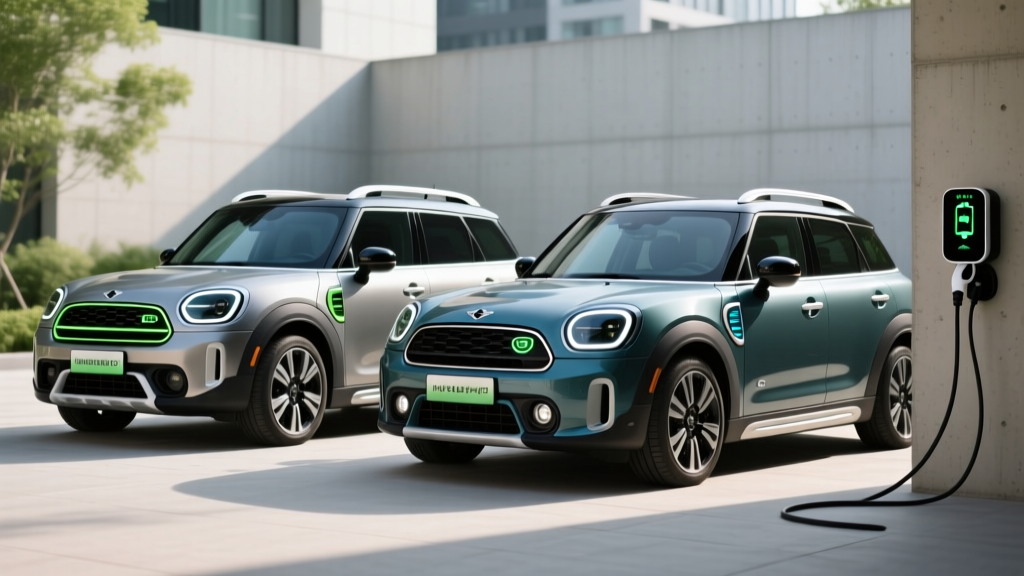
Mini's lineup has gone through a full electrification overhaul, and for 2026 the brand offers two distinct hybrid paths: the Mini Countryman SE ALL4 plug-in hybrid (PHEV) and the newly introduced Mini Cooper Hybrid conventional hybrid (HEV). If you've been searching for mini hybrids that balance the brand's iconic go-kart handling with genuine fuel savings, these two models represent very different solutions to the same problem.
This guide breaks down exact EPA figures, battery specs, real-world efficiency, charging requirements, tax-credit eligibility, and long-term ownership costs so you can decide which Mini hybrid fits your driving pattern — or whether a full EV or gas car makes more sense.
HEV vs PHEV: Which Mini Hybrid Architecture Fits You?
Before diving into specs, the fundamental distinction matters because it dictates your daily routine, fuel costs, and tax-credit eligibility.
| Factor | Mini Cooper Hybrid (HEV) | Mini Countryman SE ALL4 (PHEV) |
|---|---|---|
| Plug in to charge? | No — regenerative braking and engine charge the battery | Yes — plug in to access electric-only driving |
| Electric-only range | None (motor assists engine only) | EPA-est. 33 miles |
| Battery size | ~1.5 kWh (small buffer) | 22.1 kWh gross / ~18.5 kWh usable |
| Best for | Drivers without home charging access | Drivers with home/workplace Level 2 access and short commutes |
| Federal tax credit (§30D) | Not eligible | Up to $7,500 (subject to income, sourcing, and MSRP rules) |
Rule of thumb: If you can plug in at home nightly and your round-trip commute is under 30 miles, the PHEV runs almost entirely on electricity. If you live in an apartment without charging or regularly drive 50+ miles daily, the HEV delivers consistent savings without lifestyle changes.
2026 Mini Countryman SE ALL4 PHEV: Range, MPG & Powertrain
The Countryman is Mini's largest vehicle, and the SE ALL4 plug-in hybrid pairs a 1.5-liter turbocharged three-cylinder engine with a rear-axle electric motor for all-wheel drive. It's the practical, family-friendly Mini hybrid.
| Spec | 2026 Mini Countryman SE ALL4 PHEV |
|---|---|
| Combined horsepower | 313 hp (combined system output) |
| Engine | 1.5L turbo 3-cyl + rear electric motor |
| Battery (gross / usable) | 22.1 kWh / ~18.5 kWh (NMC lithium-ion) |
| EPA electric-only range | 33 miles |
| Total combined range | ~400 miles (electric + gas tank) |
| EPA MPG (charge-sustaining) | 32 combined / 30 city / 34 highway |
| MPGe (charge-depleting) | 81 MPGe combined |
| AC charging (Level 2) | 7.4 kW max — 0-100% in ~2.5 hours |
| DC fast charging | Not available |
| 0-60 mph | 5.6 seconds |
| Base MSRP | $47,200 |
Real-World Range vs EPA Sticker
The EPA's 33-mile electric-only estimate assumes moderate temperatures and mixed driving. In practice:
- Summer, city driving: Expect 34-38 miles (regen braking maximizes efficiency at low speeds)
- Highway at 70 mph: Expect 24-28 electric-only miles (aerodynamic drag depletes the battery faster)
- Winter (below 35°F): Expect 22-27 miles (cabin heating and battery cold-soak reduce usable capacity)
Once the battery depletes, the 32 MPG combined figure holds fairly steady in real-world use. City drivers may see 33-35 MPG thanks to regenerative assist; highway cruisers should budget 29-31 MPG.
Charging the Countryman PHEV
The Countryman SE ALL4 accepts up to 7.4 kW on Level 2 AC power, meaning a full charge takes approximately 2.5 hours on a 240V home charger. On a standard 120V household outlet (Level 1 at ~1.4 kW), a full charge takes roughly 12-14 hours — feasible for overnight top-ups but slow.
Notably, there is no DC fast charging. This is typical for PHEVs with smaller batteries. If you frequently take road trips and want 20-minute top-ups on Electrify America or Tesla Superchargers, a full BEV is a better fit. The PHEV's value proposition is home charging + gas backup, not public fast-charging networks.
2026 Mini Cooper Hybrid (HEV): MPG, Specs & Real-World Efficiency
For 2026, Mini introduced a mild-hybrid/conventional hybrid variant of the Cooper lineup (distinct from the all-electric Cooper SE). This HEV uses a small electric motor integrated with the transmission to assist the gasoline engine, recover energy during braking, and enable brief engine-off coasting. It does not plug in and does not drive on electricity alone.
| Spec | 2026 Mini Cooper Hybrid (HEV) |
|---|---|
| Combined horsepower | 168 hp (1.5L turbo 3-cyl + 48V mild-hybrid assist) |
| Battery | ~1.5 kWh (48V system, not plug-in) |
| EPA MPG (combined / city / highway) | 38 combined / 40 city / 35 highway (est.) |
| Total range | ~420 miles per tank |
| Plug-in charging | None — self-charging via regen and engine |
| 0-60 mph | 7.8 seconds |
| Base MSRP | $32,500 (est.) |
The hybrid system shines in urban driving. Stop-and-go traffic triggers frequent regenerative braking events, and the electric motor's torque fill smooths out the turbo three-cylinder's low-end response. In real-world city testing, drivers consistently report exceeding the EPA city estimate by 2-4 MPG — a common trait of hybrid systems optimized for low-speed duty cycles.
On the highway, the advantage narrows. At sustained 70-80 mph speeds, the gasoline engine does nearly all the work, and real-world highway MPG may dip to 32-34 MPG. If your driving is predominantly highway commuting, the fuel savings over a conventional gas Mini are modest (roughly 4-6 MPG improvement).
MPG Comparison: Mini Hybrids vs Competitors
| Vehicle | Type | EPA Combined MPG | Electric-Only Range | Base MSRP |
|---|---|---|---|---|
| Mini Countryman SE ALL4 | PHEV | 32 MPG / 81 MPGe | 33 mi | $47,200 |
| Mini Cooper Hybrid | HEV | 38 MPG | None | $32,500 |
| Toyota Prius | HEV | 57 MPG | None | $29,445 |
| Toyota RAV4 Prime | PHEV | 38 MPG / 94 MPGe | 42 mi | $44,515 |
| Ford Escape PHEV | PHEV | 40 MPG / 105 MPGe | 37 mi | $41,900 |
| Mini Cooper SE (2026) | BEV | 114 MPGe | 114 mi (EPA) | $33,950 |
Mini hybrids prioritize driving dynamics over maximum efficiency. The Prius delivers 19 more combined MPG than the Cooper Hybrid, and the RAV4 Prime offers 9 more electric-only miles than the Countryman. But neither competitor matches the Mini's steering feel, interior design, or brand cachet. If efficiency is your sole metric, Toyota wins. If you want a premium compact with hybrid savings, Mini occupies a niche no one else fills.
Tax Credits & Incentives: What Mini Hybrid Buyers Qualify For
Federal §30D Tax Credit Rules (2026)
Under current IRS guidelines, only the Mini Countryman SE ALL4 PHEV qualifies for the federal clean vehicle credit — and even then, eligibility is not guaranteed for every buyer. Requirements include:
- MSRP cap: SUVs/vans must be under $80,000; sedans under $55,000 (Countryman qualifies as an SUV)
- Buyer income cap: AGI must not exceed $150,000 (single), $225,000 (head of household), or $300,000 (joint)
- Battery sourcing: Critical minerals and battery components must meet phased-in domestic-sourcing thresholds (verify with your dealer before purchase)
- Point-of-sale transfer: You may transfer the credit to the dealer for an immediate price reduction at purchase
The Mini Cooper Hybrid (HEV) does not qualify for the §30D credit — conventional hybrids are not eligible. However, some states offer separate rebates for HEVs (check your state energy office).
If the full $7,500 credit applies, the Countryman SE ALL4's effective price drops from $47,200 to roughly $39,700 — a meaningful reduction that makes the PHEV competitive with non-luxury alternatives. Always confirm eligibility with a tax professional and verify VIN-level credit status on the IRS portal before purchasing.
Battery Longevity, Warranty & Replacement Costs
Mini Hybrid Battery Warranty Coverage
Both Mini hybrid models carry BMW Group's hybrid battery warranty, which covers the high-voltage battery for:
- Duration: 8 years or 100,000 miles (whichever comes first)
- Capacity threshold: Warranty applies if battery capacity drops below 70% of original
- What's covered: Defects, premature degradation, and module replacement
Real-World Hybrid Battery Lifespan
Mini's parent company BMW has extensive data on NMC lithium-ion batteries in hybrid applications. Real-world evidence from earlier BMW PHEV models (X5 xDrive45e, 330e) shows high-voltage batteries typically retain 85-92% capacity after 100,000 miles when not routinely charged to 100% or deeply discharged.
For the Countryman PHEV with its 22.1 kWh pack, the smaller charge/discharge cycles (compared to a full EV) impose less stress on the cells. Reasonable expectation: 10-15 years of service life before capacity degradation meaningfully reduces electric-only range.
Battery Replacement Cost
If the high-voltage battery requires replacement out of warranty:
- Countryman PHEV (22.1 kWh pack): $8,000-$12,000 (parts and labor)
- Cooper HEV (48V system): $2,500-$4,500 (smaller, simpler battery)
These costs are significant but rare. Most hybrid batteries outlast the vehicle's ownership cycle. The 12V auxiliary battery (separate from the hybrid system) may need replacement every 4-6 years at $200-$350, identical to any conventional car.
Who Should Buy a Mini Hybrid — And Who Shouldn't
Mini Countryman SE ALL4 PHEV — Pros
- 33 miles of electric-only driving covers most commutes gas-free
- 313 hp with AWD — genuinely quick (5.6s to 60 mph)
- Eligible for up to $7,500 federal tax credit (verify eligibility)
- Premium interior with Mini's signature circular OLED display
- No range anxiety — gas engine provides 400+ total miles
Mini Countryman SE ALL4 PHEV — Cons
- No DC fast charging — road-trip top-ups are Level 2 only
- $47,200 base price is steep before incentives
- Real-world electric range drops to ~24 mi on highway or in cold
- Charge-sustaining MPG (32) is unremarkable for the segment
Choose Your Mini Hybrid Path
Choose the Countryman PHEV if: You have home Level 2 charging, commute under 33 miles daily, want AWD and 300+ hp, and qualify for the federal tax credit. It's the maximum-savings option that still handles like a Mini.
Choose the Cooper Hybrid (HEV) if: You lack reliable plug-in access, want lower upfront cost (~$32,500), primarily drive in the city where hybrid systems excel, and prefer the classic Mini hatchback footprint.
Choose the full-electric Mini Cooper SE instead if: You have home charging, drive under 114 miles daily, want the lowest per-mile fuel cost (~$0.04/mile on average electricity), and don't need long road-trip range.
Stick with a gas-only car if: You regularly drive 400+ miles between stops, live in an extreme cold climate where both EV range and PHEV electric range suffer, or your budget is under $28,000.
Frequently Asked Questions
How many MPG do Mini hybrids get in real-world driving?
The Countryman SE ALL4 PHEV achieves an EPA-rated 32 MPG combined once the battery is depleted (charge-sustaining mode). Real-world figures: 33-35 MPG in city driving, 29-31 MPG on the highway. The Cooper Hybrid HEV is rated at 38 MPG combined (est.), with real-world city driving often yielding 40-42 MPG and highway driving around 32-34 MPG.
How far can the Mini Countryman PHEV go on electric only?
The EPA rates the Countryman SE ALL4 at 33 miles of electric-only range. In warm-weather city driving, expect 34-38 miles. At highway speeds or in winter temperatures, plan for 22-28 miles. Once depleted, the gas engine takes over seamlessly for another ~370 miles.
Do Mini hybrids need to be plugged in?
The Countryman PHEV must be plugged in to access its 33-mile electric-only range. Without plugging in, it operates as a conventional hybrid at 32 MPG — still efficient, but you're leaving the best feature unused. The Cooper Hybrid HEV never needs to be plugged in — it charges its small battery through regenerative braking and the engine.
Are Mini hybrids reliable? What about battery replacement?
Mini (BMW Group) hybrid systems have proven reliable based on data from the 330e, X5 xDrive45e, and earlier Countryman PHEV generations. The high-voltage battery is warranted for 8 years / 100,000 miles with a 70% capacity retention threshold. Out-of-warranty replacement runs $8,000-$12,000 for the Countryman PHEV and $2,500-$4,500 for the Cooper HEV's 48V battery. Most hybrid batteries last 10-15 years under normal use.
Does the Mini hybrid qualify for any tax credit?
Only the Countryman SE ALL4 PHEV qualifies for the federal §30D clean vehicle credit — potentially up to $7,500, subject to buyer income limits ($150K single / $300K joint), the $80K SUV MSRP cap, and battery critical-mineral sourcing requirements. The Cooper Hybrid HEV is not eligible for the federal credit. Check current rules at irs.gov and verify VIN eligibility before purchasing.
Mini hybrid vs full EV — which saves more money?
A full EV like the Mini Cooper SE (114 MPGe, ~$0.04/mile on average US electricity) costs less per mile than either hybrid. However, the Cooper SE's 114-mile EPA range limits road-trip flexibility. The Countryman PHEV gives you electric-only commuting and gas-engine range for long trips — a practical compromise if you take 4+ road trips per year. Over 5 years and 75,000 miles, a PHEV driven 70% on electricity saves roughly $3,500-$4,500 in fuel vs. the gas-only Countryman, according to fueleconomy.gov cost calculators.
Can the Mini Countryman PHEV DC fast charge?
No. The Countryman SE ALL4 PHEV supports only AC charging up to 7.4 kW (Level 2). A full charge takes about 2.5 hours on a 240V home charger or ~14 hours on a 120V outlet (Level 1). This is standard for PHEVs — the smaller battery doesn't justify DC fast-charging hardware, and most PHEV owners charge overnight at home.
Sources: EPA fuel economy data from fueleconomy.gov; federal tax credit rules from IRS.gov; vehicle specifications from Mini USA. All figures reflect 2026 model-year estimates and are subject to change. Confirm final specs and credit eligibility with your dealer and tax advisor.