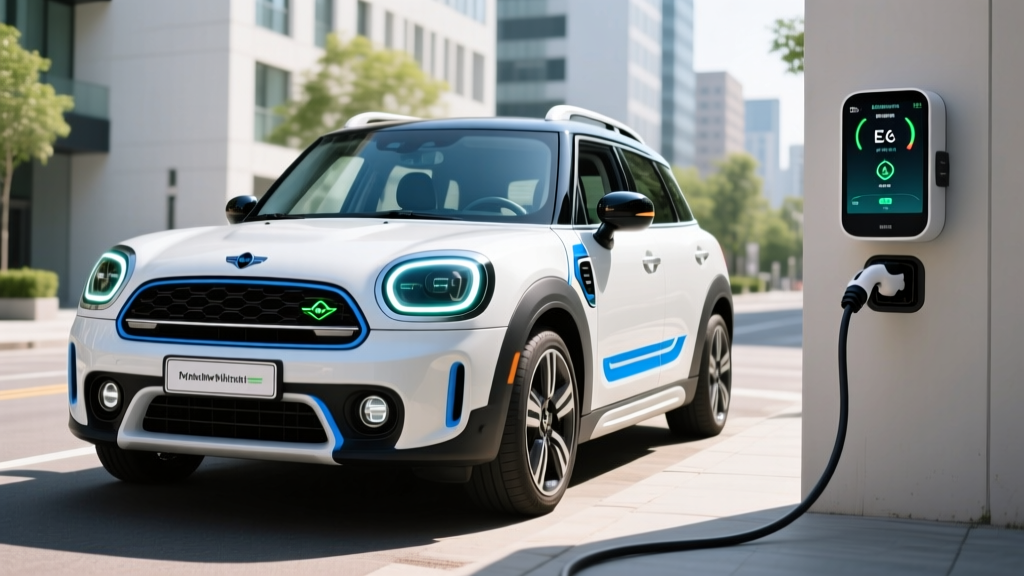
The 2026 Mini Countryman SE ALL4 plug-in hybrid occupies a specific niche: a premium compact crossover that blends genuine electric-only commuting with a gasoline safety net for longer trips. With an EPA-estimated 33 miles of electric range and a combined 321 horsepower from its three-cylinder turbo engine and electric motor, it targets drivers who want daily EV behavior without fully committing to a battery-electric vehicle. This guide breaks down the real-world efficiency, charging logistics, pricing, and whether the Mini Countryman plug-in hybrid actually qualifies for federal tax incentives in 2026.
Mini Countryman Plug-In Hybrid vs. Conventional Hybrid: What's the Difference?
Before diving into specs, it's worth clarifying a distinction that still trips up buyers. The Mini Countryman lineup includes the Countryman E (fully electric), the Countryman C (mild-hybrid gasoline), and the Countryman SE ALL4 (the plug-in hybrid covered here). Mini does not sell a conventional self-charging hybrid (HEV) version of the Countryman in the US market.
| Type | Countryman Trim | Plugs In? | Electric-Only Range | Gas Engine? | Best For |
|---|---|---|---|---|---|
| HEV (conventional hybrid) | Not offered in US | No | ~1 mile | Yes (primary) | No home charging access |
| PHEV (plug-in hybrid) | SE ALL4 | Yes | EPA 33 mi | Yes (backup + boost) | Short commute + long road trips |
| BEV (full electric) | Countryman E / SE | Yes | EPA 240+ mi | No | Home charging + mostly under 200 mi trips |
A conventional hybrid (HEV) generates all its electricity from the gasoline engine and regenerative braking — you never plug it in. A plug-in hybrid (PHEV) like the Countryman SE ALL4 carries a larger battery you charge from a wall outlet or public station, enabling meaningful electric-only driving before the gas engine activates. If you never plug in a PHEV, it operates like a heavy, less-efficient hybrid, defeating the purpose of the larger battery.
EPA Fuel Economy and Electric Range: The Numbers
The 2026 Mini Countryman SE ALL4 PHEV pairs a 1.5-liter turbocharged three-cylinder engine (161 hp) with an electric motor integrated into the seven-speed dual-clutch transmission, for a combined system output of 321 horsepower and 354 lb-ft of torque. The all-wheel-drive system (ALL4) uses the electric motor to power the rear axle when needed.
| Metric | EPA Estimate |
|---|---|
| Electric-only range | 33 miles |
| Combined MPGe (electric + gas) | 57 MPGe |
| Gas-only combined MPG | 29 MPG |
| Gas-only city MPG | 27 MPG |
| Gas-only highway MPG | 32 MPG |
| Total range (electric + gas) | ~380 miles |
Real-world caveat: The 33-mile electric range assumes moderate temperatures and mixed driving. In cold weather (below 40°F), expect that range to drop by 20-30%, yielding roughly 23-26 miles on battery alone. Highway driving at 75+ mph will also reduce electric range to approximately 25-28 miles. However, if your daily commute is under 25 miles round-trip and you charge at home nightly, you may go weeks without burning gasoline.
When operating in hybrid mode after the battery depletes, real-world MPG often exceeds the EPA's combined estimate in city driving — regenerative braking recaptures energy in stop-and-go traffic. Owners report 31-34 MPG in urban hybrid operation, though highway-only driving at high speeds may yield 27-29 MPG.
Battery, Charging, and the DC Fast-Charging Advantage
The Countryman SE ALL4 uses a 22.1 kWh gross battery (approximately 17.8 kWh usable) positioned beneath the rear seats and cargo floor. This is one of the larger batteries in the compact PHEV segment — for comparison, the Toyota RAV4 Prime carries an 18.1 kWh pack.
| Charging Method | Power (kW) | 0-100% Time | Connector |
|---|---|---|---|
| Level 1 (120V household) | ~1.4 kW | ~14 hours | J1772 / Type 2 |
| Level 2 (240V home/public) | 7.4 kW | ~2.5 hours | J1772 / Type 2 |
| DC fast charging | Up to 50 kW | ~30 min (10-80%) | CCS Combo 2 |
The 50 kW DC fast-charging capability is a genuine differentiator. Most PHEVs in this class — including the RAV4 Prime and Hyundai Tucson PHEV — lack DC fast charging entirely, relying solely on Level 2 AC charging. For Countryman owners on road trips, a 20-minute DC stop can restore 15-20 miles of electric range for the final leg home, reducing gasoline consumption on longer journeys.
For daily charging at home on a standard Level 2 wallbox (7.4 kW), a full charge takes approximately 2.5 hours. This means you can easily top off the battery during evening hours or even during a workday if your employer offers Level 2 charging.
Powertrain, Performance, and Driving Impressions
The combined 321 hp output makes the Countryman SE ALL4 the quickest variant in the lineup. Mini claims a 0-60 mph time of 5.4 seconds, which is brisk for a compact crossover and noticeably quicker than the four-cylinder Countryman C mild-hybrid (around 7.8 seconds).
The electric motor provides instant torque from a standstill, and the transition between electric and gasoline power is well-managed — one of the smoother PHEV powertrain handoffs in the segment. The ALL4 system can operate in pure front-wheel electric drive, rear-biased engine drive, or all-wheel combined mode depending on traction needs and battery state of charge.
Driving modes include Electric (battery-only up to approximately 84 mph), Hybrid (system-managed), and a battery-save mode that preserves charge for later use — useful if you're highway-driving to a city destination where electric-only operation is more efficient.
Pricing, Trims, and Federal Tax Credit Eligibility
The 2026 Mini Countryman SE ALL4 starts at a base MSRP of approximately $43,900 (including destination). Higher option packages — including the Signature and Iconic trims — can push the price toward $50,000-$53,000 with premium packages, larger wheels, and advanced driver-assistance features.
Does the Countryman PHEV Qualify for the Federal Tax Credit?
Under current IRS §30D rules, the federal clean vehicle credit applies to qualifying plug-in hybrids and full EVs, with a maximum credit of $7,500. However, eligibility depends on several factors that change frequently:
- MSRP cap: SUVs/crossovers must have an MSRP under $80,000 (the Countryman qualifies)
- Buyer income limits: AGI must not exceed $150,000 (single), $225,000 (head of household), or $300,000 (joint)
- Battery sourcing: Critical minerals and battery components must meet escalating percentage thresholds from US or FTA partners
- Final assembly: Vehicle must be assembled in North America
- Point-of-sale transfer: Eligible buyers can apply the credit as a down-payment reduction at the dealer
The Countryman SE ALL4 is assembled at the BMW Group plant in Leipzig, Germany. This means it does not meet the North American final assembly requirement for the full §30D new-vehicle credit. Buyers should consult a tax professional and verify current-year rules at fueleconomy.gov before assuming credit eligibility. Some state-level incentives (such as California's CVRP or utility rebates) may still apply regardless of assembly location.
Battery Warranty, Reliability, and Long-Term Costs
BMW/Mini High-Voltage Battery Warranty: 8 years or 100,000 miles (whichever comes first), covering defects and capacity loss below 70% of original capacity. This meets the minimum federal requirement for hybrid and EV battery coverage.
The Countryman PHEV's battery uses NMC (nickel-manganese-cobalt) chemistry, which offers higher energy density than LFP (lithium iron phosphate) but may experience slightly more degradation over time. However, PHEV batteries undergo shallower charge cycles than full EVs — you're using 17.8 kWh rather than 80+ kWh — so long-term degradation is typically modest.
Based on data from earlier-generation Mini/BMW PHEVs (the F60 Countryman SE E), owners report approximately 8-12% capacity loss over 5 years and 60,000 miles. A replacement battery pack, if needed out of warranty, would likely cost $6,000-$9,000 including labor, though this is speculative for the current U25 generation and pricing may shift by the time warranty coverage expires.
Reliability data for the 2026 model year is still accumulating. The previous-generation Countryman scored average to slightly above-average in JD Power and Consumer Reports assessments, with most complaints centered on infotainment software rather than powertrain durability. The BMW Group's B38 three-cylinder engine has proven robust in other applications.
Who Should Buy the Countryman PHEV — and Who Shouldn't?
Pros
- 33-mile electric range covers most daily commutes
- DC fast charging (50 kW) — rare in PHEV segment
- 321 hp provides genuine performance
- Premium interior with Mini's round OLED display
- All-wheel drive standard (ALL4)
- No range anxiety for road trips
Cons
- Does not qualify for federal §30D credit (German assembly)
- Higher base price than RAV4 Prime or Tucson PHEV
- Rear cargo space reduced vs. gas-only Countryman
- Electric range drops significantly in cold weather
- Must plug in regularly to realize efficiency benefits
Choose the Mini Countryman SE ALL4 PHEV if: You have a sub-30-mile daily commute, access to home or workplace Level 2 charging, want a premium-brand compact crossover, and take road trips too long for a current EV to handle comfortably in winter.
Choose a full EV (like the Countryman E) if: You have reliable home charging, rarely drive over 200 miles in a day, and want to eliminate gasoline entirely while potentially qualifying for different state incentives.
Choose a conventional hybrid (like the RAV4 Hybrid) if: You cannot plug in at home or work, want maximum fuel efficiency without behavior change, and prioritize lower purchase price over electric-only driving.
Frequently Asked Questions
How many MPG does the Mini Countryman plug-in hybrid get?
The EPA rates the 2026 Countryman SE ALL4 at 57 MPGe combined when using both electric and gasoline power. Once the battery depletes, it operates as a hybrid at an EPA-estimated 29 MPG combined (27 city / 32 highway). Real-world city driving often yields 31-34 MPG in hybrid mode due to regenerative braking.
How far can the Mini Countryman PHEV go on electric only?
The EPA estimates 33 miles of electric-only range. In real-world conditions, expect 25-28 miles at highway speeds or in cold weather (below 40°F), and up to 33-35 miles in moderate temperatures with city driving. The electric motor can propel the vehicle up to approximately 84 mph before the gas engine engages.
Can I charge the Countryman PHEV at a DC fast charger?
Yes. The 2026 Countryman SE ALL4 supports up to 50 kW DC fast charging via CCS Combo 2 connector, reaching 80% in approximately 30 minutes. This is uncommon for PHEVs and makes road-trip top-ups practical.
Is the Mini Countryman PHEV reliable?
Long-term reliability data for the U25 generation is still accumulating. The BMW Group's B38 three-cylinder engine and dual-clutch transmission have proven durable in other models. The high-voltage battery carries an 8-year/100,000-mile warranty. Previous-generation Countryman PHEVs showed average reliability with most issues related to software rather than powertrain components.
Does the Mini Countryman plug-in hybrid qualify for a tax credit?
The Countryman SE ALL4 is assembled in Germany, which disqualifies it from the federal §30D new clean vehicle credit (requires North American final assembly). However, state-level incentives may still apply — check your state's energy office or utility provider for local rebates. Always verify current rules at irs.gov before purchasing.
What happens if I never plug in the Countryman PHEV?
You can drive it as a conventional hybrid, but you'll get only 29 MPG combined while carrying the weight penalty of a 22.1 kWh battery you're not using. This defeats the economic purpose of the PHEV. If you cannot plug in regularly, a conventional hybrid (HEV) or mild-hybrid vehicle will likely save you more money.