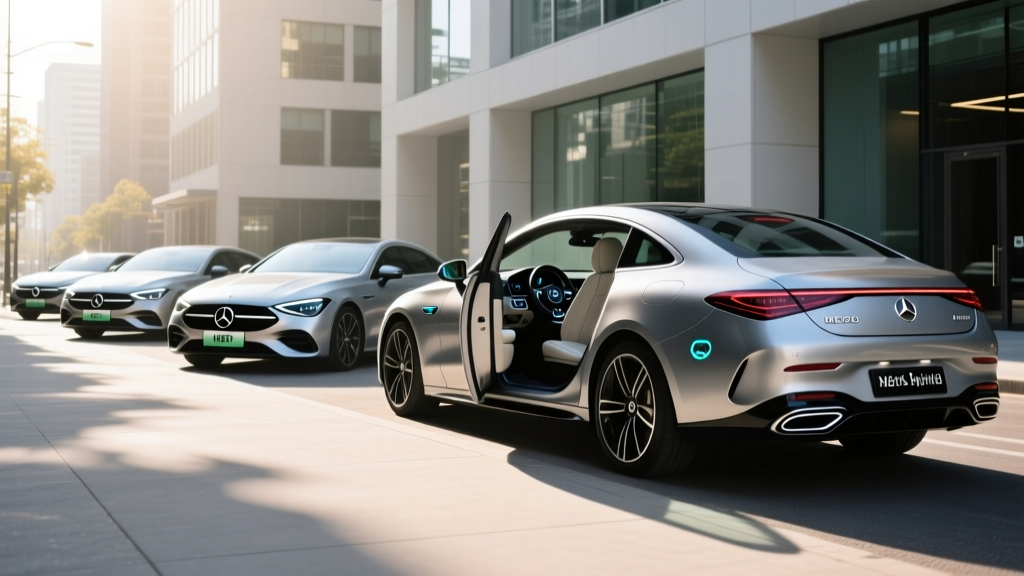
If you are researching a Mercedes hybrid car in 2026, the brand's lineup has consolidated into two distinct camps: plug-in hybrids (PHEVs) that deliver meaningful electric-only commuting range, and AMG-badged conventional hybrids (HEVs) that use a small electric motor for performance boost rather than efficiency. Mercedes-Benz has fully exited the standard non-performance HEV segment in the United States — there is no equivalent to a Toyota Camry Hybrid wearing a three-pointed star.
This guide covers every electrified Mercedes model currently available to U.S. buyers, with exact EPA figures, real-world efficiency observations, battery specifications, and federal tax credit eligibility under current IRS §30D rules.
HEV vs PHEV: What Mercedes Actually Sells in 2026
Before diving into specific models, it is essential to understand the distinction between the two hybrid types in the Mercedes lineup, because they serve entirely different use cases.
Conventional Hybrid (HEV) — No Plug Required
- Small battery (typically under 2 kWh) charged only by regenerative braking and the engine
- Electric motor assists the gas engine but cannot drive the car on electricity alone for meaningful distances
- No charging cable, no plug — you fuel it like a normal gas car
- In Mercedes' 2026 lineup: AMG performance models (e.g., AMG GT 63 S E PERFORMANCE)
- Primary benefit: performance enhancement, not fuel savings
Plug-In Hybrid (PHEV) — Plugs In, Drives on Electric
- Larger battery (18–29 kWh) that you charge via a plug — Level 1 or Level 2
- Can drive 30–50+ miles on electricity alone before the gas engine activates
- Once the battery is depleted, it operates as a conventional hybrid
- In Mercedes' 2026 lineup: GLC 350e, GLE 350e, S 580e
- Primary benefit: daily electric commuting with gas-engine road-trip flexibility
If your goal is fuel savings and electric commuting, the PHEV models are what you want. If you are shopping for AMG performance with a mild efficiency assist, the HEV models fill that niche — but do not expect Prius-level MPG from them.
2026 Mercedes PHEV Lineup: Range, MPG, and Charging Specs
Mercedes' U.S. PHEV portfolio centers on three models: the compact luxury GLC 350e SUV, the midsize GLE 350e SUV, and the flagship S 580e sedan. All three share a similar architecture — a turbocharged four-cylinder engine paired with a permanently excited synchronous electric motor integrated into the transmission.
| Specification | GLC 350e 4MATIC | GLE 350e 4MATIC | S 580e 4MATIC |
|---|---|---|---|
| Powertrain | 2.0L turbo I4 + electric motor | 2.0L turbo I4 + electric motor | 3.0L turbo I6 + electric motor |
| Combined Horsepower | 315 hp | 302 hp | 443 hp |
| Combined Torque | 406 lb-ft | 384 lb-ft | 516 lb-ft |
| Battery Capacity (usable) | 18.9 kWh (NMC) | 18.9 kWh (NMC) | 22.7 kWh (NMC) |
| EPA Electric-Only Range | 40 miles | 37 miles | 40 miles |
| EPA MPGe (electric + gas) | 56 MPGe | 50 MPGe | 55 MPGe |
| EPA MPG (gas-only, charge-depleted) | 29 combined (26 city / 32 hwy) | 26 combined (23 city / 29 hwy) | 28 combined (25 city / 32 hwy) |
| Total Combined Range | ~430 miles | ~420 miles | ~460 miles |
| DC Fast Charging | Yes, 60 kW max | Yes, 60 kW max | Yes, 60 kW max |
| Level 2 Charge Time (0–100%) | ~2.5 hours at 7.4 kW | ~2.5 hours at 7.4 kW | ~3 hours at 7.4 kW |
| 0–60 mph | 6.5 seconds | 7.0 seconds | 4.9 seconds |
| Starting MSRP | $59,950 | $72,350 | $120,850 |
Sources: EPA fueleconomy.gov, Mercedes-Benz USA. Specs reflect 2025–2026 model year. Verify trim-specific pricing with your dealer.
Real-World Range and Efficiency Observations
EPA electric-only range figures for the Mercedes PHEVs are achievable under moderate conditions — 65–75°F, mixed city/highway driving, no heavy HVAC use. In practice, expect the following:
- City commuting (under 45 mph): Electric range often exceeds EPA by 5–10 miles thanks to regenerative braking. The GLC 350e can return 43–46 miles on a full charge in stop-and-go traffic.
- Highway driving (70+ mph): Electric range drops to roughly 28–33 miles. Aerodynamic drag at speed depletes the battery faster, and there is less regen opportunity.
- Cold weather (below 32°F): Expect 25–35% range reduction. Battery chemistry is less efficient in cold temperatures, and cabin heating draws significant power. The GLC 350e's 40-mile EPA rating may shrink to 26–30 miles in January in Chicago or Boston.
Once the battery is depleted and the gas engine takes over, real-world MPG generally tracks close to the EPA gas-only figures for the GLC and S-Class. The heavier GLE 350e tends to return 1–2 MPG below its EPA combined rating in mixed driving, particularly if you frequently drive at highway speeds with a depleted battery.
Charging a Mercedes PHEV: What You Need to Know
One of the most important details for prospective Mercedes PHEV buyers is that all three 2026 models support DC fast charging — a feature that many competing luxury PHEVs lack. The 60 kW DC capability means a 10–80% charge in approximately 20–25 minutes at a compatible public charger.
| Charging Level | Power (kW) | Approximate Speed | Full Charge Time |
|---|---|---|---|
| Level 1 (120V household outlet) | ~1.4 kW | ~4–5 miles of range per hour | 12–16 hours (0–100%) |
| Level 2 (240V home or public) | 7.4 kW (onboard charger max) | ~22–25 miles of range per hour | 2.5–3 hours (0–100%) |
| DC Fast Charge (public CCS) | 60 kW peak | ~10–80% in ~22 minutes | Not recommended for daily use |
For daily use, a Level 2 home charger is the ideal setup. Because the PHEV batteries are relatively small (18.9–22.7 kWh usable), overnight charging on even a standard 120V outlet can replenish most of the battery — though it takes 12+ hours. If your daily commute is under 35 miles round-trip, Level 1 charging overnight may be sufficient, saving you the cost of a Level 2 installation.
The charging connector on all U.S.-spec 2026 Mercedes PHEVs is a CCS1/J1772 combo port. Mercedes has announced a transition to the NACS (Tesla-style) connector for future battery-electric models, but the current PHEV lineup retains CCS1. This means full access to Electrify America, EVgo, and ChargePoint DC networks, plus Tesla Superchargers via a CCS-to-NACS adapter.
AMG HEV Models: Performance Hybrids, Not Efficiency Hybrids
Mercedes-AMG's "E PERFORMANCE" badge denotes a conventional hybrid system designed for performance, not fuel economy. The flagship example is the AMG GT 63 S E PERFORMANCE, which pairs a hand-built 4.0L V8 biturbo with a rear-axle electric motor for a combined 831 horsepower.
| Specification | AMG GT 63 S E PERFORMANCE |
|---|---|
| Powertrain | 4.0L V8 biturbo + rear-axle electric motor |
| Combined Horsepower | 831 hp |
| Combined Torque | 1,033 lb-ft |
| Battery Capacity | 6.1 kWh (high-performance NMC) |
| Electric-Only Range | ~7 miles (not EPA-rated for EV mode) |
| EPA MPG (combined) | 16 combined (14 city / 20 hwy) |
| 0–60 mph | 2.7 seconds |
| Starting MSRP | $196,000 |
This is a hybrid in the same way a Formula 1 car is a hybrid: the electric motor provides instant torque fill and launch performance, not efficiency. The 6.1 kWh battery is designed for rapid discharge and recharge cycles during aggressive driving, not for electric commuting. If fuel economy is your priority, this is not the Mercedes hybrid car for you.
Other AMG E PERFORMANCE models follow the same philosophy, including variants of the AMG S 63 and AMG C 63 S. All use small, high-output batteries with no plug-in capability — they charge exclusively through regenerative braking and the engine.
Federal Tax Credits for Mercedes PHEVs in 2026
Under the current IRS §30D Clean Vehicle Credit rules, qualifying PHEVs may be eligible for up to $7,500 in federal tax credits, split into two halves:
- $3,750 — Battery Components: At least 60% of battery components must be manufactured or assembled in North America (threshold increases annually through 2029)
- $3,750 — Critical Minerals: At least 60% of critical minerals must be sourced from the U.S. or a free-trade-agreement partner (threshold increases annually)
- MSRP Cap: SUVs/wagons must be under $80,000; sedans under $55,000
- Income Cap: AGI must not exceed $150,000 (single), $225,000 (head of household), or $300,000 (joint filers)
- Point-of-Sale Transfer: Eligible buyers can transfer the credit to the dealer at purchase, reducing the purchase price directly rather than waiting for a tax refund
- FEOC Restriction: Vehicles with battery components from a "foreign entity of concern" (China, Russia, etc.) may be disqualified — this has narrowed the eligible list significantly since 2024
Current Mercedes PHEV credit status (2026): The GLC 350e, with a starting MSRP of $59,950, falls under the $80,000 SUV cap and may qualify for partial or full credit depending on battery sourcing compliance. The GLE 350e at $72,350 is also under the SUV cap. The S 580e sedan at $120,850 exceeds the $55,000 sedan cap and does not qualify.
Eligibility changes frequently as battery supply chains shift. Always verify current status on fueleconomy.gov before purchasing, and consult a tax professional regarding your specific income situation.
Battery Warranty, Reliability, and Replacement Costs
Hybrid battery longevity is consistently one of the top concerns for buyers transitioning from a conventional gas vehicle. Here is what Mercedes provides:
Mercedes PHEV Battery Warranty
- Coverage: 6 years / 62,000 miles (whichever comes first) for the high-voltage battery
- Capacity Threshold: Mercedes warrants the battery will retain at least 70% of its original capacity during the warranty period
- Powertrain Warranty: 4 years / 50,000 miles (standard Mercedes new-vehicle warranty)
- Extended Coverage: California and states adopting CARB emissions rules may require extended hybrid-component warranties (up to 10 years / 150,000 miles for specific emissions-related components)
Replacement cost: If the high-voltage battery requires replacement outside of warranty, expect a cost between $12,000 and $18,000 for the PHEV models, depending on the specific battery pack. The AMG E PERFORMANCE battery, being a specialized high-discharge unit, is significantly more expensive to replace — estimated at $20,000+.
Reliability context: Mercedes PHEV powertrains have proven generally reliable in the 2023–2026 model years. The 2.0L turbo I4 used in the GLC and GLE 350e is a well-established engine family. The primary reliability considerations involve the complexity of the dual powertrain — there are more components (electric motor, power electronics, onboard charger, high-voltage cabling) than in a conventional gas car. Most reported issues have been software-related rather than hardware failures.
For comparison, Toyota's hybrid systems carry a 10-year/150,000-mile battery warranty and have decades of field-proven reliability data. Mercedes' 6-year/62,000-mile battery warranty is shorter than many competitors. If long-term ownership beyond the warranty period is your plan, consider purchasing an extended warranty or budgeting for potential out-of-pocket battery service.
Mercedes Hybrid vs Full EV vs Gas: Which Fits You?
Choose a Mercedes PHEV (GLC 350e, GLE 350e, S 580e) if:
- Your daily commute is under 40 miles round-trip and you can charge at home
- You want electric driving for daily errands but need gas-engine flexibility for road trips
- You live in a region with cold winters where EV range loss is a concern
- You are not ready to rely on public charging infrastructure for long trips
- You want a luxury badge with a smoother transition from gas to electric
Choose a full EV (Mercedes EQE, EQS, or competitor) if:
- You have reliable home Level 2 charging and your daily driving is under 200 miles
- You want the lowest per-mile operating cost and minimal maintenance
- You are motivated by eliminating tailpipe emissions entirely
- You want access to the full $7,500 federal tax credit (many full EVs qualify)
- You plan to own the vehicle 8+ years and want fewer moving parts
Choose a conventional gas vehicle if:
- You cannot charge at home (apartment, street parking, no garage)
- Your driving is mostly long highway trips where PHEV electric range provides minimal benefit
- Upfront purchase price is your primary concern
- You prefer the simplest possible maintenance profile
The Mercedes PHEVs occupy a specific sweet spot: luxury buyers who want electric commuting without range anxiety. They are not the most efficient option — a full EV like the Mercedes EQE 350+ delivers 2.5–3× the electric range at lower per-mile cost — but they eliminate the behavioral change of trip planning around chargers.
Pricing and Ownership Cost Summary
| Cost Factor (5 Years / 75,000 Miles) | GLC 350e PHEV | GLC 300 (Gas) | EQE 350+ (Full EV) |
|---|---|---|---|
| Starting MSRP | $59,950 | $48,250 | $76,050 |
| Estimated Federal Tax Credit | $3,750–$7,500 | $0 | $3,750–$7,500 |
| Fuel / Electricity Cost | ~$4,800 | ~$9,200 | ~$3,600 |
| Maintenance (estimated) | ~$3,500 | ~$4,200 | ~$2,200 |
| Insurance (estimated avg) | ~$10,500 | ~$8,800 | ~$11,200 |
| Estimated 5-Yr Depreciation | ~$24,000 | ~$20,000 | ~$32,000 |
| Estimated 5-Yr Total Cost | ~$50,000–$54,500 | ~$50,450 | ~$58,850 |
Estimates based on 15,000 miles/year, national average gas and electricity prices, and typical luxury-vehicle depreciation curves. Actual costs vary by state, driving habits, and charging behavior. PHEV fuel cost assumes 70% of daily miles driven on electricity.
The GLC 350e PHEV can approach the gas-only GLC 300 in total 5-year cost when the federal tax credit applies and you charge regularly. The advantage widens in states with additional EV incentives and lower electricity rates. However, the higher upfront MSRP and insurance premiums narrow the gap compared to what pure fuel-cost comparisons might suggest.
Pros and Cons of Mercedes Hybrid Cars
Pros
- 37–40 miles of electric-only range covers most daily commutes
- DC fast charging capability (60 kW) — rare among luxury PHEVs
- Seamless gas-electric powertrain transitions; no range anxiety
- Refined ride quality and Mercedes MBUX tech across the lineup
- Strong combined horsepower for confident highway merging
- Potential federal tax credit reduces effective purchase price
Cons
- Battery warranty (6 yr/62k mi) is shorter than Toyota, Hyundai, BMW
- Gas-only MPG is unremarkable once the battery depletes
- Higher MSRP than gas-only equivalents ($10,000–$15,000 premium)
- Cold-weather electric range drops significantly (25–35%)
- No conventional HEV option for efficiency-focused buyers (AMG HEVs are performance-only)
- Smaller cargo area vs gas-only models due to battery packaging
Frequently Asked Questions
How many MPG does a Mercedes hybrid car get?
It depends on the model and whether you are driving on electricity or gas. The GLC 350e PHEV achieves 56 MPGe when combining electric and gas operation, and 29 MPG combined (26 city / 32 highway) when running on gas alone after the battery is depleted. The AMG GT 63 S E PERFORMANCE conventional hybrid returns just 16 MPG combined — it is a performance vehicle, not an efficiency vehicle.
How far can a Mercedes PHEV go on electric only?
The 2026 GLC 350e and S 580e are EPA-rated for 40 miles of electric-only range, while the GLE 350e is rated for 37 miles. In real-world city driving, you may see 43–46 miles. On the highway at 70+ mph, expect 28–33 miles. In freezing temperatures, plan for 26–30 miles from a full charge.
Do Mercedes hybrids need to be plugged in?
The PHEV models (GLC 350e, GLE 350e, S 580e) should be plugged in to realize their full electric-range benefit, but they will operate as regular hybrids if you never plug them in — you simply will not benefit from the electric-only range and will get gas-only MPG. The AMG E PERFORMANCE conventional hybrids (HEVs) cannot be plugged in and charge their small battery through regenerative braking only.
Is a Mercedes hybrid reliable, and what does battery replacement cost?
Mercedes PHEV powertrains have been generally reliable in the 2023–2026 generation, with most issues being software-related. The high-voltage battery is warranted for 6 years / 62,000 miles with a 70% capacity retention threshold. Out-of-warranty battery replacement costs range from approximately $12,000 to $18,000 for PHEV models. For comparison, Toyota's hybrid battery warranty extends to 10 years / 150,000 miles.
Does a Mercedes hybrid car qualify for a federal tax credit?
Some do, depending on the model and your income. The GLC 350e and GLE 350e fall under the $80,000 SUV MSRP cap and may qualify for up to $7,500 under IRS §30D, subject to battery-sourcing requirements and buyer income limits. The S 580e sedan exceeds the $55,000 sedan cap and does not qualify. Always check current eligibility on fueleconomy.gov and consult a tax professional before relying on credit availability.
How long does it take to charge a Mercedes PHEV at home?
On a Level 2 (240V) home charger, the GLC 350e and GLE 350e fully charge in approximately 2.5 hours at 7.4 kW. The S 580e, with its slightly larger battery, takes about 3 hours. On a standard 120V household outlet (Level 1), a full charge takes 12–16 hours — feasible for overnight replenishment if your daily electric driving is under 35 miles.
Mercedes PHEV vs full EV: which should I buy?
Choose the PHEV if you need road-trip flexibility, lack reliable public charging near your routes, or want a gradual transition to electric driving. Choose a full EV (like the EQE or EQS) if you have home charging, your daily driving is under 200 miles, and you want the lowest operating cost and zero tailpipe emissions. The PHEV is a bridge technology — excellent for specific use cases, but a full EV delivers greater long-term savings and simplicity if your lifestyle supports it.