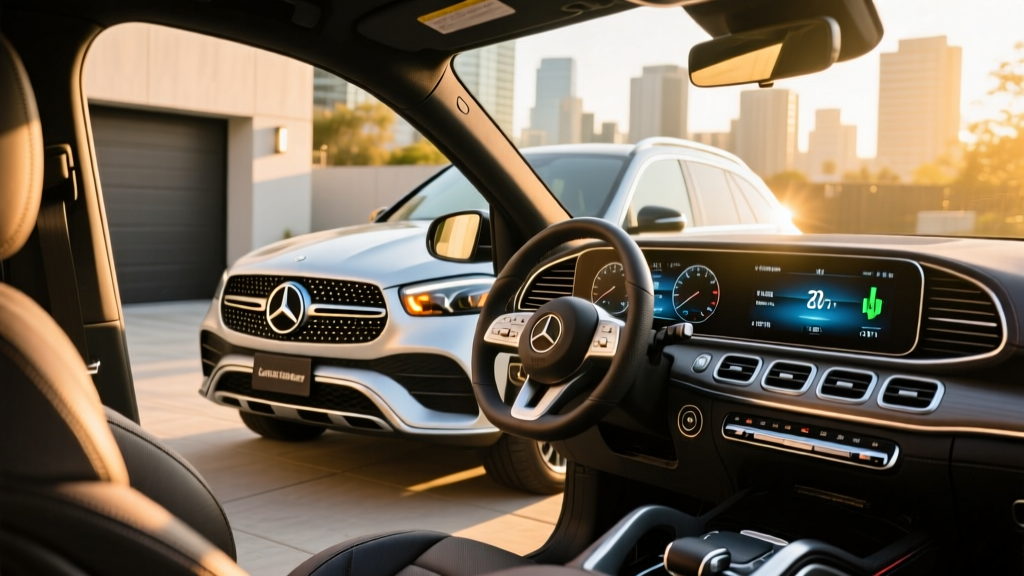
The Mercedes-Benz GLE 450e 4MATIC occupies a specific niche: a midsize luxury SUV that can handle daily commutes on electricity alone while retaining a gas engine for road trips. For buyers weighing the Mercedes-Benz GLE plug-in hybrid against full electric alternatives or conventional hybrids, the math comes down to commute distance, home charging access, and whether the luxury PHEV premium pays off in fuel savings and refinement.
This review covers the current-generation GLE 450e's electric range, fuel economy, powertrain specs, charging requirements, and ownership economics — with real-world expectations rather than just brochure numbers.
GLE Plug-In Hybrid Specs at a Glance
| Specification | 2025–2026 GLE 450e 4MATIC |
|---|---|
| EPA Electric-Only Range | 45 miles |
| EPA Combined MPGe (Electric + Gas) | 56 MPGe |
| EPA MPG (Gas Only, Charge-Depleted) | 23 city / 25 highway / 24 combined |
| Total Combined Range | |
| Battery Capacity (Usable) | 23.3 kWh (lithium-ion NMC) |
| AC Charging (Level 2) | 7.4 kW onboard charger |
| DC Fast Charging | Not available |
| Level 2 Charge Time (0–100%) | ~3.5 hours |
| Combined Horsepower | 381 hp / 479 lb-ft torque |
| Engine | 2.0L turbocharged inline-4 + electric motor |
| 0–60 mph | 5.5 seconds |
| Base MSRP | ~$74,050 |
| Federal §30D Tax Credit | Not eligible (battery sourcing) |
Understanding the GLE 450e: PHEV vs. Conventional Hybrid
The GLE 450e is a plug-in hybrid electric vehicle (PHEV), not a conventional hybrid (HEV). The distinction matters for ownership:
- Conventional Hybrid (HEV): A small battery recharges via regenerative braking and the engine. No plug, no electric-only range beyond a mile or two at low speed. Think Toyota RAV4 Hybrid.
- Plug-In Hybrid (PHEV): A larger battery (23.3 kWh usable in the GLE 450e) charges from a wall outlet or Level 2 charger, enabling substantial electric-only driving — 45 EPA-rated miles here — before the gas engine activates.
- Full EV (BEV): No gas engine. All propulsion from a large battery (typically 75–110 kWh). Requires regular charging.
The GLE lineup does not offer a conventional HEV variant in the US market. The choice is between the GLE 450e PHEV, the mild-hybrid GLE 350/450 (which use a 48-volt system for minor efficiency assists but cannot drive on electric power alone), or a full EV like the Mercedes EQE SUV.
Electric-Only Range: 45 EPA Miles in Practice
EPA Rating: 45 miles electric-only
Real-World Expectation: 35–42 miles in mixed driving; 30–35 miles at sustained highway speeds (70+ mph) or in cold weather (below 40°F). The GLE 450e's electric motor produces 134 hp on its own, adequate for city and suburban driving but the engine will engage under hard acceleration or when climate control demands significant heat in winter.
Mercedes integrates the electric motor into the transmission housing, meaning the transition between electric and gas power is generally seamless. The SUV defaults to EV mode at startup and holds it until the battery depletes or the driver demands full power. A "Battery Hold" mode preserves charge for later use — useful if you're driving to a city center where you want zero-emission operation.
For a 30-mile round-trip commute with home charging, the GLE 450e can operate as an EV Monday through Friday, burning zero gasoline. Weekend road trips use the 2.0L turbo engine with no range anxiety. This dual personality is the PHEV value proposition.
Fuel Economy: EPA Numbers and Real-World MPG
| Driving Mode | City | Highway | Combined |
|---|---|---|---|
| Charge-Depleted (Gas Only) | 23 MPG | 25 MPG | 24 MPG |
| Charge-Sustaining (Hybrid Mode) | ~25 MPG | ~27 MPG | ~26 MPG |
| MPGe (Electric + Gas Combined) | 56 MPGe | ||
The 56 MPGe figure applies when you're regularly charging and using electric miles. MPGe (miles per gallon equivalent) converts electricity consumption into a gasoline-equivalent metric. Once the battery depletes, you're looking at 23–24 MPG combined — respectable for a 5,400-pound luxury SUV but not dramatically better than the mild-hybrid GLE 450's ~22 MPG combined.
The real-world MPG story: If you charge nightly and your daily driving stays under 45 miles, your effective fuel consumption could approach zero gasoline for weeks. If you never charge, you're carrying 500+ pounds of battery and motor weight for no benefit, getting slightly worse fuel economy than a lighter gas-only SUV. PHEVs reward disciplined charging habits.
According to fueleconomy.gov, the GLE 450e's annual fuel cost is estimated at $1,550 assuming 15,000 miles/year, 55% highway, and regular charging. Without charging, that figure climbs to approximately $2,800/year.
Powertrain: 381 Combined Horsepower
The GLE 450e pairs a 2.0-liter turbocharged inline-four (208 hp, 236 lb-ft) with an electric motor integrated into the 9-speed automatic transmission (134 hp, 325 lb-ft). Combined output reaches 381 hp and 479 lb-ft of torque, routed through Mercedes' 4MATIC all-wheel-drive system.
The result is a 5.5-second 0–60 mph time — quicker than the base GLE 350 (6.8 seconds) and competitive with the six-cylinder GLE 450 mild-hybrid. The electric motor's instant torque gives strong off-the-line acceleration, and the powertrain is notably refined in EV mode with zero engine noise at low speeds.
One engineering trade-off: the 2.0L four-cylinder lacks the smoothness of Mercedes' inline-six when the engine does activate. It's not coarse, but buyers accustomed to six-cylinder luxury SUVs may notice the difference under hard acceleration.
Charging the GLE 450e: Level 2 Only
| Charging Level | Power | 0–100% Time | Miles of EV Range per Hour |
|---|---|---|---|
| Level 1 (120V household outlet) | ~1.4 kW | ~17 hours | ~3 miles/hr |
| Level 2 (240V home/public) | 7.4 kW (max) | ~3.5 hours | ~13 miles/hr |
| DC Fast Charging | Not supported | ||
The GLE 450e's 7.4 kW onboard charger is adequate for overnight home charging but limits public Level 2 utility — you won't fully recharge during a two-hour shopping trip. The absence of DC fast charging is a notable limitation for a 2026 vehicle in this price class. Competitors like the BMW X5 xDrive50e offer optional DC fast charging at up to 50 kW.
Home charging setup: A Level 2 home charger (240V, 32-amp minimum) is strongly recommended. With a 7.4 kW acceptance rate, a standard 48-amp Level 2 unit like the ChargePoint Home Flex or Emporia Level 2 will max out the GLE's charging capability. Expect a full charge in roughly 3.5 hours — plug in when you get home, and the battery is full well before morning.
Level 1 charging from a standard 120V outlet technically works but is impractical as a primary strategy: 17 hours for a full charge means you'll rarely start the day with a complete battery unless your daily driving is minimal.
Pricing, Trims, and Tax Credit Eligibility
The GLE 450e 4MATIC starts at approximately $74,050 (including destination), placing it $8,000–$10,000 above the mild-hybrid GLE 350 4MATIC. Standard equipment includes MBUX infotainment with dual 12.3-inch displays, leatherette upholstery, heated front seats, and a comprehensive suite of driver-assistance features.
Common option packages (Premium Package, AMG Line exterior, Driver Assistance Package) can push a well-equipped GLE 450e to $85,000–$92,000.
Federal §30D Tax Credit Status: Not Eligible
The GLE 450e does not qualify for the federal $7,500 Clean Vehicle Credit under current IRS rules. The primary barrier is battery component and critical mineral sourcing requirements — the battery cells do not meet the North American manufacturing thresholds mandated by the Inflation Reduction Act.
- MSRP Cap ($80,000 for SUVs): ✓ Passes at base price
- Buyer Income Cap ($300K joint / $150K single): Varies by buyer
- Battery Component Manufacturing: ✗ Does not meet requirement
- Critical Minerals Sourcing: ✗ Does not meet requirement
Check the latest eligibility list at fueleconomy.gov or consult a tax professional, as sourcing rules update periodically.
Some states offer separate PHEV incentives. California's Clean Vehicle Rebate, for example, has historically offered $1,000–$1,500 for qualifying PHEVs, though program availability varies by funding cycle. Check your state's energy office for current programs.
Battery Warranty, Reliability, and Replacement Cost
High-Voltage Battery Warranty: 6 years / 62,000 miles (whichever comes first) for capacity below 70% of original.
Powertrain Warranty: 4 years / 50,000 miles
Limited Vehicle Warranty: 4 years / 50,000 miles
Mercedes' high-voltage battery warranty is shorter than some competitors — BMW covers PHEV batteries for 8 years/80,000 miles, and Toyota covers hybrid batteries for 10 years/150,000 miles. The 6-year/62,000-mile coverage is the minimum acceptable for a vehicle in this price range.
Battery degradation reality: PHEV batteries experience more charge cycles than full EV batteries because the usable window is smaller (you cycle through the 23.3 kWh pack more frequently). However, Mercedes engineers in a buffer — approximately 2–3 kWh at the top and bottom of the pack — to reduce stress on cells. Expect 8–12% capacity loss over 8–10 years based on industry data from similar NMC chemistry PHEV packs. A degraded pack might deliver 36–40 electric miles instead of 45.
Replacement cost: Out-of-warranty high-voltage battery replacement for the GLE 450e is estimated at $12,000–$18,000 including parts and labor. This is a worst-case scenario — most PHEV batteries outlast the vehicle's ownership cycle. Mercedes has not published an official replacement figure; the estimate is based on comparable luxury PHEV battery costs and dealer service bulletins.
Reliability data: The current-generation GLE (V167 platform, introduced 2019, refreshed 2024) has average reliability ratings from J.D. Power and Consumer Reports. The PHEV powertrain adds complexity (electric motor, power electronics, charging system) compared to the mild-hybrid variants, but the 2.0L turbo engine is a well-established Mercedes unit. Common complaints in the GLE line relate to MBUX software glitches and air suspension issues — neither specific to the PHEV.
GLE 450e vs. Full EV vs. Gas: Which Fits Your Life?
Choose the GLE 450e PHEV if:
- Your daily commute is under 40 miles round-trip and you can charge at home
- You want electric daily driving but take road trips where charging infrastructure is sparse
- You want one vehicle for both city EV driving and long-distance capability
- You value the GLE's interior quality, ride comfort, and brand prestige
Choose a full EV (like the EQE SUV or BMW iX) if:
- You have reliable home charging and your trips rarely exceed 250 miles
- You want zero maintenance on engine, transmission, and exhaust components
- You want to qualify for the $7,500 federal tax credit (many EVs qualify; this PHEV does not)
- You want lower per-mile "fuel" costs — electricity at $0.14/kWh is ~$0.04/mile vs. $0.15/mile for gas
Choose the gas/mild-hybrid GLE 450 if:
- You cannot install a Level 2 home charger (apartment, no garage, electrical panel limitations)
- Your daily driving regularly exceeds 50 miles, negating the PHEV advantage
- You want the smoothness of the inline-six engine (GLE 450 mild-hybrid)
- You want a lower purchase price — the GLE 350 starts ~$10,000 less
Pros and Cons: Living with the GLE 450e
Pros
- 45-mile EV range covers most daily commutes entirely on electricity
- 381 combined hp provides confident acceleration
- Seamless transitions between electric and gas power
- Quiet, refined EV-mode driving around town
- Full GLE interior quality, cargo space, and tech features retained
- No range anxiety for road trips — 460-mile total range
Cons
- No DC fast charging — a significant omission at this price
- Does not qualify for $7,500 federal tax credit
- Battery warranty (6 yr/62K mi) is shorter than key competitors
- $10,000 premium over mild-hybrid GLE 350 takes years to recoup in fuel savings
- 2.0L four-cylinder less refined than inline-six when engine engages
- Charge-depleted MPG (23–24) is only marginally better than gas-only GLE
5-Year Cost of Ownership Snapshot
| Cost Factor | GLE 450e PHEV | GLE 450 Mild-Hybrid |
|---|---|---|
| Purchase Price (base) | $74,050 | $66,250 |
| Federal Tax Credit | $0 | $0 |
| Fuel (5 yr, 15K mi/yr, regular charging) | ~$4,200 | ~$11,500 |
| Home Charger Installation | ~$1,200 | $0 |
| Maintenance (5 yr) | ~$3,800 | ~$4,500 |
| Estimated Depreciation (5 yr) | ~$32,000 | ~$28,000 |
| Estimated 5-Year Total | ~$115,250 | ~$110,250 |
The PHEV saves roughly $7,300 in fuel over five years but costs $7,800 more upfront plus ~$1,200 for home charging installation. The net result: the GLE 450e costs approximately $5,000 more to own over five years at base pricing. The PHEV only breaks even if gas prices rise significantly above $4/gallon or if you secure a state incentive.
The ownership equation shifts if you value the EV driving experience itself — silent, smooth, instant-torque commutes have a quality-of-life benefit that doesn't appear on a spreadsheet.
Frequently Asked Questions
How many MPG does the Mercedes-Benz GLE plug-in hybrid get?
The GLE 450e is rated at 56 MPGe when combining electric and gas driving. Once the battery depletes, it returns 23 city / 25 highway / 24 combined MPG on gasoline alone. Real-world charge-depleted MPG averages 22–26 depending on driving style and terrain.
How far can the GLE 450e go on electric only?
The EPA rates the GLE 450e at 45 miles of electric-only range. In real-world conditions — highway speeds, cold weather, or aggressive acceleration — expect 30–42 miles before the gas engine engages.
Does the GLE plug-in hybrid qualify for a federal tax credit?
No. The GLE 450e does not qualify for the $7,500 federal §30D Clean Vehicle Credit because its battery components and critical minerals do not meet current North American sourcing requirements. Always verify current status at fueleconomy.gov as rules update periodically.
Can the GLE 450e DC fast charge?
No. The GLE 450e only supports AC charging at up to 7.4 kW via Level 2. A full charge takes approximately 3.5 hours. There is no DC fast charging capability, which limits the usefulness of public charging stations during road trips.
Is the GLE plug-in hybrid reliable, and what does battery replacement cost?
The GLE 450e has average reliability ratings for its class. The high-voltage battery is warrantied for 6 years/62,000 miles (70% capacity retention). Out-of-warranty battery replacement is estimated at $12,000–$18,000. Most PHEV batteries last 10–15 years before significant degradation.
Should I get the GLE PHEV or a full electric SUV?
If you can charge at home and your daily driving is under 40 miles, the GLE 450e lets you drive electric daily while keeping gas capability for road trips. If you rarely exceed 250 miles between charges and want lower operating costs plus federal tax credit eligibility, a full EV like the EQE SUV or BMW iX may be a better financial choice.
Do I need to charge the GLE 450e every night?
For maximum benefit, yes. Charging nightly ensures you start each day with a full 45-mile EV range. If you skip charging, the vehicle operates as a heavier, less efficient hybrid — negating the PHEV's purpose. Level 2 home charging is strongly recommended; Level 1 (120V) is too slow for practical daily use.