Quick Verdict: The GLE 450e Bridges Luxury and Electrification
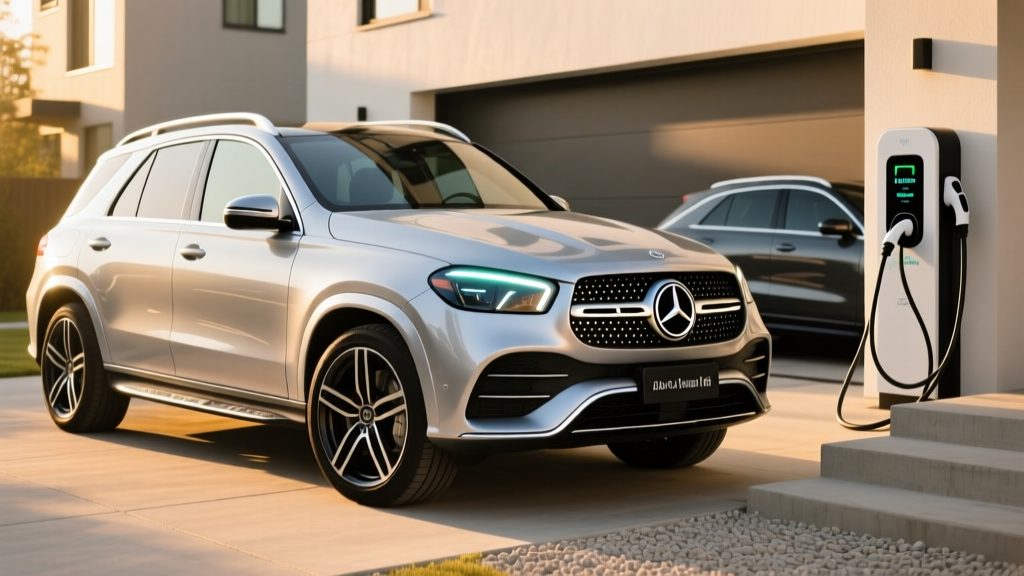
The 2026 Mercedes-Benz GLE 450e 4MATIC plug-in hybrid (PHEV) targets a specific buyer: someone who wants a premium midsize SUV with genuine electric-only commuting capability, but isn't ready to commit to a full battery-electric vehicle (BEV) for longer road trips. With an EPA-estimated 48 miles of electric range, a combined 375 horsepower, and the ability to run entirely on gasoline when the battery depletes, it occupies a practical middle ground.
But middle grounds have trade-offs. The GLE 450e carries a heavier curb weight than its gas-only sibling, its cargo space is slightly compromised by the battery pack, and its $7,500 federal tax credit eligibility hinges on battery sourcing rules that have tightened significantly. Let's break down every number that matters.
GLE 450e Full Specification Table
| Specification | 2026 Mercedes-Benz GLE 450e 4MATIC |
|---|---|
| Powertrain | 2.0L turbocharged I4 + electric motor (PHEV) |
| Combined Horsepower | 375 HP / 479 lb-ft torque |
| Battery (Usable) | 23.3 kWh (lithium-ion, NMC chemistry) |
| EPA Electric Range | 48 miles |
| EPA MPGe (Electric + Gas) | 56 MPGe combined |
| EPA MPG (Gas Only, Battery Depleted) | 23 city / 27 highway / 25 combined |
| Total Combined Range | ~440 miles (electric + gasoline) |
| Level 2 AC Charging (Max) | 7.4 kW (onboard charger) |
| DC Fast Charging | Not available |
| Level 2 Charge Time (0–100%) | ~3.5 hours |
| 0–60 mph | 5.6 seconds |
| Drivetrain | 4MATIC all-wheel drive |
| Towing Capacity | 5,500 lbs (properly equipped) |
| Cargo Volume (Behind 2nd Row) | 28.2 cu ft |
| Base MSRP | $65,750 (before destination) |
| Battery Warranty | 6 years / 62,000 miles (high-voltage) |
| Powertrain Warranty | 4 years / 50,000 miles |
Electric Range, MPGe, and Gas-Only MPG: The Real Numbers
Real-World Expectation: 38–44 miles in mixed driving; as low as 32 miles in cold weather (below 40°F) or sustained highway speeds above 70 mph. Expect closer to 46 miles in mild-weather city commuting where regenerative braking recaptures energy.
The EPA rates the GLE 450e at 48 miles of electric-only range, which covers most daily commutes without burning a drop of gasoline. That range figure assumes moderate temperatures, mixed city/highway driving, and speeds under 65 mph. In practice, PHEVs lose electric range faster than BEVs in cold weather because cabin heating draws from the same battery, and there's no dedicated heat pump on the 450e as there is on Mercedes' full EVs like the EQE SUV.
Fuel Economy Breakdown
| Driving Mode | City | Highway | Combined |
|---|---|---|---|
| Electric (MPGe) | 58 MPGe | 54 MPGe | 56 MPGe |
| Gas Only (Battery Depleted) | 23 MPG | 27 MPG | 25 MPG |
When the battery is depleted and the GLE operates as a conventional hybrid, the 2.0-liter turbo four-cylinder returns a respectable 25 MPG combined. That's notably better than the gas-only GLE 350's 22 MPG combined, thanks to the electric motor assisting during acceleration and regenerative braking recovering energy in stop-and-go traffic. Source: EPA Fuel Economy.
Real-world MPG note: PHEVs reward city driving. If your daily routine involves heavy traffic and frequent stops, you'll see gas-only MPG closer to 27–28 in the city because regen braking recharges the battery more effectively. Highway-only drivers who rarely plug in may see 22–23 MPG combined — the heavy battery pack works against efficiency once the electric advantage is gone.
HEV vs. PHEV: What's the Difference and Why It Matters for the GLE
Mercedes does not currently offer the GLE as a conventional hybrid (HEV) in the U.S. market — the 450e is strictly a plug-in hybrid. But understanding the distinction is essential if you're cross-shopping:
Conventional Hybrid (HEV)
- No plug — recharges via regenerative braking and engine
- Small battery (~1–2 kWh)
- Electric-only range: 0–2 miles at low speeds
- Improves MPG by 20–40% vs gas-only
- No federal tax credit
- Example: Toyota Highlander Hybrid
Plug-In Hybrid (PHEV)
- Plugs in to recharge — also uses regen and engine
- Larger battery (15–30+ kWh)
- Electric-only range: 25–50+ miles
- Can drive weeks without gasoline on short commutes
- May qualify for federal/state incentives
- Example: Mercedes GLE 450e
The GLE 450e's 23.3 kWh battery is large enough for genuine daily electric commuting. If you can charge at home or work, you may use gasoline only for road trips exceeding 48 miles. If you never plug in, you're carrying 500+ lbs of battery weight for no benefit — making the gas-only GLE 350 a more efficient choice for that use case.
Charging the GLE 450e: Level 2 Only, No DC Fast Charging
The GLE 450e comes equipped with a 7.4 kW onboard charger, which means Level 2 charging at home or at public stations. Here's the charging reality:
| Charging Level | Power | Time (0–100%) | Availability |
|---|---|---|---|
| Level 1 (120V household outlet) | ~1.4 kW | ~17 hours | Any standard outlet |
| Level 2 (240V home/public) | 7.4 kW (max) | ~3.5 hours | Home wallbox, public stations |
| DC Fast Charging | N/A | N/A | Not supported |
No DC fast charging is a deliberate limitation. Mercedes reserves DC fast-charging capability for its full BEV lineup and some higher-tier PHEVs in other markets. For the GLE 450e, you'll rely on overnight home charging (a Level 2 wallbox is strongly recommended) or opportunistic Level 2 top-ups at shopping centers and workplaces.
At 7.4 kW, a full charge from empty takes roughly 3.5 hours. In practice, most owners will plug in overnight and wake to a full battery every morning — which is the intended PHEV workflow. A 240V / 32-amp home circuit is sufficient to deliver the full 7.4 kW.
Powertrain Performance: 375 HP with Seamless Handoff
The GLE 450e pairs a 2.0-liter turbocharged inline-four (producing roughly 255 HP on its own) with an electric motor integrated into the 9-speed automatic transmission housing. Combined output is 375 HP and 479 lb-ft of torque, delivered to all four wheels via 4MATIC all-wheel drive.
The 0–60 mph sprint takes 5.6 seconds — meaningfully quicker than the gas-only GLE 350's 6.8-second run. The electric motor's instant torque fills in the low-RPM gap before the turbo spools, giving the 450e a responsive, confident feel from a stop. The transition between electric and gas power is well-managed; most drivers won't notice the handoff unless the engine kicks in under hard acceleration.
Multiple drive modes let you control how the powertrain behaves: Electric mode forces battery-only operation (up to 48 miles), Hybrid mode lets the car decide optimally, and Battery Hold preserves charge for later use — useful if you're driving on the highway and want to save electric range for city driving at your destination.
Pricing, Trims, and Federal Tax Credit Eligibility
The 2026 GLE 450e 4MATIC starts at $65,750 (plus $1,150 destination), placing it between the gas-only GLE 350 (~$61,000) and the six-cylinder GLE 450 (~$68,000). Key option packages — the AMG Line exterior, Premium Package with 360° cameras, and the MBUX augmented-reality navigation — can push a well-equipped 450e past $78,000.
Federal Tax Credit: §30D Eligibility
- MSRP cap: SUVs/vans must be under $80,000 MSRP. The GLE 450e base qualifies, but heavily optioned examples may exceed the cap.
- Buyer income cap: Modified AGI must not exceed $150,000 (single) / $300,000 (joint).
- Battery sourcing: A percentage of critical minerals and battery components must be sourced from the U.S. or free-trade-agreement countries. Mercedes has not publicly confirmed that the GLE 450e's battery meets 2026 sourcing thresholds.
- Point-of-sale transfer: If eligible, the credit can be applied at the dealership to reduce your purchase price directly.
Because the GLE 450e's battery is assembled outside the U.S. (Mercedes sources PHEV battery packs from facilities in Europe and Asia), the critical-minerals and battery-component requirements under §30D may disqualify it from the full $7,500 credit — or any credit at all — depending on the model year's specific sourcing. This is the single most important factor to verify with your dealer and a tax professional before assuming you'll receive the incentive.
Battery Warranty, Reliability, and Long-Term Ownership Costs
Powertrain Warranty: 4 years / 50,000 miles
Battery Replacement Cost (estimated): $12,000–$18,000 out of warranty
Mercedes provides a 6-year/62,000-mile warranty on the GLE 450e's high-voltage battery, which is shorter than the 8-year/100,000-mile standard you'll find on most full BEVs (including the Tesla Model X and BMW iX). The warranty covers defects and capacity loss below a specified threshold (typically 70% state of health), but normal degradation over time may not be covered.
Real-world PHEV battery degradation data from similar Mercedes systems (like the older GLE 350e) suggests owners can expect 85–90% battery capacity retention after 5 years of daily charging cycles. The 23.3 kWh pack uses NMC (nickel-manganese-cobalt) chemistry, which offers good energy density but is more susceptible to calendar degradation than LFP chemistry. To maximize longevity:
- Avoid routinely charging to 100% unless you need full range — the car's battery management system includes a buffer, but habitual full charges accelerate wear.
- Minimize exposure to extreme heat (prolonged parking in direct summer sun).
- Use the car's built-in charge scheduling to avoid sitting at 100% SoC overnight.
Mercedes-Benz reliability ratings from IIHS and owner surveys place the GLE near the luxury-SUV median. The PHEV powertrain adds complexity (two power sources, additional cooling circuits, high-voltage components), which historically translates to higher repair costs out of warranty compared to simpler gas-only drivetrains.
GLE 450e vs. Full EV vs. Gas: Which Should You Choose?
Choose the GLE 450e PHEV If:
- Your daily commute is under 45 miles round-trip
- You can charge at home (garage or driveway with 240V)
- You take 3+ road trips per year and don't want to plan around charging
- You want luxury and towing (5,500 lbs) without full-BEV range anxiety
- You want to reduce gasoline use by 60–80% without going fully electric
Choose a Full EV (e.g., BMW iX, Tesla Model X) If:
- You can charge at home AND have reliable public DC fast-charging access
- You want zero gasoline, zero oil changes, and minimal drivetrain maintenance
- Your daily driving is under 250 miles and you road-trip fewer than 5 times/year
- You want the lowest per-mile fuel cost (~$0.04/mile on home electricity vs ~$0.15/mile on gas)
- You want a longer battery warranty (typically 8 years/100,000 miles)
Choose the Gas-Only GLE 350 If:
- You cannot charge at home (apartment, street parking, no garage)
- Your commute exceeds 50 miles and is mostly highway
- You want the lowest purchase price and simplest maintenance
- You drive fewer than 8,000 miles per year (fuel savings won't offset PHEV premium)
Pros and Cons at a Glance
Pros
- 48-mile electric range covers most daily commutes
- 375 HP provides confident acceleration (5.6s 0–60)
- Seamless gas/electric transitions
- 5,500-lb towing capacity (rare for PHEVs)
- 25 MPG gas-only is solid for a 5,000+ lb luxury SUV
- Premium interior with latest MBUX
Cons
- No DC fast charging — Level 2 only
- 6-year battery warranty is shorter than BEV standards
- Federal tax credit eligibility uncertain due to battery sourcing
- $65,750 starting price is steep before options
- Cargo space reduced vs gas GLE (28.2 vs 33.3 cu ft)
- Heavy curb weight (~5,400 lbs) affects handling
Frequently Asked Questions
How many MPG does the Mercedes GLE plug-in hybrid get?
The 2026 GLE 450e is rated at 56 MPGe combined when operating in electric-assisted mode, and 25 MPG combined (23 city / 27 highway) when running on gasoline alone after the battery is depleted. Real-world results vary: city drivers who plug in regularly may use almost no gasoline, while highway-heavy drivers who never charge may see 22–23 MPG.
How far can the GLE 450e go on electric only?
The EPA rates it at 48 miles of electric-only range. In real-world conditions, expect 38–44 miles in mixed driving, and as low as 32 miles in cold weather or at sustained highway speeds. This is sufficient for most daily commutes under 45 miles round-trip.
Does the GLE plug-in hybrid qualify for the $7,500 federal tax credit?
Possibly, but not guaranteed. The GLE 450e meets the MSRP cap (under $80,000 for SUVs) and buyer income limits may apply. However, the battery's critical-mineral and component sourcing must meet §30D thresholds, and Mercedes has not confirmed full compliance for the 2026 model year. Verify at IRS.gov and with your dealer before assuming eligibility.
Is the GLE 450e reliable, and what does battery replacement cost?
Mercedes PHEV systems have proven moderately reliable, with the main concern being long-term battery degradation. The high-voltage battery is warranted for 6 years/62,000 miles. Out-of-warranty replacement is estimated at $12,000–$18,000 based on current parts pricing for comparable Mercedes PHEV packs. Most owners report 85–90% battery capacity after 5 years of daily charging.
Can the GLE 450e DC fast charge?
No. The GLE 450e supports only Level 1 (120V) and Level 2 (240V) AC charging, with a maximum onboard charger rate of 7.4 kW. A full Level 2 charge takes approximately 3.5 hours. DC fast charging is not available on this model.
How much does it cost to charge the GLE 450e at home?
Filling the 23.3 kWh battery from empty at the U.S. average residential electricity rate of ~$0.16/kWh costs approximately $3.73. That delivers roughly 48 miles of range — equivalent to about $0.08 per mile on electricity, compared to roughly $0.15–$0.18 per mile on premium gasoline at $4.00/gallon and 25 MPG.