Quick Verdict: The GLE 450e PHEV Bridges Luxury and Electrification
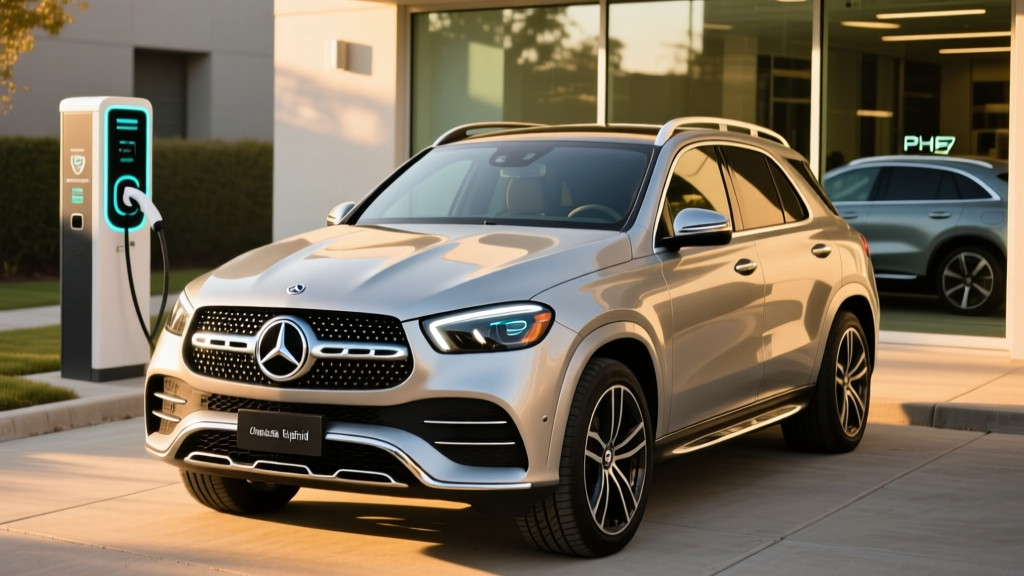
The 2026 Mercedes-Benz GLE 450e 4MATIC plug-in hybrid (PHEV) occupies a specific niche: buyers who want a premium midsize SUV with genuine electric-only commuting capability but aren't ready to commit to a fully electric vehicle like the EQE SUV. With an EPA-rated 48 miles of electric-only range, 375 combined horsepower, and a starting MSRP around $67,550, the GLE hybrid targets affluent commuters who can charge at home and want to eliminate daily gasoline use without sacrificing the cargo space, towing capacity, and road-trip flexibility of a traditional SUV.
This guide covers the GLE 450e PHEV exclusively. Mercedes-Benz does not currently offer a conventional hybrid (HEV) version of the GLE for the U.S. market — if you see "GLE hybrid" referenced without the plug-in distinction, it almost certainly refers to this PHEV. We'll break down the real-world efficiency, charging logistics, powertrain specs, tax credit eligibility under current IRS §30D rules, and battery longevity so you can make an informed purchase decision.
HEV vs PHEV: What the GLE Hybrid Actually Is
Before evaluating the GLE 450e, it's critical to understand the two hybrid architectures available across the auto industry, because the distinction affects your daily routine, fuel costs, and tax credit eligibility.
Conventional Hybrid (HEV)
- Small battery (typically 1-2 kWh), charged only by regenerative braking and the engine
- No plug — you never charge it externally
- Electric-only range: less than 1 mile, if any
- Fuel economy boost: 20-40% better than a comparable gas car
- No federal tax credit eligibility
- Example: Toyota Highlander Hybrid
Plug-In Hybrid (PHEV) — GLE 450e
- Larger battery (23.3 kWh usable in the GLE 450e), charged via plug or engine
- Must plug in to realize the electric-only range and efficiency benefits
- Electric-only range: 48 miles EPA
- After battery depletion, operates as a conventional hybrid using the gas engine
- May qualify for partial or full federal tax credit depending on sourcing and income
- Example: Mercedes-Benz GLE 450e 4MATIC
The GLE 450e is firmly a PHEV. If you cannot charge at home or at work, you will forfeit most of its efficiency advantage and effectively drive a heavy, expensive gas SUV. Plug-in access is non-negotiable for this vehicle to make financial sense.
GLE 450e Powertrain: Engine, Motor, and Combined Output
The 2026 GLE 450e pairs a turbocharged 2.0-liter inline-four gasoline engine with a permanently excited synchronous electric motor integrated into the 9G-TRONIC nine-speed automatic transmission. Here's the complete powertrain breakdown:
| Specification | Value |
|---|---|
| Gas Engine | 2.0L turbocharged inline-4 |
| Engine Output | 255 hp / 295 lb-ft torque |
| Electric Motor Output | 134 hp / 325 lb-ft torque |
| Combined System Output | 375 hp / 480 lb-ft torque |
| Transmission | 9-speed automatic (9G-TRONIC) |
| Drivetrain | 4MATIC all-wheel drive |
| 0-60 mph | 5.6 seconds (manufacturer estimate) |
| Towing Capacity | 7,700 lbs (with trailer hitch package) |
| Battery Chemistry | NMC (nickel manganese cobalt) lithium-ion |
| Battery Capacity (Gross / Usable) | 31.2 kWh gross / 23.3 kWh usable |
| EPA Electric-Only Range | 48 miles |
| EPA Combined MPGe (Electric + Gas) | 56 MPGe |
| EPA MPG (Gas-Only, Battery Depleted) | 23 city / 25 highway / 24 combined |
| Total Combined Range (Est.) | ~480 miles |
| Fuel Tank Capacity | 19.8 gallons |
The 375 combined horsepower figure is competitive with the non-hybrid GLE 450 (which uses a 3.0L turbo I6 with mild-hybrid assist at 375 hp), but the PHEV's 480 lb-ft of torque and instant electric motor response give it noticeably stronger off-the-line acceleration in daily driving. The electric motor's 325 lb-ft is available from zero RPM, which makes city stoplight launches and highway merging feel effortless without the engine even firing.
Fuel Economy: EPA Ratings vs Real-World MPG
PHEV fuel economy is uniquely difficult to summarize because it depends entirely on how often you charge and how far you drive between charges. The EPA provides two separate figures to account for this:
| Driving Mode | City | Highway | Combined |
|---|---|---|---|
| Electric + Gas (MPGe) | — | — | 56 MPGe |
| Gas Only (Battery Depleted) | 23 MPG | 25 MPG | 24 MPG |
Real-World Efficiency Expectations
Electric-only range: The EPA rates the GLE 450e at 48 electric miles. In real-world mixed driving at moderate temperatures (60-75°F), expect 42-46 miles. Highway driving at 70+ mph reduces this to roughly 35-38 miles. In cold weather (below 35°F), battery efficiency drops and cabin heating draws significant power — plan on 30-35 electric miles in winter conditions.
Gas-only MPG: Once the battery is depleted, the 24 MPG combined EPA figure is realistic for mixed driving. Owners who rarely charge report 21-23 MPG in heavy city traffic and 25-27 MPG on steady highway cruises. This is comparable to the non-hybrid GLE 450, which achieves roughly 22 MPG combined — the PHEV carries approximately 300 lbs of extra battery weight, which partially offsets the hybrid system's efficiency gains when running on gas alone.
Best-case scenario: If your round-trip commute is under 45 miles and you charge every night, you may use less than 5 gallons of gasoline per month. Several owner reports on forums indicate achieving the equivalent of 80-100+ MPGe over months of predominantly electric commuting with occasional long gas trips.
Charging the GLE 450e: Level 1, Level 2, and DC Fast Charging
The GLE 450e's 23.3 kWh usable battery requires meaningful charging infrastructure to realize its benefits. Here are the charging specifications and realistic timelines:
| Charging Level | Power (kW) | Connector | 0-100% Time | Miles of Range per Hour |
|---|---|---|---|---|
| Level 1 (120V household) | ~1.4 kW | J1772 | ~17-18 hours | ~3 miles/hr |
| Level 2 (240V home/public) | Up to 7.4 kW | J1772 | ~3.5 hours | ~14 miles/hr |
| DC Fast Charging | Not supported | N/A | N/A | N/A |
The onboard charger maxes out at 7.4 kW on Level 2 AC power, which is typical for PHEVs. The critical limitation: the GLE 450e does not support DC fast charging. This means you cannot top up the battery at a highway rest stop in 15 minutes like you could in a full EV. All charging must happen via AC power — practically, this means at home overnight or at a workplace Level 2 station.
For most PHEV owners, Level 2 home charging is the standard. A 240V Level 2 charger (such as a ChargePoint Home Flex or Mercedes-Benz Wallbox) installed on a 40-amp circuit will fully replenish the battery in roughly 3.5 hours. Even a Level 1 trickle charge from a standard 120V outlet can recover approximately 25-30 miles of range overnight (10-12 hours), which covers many commuters' needs — though it's slow and inefficient.
Mercedes-Benz includes a dual-voltage charging cord with the vehicle that supports both 120V and 240V outlets, but a dedicated Level 2 home station is strongly recommended for daily PHEV use.
Pricing, Trims, and Federal Tax Credit Eligibility
The 2026 GLE 450e 4MATIC starts at an MSRP of approximately $67,550 (including destination charge). Key trim and option considerations:
- Base GLE 450e 4MATIC: ~$67,550 — includes MBUX infotainment, power liftgate, leatherette upholstery, 48V mild-hybrid ancillary systems, and the PHEV powertrain
- Premium Package: ~$3,000 — adds Burmester audio, ambient lighting, enhanced parking assist
- AMG Line Exterior: ~$3,500 — sport styling, larger wheels
- Driver Assistance Package: ~$2,250 — adds adaptive cruise, lane-centering (Level 2 SAE), active blind-spot assist
- Typical well-equipped build: $72,000-$78,000 before incentives
Federal §30D Tax Credit for the GLE 450e PHEV
Under current IRS rules, the GLE 450e may qualify for up to $3,750 in federal tax credit — not the full $7,500 — because the vehicle must meet two separate $3,750 requirements (critical minerals and battery component sourcing), and many European-built PHEVs only satisfy one as of the 2026 model year. Key eligibility criteria:
- MSRP cap: SUVs must be under $80,000 MSRP — the base GLE 450e qualifies, but heavily optioned builds may exceed the cap. Verify your exact configuration.
- Buyer income cap: Adjusted gross income must not exceed $150,000 (single), $225,000 (head of household), or $300,000 (married filing jointly).
- Battery sourcing: Critical minerals and battery components must meet phased-in domestic/free-trade-agreement sourcing thresholds. Mercedes-Benz has been working to comply, but eligibility can change mid-year.
- Point-of-sale transfer: As of 2024, buyers can transfer the credit to the dealer at purchase for an immediate price reduction, rather than waiting to claim it on their tax return.
- Final assembly: Must occur in North America. The GLE for the U.S. market is assembled in Tuscaloosa, Alabama, which satisfies this requirement.
Always verify current eligibility on the official IRS Clean Vehicle Credits page and confirm with your dealer before purchase. Rules change frequently, and the credit amount can vary by production batch and model year.
Many states also offer additional PHEV incentives — California's CVRP program, Colorado's state tax credit, and various utility rebates can stack on top of the federal credit. Check your state's energy office and local utility for current programs.
Battery Warranty, Reliability, and Replacement Cost
Mercedes-Benz High-Voltage Battery Warranty
Mercedes-Benz covers the GLE 450e's high-voltage battery for 6 years or 62,000 miles (whichever comes first) against defects and capacity loss below 70% of original capacity. This is notably shorter than the 8-year/100,000-mile warranty common among competitors like Toyota, Hyundai, and BMW. Some states with California Air Resources Board (CARB) emissions requirements mandate extended hybrid battery warranties of 10 years/150,000 miles — check your state's regulations.
Mercedes also offers an optional Extended Limited Warranty that can extend coverage up to 10 years, which is worth considering at purchase for long-term ownership peace of mind.
Reliability: The GLE platform has been in production since 2019 (current W167/V167 generation), and the PHEV powertrain has been on sale in Europe since 2020 and in the U.S. since the 2024 model year. Long-term reliability data for the 450e specifically is still accumulating. Mercedes-Benz's overall brand reliability ratings from Consumer Reports and J.D. Power remain mid-pack to below-average for the luxury segment, which is a consideration. The 9G-TRONIC transmission and M254 turbo engine are proven components, but the complex integration of high-voltage systems adds potential failure points that don't exist in a conventional GLE.
Battery replacement cost: If the high-voltage battery requires replacement outside of warranty, expect a cost between $12,000 and $18,000 for the battery pack plus labor, based on current Mercedes-Benz parts pricing. This is a significant expense and underscores the importance of either purchasing within the warranty period or securing extended coverage. Individual module replacement may be possible at lower cost if only a portion of the pack degrades, but this depends on dealer capability and parts availability.
12V battery note: Like all modern Mercedes vehicles, the GLE 450e has a conventional 12V lithium auxiliary battery (separate from the high-voltage traction battery) that powers electronics, lights, and control modules. This battery typically lasts 4-6 years and costs approximately $400-$600 to replace.
Who Should Buy the GLE 450e PHEV — and Who Shouldn't
Choose the GLE 450e PHEV If:
- Your daily round-trip commute is under 45 miles and you can charge at home every night
- You want a luxury midsize SUV with towing capability (7,700 lbs) that a full EV like the EQE SUV can't match at this price point
- You take 2-4 long road trips per year and don't want to plan around DC fast-charging infrastructure
- You value the instant torque and quiet electric driving experience but need the security of a gas engine for range flexibility
- You want to reduce (not eliminate) your gasoline consumption and carbon footprint
Choose a Full EV (e.g., BMW iX, Mercedes EQE SUV) If:
- You want zero gasoline use and zero oil changes
- You have reliable home charging and access to DC fast chargers for road trips
- You want lower long-term maintenance costs (no engine, transmission fluid, spark plugs)
- Your state offers significant EV-only incentives that PHEVs don't qualify for
Choose a Conventional Hybrid (e.g., BMW X5 xDrive50e alternative, Lexus TX 500h) If:
- You cannot charge at home or at work — a conventional HEV doesn't need a plug
- You want simpler ownership with no high-voltage battery charging logistics
- You primarily drive long distances where PHEV electric range provides minimal benefit
Choose the Gas-Only GLE 450 If:
- You drive fewer than 8,000 miles per year and the fuel savings don't justify the PHEV price premium
- You have no access to any charging infrastructure
- You prefer the lighter weight and slightly more cargo space of the non-hybrid platform
Pros
- 48-mile EPA electric range covers most daily commutes without gasoline
- 375 hp and 480 lb-ft provide confident acceleration and highway merging
- 7,700-lb towing capacity — rare for a PHEV in this class
- Quiet, smooth electric-only driving in stop-and-go traffic
- Mercedes MBUX infotainment and build quality remain class-leading
- North American assembly (Alabama) supports §30D final-assembly requirement
Cons
- No DC fast charging — all charging is AC only (Level 1/2)
- Battery warranty of 6yr/62k mi is shorter than competitors' 8yr/100k mi
- Gas-only MPG (24 combined) is unremarkable for a hybrid — weight penalty shows
- High-voltage battery replacement cost ($12k-$18k) is a long-term risk
- Only partial §30D credit eligibility (~$3,750) vs full $7,500 for qualifying EVs
- Electric range drops to ~30-35 miles in cold weather
Frequently Asked Questions
How many MPG does the GLE 450e hybrid get?
The EPA rates the GLE 450e at 56 MPGe combined when using both electric and gas power, and 24 MPG combined (23 city / 25 highway) when running on gasoline alone after the battery is depleted. Real-world results vary significantly based on charging frequency — owners who charge daily and commute under 45 miles may use gasoline only on weekend trips, effectively achieving 80+ MPGe over a month. Those who rarely charge will see 21-24 MPG, similar to a gas-only GLE.
How far can the GLE 450e go on electric power only?
The EPA rates the GLE 450e at 48 miles of electric-only range. Real-world expectations are 42-46 miles in moderate mixed driving, 35-38 miles at sustained highway speeds, and 30-35 miles in cold weather below 35°F. After the battery depletes, the gasoline engine takes over seamlessly, and the vehicle operates as a conventional hybrid with no range limitation beyond its 19.8-gallon fuel tank (~430 additional miles).
Is the GLE 450e a conventional hybrid or a plug-in hybrid?
The GLE 450e is a plug-in hybrid (PHEV). It must be plugged into an external power source (Level 1 or Level 2 charger) to achieve its 48-mile electric-only range. Without plugging in, it functions as a conventional hybrid with regenerative braking, but you'll sacrifice the primary efficiency and cost-saving benefit of the vehicle. Mercedes-Benz does not offer a non-plug-in HEV version of the GLE in the U.S. market.
Does the GLE 450e qualify for the federal tax credit?
The GLE 450e may qualify for up to $3,750 under the IRS §30D Clean Vehicle Credit — not the full $7,500 — because it must meet both critical minerals and battery component sourcing requirements, and European-sourced battery components may not fully satisfy both thresholds. Eligibility also depends on your income (under $150k single / $300k joint), the vehicle's MSRP (under $80,000 for SUVs), and final assembly location (the U.S.-built GLE satisfies this). Always verify on IRS.gov before purchase, as rules change periodically.
How reliable is the GLE 450e and what does battery replacement cost?
The GLE 450e's powertrain components (M254 engine, 9G-TRONIC transmission) are proven, but long-term reliability data for the PHEV system specifically is still limited given its 2024 U.S. launch. Mercedes-Benz covers the high-voltage battery for 6 years/62,000 miles against defects and capacity loss below 70%. Out-of-warranty battery replacement is estimated at $12,000-$18,000. Consider purchasing an extended warranty if you plan to own the vehicle beyond 6 years. The brand's overall reliability ratings remain mid-pack in the luxury segment per Consumer Reports and J.D. Power.
Can the GLE 450e DC fast charge?
No. The GLE 450e only supports AC charging via Level 1 (120V, ~1.4 kW) or Level 2 (240V, up to 7.4 kW). It cannot use DC fast chargers (CCS, NACS, or CHAdeMO). A full charge on Level 2 takes approximately 3.5 hours. This is standard for most PHEVs — only a handful of PHEVs on the market (such as the Mitsubishi Outlander PHEV) offer DC fast charging capability.
What is the total combined range of the GLE 450e?
With a fully charged battery and a full 19.8-gallon fuel tank, the GLE 450e can travel approximately 480 miles total — 48 miles on electricity plus roughly 430 miles on gasoline. This makes it practical for long road trips without the range planning required by a full EV.
Sources: EPA fuel economy data via fueleconomy.gov, Mercedes-Benz USA official specifications, IRS §30D Clean Vehicle Credit guidelines at irs.gov.