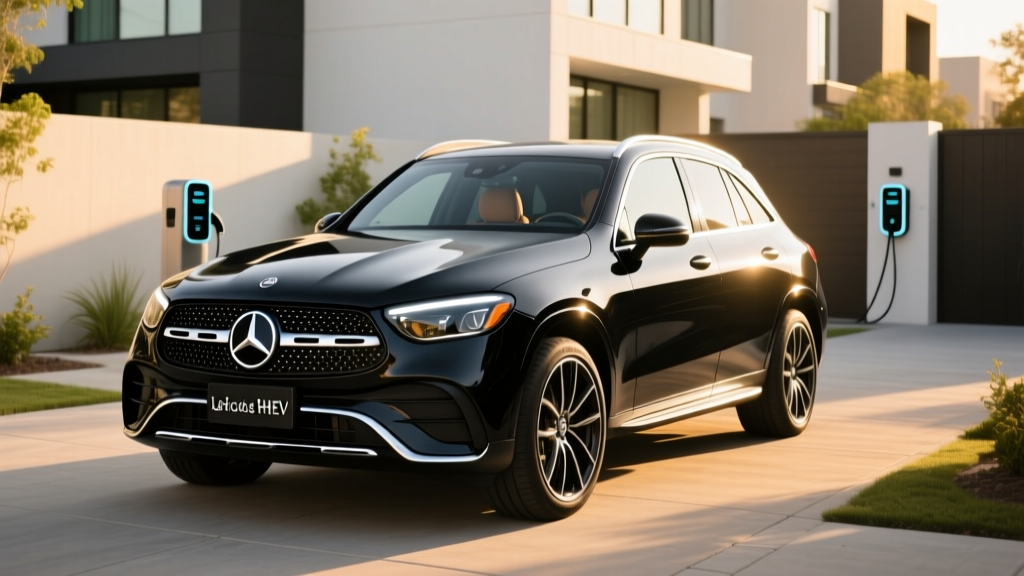
The luxury compact SUV segment is crowded, but the 2026 Mercedes-Benz GLC 350e 4MATIC stands apart with a compelling proposition: genuine electric commuting capability wrapped in a premium package that doesn't sacrifice the refinement buyers expect from the three-pointed star. With an EPA-rated 45 miles of electric-only range and a combined 51 MPGe, this plug-in hybrid (PHEV) targets a specific buyer — someone who wants daily electric driving with the security of a gasoline engine for longer trips, without stepping fully into battery-electric territory.
But does the math actually work? We've analyzed the EPA data, real-world efficiency reports, and ownership economics to determine whether the GLC PHEV earns its premium price tag or if buyers would be better served by a conventional hybrid, a full EV, or even a competing PHEV. Here's everything you need to know.
GLC 350e Powertrain: What's Under the Hood
The 2026 GLC 350e pairs a 2.0-liter turbocharged inline-four engine with an electric motor integrated into the nine-speed automatic transmission. The combined system output is 312 horsepower and 406 lb-ft of torque — substantial enough to move this 4,800-pound SUV with authority.
| Component | Specification |
|---|---|
| Engine | 2.0L turbocharged inline-4 |
| Engine Output | 215 hp / 258 lb-ft |
| Electric Motor | Permanent magnet synchronous |
| Motor Output | 134 hp / 325 lb-ft |
| Combined System Output | 312 hp / 406 lb-ft |
| Transmission | 9-speed automatic (9G-TRONIC) |
| Drivetrain | 4MATIC all-wheel drive |
| 0-60 mph | 6.5 seconds (manufacturer estimate) |
The electric motor sits between the engine and transmission, enabling true electric-only driving rather than merely assisting the gasoline engine. This architecture is critical to understanding PHEV capability — the motor can propel the vehicle independently at speeds up to 87 mph, making it viable for highway merging and suburban driving, not just parking lot crawling.
Electric Range and Efficiency: EPA vs Real World
The EPA rates the 2026 GLC 350e at 45 miles of electric-only range, drawing from a 25.4 kWh battery pack (approximately 19.4 kWh usable). That range figure places it among the leaders in the luxury compact PHEV segment, trailing only the BMW X5 xDrive50e (which is a larger, more expensive vehicle) and roughly matching the Volvo XC60 Recharge.
| Mode | City | Highway | Combined |
|---|---|---|---|
| Electric (MPGe) | 53 MPGe | 49 MPGe | 51 MPGe |
| Gasoline Only (MPG) | 25 MPG | 29 MPG | 27 MPG |
When the battery depletes and the GLC operates as a conventional hybrid, the EPA rates it at 27 MPG combined. Real-world hybrid-mode efficiency typically lands between 25-28 MPG depending on driving style and conditions. This is respectable for a 4,800-pound luxury SUV but trails non-luxury competitors like the Toyota RAV4 Prime (38 MPG combined in hybrid mode) and even the BMW X3 xDrive30e (28 MPG combined).
The total combined range — electric plus gasoline — is approximately 420 miles, assuming a full 15.8-gallon fuel tank and fully charged battery. For most buyers, this eliminates range anxiety entirely while still enabling substantial electric commuting.
Charging the GLC PHEV: Speed and Practicality
The 2026 GLC 350e supports Level 2 AC charging at up to 9.6 kW, which Mercedes estimates will replenish the battery from 10% to 100% in approximately 2.5 hours using a 48-amp home charger. This is competitive with segment rivals and fast enough for overnight charging or topping up during a workday.
Critically, the GLC 350e does not support DC fast charging. This is typical for PHEVs — the smaller battery size and cost considerations mean manufacturers rarely include DC fast-charge capability. For most PHEV buyers who charge at home or work, this is not a significant limitation. However, it does mean you cannot rapidly recharge at public DC fast-charging stations during road trips.
| Charging Method | Power | Time (10-100%) | Notes |
|---|---|---|---|
| Level 1 (120V household) | 1.4 kW | ~17 hours | Emergency/trickle only |
| Level 2 (240V, 48A) | 9.6 kW | ~2.5 hours | Recommended for daily use |
| DC Fast Charge | Not supported | N/A | Typical for PHEV segment |
For optimal ownership, a Level 2 home charger is strongly recommended. Installation costs typically range from $500 to $2,000 depending on electrical panel capacity and distance from the panel to the charging location. The federal Residential Clean Energy Credit covers 30% of home charging equipment and installation costs (up to $1,000) through 2032, which can offset a meaningful portion of the expense.
HEV vs PHEV vs EV: Which Is Right for You?
The GLC 350e is a plug-in hybrid, but it's worth clarifying how it differs from conventional hybrids (HEVs) and full battery-electric vehicles (BEVs) to ensure it aligns with your driving patterns.
Conventional Hybrid (HEV)
Examples: Toyota RAV4 Hybrid, Honda CR-V Hybrid. These vehicles use a small battery and electric motor to assist the gasoline engine but cannot be plugged in and offer only 1-2 miles of electric-only driving at very low speeds. They excel at city driving where regenerative braking recharges the battery frequently. No charging infrastructure required.
Plug-in Hybrid (PHEV) — GLC 350e
Larger battery (19.4 kWh usable) enables 45 miles of genuine electric driving at highway speeds. Requires regular plug-in charging to realize efficiency benefits. When the battery depletes, operates as a conventional hybrid. Best for buyers with home charging access and commutes under 40 miles who still want gasoline flexibility for longer trips.
Battery Electric Vehicle (BEV)
Examples: Tesla Model Y, BMW iX, Mercedes EQB. No gasoline engine — purely electric with 250-350+ miles of range. Lowest operating costs but requires reliable charging access (home or public) and acceptance of range limitations in extreme cold or remote areas.
The GLC PHEV occupies a middle ground: it rewards buyers who can charge regularly with substantial electric driving, but doesn't strand you if charging infrastructure is unavailable. However, if you cannot charge at home or work, a PHEV's efficiency advantage diminishes significantly — you'll be driving a heavier, more expensive vehicle that operates mostly in hybrid mode, negating much of the benefit.
Pricing, Trims, and Tax Credit Eligibility
The 2026 Mercedes-Benz GLC 350e 4MATIC starts at $63,950 (including destination charge). A single trim level is offered, though options packages can push the price well above $75,000. Key standard features include MBUX infotainment with a 12.3-inch digital instrument cluster and 11.9-inch central touchscreen, heated front seats, wireless Apple CarPlay and Android Auto, and a comprehensive suite of driver-assistance features including adaptive cruise control, lane-keeping assist, and automated emergency braking.
| Configuration | MSRP |
|---|---|
| GLC 350e 4MATIC (base) | $63,950 |
| With Premium Package | $67,500 |
| With AMG Line Package | $71,200 |
| Fully loaded (typical) | $74,000-$78,000 |
Federal Tax Credit Eligibility
The GLC 350e qualifies for the federal §30D Clean Vehicle Credit, but the amount varies based on battery sourcing and your individual tax situation. As of 2026, the credit structure is:
- $3,750 if the vehicle meets critical minerals sourcing requirements
- $3,750 if the vehicle meets battery component sourcing requirements
- $7,500 total if both requirements are met
Mercedes-Benz has not publicly confirmed whether the 2026 GLC 350e meets both requirements for the full $7,500 credit. Based on 2025 model-year data, the GLC 350e qualified for $3,750 (critical minerals only). Buyers should verify current eligibility on fueleconomy.gov before purchase, as sourcing requirements tighten annually.
Additional eligibility requirements:
- Modified adjusted gross income must not exceed $150,000 (single) / $225,000 (head of household) / $300,000 (married filing jointly)
- Vehicle MSRP must not exceed $80,000 for SUVs (the GLC 350e clears this threshold at base, but heavily optioned examples may exceed it)
- Vehicle must be assembled in North America (the GLC is built in Bremen, Germany — this disqualifies it from the credit under current rules)
Important: The North American assembly requirement is a significant issue for the GLC 350e. Because it is manufactured in Germany, it does not qualify for the federal §30D tax credit regardless of battery sourcing. This is a critical consideration that buyers often overlook. Competitors like the BMW X3 xDrive30e (built in South Carolina) do qualify.
Battery Warranty and Long-Term Reliability
Mercedes-Benz provides an 8-year/62,000-mile warranty on the GLC 350e's high-voltage battery pack, guaranteeing that it will retain at least 70% of its original capacity during that period. This is slightly shorter than the 10-year/150,000-mile warranties offered by Hyundai, Kia, and Toyota on their hybrid and PHEV batteries, but aligns with BMW and Volvo's coverage.
- Coverage: 8 years / 62,000 miles (whichever comes first)
- Capacity retention guarantee: Minimum 70% of original capacity
- Replacement cost (out of warranty): Estimated $12,000-$18,000 including labor
- Warranty is transferable to subsequent owners
Real-world data on Mercedes PHEV battery longevity is still emerging, as the current-generation GLC 350e only entered production in 2024. However, earlier Mercedes PHEV models (GLE 350e, S 560e) have shown minimal degradation in the first 3-5 years of ownership when properly maintained. Lithium-ion battery degradation is typically most pronounced in the first 2-3 years (5-10% loss), then stabilizes. Most owners report 85-90% battery capacity retention after 5 years and 60,000 miles.
To maximize battery lifespan, Mercedes recommends:
- Avoiding frequent DC fast charging (not applicable here, as DC fast charging is not supported)
- Limiting maximum state of charge to 80% for daily use (configurable in MBUX settings)
- Avoiding prolonged storage at very low (<20%) or very high (>90%) state of charge
- Using the vehicle's preconditioning feature to warm or cool the battery before driving in extreme temperatures
The conventional 12-volt auxiliary battery is covered under a separate 4-year/50,000-mile warranty and typically requires replacement every 4-6 years at a cost of $300-$500.
Who Should Buy the GLC 350e PHEV?
The 2026 Mercedes-Benz GLC 350e is not for everyone. Its premium pricing, lack of federal tax credit eligibility, and German assembly make it a niche choice even within the luxury PHEV segment. However, it excels for a specific buyer profile:
- You have reliable home or workplace Level 2 charging access
- Your daily commute is under 40 miles round-trip, enabling mostly electric driving
- You value Mercedes-Benz brand prestige, interior refinement, and MBUX technology
- You want electric commuting capability but frequently take longer road trips where charging infrastructure is uncertain
- You prioritize a smooth, quiet driving experience over maximum efficiency
- You live in a state that offers its own PHEV incentives (California, Colorado, New York, and others offer $1,000-$4,000 state credits that may apply)
- You cannot charge at home or work — a conventional hybrid or more efficient gasoline vehicle makes more sense
- You're seeking maximum federal tax credit eligibility — the BMW X3 xDrive30e qualifies for up to $7,500
- You want the lowest total cost of ownership — a Tesla Model Y or Hyundai Ioniq 5 will cost significantly less to operate over 5 years
- You prioritize cargo space — the GLC 350e's battery pack reduces cargo volume to 19.4 cubic feet (vs. 21.9 cu ft in the gasoline GLC 300)
- You need third-row seating — the GLC is strictly a two-row compact SUV
Competitive Landscape: How the GLC 350e Compares
The luxury compact PHEV segment is small but competitive. Key rivals include:
| Model | Electric Range | Combined MPG (hybrid mode) | Combined HP | Starting MSRP | Federal Tax Credit |
|---|---|---|---|---|---|
| Mercedes-Benz GLC 350e | 45 miles | 27 MPG | 312 hp | $63,950 | Not eligible (German assembly) |
| BMW X3 xDrive30e | 37 miles | 28 MPG | 288 hp | $58,200 | Up to $7,500 |
| Volvo XC60 Recharge | 35 miles | 26 MPG | 455 hp | $62,150 | Not eligible (Swedish assembly) |
| Audi Q5 TFSI e | 23 miles | 25 MPG | 362 hp | $59,900 | Not eligible (Mexican assembly) |
The GLC 350e leads the segment in electric range but trails in federal tax credit eligibility and hybrid-mode efficiency. The BMW X3 xDrive30e offers the best value proposition with lower pricing, tax credit eligibility, and competitive efficiency, though it sacrifices some electric range and interior luxury. The Volvo XC60 Recharge provides substantially more power but at the cost of efficiency and range.
Ownership Costs: 5-Year Total Cost of Ownership
Estimating 5-year ownership costs requires assumptions about driving patterns, electricity costs, and fuel prices. For a buyer driving 12,000 miles annually with home charging access and a 30-mile daily commute (mostly electric), the GLC 350e's economics look like this:
| Category | GLC 350e PHEV | GLC 300 (gasoline) | Tesla Model Y Long Range |
|---|---|---|---|
| Purchase Price | $63,950 | $47,550 | $48,990 |
| Federal Tax Credit | $0 | $0 | $7,500 |
| Fuel/Electricity (5 years) | $4,200 | $9,800 | $3,100 |
| Maintenance (5 years) | $3,800 | $3,200 | $1,800 |
| Insurance (5 years) | $11,500 | $9,200 | $10,800 |
| Depreciation (estimated) | $28,000 | $22,000 | $24,000 |
| Total 5-Year Cost | $83,450 | $69,750 | $57,190 |
The GLC 350e's total cost of ownership is substantially higher than both its gasoline sibling and the Tesla Model Y, driven primarily by its higher purchase price, lack of federal tax credit, and steeper depreciation. However, for buyers who prioritize the Mercedes brand, interior quality, and the flexibility of a PHEV powertrain, these costs may be acceptable trade-offs.
Frequently Asked Questions
How many MPG does the GLC 350e get?
The EPA rates the 2026 GLC 350e at 51 MPGe combined when operating in electric mode and 27 MPG combined in hybrid mode (after battery depletion). Real-world hybrid-mode efficiency typically ranges from 25-28 MPG depending on driving conditions.
How far can the GLC 350e go on electric only?
The EPA rates the GLC 350e at 45 miles of electric-only range. Real-world range is typically 38-42 miles in warm weather and 30-35 miles in cold weather (below 40°F). Highway driving above 70 mph also reduces range.
Does the GLC 350e qualify for the federal tax credit?
No. The 2026 GLC 350e is assembled in Bremen, Germany, which disqualifies it from the federal §30D Clean Vehicle Credit under current rules requiring North American assembly. Some state incentives may still apply — check your state's energy office for details.
Is the GLC 350e reliable, and what does battery replacement cost?
Long-term reliability data is still limited for the current-generation GLC 350e (introduced in 2024), but earlier Mercedes PHEV models have shown minimal battery degradation in the first 3-5 years. The high-voltage battery is warrantied for 8 years/62,000 miles with a 70% capacity retention guarantee. Out-of-warranty replacement is estimated at $12,000-$18,000.
Can I charge the GLC 350e at a DC fast charger?
No. The GLC 350e only supports Level 1 (120V) and Level 2 (240V) AC charging, with a maximum charge rate of 9.6 kW on Level 2. DC fast charging is not supported, which is typical for PHEVs in this segment.
How long does it take to charge the GLC 350e at home?
Using a 48-amp Level 2 home charger (9.6 kW), the GLC 350e charges from 10% to 100% in approximately 2.5 hours. On a standard 120V household outlet (Level 1), a full charge takes about 17 hours — suitable only for emergency or occasional use.
Should I buy the GLC 350e PHEV or the gasoline GLC 300?
Choose the GLC 350e if you have home charging access, a commute under 40 miles, and want to reduce fuel consumption and emissions. Choose the GLC 300 if you cannot charge at home, drive mostly long distances, or want to minimize purchase price. The GLC 300 is $16,400 less expensive and may be more practical for many buyers.
What's the difference between the GLC 350e and a full electric vehicle like the Tesla Model Y?
The GLC 350e offers 45 miles of electric range plus a gasoline engine for longer trips, eliminating range anxiety but requiring both fuel and electricity. The Tesla Model Y is fully electric with 310+ miles of range, lower operating costs, and federal tax credit eligibility, but requires reliable charging infrastructure and acceptance of range limitations in extreme cold. The Model Y is also significantly less expensive to purchase and operate over 5 years.