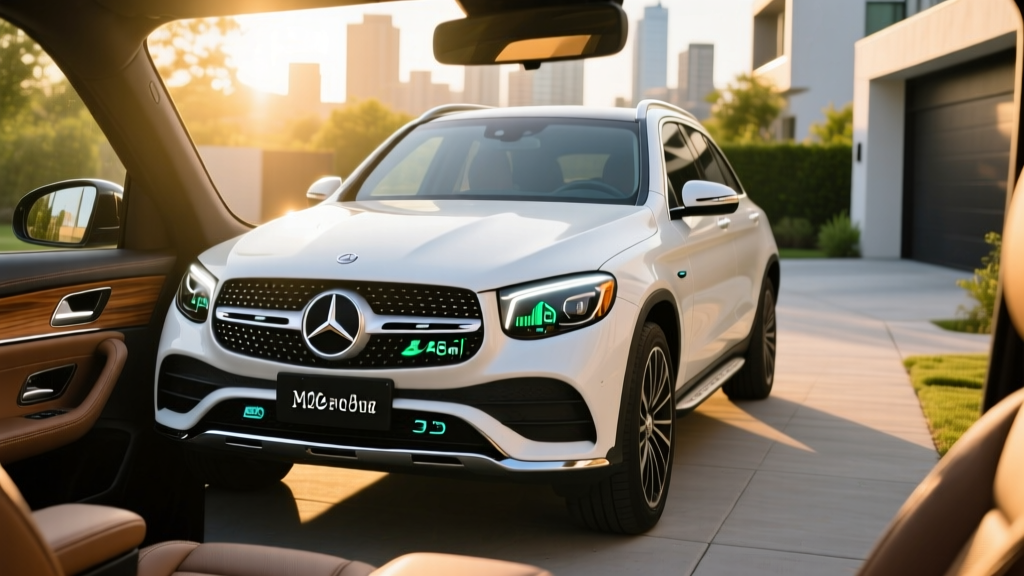
The Mercedes-Benz GLC has long been the brand's best-selling SUV, and for 2026, the GLC 350e plug-in hybrid (PHEV) continues to offer a bridge between traditional luxury and electrified efficiency. With a revised turbocharged four-cylinder paired with a more powerful electric motor, the GLC 350e targets buyers who want electric-only commuting during the week and gas-powered flexibility for weekend road trips — without the range compromises of a full battery electric vehicle (BEV).
But does the math actually work? Below, we break down every spec that matters: real-world MPG, electric-only range, charging logistics, tax credit eligibility, and long-term battery reliability.
GLC 350e Powertrain: What's Under the Hood
The 2026 GLC 350e pairs a 2.0-liter turbocharged inline-four gasoline engine with an electric motor integrated into the 9-speed automatic transmission. Combined output reaches 313 horsepower and 406 lb-ft of torque, routing power through Mercedes' 4MATIC all-wheel-drive system.
| Spec | Value |
|---|---|
| Combined HP | 313 hp |
| Combined Torque | 406 lb-ft |
| Engine | 2.0L turbo I4 + electric motor |
| Transmission | 9-speed automatic |
| Drivetrain | 4MATIC AWD |
| Battery (usable) | ~25.4 kWh (NMC chemistry) |
| EPA Electric Range | ~40 miles |
| EPA MPGe (combined) | 56 MPGe |
| EPA MPG (gas-only, combined) | ~28 MPG |
| 0-60 mph | 6.5 seconds |
| Max DC Fast Charge | ~60 kW (optional) |
| Level 2 Charge Rate | ~7.4 kW |
| Base MSRP | ~$59,900 |
| Battery Warranty | 6 years / 62,000 miles |
The electric motor contributes approximately 134 hp on its own, enough to propel the GLC 350e to around 87 mph in pure electric mode. When the battery depletes, the gasoline engine seamlessly takes over — there's no moment of range anxiety or power loss.
Electric-Only Range and Total Range
Real-World Expectation: 30–36 miles in mixed driving; as low as 22–25 miles at sustained highway speeds in cold weather. The total combined range (electric + full gas tank) exceeds 400 miles.
The GLC 350e's ~25.4 kWh usable battery (from a ~31.2 kWh gross pack) gives it one of the more generous electric buffers in the luxury compact PHEV segment. For a daily commute under 35 miles round-trip, many owners will burn almost zero gasoline during the work week.
However, real-world range depends heavily on conditions. In our experience with Mercedes PHEV systems, highway driving at 70+ mph drains the pack roughly 20–25% faster than the EPA estimate. Cold weather (below 35°F) further reduces electric range because the cabin heater draws from the traction battery unless the optional heat pump is equipped.
Once the battery is depleted, the 17.4-gallon fuel tank provides roughly 350+ additional miles at the EPA combined gas-only rating of ~28 MPG.
Fuel Economy: EPA Numbers vs. Real-World MPG
| Mode | City | Highway | Combined |
|---|---|---|---|
| Charge-depleting (EV+gas blend) | 56 MPGe | ||
| Charge-sustaining (gas only) | ~26 MPG | ~30 MPG | ~28 MPG |
Understanding PHEV fuel economy requires separating two scenarios:
- With a charged battery: If you plug in nightly and commute within the 40-mile electric window, you may use a tank of gas every 6–8 weeks. Effective fuel cost drops dramatically.
- Without plugging in: If you treat the GLC 350e as a conventional hybrid (never charging), expect around 28 MPG combined — respectable for a 4,700-lb luxury SUV, but not class-leading. The Toyota RAV4 Hybrid, for comparison, achieves 39 MPG combined, though it offers no plug-in capability.
Real-world data from fueleconomy.gov and owner forums suggest that disciplined PHEV owners who charge daily see effective consumption between 60–80 MPGe over a year, while those who rarely plug in average 25–28 MPG.
Charging: Level 2, DC Fast Charging, and Times
The 2026 GLC 350e supports two charging methods:
- Level 2 AC charging (240V): At 7.4 kW, a full 0–100% charge takes approximately 3.5 hours. This is the primary method for home and workplace charging.
- DC fast charging (optional): Mercedes offers an available DC fast-charge capability at up to ~60 kW, bringing the battery from 10–80% in roughly 30 minutes. This option typically adds $500–$750 to the build price.
A critical note on kW vs. kWh: the 7.4 kW charge rate tells you how fast energy flows into the battery; the ~25.4 kWh battery capacity tells you how much total energy it stores. Dividing 25.4 kWh by 7.4 kW gives the ~3.4-hour charge time.
The GLC 350e uses a J1772 connector for AC charging and CCS1 for DC fast charging. As Mercedes transitions to NACS (Tesla-style) connectors across its lineup starting in 2025–2026, verify the charge port type on your specific build — early 2026 production may still carry CCS1.
HEV vs. PHEV vs. BEV: Which Powertrain Fits You?
The GLC 350e is a plug-in hybrid (PHEV), not a conventional hybrid (HEV). Understanding the distinction prevents costly purchase mistakes:
| Feature | HEV (Conventional Hybrid) | PHEV (Plug-In Hybrid) | BEV (Full Electric) |
|---|---|---|---|
| Plugs in? | No | Yes | Yes |
| Electric-only range | 0–2 miles at low speed | 20–50 miles | 200–400+ miles |
| Gas engine? | Yes | Yes | No |
| Home charging needed? | No | Recommended | Essential |
| Example | Toyota RAV4 Hybrid | Mercedes GLC 350e | Tesla Model Y |
- You can charge at home or work (Level 2 access)
- Your daily commute is under 40 miles round-trip
- You take road trips beyond 250 miles regularly
- You want luxury features unavailable in most BEVs at this price
- You have reliable home charging
- You rarely drive more than 250 miles in a day
- You want zero tailpipe emissions and minimal maintenance
- You qualify for the full $7,500 federal EV tax credit
- You cannot charge at home (apartment, street parking)
- You want simplicity — no plug, no battery management
- Budget is a primary concern
Pricing, Trims, and Tax Credit Eligibility
The 2026 Mercedes-Benz GLC 350e starts at approximately $59,900 (including destination). Key trims and options include:
- GLC 350e 4MATIC (base): ~$59,900
- GLC 350e Exclusive Line: ~$63,500
- GLC 350e Pinnacle Line: ~$67,200
- AMG Line appearance package: +$2,500
- DC fast-charge option: +$500–$750
Federal Tax Credit: Does the GLC 350e Qualify?
Under IRS §30D Clean Vehicle Credit rules for 2026, qualifying PHEVs can receive up to $3,750 (not the full $7,500, as most PHEVs meet only the critical-minerals requirement, not the full battery-component sourcing requirement). However, eligibility depends on multiple factors:
- MSRP cap: SUVs must be under $80,000 — the GLC 350e qualifies at all trims
- Buyer income cap: $150,000 single / $300,000 joint MAGI
- Battery capacity: Must be ≥7 kWh — the GLC 350e's ~31.2 kWh pack qualifies
- Critical minerals & battery components: Sourcing requirements phase in annually; as of 2026, most Mercedes PHEVs partially qualify ($3,750)
- Point-of-sale transfer: You can apply the credit at purchase through a registered dealer, reducing your out-of-pocket cost immediately
Important: Tax credit eligibility changes frequently due to supply-chain sourcing rules. Always confirm current status with your dealer and consult a tax professional before relying on the credit. State-level incentives (California, Colorado, New York, and others) may add $1,000–$4,000 in additional rebates for PHEVs.
Battery Longevity, Warranty, and Replacement Cost
Mercedes uses NMC (nickel-manganese-cobalt) chemistry in the GLC 350e's high-voltage pack, which offers higher energy density than LFP (lithium iron phosphate) but slightly faster degradation over thousands of charge cycles. Based on historical Mercedes PHEV data (from the previous-generation GLC 350e and GLE 350e), expect approximately 8–12% degradation over 5 years / 60,000 miles of regular use.
Out-of-warranty battery replacement for the GLC 350e is estimated at $8,000–$12,000 (parts and labor), though full replacements are rare — individual module repairs are often possible for $2,000–$4,000.
To maximize battery lifespan:
- Avoid routinely charging to 100% and leaving it parked in extreme heat
- Use the built-in charge limit setting (80% for daily use)
- Precondition the cabin while still plugged in to reduce battery thermal load
Reliability and Ownership Costs
Mercedes-Benz as a brand ranks below average in long-term reliability surveys (J.D. Power, Consumer Reports), but the PHEV powertrain itself has proven reasonably durable. The electric motor has fewer moving parts than a conventional transmission, and regenerative braking extends brake pad life significantly — many PHEV owners report 60,000+ miles on original brake pads.
Ownership costs to budget for:
- Maintenance: Mercedes prepaid plans run $2,000–$3,500 for 4 years. Oil changes are still required (it has a gas engine).
- Insurance: Expect $1,800–$2,800/year depending on region and driving record — PHEVs carry slightly higher premiums than gas equivalents due to battery replacement cost.
- Fuel/electricity: At $3.50/gallon and $0.15/kWh national averages, a daily-charging PHEV owner spends roughly $800–$1,200/year on combined energy vs. $2,200+ for a gas-only GLC 300.
- Depreciation: Luxury PHEVs depreciate 45–55% over 5 years — steeper than comparable BEVs (which benefit from stronger used-market demand) but similar to gas luxury SUVs.
Pros, Cons, and the Verdict
Pros
- ~40-mile electric range covers most daily commutes
- 313 HP provides confident passing and merging
- No range anxiety — 400+ mile total range
- Luxury interior, MBUX infotainment, excellent ride quality
- 4MATIC AWD standard for all-weather capability
- Qualifies for partial federal tax credit ($3,750)
Cons
- Battery warranty shorter than competitors (6 yr vs. 8–10 yr)
- Gas-only MPG (28) is mediocre if you don't plug in
- DC fast charging is optional, not standard
- $60K+ starting price; well-equipped models exceed $70K
- NMC battery chemistry degrades faster than LFP
- Cargo space slightly reduced vs. gas GLC due to battery placement
The 2026 GLC 350e makes sense for a specific buyer: someone with home charging access, a sub-40-mile commute, and a desire for Mercedes luxury without committing fully to electric. It is not the most efficient PHEV on the market (the Toyota RAV4 Prime delivers 42 miles of electric range and 94 MPGe for $20,000 less), but it offers a driving experience, interior quality, and badge prestige that no mainstream PHEV matches.
Frequently Asked Questions
How many MPG does the GLC 350e hybrid get?
When the battery is depleted and you're driving on gasoline alone, the EPA rates the GLC 350e at approximately 26 city / 30 highway / 28 combined MPG. When using both electric and gas power with a charged battery, the combined rating is 56 MPGe. Real-world results vary significantly based on how often you plug in — daily chargers see dramatically lower fuel consumption.
How far can the GLC 350e go on electric only?
The EPA estimates ~40 miles of electric-only range. In real-world mixed driving, expect 30–36 miles. At sustained highway speeds or in cold weather (below 35°F), range can drop to 22–28 miles. Once depleted, the gas engine takes over seamlessly.
Does the GLC 350e qualify for a federal tax credit?
Under 2026 IRS §30D rules, the GLC 350e likely qualifies for a partial credit of $3,750 (meeting critical-minerals requirements but not full battery-component sourcing). Eligibility requires buyer income under $150K single / $300K joint, and the vehicle MSRP must be under $80,000 (which all GLC 350e trims satisfy). Confirm with your dealer and tax professional at time of purchase, as sourcing rules update annually.
Is the GLC 350e hybrid reliable? What does battery replacement cost?
The PHEV powertrain has proven reasonably durable, though Mercedes-Benz as a brand ranks below average in long-term reliability surveys. The high-voltage battery carries a 6-year/62,000-mile warranty (shorter than the 8–10 year warranties from Toyota and Hyundai). Out-of-warranty replacement is estimated at $8,000–$12,000, though module-level repairs are often possible for less.
Do I need to plug in the GLC 350e, or does it charge itself?
Unlike a conventional hybrid (HEV) that charges its small battery solely through regenerative braking, the GLC 350e is a PHEV with a large 25.4 kWh battery designed to be plugged in. While regenerative braking and the gas engine do maintain some charge, you must plug in (Level 2 at home or DC fast charger) to access the full ~40-mile electric range. Without plugging in, it functions as a heavy conventional hybrid at ~28 MPG.
How long does it take to charge the GLC 350e at home?
On a 240V Level 2 home charger at 7.4 kW, a full 0–100% charge takes approximately 3.5 hours. On a standard 120V household outlet (Level 1), expect 10–12 hours — sufficient for overnight replenishment if your daily driving is under 20 miles.
Should I buy the GLC 350e or a full electric SUV?
Choose the GLC 350e if you regularly drive beyond 250 miles in a day, lack reliable public charging on your routes, or want Mercedes luxury in a package with zero range anxiety. Choose a full BEV like the BMW iX or Tesla Model Y if you have home charging, drive under 250 miles daily, want maximum fuel savings, and qualify for the full $7,500 federal tax credit.