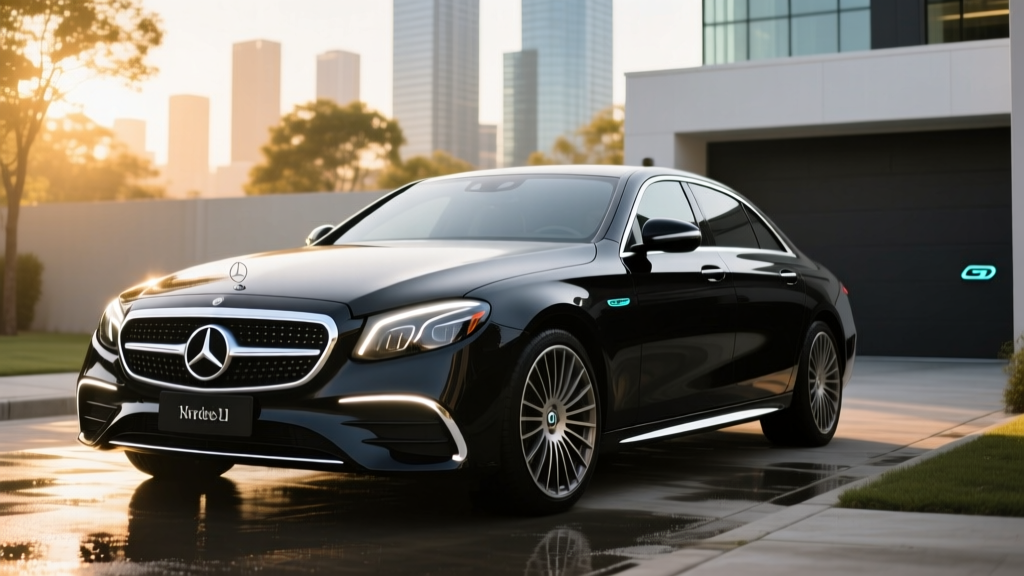
If you're searching for an E-Class hybrid, you're looking at one of the most refined plug-in hybrid sedans on the market. The current-generation Mercedes-Benz E 350e 4MATIC pairs a turbocharged inline-four with a rear-axle electric motor and a 25.4 kWh battery pack — delivering genuine electric-only commuting range wrapped in a mid-size luxury sedan. For 2026, the E-Class PHEV continues as a bridge technology for buyers who want EV-like daily driving without range anxiety on longer trips.
But is the E 350e the right electrified vehicle for your garage, or should you look at a full battery-electric alternative like the EQE? This guide breaks down the real-world numbers — EPA efficiency, actual electric range, charging logistics, and ownership economics — so you can decide with data, not marketing.
E-Class Hybrid Powertrain: How It Works
The 2026 Mercedes-Benz E 350e 4MATIC uses a plug-in hybrid (PHEV) architecture, which is fundamentally different from a conventional hybrid (HEV) like the Toyota Camry Hybrid. Here's the distinction:
HEV vs PHEV — What's the Difference?
| Feature | Conventional Hybrid (HEV) | Plug-In Hybrid (PHEV) |
|---|---|---|
| Plugs in to charge? | No — charges via regenerative braking and engine | Yes — has a larger battery you plug in |
| Electric-only range | 0–2 miles at very low speed | 40–60+ miles at full highway speed |
| Battery size | 1–2 kWh | 15–30 kWh (E 350e: 25.4 kWh) |
| Federal tax credit | No | Up to $3,750 (if eligible) |
| Home charging needed | No | Yes — Level 2 recommended |
The E 350e's powertrain combines a 2.0-liter turbocharged inline-four producing 208 horsepower with an electric motor integrated into the 9-speed automatic transmission making 127 hp. Combined system output is 309 horsepower and 406 lb-ft of torque, routed through Mercedes' 4MATIC all-wheel-drive system. The 25.4 kWh lithium-ion battery pack (approximately 21.5 kWh usable) sits beneath the trunk floor, slightly reducing cargo volume compared to the gas-only E 350.
Fuel Economy and Electric-Only Range
The EPA rates the 2026 E 350e 4MATIC at 62 MPGe combined when operating in electric mode and 39 MPG combined when running as a hybrid after the battery is depleted. Here's the full breakdown:
| Mode | City | Highway | Combined |
|---|---|---|---|
| Electric-only (MPGe) | 68 MPGe | 57 MPGe | 62 MPGe |
| Hybrid (gas engine, MPG) | 36 MPG | 42 MPG | 39 MPG |
Electric-only range: The EPA estimates 57 miles on a full charge. In real-world mixed driving at moderate temperatures, expect 45–55 miles. Highway speeds above 70 mph and cold weather (below 40°F) will reduce that to roughly 35–42 miles.
Real-World Range Reality Check
EPA electric range: 57 miles
Real-world expectation: 45–55 miles (mixed driving), 35–42 miles (highway or cold weather)
Total combined range: ~480 miles (gas tank + full battery)
For comparison, a commute of 30 miles round-trip means most E 350e owners will drive entirely on electricity during the workweek — never starting the gas engine — if they charge nightly at home. The 39 MPG hybrid-mode figure is also excellent for a 4,600-pound luxury sedan; the gas-only E 350 4MATIC manages just 27 MPG combined.
Charging the E 350e PHEV: What You Need to Know
The E 350e comes with a J1772/CCS Combo inlet and supports AC Level 2 charging at up to 9.6 kW. There is no DC fast charging capability — a limitation common among PHEVs, since the battery is too small to justify the cost and weight of DC hardware.
| Charging Level | Power | Time (0–100%) | Notes |
|---|---|---|---|
| Level 1 (120V household outlet) | ~1.4 kW | ~16 hours | Emergency/trickle only |
| Level 2 (240V home charger) | 9.6 kW | ~2.5 hours | Recommended daily charging |
| DC Fast Charge | Not supported | N/A | No DC inlet on PHEV |
A Level 2 home charger (such as a ChargePoint Home Flex or Wallbox Pulsar Plus) is practically mandatory for PHEV ownership. Without one, you'll rely on Level 1 trickle charging, which won't fully replenish the battery overnight if you've driven the full electric range. Budget $500–$1,200 for a quality Level 2 charger and $800–$2,500 for professional installation depending on your electrical panel's capacity and proximity to the garage. If your home has a 200-amp panel with spare capacity, installation is straightforward. Older homes with 100-amp service may need a panel upgrade ($2,000–$4,000) before adding a dedicated 40-amp circuit.
Pricing, Trims, and Federal Tax Credit Eligibility
The 2026 Mercedes-Benz E 350e 4MATIC starts at a base MSRP of approximately $65,950 (including destination). A well-equipped model with the Premium Package, MBUX Superscreen, and Driver Assistance Package will land in the $72,000–$78,000 range.
Federal tax credit: Under the IRS §30D Clean Vehicle Credit, the E 350e may qualify for a partial credit of up to $3,750, depending on battery-critical-mineral and component sourcing requirements that shift annually. However, several caveats apply:
- MSRP cap: Sedans must be under $55,000 MSRP — the E 350e exceeds this cap, which disqualifies it from the federal credit.
- Income cap: Even if it qualified, buyer AGI must be under $150,000 (single) or $300,000 (joint).
- Battery sourcing: Critical mineral and component sourcing thresholds tighten each year under the Inflation Reduction Act.
- Point-of-sale transfer: Eligible credits can be transferred to the dealer at purchase for an immediate price reduction.
The bottom line on incentives: Because the E 350e is a sedan priced above the $55,000 MSRP cap, it does not qualify for the federal §30D tax credit as of 2026. Some states offer separate PHEV rebates (California's CVRP, for instance, has been restructured and may offer reduced or no rebates for luxury-priced vehicles). Check your state energy office or the DOE's alternative fuels site for local incentive details.
Driving Dynamics and Performance
The E 350e delivers the quiet, composed ride quality the E-Class is known for, with the added benefit of silent electric motoring around town. The combined 309 hp and instant electric torque give it confident passing power — Mercedes estimates 0–60 mph in 5.7 seconds. That's not sports-sedan quick (the AMG E 53 does it in 4.4 seconds), but it's brisk for a luxury sedan focused on efficiency.
In EV mode, the cabin is nearly silent. The transition from electric to gas power is seamless — one of Mercedes' engineering strengths. The 9-speed automatic handles gear changes imperceptibly, and regenerative braking can be adjusted via steering-wheel paddles from coasting to moderate one-pedal-style deceleration (though not full one-pedal driving to a stop, as in a full BEV).
The trade-off is weight: at roughly 4,670 pounds, the E 350e carries about 350 pounds more than the gas E 350, which you can feel during spirited cornering. This is a comfort-oriented grand tourer, not a canyon carver.
Battery Longevity, Warranty, and Reliability
Hybrid and PHEV battery longevity is a top concern for buyers. Mercedes-Benz covers the E 350e's high-voltage battery with a 6-year/62,000-mile warranty (whichever comes first), guaranteeing it will retain at least 70% of its original capacity during that period. Note: this is shorter than the 8-year/100,000-mile warranties offered by Hyundai, Toyota, and most mainstream brands on their hybrid batteries.
E 350e Battery Warranty at a Glance
Coverage: 6 years / 62,000 miles
Capacity threshold: 70% State of Health (SoH)
Estimated out-of-warranty replacement: $12,000–$18,000 (battery pack + labor)
General hybrid component warranty: 4 years / 50,000 miles
Real-world data from earlier-generation Mercedes PHEVs (the W213 E 350e from 2017–2019) suggests battery degradation is moderate — typically 10–15% capacity loss over 5 years with normal daily cycling. The larger 25.4 kWh pack in the current generation should experience less stress per cycle (since you're using a smaller percentage of total capacity daily), which bodes well for longevity.
If the battery does need replacement out of warranty, expect a cost between $12,000 and $18,000 at a Mercedes dealer. Third-party hybrid battery specialists may offer refurbished packs for less, though availability for newer models is limited. Given the warranty terms, we recommend factoring potential battery replacement into your 8–10 year ownership cost projections.
E-Class PHEV vs Full EV vs Gas: Which Fits You?
The E 350e occupies a specific niche. Here's a decision framework:
Choose the E 350e PHEV if:
- Your daily commute is under 50 miles round-trip (you'll run on electricity most days)
- You take regular road trips of 200+ miles where charging infrastructure is sparse
- You want electric driving without committing to full BEV ownership
- You have access to home Level 2 charging
Choose a full EV (like the Mercedes EQE) if:
- You have reliable home charging and your trips rarely exceed 250 miles
- You want zero tailpipe emissions and minimal maintenance
- You want to qualify for the full $7,500 federal tax credit (EQE SUV may qualify)
Choose the gas E 350 if:
- You cannot install a home charger (apartment, no garage)
- Your annual mileage is very low (under 8,000 miles — the PHEV premium won't pay back)
- You prefer a lighter, slightly more agile driving feel
Pros and Cons
Pros
- Genuine 45–55 mile real-world electric range covers most commutes
- 39 MPG hybrid mode is excellent for a luxury sedan
- Silent, smooth electric driving around town
- No range anxiety — gas engine for long trips
- Strong combined 309 hp with seamless powertrain transitions
- Refined ride quality and top-tier MBUX infotainment
Cons
- $65,950+ MSRP disqualifies it from the federal §30D tax credit
- No DC fast charging — Level 2 home charging is essential
- Battery warranty (6 yr/62k mi) is shorter than competitors
- ~350 lbs heavier than gas E 350, affecting handling
- Trunk space reduced by battery placement
- Out-of-warranty battery replacement costs $12,000–$18,000
Frequently Asked Questions
How many MPG does the E-Class hybrid get?
The 2026 Mercedes-Benz E 350e 4MATIC achieves 39 MPG combined (36 city / 42 highway) in hybrid mode after the battery is depleted. In electric mode, it's rated at 62 MPGe combined. Real-world highway driving at 75+ mph may yield 35–37 MPG in hybrid mode, while city-heavy routes can push 40+ MPG thanks to regenerative braking.
How far can the E-Class PHEV go on electric only?
The EPA rates the E 350e at 57 miles of electric-only range. In real-world conditions — mixed city/highway at moderate temperatures — expect 45 to 55 miles. Cold weather (below 40°F) and sustained highway speeds above 70 mph reduce that to approximately 35 to 42 miles.
Does the E 350e qualify for a federal tax credit?
No. Under current IRS §30D rules, the federal Clean Vehicle Credit has an MSRP cap of $55,000 for sedans. The E 350e starts at ~$65,950, which disqualifies it. Some state-level incentives may still apply — check your state's energy office for details.
Is the E-Class hybrid reliable? What about battery replacement cost?
Mercedes' PHEV systems have proven reasonably reliable, with earlier generations showing moderate battery degradation (10–15% over 5 years). The high-voltage battery is covered for 6 years/62,000 miles at 70% capacity retention. Out-of-warranty replacement runs $12,000–$18,000. The conventional powertrain components (engine, transmission) carry Mercedes' standard 4-year/50,000-mile warranty.
Do I need to plug in the E 350e, or does it charge itself?
The E 350e is a plug-in hybrid (PHEV), meaning you need to plug it in to access the full electric range. You can drive it without ever plugging in — it will function as a conventional hybrid using the gas engine and regenerative braking — but you'll lose the primary efficiency benefit. A Level 2 home charger is strongly recommended.
Can the E 350e DC fast charge?
No. The E 350e supports only AC charging — up to 9.6 kW on Level 2, which fully charges the battery in about 2.5 hours. DC fast charging is not available, which is typical for PHEVs with smaller battery packs.
How does the E-Class PHEV compare to the Mercedes EQE?
The EQE sedan is a full battery-electric vehicle with ~300 miles of EPA range, no gas engine, and potential eligibility for federal tax credits (depending on trim and sourcing). The E 350e offers shorter electric range but eliminates range anxiety for long trips. If your daily driving is under 50 miles and you road-trip frequently, the E 350e PHEV is the more versatile choice. If you have reliable charging and rarely exceed 250 miles per trip, the EQE delivers lower running costs and zero tailpipe emissions.