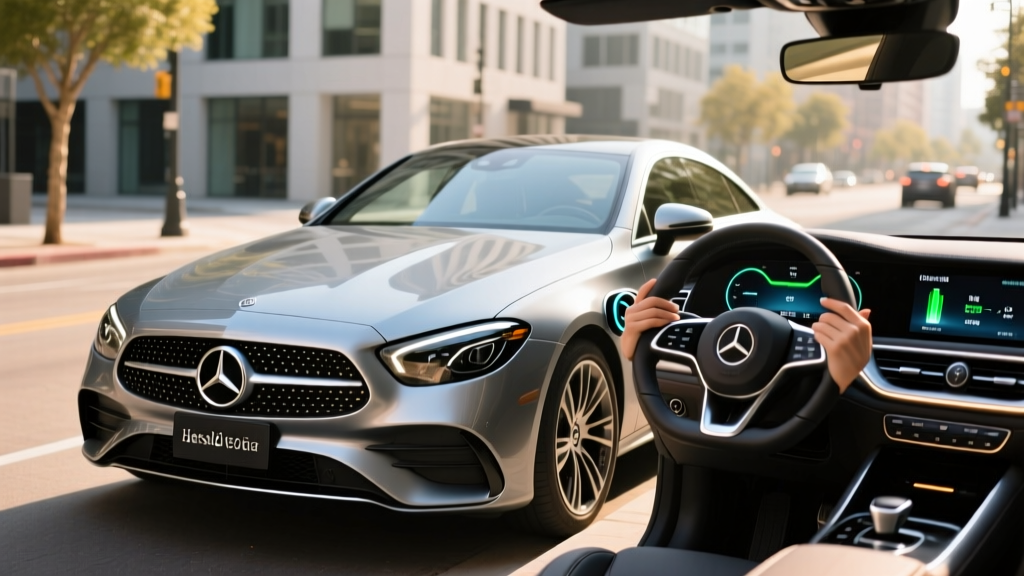
The Mercedes-Benz CLE-Class debuted as a sleek replacement for both the C-Class and E-Class coupes, consolidating two nameplates into one premium two-door. For buyers searching for a CLE hybrid, the current lineup centers on a 48-volt mild-hybrid system rather than a full plug-in hybrid (PHEV) powertrain. That distinction matters enormously for your fuel bills, your charging habits, and whether any federal tax credits apply. Below, we break down exactly what the CLE's hybrid system delivers in real-world driving, what it costs, and where a PHEV variant might fit into Mercedes' roadmap.
HEV vs PHEV vs Mild Hybrid: Where the CLE Fits
Before examining the numbers, it's essential to understand the three electrification tiers Mercedes uses across its lineup, because the CLE occupies a specific rung:
| Type | Battery Size | Plug-In? | Electric-Only Driving | Example |
|---|---|---|---|---|
| Mild Hybrid (MHEV) | ~1–2 kWh (48V) | No | Minimal (assist only, coasting) | CLE 300 4MATIC, CLE 450 |
| Full Hybrid (HEV) | ~1–2 kWh | No | Brief low-speed EV mode | Toyota Camry Hybrid |
| Plug-In Hybrid (PHEV) | ~15–25 kWh | Yes | 25–55 miles typical | Mercedes S 580e, BMW 330e |
The current CLE models sold in the United States — the CLE 300 4MATIC and CLE 450 4MATIC — use Mercedes' second-generation 48-volt integrated starter-generator (ISG) system paired with a turbocharged gasoline engine. This is a mild hybrid, not a full HEV or PHEV. The ISG can add up to 23 hp and 148 lb-ft of torque in short boost bursts, enable smooth engine stop-start, and allow the car to coast with the engine fully off. You never plug it in. There is no electric-only driving mode in the way a PHEV owner experiences.
Mercedes has offered PHEV versions of the C-Class sedan in Europe (the C 300 e), and the new modular MMA platform underpinning upcoming models supports PHEV layouts. However, as of the 2026 model year, no CLE PHEV is officially sold in the US market. If Mercedes introduces a CLE plug-in hybrid, it would likely borrow from the C-Class PHEV architecture with a ~25.4 kWh battery and roughly 40–50 miles of electric-only range.
CLE Hybrid MPG: EPA Ratings and Real-World Economy
Here's what the EPA says about the current mild-hybrid CLE models, based on fueleconomy.gov data:
| Model | City MPG | Highway MPG | Combined MPG | Annual Fuel Cost* |
|---|---|---|---|---|
| 2025/2026 CLE 300 4MATIC (2.0L Turbo + 48V MHEV) | 24 | 34 | 28 | ~$2,550 |
| 2025/2026 CLE 450 4MATIC (3.0L I6 Turbo + 48V MHEV) | 22 | 31 | 25 | ~$2,850 |
*Based on 15,000 miles/year, 55% city driving, premium gasoline at ~$3.85/gallon. Source: EPA.
Real-World MPG vs. EPA Sticker
The 48-volt mild-hybrid system provides its greatest efficiency benefit in stop-and-go city driving, where the ISG enables seamless engine shut-off at stops and regenerative braking recovers energy. In real-world mixed driving, owners typically report the CLE 300 achieving 26–30 mpg combined, with highway cruising sometimes pushing past the EPA's 34 mpg highway estimate thanks to the engine-off coasting function.
However, aggressive driving, cold weather, and short trips erode those gains. In sub-freezing temperatures, expect a 10–15% reduction in fuel economy — the mild-hybrid system cannot offset the energy demands of cabin heating and increased engine friction the way a PHEV's electric drivetrain can. On sustained 80 mph highway runs, the CLE 450's inline-six delivers a smooth but thirstier 27–29 mpg in our experience.
Compared to a conventional gas-only luxury coupe of similar power (think BMW 430i xDrive at 27 combined mpg), the CLE 300's mild hybrid delivers a modest 1–2 mpg advantage — meaningful over 5 years of ownership but not transformational.
Powertrain Specs: Horsepower, Engine, and Electric Assist
| Specification | CLE 300 4MATIC | CLE 450 4MATIC |
|---|---|---|
| Engine | 2.0L Turbocharged I-4 | 3.0L Turbocharged I-6 |
| Hybrid System | 48V ISG (Gen 2) | 48V ISG (Gen 2) |
| Combined Horsepower | 255 hp | 375 hp |
| Combined Torque | 295 lb-ft | 369 lb-ft |
| ISG Boost (electric assist) | 23 hp / 148 lb-ft | 23 hp / 148 lb-ft |
| Transmission | 9G-TRONIC 9-speed auto | 9G-TRONIC 9-speed auto |
| Drivetrain | 4MATIC AWD | 4MATIC AWD |
| 0–60 mph | 5.8 sec | 4.2 sec |
| Top Speed | 130 mph (electronically limited) | 155 mph (electronically limited) |
The second-generation ISG is mounted directly on the engine's crankshaft, making the system more compact and responsive than belt-driven alternatives. During acceleration, the electric motor fills in torque before the turbo spools, eliminating lag and making the CLE 300 feel quicker than its 255 hp suggests. During deceleration, the ISG recovers energy to recharge the small 48-volt lithium-ion battery. At steady highway speeds, the engine can decouple entirely and shut off, letting the car coast on momentum alone — a feature Mercedes calls "sailing mode."
Pricing, Trims, and Tax Credit Eligibility
| Trim | Base MSRP (2025/2026) | Federal Tax Credit |
|---|---|---|
| CLE 300 4MATIC Coupe | $60,150 | Not eligible (§30D excludes MHEV) |
| CLE 450 4MATIC Coupe | $68,850 | Not eligible (§30D excludes MHEV) |
| AMG CLE 53 Coupe | $80,850 | Not eligible (§30D excludes MHEV) |
Under current IRS §30D clean vehicle credit rules, the federal tax credit of up to $7,500 applies only to battery electric vehicles (BEVs) and plug-in hybrids (PHEVs) meeting specific battery sourcing, critical mineral, MSRP cap, and buyer income requirements. The CLE's 48-volt mild-hybrid system does not qualify for any portion of the federal EV tax credit.
Some states offer their own incentives for hybrids, but these are increasingly rare and typically target PHEVs or BEVs. Check your state's energy office or department of environmental quality for current programs. A few states still offer modest rebates ($500–$1,000) for any vehicle exceeding 30 mpg combined, which the CLE 300 meets.
Battery Warranty, Reliability, and Replacement Costs
Mercedes-Benz Hybrid Battery Coverage
- 48-Volt Battery Warranty: 6 years / unlimited miles (standard new-vehicle limited warranty)
- Powertrain Warranty: 6 years / 70,000 miles
- ISG Unit: Covered under powertrain warranty
- Estimated 48V Battery Replacement: $1,500–$3,000 (parts + labor, out of warranty)
Unlike PHEVs and BEVs, which carry federally mandated 8-year/100,000-mile battery warranties under EPA and CARB rules, the CLE's small 48-volt battery falls under Mercedes' standard vehicle warranty. The 48V lithium-ion pack is far smaller and less stressed than a PHEV traction battery, and failure rates in Mercedes' second-generation ISG systems have been low based on owner reports and service data.
The ISG itself is integrated into the engine assembly and is covered under the 6-year/70,000-mile powertrain warranty. If it fails out of warranty, replacement is more involved — expect $4,000–$7,000 including labor, as the unit sits between the engine and transmission.
For long-term reliability, Mercedes' turbocharged four-cylinder (M264/M254 family) and inline-six (M256) engines paired with the ISG have proven durable in the C-Class and E-Class applications. The 9G-TRONIC transmission is well-established with no systemic failure patterns. The primary ownership cost concern is premium fuel and Mercedes' higher-than-average maintenance pricing — budget $1,200–$1,800 annually for scheduled service after the warranty period.
Who Should Choose the CLE Hybrid vs. a PHEV or Full EV?
CLE Mild Hybrid Is Right For You If:
- You want a premium luxury coupe with no plug-in charging hassle
- You drive 10,000–15,000 miles/year and accept 25–28 mpg as reasonable for a 255–375 hp coupe
- You lack access to home or workplace charging (no Level 2 outlet needed)
- You value the CLE's design, MBUX infotainment, and Mercedes brand cachet
- You plan to keep the car 4–6 years within the warranty period
Consider a PHEV Instead If:
- Your daily commute is under 40 miles and you can charge at home (a PHEV eliminates most gasoline use)
- You want federal tax credit eligibility (up to $7,500 under §30D, subject to income and sourcing rules)
- You want to future-proof against rising fuel costs with electric-only daily driving
Consider a Full BEV If:
- You have reliable home Level 2 charging and your trips rarely exceed 250 miles
- You want the lowest per-mile energy cost (~$0.04/mile electric vs. ~$0.14/mile gasoline)
- You want to maximize federal and state incentives
The CLE hybrid occupies a specific niche: luxury coupe buyers who want mild electrification benefits without lifestyle changes. If your priority is maximum fuel savings, a PHEV like the BMW 330e xDrive (22 mi electric, 28 mpg combined after battery depletes, eligible for partial §30D credit) or a full EV like the BMW i4 eDrive40 (307 mi EPA range) will save you $1,500–$3,000 more over five years in fuel. But neither matches the CLE's coupe styling or Mercedes interior ambiance.
Pros
- Smooth, lag-free acceleration from ISG torque fill
- No charging infrastructure required
- Premium interior with latest MBUX system
- Competitive highway fuel economy (31–34 mpg)
- Strong resale value for Mercedes coupes
Cons
- No federal or most state tax credit eligibility
- Mild-hybrid MPG gains are modest vs. PHEV/BEV
- Premium fuel required (91+ octane)
- No electric-only driving capability
- Higher maintenance costs than mainstream hybrids
Frequently Asked Questions
How many MPG does the Mercedes CLE hybrid get?
The CLE 300 4MATIC achieves an EPA-rated 24 city / 34 highway / 28 combined mpg. The CLE 450 4MATIC rates at 22 city / 31 highway / 25 combined mpg. Real-world results typically fall within 1–2 mpg of these figures, with highway driving sometimes exceeding the EPA estimate thanks to engine-off coasting.
Does the CLE hybrid need to be plugged in?
No. The CLE uses a 48-volt mild-hybrid system that recharges through regenerative braking and the engine. There is no plug, no charging port, and no electric-only driving range. This is fundamentally different from a PHEV, which requires plug-in charging to access its electric-only miles.
Will Mercedes release a CLE plug-in hybrid (PHEV)?
Mercedes has not announced a CLE PHEV for the US market as of the 2026 model year. The C-Class sedan offers a PHEV in Europe (C 300 e with ~60 miles of electric range on WLTP), and Mercedes' upcoming MMA platform supports PHEV powertrains. If a CLE PHEV arrives, expect ~25 kWh of battery capacity, 35–50 miles of EPA electric range, and eligibility for a partial federal tax credit under §30D.
Is the CLE hybrid reliable, and what does battery replacement cost?
Mercedes' second-generation 48V ISG system has shown low failure rates across the C-Class, E-Class, and CLE applications. The 48V battery is covered under the 6-year new-vehicle warranty, and replacement costs an estimated $1,500–$3,000 out of warranty. The ISG unit, covered under the powertrain warranty (6 yr/70,000 mi), is costlier at $4,000–$7,000 to replace. These figures are significantly lower than PHEV or BEV traction battery replacements, which can exceed $10,000–$20,000.
Does the CLE hybrid qualify for any tax credit?
No. Under current IRS §30D rules, the federal clean vehicle credit applies only to plug-in electric vehicles (BEVs and PHEVs) with battery capacities of at least 7 kWh. The CLE's 48-volt mild-hybrid system does not meet this threshold. Always consult a tax professional to confirm eligibility for any federal or state incentive, as rules and income caps change annually.
How does the CLE hybrid compare to a Toyota Camry Hybrid?
The Camry Hybrid (51 city / 49 highway / 50 combined mpg, ~$30,000 MSRP) delivers nearly double the CLE's fuel economy at half the price. But this comparison misses the point — the CLE is a premium luxury coupe with 255–375 hp, Mercedes' MBUX technology, and coupe styling. Buyers cross-shopping these vehicles are rare. A closer comparison is the BMW 430i xDrive (27 combined mpg, ~$55,000) or the Audi A5 (27 combined mpg, ~$52,000), where the CLE's mild hybrid delivers a slight MPG edge.