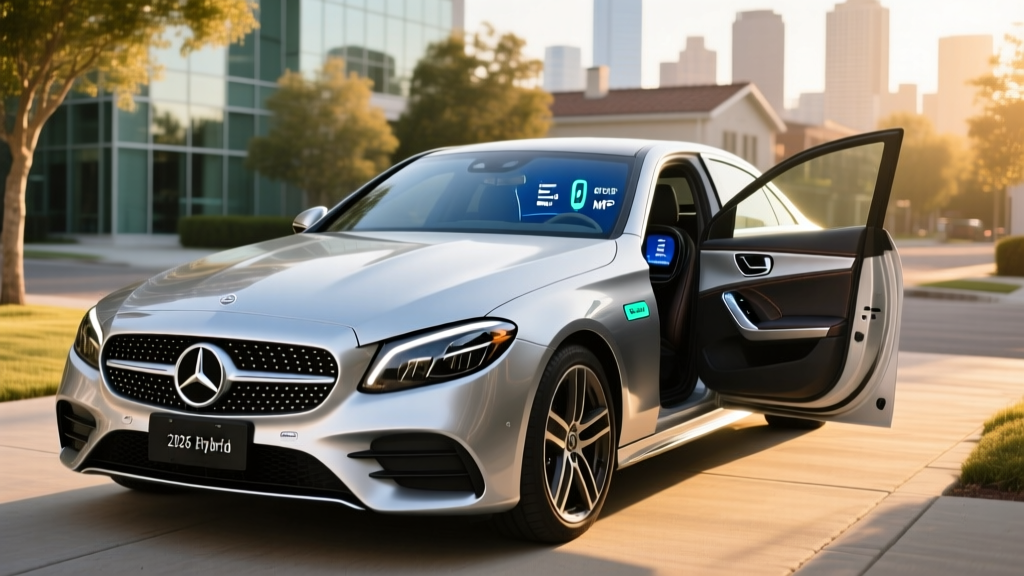
If you want the refinement and interior luxury of a Mercedes-Benz C-Class but aren't ready to commit to a fully electric vehicle, the 2026 C 300e plug-in hybrid (PHEV) is the model to study. Unlike a conventional hybrid (HEV) that relies solely on regenerative braking and its gasoline engine to charge a small battery, the C 300e packs a large 29 kWh lithium-ion pack that you plug in overnight — giving it genuine electric-only commuting capability before the turbocharged 2.0L four-cylinder ever wakes up.
But does the C 300e's PHEV system deliver in the real world? Below we break down its electric range, fuel economy, powertrain output, charging behavior, pricing, and federal tax-credit eligibility — with the exact numbers buyers need.
C-Class Hybrid Lineup: HEV vs PHEV Explained
Before diving into specs, it's worth clarifying what "hybrid C-Class" actually means for the 2026 model year. In the U.S. market, Mercedes-Benz offers the C-Class sedan primarily as the C 300e plug-in hybrid. There is no conventional HEV (non-plug-in hybrid) variant of the current W206-generation C-Class sold in North America.
| Feature | Conventional Hybrid (HEV) | Plug-In Hybrid (PHEV) — C 300e |
|---|---|---|
| Battery Size | 1–2 kWh (small) | 29 kWh (large) |
| Plug In to Charge? | No — charges via regen & engine | Yes — Level 1 or Level 2 |
| Electric-Only Range | 0–2 miles at low speed | ~60 miles (EPA est.) |
| Federal Tax Credit | None | Up to $3,750 (§30D, varies) |
| Best For | No home charging access | Home chargers with short commutes |
The distinction matters. A conventional hybrid like the Toyota Camry HEV gives you better MPG without changing any habits. The C 300e PHEV rewards you with zero-emission daily driving — but only if you plug it in regularly. Drive it without charging and you're hauling a heavy battery on gasoline alone, which erodes the efficiency advantage.
Powertrain and Performance Specs
The 2026 C 300e pairs a turbocharged 2.0-liter inline-four gasoline engine with a permanently excited synchronous electric motor integrated into the 9G-TRONIC nine-speed automatic transmission. Combined output is substantial for a compact luxury sedan.
| Engine | 2.0L turbocharged I4 |
| Engine Output | 201 hp / 236 lb-ft |
| Electric Motor Output | 127 hp / 325 lb-ft |
| Combined System Output | 313 hp / 406 lb-ft |
| Transmission | 9-speed automatic (9G-TRONIC) |
| Drivetrain | Rear-wheel drive (4MATIC available) |
| 0–60 mph | ~5.4 seconds |
| Battery (Usable) | 25.4 kWh usable / 29 kWh gross (NMC) |
| EPA Electric Range | ~60 miles (est.) |
| Total Combined Range | ~440 miles (gas + electric) |
| Fuel Tank | 15.8 gallons |
| Base MSRP | $58,900 (est.) |
The 313 combined horsepower means this is not a slow eco-box. In electric-only mode, acceleration is brisk enough for highway merging. When both power sources engage, the C 300e pulls with the authority of a sport sedan — the instant electric torque fills in the low-RPM gap before the turbo spools.
Fuel Economy: EPA MPG and Real-World Expectations
PHEV fuel economy is context-dependent. If you charge daily and commute within the electric range, you may burn almost no gasoline for weeks. If you never plug in, you're driving a heavy conventional car.
| Metric | City | Highway | Combined |
|---|---|---|---|
| Charge-Sustaining MPG (gas only) | ~32 | ~38 | ~34 |
| MPGe (electric + gas combined) | ~80 MPGe (est.) | ||
| Electric-Only Efficiency | ~2.8–3.0 kWh/mi | ||
When operating in charge-sustaining mode (battery depleted, running on gasoline), the C 300e returns roughly 34 MPG combined. That's competitive with the BMW 330e (~28 MPG combined gas-only) and significantly better than the gas-only C 300 at 29 MPG combined per fueleconomy.gov. Real-world charge-sustaining MPG tends to land between 30–36 depending on driving style and terrain.
Charging: How Long Does the C 300e Take to Charge?
The C 300e supports AC charging via its onboard charger. Here's what to expect at each level:
| Level | Power (kW) | 0–100% Time | Infrastructure |
|---|---|---|---|
| Level 1 (120V household) | ~1.4 kW | ~18–20 hours | Standard outlet |
| Level 2 (240V, 32A) | ~7.4 kW | ~3.5–4 hours | Home wallbox / public L2 |
| DC Fast Charge | Not supported (U.S.) | N/A | N/A |
The C 300e does not support DC fast charging in the U.S. market. The onboard AC charger maxes out at approximately 7.4 kW. For a 25.4 kWh usable battery, a full Level 2 charge takes roughly 3.5 to 4 hours — easily achievable during a workday or overnight at home.
A note on terminology: kW (kilowatts) measures the rate of energy flow — how fast you're charging. kWh (kilowatt-hours) measures stored energy — the battery's total capacity. Think of kW as the speed of water flowing through a hose, and kWh as the size of the bucket.
For home charging, a Level 2 wallbox on a dedicated 40-amp circuit is the practical minimum. Installation costs typically range from $800–$2,500 depending on panel proximity and whether your electrical panel needs an upgrade. We recommend getting a quote from a licensed electrician before purchasing the vehicle.
Pricing, Trims, and Federal Tax Credit Eligibility
The 2026 C 300e starts at an estimated $58,900 (including destination). A 4MATIC all-wheel-drive variant adds approximately $2,500. Well-equipped examples with the AMG Line exterior, Premium package, and MBUX upgrades can push past $68,000.
Does the C 300e Qualify for the Federal Tax Credit?
Under IRS §30D Clean Vehicle Credit rules, PHEVs are eligible — but only if they meet strict criteria:
- Battery capacity: Must be ≥ 7 kWh (C 300e passes at 29 kWh gross)
- MSRP cap: Sedans must be ≤ $55,000 — the C 300e at ~$58,900 exceeds this cap and is therefore not eligible for the federal §30D credit in most configurations
- Buyer income cap: AGI ≤ $150,000 (single) / $300,000 (joint)
- Critical minerals & battery components: Must meet annually escalating domestic-sourcing thresholds
- Assembly: Final assembly must occur in North America
This is a significant consideration. Competitors like the BMW 330e (starting ~$46,000) may fall under the MSRP cap and qualify for partial or full federal credits, depending on battery sourcing compliance. Always verify current-year rules at fueleconomy.gov's tax credit tracker.
Battery Warranty, Reliability, and Replacement Cost
8 years / 62,000 miles (whichever comes first), covering defects and capacity loss below approximately 70% of original capacity.
Mercedes-Benz uses an NMC (nickel-manganese-cobalt) lithium-ion battery pack in the C 300e. NMC chemistry offers high energy density — critical for fitting 29 kWh into a sedan platform — but is somewhat more sensitive to sustained high-SoC storage and extreme heat than LFP chemistry.
What Does Battery Replacement Cost?
Out-of-warranty high-voltage battery replacement for the C 300e is estimated at $12,000–$18,000 including parts and labor, based on comparable Mercedes PHEV service data. This is a worst-case scenario. In practice, modern PHEV batteries rarely fail catastrophically — degradation is gradual, and most owners will see 10–15% capacity loss over the first 8–10 years with normal use.
To maximize battery longevity:
- Avoid leaving the car at 100% SoC for extended periods in hot weather
- Use the vehicle's built-in charge-limit setting (target 80–90% for daily use)
- Precondition the cabin while still plugged in to reduce battery thermal load
Reliability for the W206-generation C-Class has been mixed in early owner surveys. The powertrain itself is well-proven, but MBUX infotainment glitches and sensor-related ADAS quirks have been reported. The hybrid system adds complexity, but the electric motor and power electronics have fewer wear components than a traditional transmission.
C-Class Hybrid vs Full EV vs Gas: Which Should You Choose?
- Your daily commute is under 50 miles round-trip
- You can install a Level 2 charger at home
- You want zero-emission weekday driving but need gas flexibility for road trips
- You value the C-Class interior and don't want to switch to a Tesla or Lucid
- You have reliable home charging and your daily needs fit within 250+ miles of range
- You want lower maintenance costs (no oil changes, fewer moving parts)
- You want to maximize federal/state EV incentives
- You cannot charge at home or at work
- Your budget is tighter (C 300 starts ~$47,000)
- You drive predominantly long highway stretches where PHEV electric range is irrelevant
- ~60 miles electric range covers most commutes
- 313 hp combined — genuinely quick
- Premium interior with MBUX, excellent NVH
- No range anxiety — gas engine for road trips
- 34 MPG combined even without charging
- $58,900+ MSRP exceeds §30D federal credit cap
- No DC fast charging
- Trunk space reduced by battery placement (~12.6 cu ft vs 13.1 in gas C 300)
- Heavy — ~4,500 lbs hurts handling vs gas model
- Complex powertrain = potentially higher long-term maintenance
Frequently Asked Questions
How many MPG does the Mercedes C-Class hybrid get?
In charge-sustaining mode (battery depleted, gas-only), the 2026 C 300e returns approximately 32 city / 38 highway / 34 combined MPG. When regularly charged, effective MPGe can exceed 80 MPGe, though this depends entirely on how much you drive within the electric range.
How far can the C 300e go on electric only?
The EPA-estimated electric-only range is approximately 60 miles. Real-world results vary: expect 48–55 miles in warm weather with mixed driving, and 40–45 miles in cold winter conditions due to cabin heating and battery thermal demands.
Does the C 300e qualify for any tax credit?
The C 300e sedan exceeds the $55,000 MSRP cap for sedans under the federal §30D Clean Vehicle Credit, making it ineligible for the federal credit in most cases. State-level incentives may still apply — check your state's energy office. Always consult a tax professional.
Is the C-Class hybrid reliable?
The hybrid powertrain components (electric motor, power electronics) are generally robust. The W206-generation C-Class has seen some early MBUX software complaints. The high-voltage battery is warrantied for 8 years / 62,000 miles against defects and excessive capacity loss.
What is the battery replacement cost?
Out-of-warranty HV battery replacement is estimated at $12,000–$18,000. However, catastrophic battery failure is rare — gradual degradation of 10–15% over 8–10 years is more typical with proper care.
Can I charge the C 300e at a DC fast charger?
No. The U.S.-spec C 300e supports only AC charging (Level 1 and Level 2), with a maximum onboard charger rate of ~7.4 kW. A full Level 2 charge takes about 3.5–4 hours.
Hybrid vs PHEV vs EV — which fits me?
If you can charge at home and commute under 50 miles daily, the PHEV offers the best of both worlds: electric weekdays, gas for road trips. If you never want to visit a gas station and have home charging, a full EV is simpler and cheaper to maintain. If you can't charge at home, a conventional hybrid (not available in the U.S. C-Class) or gas model is the practical choice.