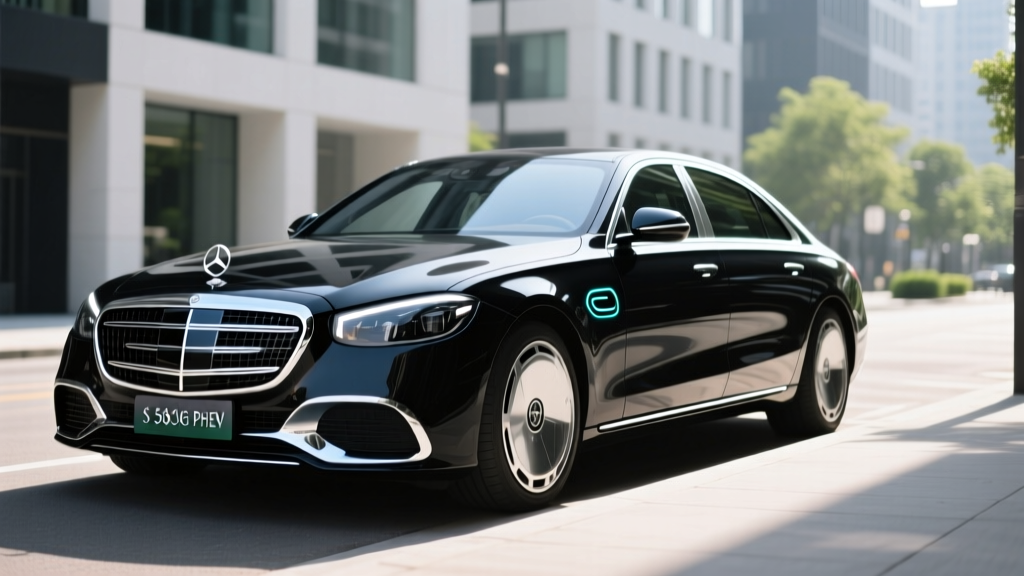
The Mercedes-Benz S-Class has defined the luxury flagship sedan for decades, but electrification has reshaped what buyers expect from a six-figure cruiser. For 2026, the Mercedes-Benz S-Class hybrid lineup centers on the S 580e 4MATIC plug-in hybrid (PHEV), offering a meaningful electric-only commute range wrapped in one of the most refined cabins in the industry. There is no conventional hybrid (HEV) S-Class sold in the U.S. market — Mercedes has committed fully to the plug-in architecture for this nameplate.
This guide breaks down the S 580e's real-world efficiency, charging behavior, powertrain specs, and total ownership picture so you can decide whether this PHEV flagship fits your garage — or whether a full EV like the EQS or a rival PHEV makes more sense.
2026 S 580e Powertrain: Engine, Motor, and Combined Output
The S 580e pairs a turbocharged 3.0-liter inline-six gasoline engine with a permanently excited synchronous electric motor integrated into the 9G-TRONIC 9-speed automatic transmission. The combined system output is substantial:
| Specification | Value |
|---|---|
| Gasoline Engine | 3.0L Turbocharged Inline-6 (362 hp / 369 lb-ft) |
| Electric Motor | 110 kW (148 hp / 325 lb-ft) |
| Combined System Output | 442 hp / 516 lb-ft torque |
| Transmission | 9G-TRONIC 9-speed automatic |
| Drivetrain | 4MATIC all-wheel drive |
| 0–60 mph | 5.0 seconds (manufacturer est.) |
| Battery (Usable) | 28.6 kWh lithium-ion (NMC chemistry) |
The inline-six is smooth and refined — a hallmark of Mercedes' modular engine family — and the electric motor fills in torque instantly off the line. The result is effortless acceleration that belies the sedan's 5,000+ lb curb weight. Unlike some PHEVs that feel strained once the battery depletes, the S 580e's six-cylinder is more than adequate as a standalone powerplant, maintaining composure even in charge-sustaining mode on long highway runs.
Electric-Only Range and Total Driving Range
The S 580e's 28.6 kWh usable battery pack (from a gross capacity of approximately 31.2 kWh) delivers an EPA-estimated 48 miles of electric-only range. That figure places it among the longest electric-only ranges of any luxury PHEV sedan currently on sale, enough to cover most daily commutes without engaging the gasoline engine.
EPA electric-only: 48 miles. In mixed city/suburban driving at moderate temperatures, expect 40–46 miles before the engine engages. Highway driving at 70+ mph reduces electric range to roughly 32–36 miles due to aerodynamic drag and the sedan's weight. In freezing weather (below 32°F), cabin heating and battery thermal management can reduce electric range by 20–30%, yielding approximately 30–38 miles.
Once the battery is depleted, the S 580e operates as a conventional hybrid with the inline-six and regenerative braking recapturing energy. With a 20.6-gallon fuel tank, the total combined range (electric + gasoline) exceeds 480 miles, eliminating range anxiety entirely on long trips.
Fuel Economy: EPA MPG and Real-World Efficiency
The S 580e carries two efficiency ratings: MPGe (miles per gallon equivalent) when operating on electricity, and conventional MPG when the battery is depleted and the gasoline engine takes over.
| Metric | City | Highway | Combined |
|---|---|---|---|
| MPGe (electric + gas) | 58 | 54 | 56 MPGe |
| MPG (charge-sustaining / gas only) | 22 | 29 | 25 MPG |
Real-world MPG note: In practice, PHEV owners who charge daily and commute within the electric range may use little to no gasoline for weeks. The charge-sustaining MPG of 25 combined is respectable for a 5,000-lb luxury sedan with a turbocharged six-cylinder, but it's not exceptional. For comparison, a conventional gas S 500 returns roughly 24 MPG combined. The real efficiency gain comes from maximizing electric-only miles — which requires regular charging.
City driving in hybrid mode tends to slightly exceed the EPA estimate thanks to aggressive regenerative braking recapturing energy in stop-and-go traffic. Highway cruising in gas mode generally aligns with or slightly falls below the 29 MPG estimate depending on speed and terrain.
Charging the S 580e: Level 2, DC Fast Charging, and Times
The S 580e supports both AC Level 2 charging and DC fast charging — a significant advantage over PHEVs limited to AC-only charging, which can take hours.
| Charging Level | Power | Connector | 0–100% Time |
|---|---|---|---|
| Level 1 (120V household) | ~1.4 kW | J1772 | ~20+ hours (not practical) |
| Level 2 (240V home/public) | 7.4 kW | J1772 / NACS (with adapter) | ~4.5 hours |
| DC Fast Charge | Up to 60 kW | CCS1 | 10–80% in ~20 minutes |
The 60 kW DC fast-charging capability is a standout feature. Most PHEVs on the market do not offer DC fast charging at all, or limit it to 30–50 kW. At 60 kW, the S 580e can replenish enough charge during a 20-minute stop to add approximately 25–30 miles of electric range — useful for road-trip charging stops or mid-day top-ups at public stations.
For daily use, a home Level 2 charger (240V, 32A or higher) is the practical solution. A full overnight charge takes roughly 4.5 hours, meaning you can plug in after arriving home and be fully charged well before morning. Installation of a Level 2 home charger typically costs $800–$2,000 including equipment and electrician labor, depending on your panel capacity and run length.
Pricing, Trims, and Federal Tax Credit Eligibility
The 2026 S 580e 4MATIC starts at an MSRP of approximately $120,500 (including destination). Well-optioned examples with AMG Line packages, Executive Rear Seat Plus, and advanced driver-assistance features can push the price past $145,000.
- MSRP Cap: Sedans must have an MSRP at or below $55,000 to qualify. The S 580e at $120,500+ does NOT qualify for the federal §30D new EV/PHEV credit.
- Battery Sourcing: Even if the MSRP cap were met, critical-mineral and battery-component sourcing requirements must be satisfied (IRS §30D rules).
- Income Caps: Modified AGI limits apply ($150K single / $300K joint filers).
- Point-of-Sale Transfer: Eligible credits can be transferred to the dealer at purchase, but this is moot for the S 580e given the MSRP cap.
Bottom line: The S 580e does not qualify for the federal PHEV tax credit due to its price. Some states (e.g., California, Colorado, New York) offer separate PHEV rebates that may apply — check your state's energy office for current programs.
Battery Warranty, Reliability, and Replacement Cost
Mercedes-Benz provides a hybrid battery warranty of 6 years or 62,000 miles (whichever comes first) for the S 580e's high-voltage pack. This covers defects and capacity loss below a specified threshold (typically 70% state of health). The general vehicle limited warranty covers 4 years / 50,000 miles.
High-voltage battery warranty: 6 years / 62,000 miles
Powertrain warranty: 4 years / 50,000 miles
Expected battery lifespan: 10–15 years with normal use before significant degradation
Estimated replacement cost (out of warranty): $12,000–$18,000 (battery pack + labor, dealer pricing)
12V auxiliary battery: Standard AGM, ~$300–$500 replacement
The S-Class has historically scored average to slightly below average in long-term reliability surveys from sources like Consumer Reports, largely due to the complexity of its electronics and luxury features rather than powertrain failures. The PHEV system itself — battery, motor, power electronics — has proven robust across Mercedes' EQ and PHEV lineup. The inline-six engine is a proven design with a strong reliability record.
For buyers concerned about out-of-warranty repair costs, Mercedes offers extended warranty packages (up to 7 years / 100,000 miles) that can cover the hybrid system. Given the vehicle's price point, an extended warranty is strongly recommended and often negotiated into the purchase.
S 580e vs. Full EV (EQS) vs. Gas S-Class: Which Fits You?
Choosing between the S 580e PHEV, the all-electric EQS sedan, and the conventional gas S 500 depends on your driving patterns, charging access, and priorities.
| Attribute | S 580e (PHEV) | S 500 (Gas) | EQS 450+ (EV) |
|---|---|---|---|
| Starting MSRP | ~$120,500 | ~$118,000 | ~$105,550 |
| Electric-Only Range | 48 miles | None | 390 miles (EPA) |
| Total Range | 480+ miles | ~450 miles | 390 miles |
| Combined Efficiency | 56 MPGe / 25 MPG gas | 24 MPG | 97 MPGe |
| Federal Tax Credit | Not eligible (MSRP cap) | None | Not eligible (MSRP cap) |
| Home Charging Needed? | Recommended (Level 2) | No | Essential (Level 2) |
| Best For | Daily EV commute + long road trips | Low-mileage owners, no charging access | Full EV commitment, lower running costs |
- You commute under 45 miles round-trip and can charge at home nightly
- You take regular long road trips and don't want to plan around charging stops
- You want S-Class luxury with reduced daily fuel consumption
- Your household has one garage spot and you want one vehicle to do everything
- You cannot install a Level 2 home charger (PHEVs lose their advantage on gas-only driving)
- You want zero tailpipe emissions — consider the EQS
- You're seeking a federal tax credit — the S 580e's MSRP disqualifies it
- You drive very few miles annually — the gas S 500 may be simpler and cheaper to own
Pros and Cons of the 2026 S 580e Hybrid
- 48 miles of electric-only range covers most daily commutes
- DC fast charging at 60 kW — rare among PHEVs
- 442 combined hp delivers effortless acceleration
- 480+ mile total range eliminates road-trip range anxiety
- Class-leading interior quality, ride comfort, and technology
- Quiet, refined inline-six even in gas-only mode
- $120,500+ starting price; no federal tax credit eligibility
- Charge-sustaining MPG (25 combined) only marginally better than gas S 500
- Battery warranty shorter than many competitors (6 yr vs. 8–10 yr)
- Heavy curb weight affects tire wear and braking distances
- Complex electronics historically impact long-term reliability scores
- Requires home Level 2 charging to realize efficiency benefits
Frequently Asked Questions
How many MPG does the Mercedes-Benz S-Class hybrid get?
The 2026 S 580e achieves 56 MPGe combined when using both electric and gasoline power, and 25 MPG combined (22 city / 29 highway) when operating on gasoline alone after the battery is depleted. Real-world gas-only MPG typically matches or slightly exceeds EPA city estimates thanks to regenerative braking in urban driving.
How far can the S 580e go on electric only?
The EPA rates the S 580e at 48 miles of electric-only range. Real-world results vary: expect 40–46 miles in moderate city/suburban driving, 32–36 miles at sustained highway speeds, and as low as 30–38 miles in freezing temperatures when battery efficiency drops and cabin heating draws additional power.
Hybrid vs. PHEV vs. EV — which is right for a luxury sedan buyer?
A conventional hybrid (HEV) requires no plug-in and offers modest MPG gains — but Mercedes doesn't sell an HEV S-Class in the U.S. A PHEV like the S 580e is ideal if you can charge at home and want electric commuting with gas-engine flexibility for long trips. A full EV like the EQS offers the lowest per-mile energy cost and zero tailpipe emissions but requires reliable charging access and route planning for road trips exceeding 390 miles.
Is the S 580e reliable, and what does battery replacement cost?
The PHEV powertrain (battery, motor, and inline-six) has proven mechanically sound, though the S-Class's complex electronics and luxury systems can drive higher repair costs as the vehicle ages. The high-voltage battery is warrantied for 6 years / 62,000 miles. Out-of-warranty battery replacement is estimated at $12,000–$18,000. An extended warranty is strongly recommended for long-term ownership.
Does the S 580e qualify for any tax credit?
No. The federal §30D clean vehicle credit has an MSRP cap of $55,000 for sedans, and the S 580e's $120,500+ starting price far exceeds that limit. Some state-level incentives for PHEVs may apply depending on your jurisdiction — check your state energy office or the Alternative Fuels Data Center for current programs.
Does the S 580e support DC fast charging?
Yes. The S 580e supports DC fast charging at up to 60 kW via a CCS1 connector, enabling a 10–80% charge in approximately 20 minutes. This is a significant advantage over most PHEVs, which either lack DC charging entirely or offer it at lower power levels.