Mercedes-Benz Plug-In Hybrid Lineup at a Glance
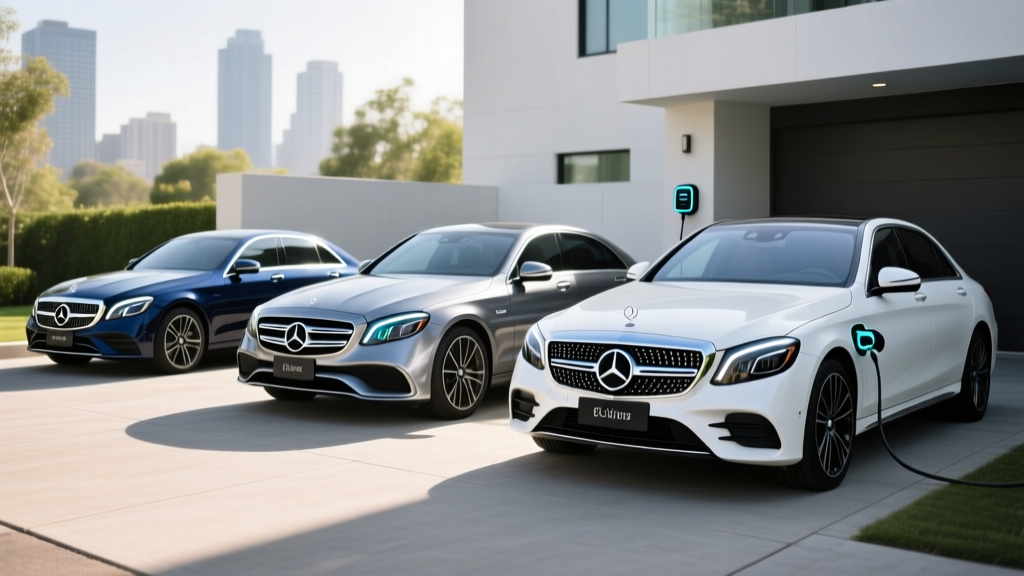
If you're researching a Mercedes-Benz plug-in hybrid, you're likely weighing luxury against electrification practicality. Mercedes currently offers PHEV powertrains across its core sedan and SUV lines — most notably the S 580e, GLC 350e, and GLE 350e. Each pairs a turbocharged gasoline engine with a substantial electric motor and a battery large enough to cover most daily commutes on electricity alone.
This guide breaks down exact EPA figures, real-world efficiency, battery specs, charging times, pricing, and federal tax credit eligibility for every current Mercedes-Benz plug-in hybrid model. We'll also clarify how these PHEVs differ from conventional hybrids and full EVs so you can choose the right powertrain for your driving pattern.
HEV vs. PHEV: What Mercedes-Benz Actually Offers
Mercedes-Benz does not currently sell a conventional hybrid (HEV) in the U.S. market — the kind that recharges its small battery through regenerative braking and never plugs in. Instead, the brand's mild-hybrid systems (branded EQ Boost) use a 48-volt integrated starter-generator to assist the gas engine but cannot drive on electric power alone and do not plug in.
Conventional Hybrid (HEV) vs. Plug-In Hybrid (PHEV)
| Feature | HEV (not offered by Mercedes U.S.) | PHEV (Mercedes current lineup) |
|---|---|---|
| Plugs in to charge? | No | Yes — Level 1 or Level 2 |
| Electric-only driving | No (assist only) | Yes — 30–48 miles typical |
| Battery size | 1–2 kWh | 23–29 kWh usable |
| Fuel economy when battery depleted | 40–55 MPG combined | 23–30 MPG combined (gas-only) |
| Best for | No home charging access | Home/work charging available |
If you see "EQ Boost" or "mild hybrid" on a Mercedes spec sheet, that's a 48V assist system — not a plug-in. The models covered below carry the "e" badge (e.g., GLC 350e) and are true plug-in hybrids with meaningful electric-only range.
2025–2026 Mercedes-Benz PHEV Models: Specs & Efficiency
| Spec | S 580e Sedan | GLC 350e SUV | GLE 350e SUV |
|---|---|---|---|
| Powertrain | 3.0L I6 turbo + electric motor | 2.0L I4 turbo + electric motor | 2.0L I4 turbo + electric motor |
| Combined HP | 469 hp | 312 hp | 302 hp |
| 0–60 mph | 5.0 sec | 6.2 sec | 6.5 sec |
| Battery (usable) | ~22.7 kWh (NMC) | ~23.3 kWh (NMC) | ~23.3 kWh (NMC) |
| EPA electric-only range | ~38 mi | ~39 mi | ~45 mi |
| EPA MPGe (combined) | ~55 MPGe | ~66 MPGe | ~56 MPGe |
| Gas-only MPG (combined) | ~26 MPG | ~27 MPG | ~24 MPG |
| Total range (electric + gas) | ~430 mi | ~410 mi | ~480 mi |
| Max AC charge rate | 7.4 kW (Level 2) | 7.4 kW (Level 2) | 7.4 kW (Level 2) |
| DC fast charging | No | No (optional 60 kW on some markets) | No (optional 60 kW on some markets) |
| Level 2 charge time (0–100%) | ~3.5 hours | ~3.5 hours | ~3.5 hours |
| Starting MSRP | ~$120,500 | ~$59,900 | ~$67,500 |
| Federal §30D tax credit | Not eligible (MSRP cap exceeded) | Up to $3,750* | Up to $3,750* |
| Drivetrain | RWD (4MATIC optional) | 4MATIC AWD | 4MATIC AWD |
*Tax credit amounts depend on battery component and critical-mineral sourcing compliance under current IRS §30D rules. Verify eligibility at irs.gov or with a tax professional. The S 580e exceeds the $80,000 MSRP cap for sedans under §30D and is not eligible.
Electric-Only Range: EPA Sticker vs. Real World
The EPA electric-only range figures above assume moderate temperatures, flat terrain, and mixed city/highway driving. In practice, expect variation:
- City driving, mild weather: You'll often match or slightly exceed the EPA electric range. Regenerative braking recaptures energy in stop-and-go traffic, and lower speeds reduce battery draw. The GLE 350e's 45-mile EPA rating can stretch to 47–50 miles in urban commuting at 65°F.
- Highway driving at 70+ mph: Expect a 15–25% reduction. Aerodynamic drag rises with the square of speed, and the electric motor works harder without regen opportunities. That 39-mile GLC 350e rating may deliver 30–33 miles at sustained interstate speeds.
- Cold weather (below 32°F): Lithium-ion batteries lose efficiency in the cold, and cabin heating draws significant power. Plan for 25–40% less electric range in winter. A 38-mile EPA rating in the S 580e might yield 23–28 miles in January in Chicago.
- Preconditioning helps: If you're plugged in, precondition the cabin and battery while still on shore power. This preserves battery charge for actual driving and reduces cold-weather range loss.
Real-World Electric Range Expectations
EPA sticker (GLE 350e): 45 miles electric-only
City, 65°F: 44–50 miles
Highway, 70 mph, 65°F: 34–38 miles
City, 20°F with heat: 27–34 miles
Charging: What You Need at Home and On the Road
All current U.S.-market Mercedes-Benz PHEVs come standard with AC charging capability via a J1772 connector. Here's what that means for daily use:
| Charging Level | Power (kW) | Time to Full | Practical Use |
|---|---|---|---|
| Level 1 (120V household outlet) | ~1.4 kW | ~16–18 hours | Overnight top-up only; too slow for daily full recharge |
| Level 2 (240V home/public) | 7.4 kW | ~3–3.5 hours | Ideal daily charging — wake up to a full battery |
| DC Fast Charge (optional, non-U.S. markets) | Up to 60 kW | ~20 min (10–80%) | Not standard on U.S. models; check availability |
A critical distinction: kW (kilowatts) measures charging power — how fast energy flows into the battery. kWh (kilowatt-hours) measures battery energy capacity — how much the battery stores. A 23.3 kWh battery charged at 7.4 kW takes roughly 3.1 hours from empty to full (23.3 ÷ 7.4 ≈ 3.1 hours, plus some taper near 100%).
Most U.S.-spec Mercedes PHEVs do not include DC fast charging. This means road-trip charging relies on the gas engine — which is the point of a PHEV. You drive electric locally and use gasoline for longer trips. If DC fast charging matters to you, verify the specific model year and trim, as Mercedes has offered it as an option in some markets.
For home charging, a Level 2 wallbox (such as a ChargePoint Home Flex or Mercedes-branded wallbox) wired to a 240V/40A circuit will fully recharge any current Mercedes PHEV overnight. Installation typically costs $500–$1,500 depending on panel proximity and local permit requirements. A licensed electrician should assess your panel capacity — most 200A residential panels can accommodate a PHEV charger without upgrade.
Fuel Economy Deep Dive: MPG When the Battery Runs Out
A PHEV's fuel economy splits into two numbers that matter differently depending on your driving:
| Model | MPGe (electric + gas combined) | Gas-Only City MPG | Gas-Only Highway MPG | Gas-Only Combined MPG |
|---|---|---|---|---|
| S 580e | ~55 MPGe | ~22 | ~30 | ~26 |
| GLC 350e | ~66 MPGe | ~24 | ~30 | ~27 |
| GLE 350e | ~56 MPGe | ~21 | ~27 | ~24 |
MPGe (miles per gallon equivalent) converts the energy in electricity to a gasoline-equivalent number so you can compare across powertrains. It's most useful when you're driving primarily on electricity. Once the battery depletes, the gas-only MPG column becomes your real number.
In real-world driving, PHEVs often exceed their gas-only EPA city ratings because regenerative braking recovers energy in stop-and-go traffic — even after the battery is "empty," the small buffer still captures regen. Highway MPG tends to track closer to the EPA sticker or slightly below, especially at speeds above 75 mph or in mountainous terrain.
If your commute is under 40 miles round-trip and you charge nightly, you may use gasoline only on weekend road trips. In that scenario, your effective fuel cost drops dramatically — electricity at $0.14/kWh costs roughly $3.20 to fully charge a 23 kWh battery, covering 35–45 miles. That's equivalent to about $0.80–$1.00 per gallon of gasoline.
Battery Warranty, Reliability, and Replacement Cost
Mercedes-Benz PHEV Battery Warranty
Coverage: 6 years / 62,000 miles (whichever comes first) for the high-voltage battery in most U.S.-market Mercedes PHEVs. Some states with California Air Resources Board (CARB) emissions requirements extend hybrid battery coverage to 10 years / 150,000 miles.
Capacity threshold: Mercedes typically warrants the battery against capacity loss below 70% of original capacity during the warranty period.
Replacement cost (out of warranty): $8,000–$15,000 depending on model, including parts and labor.
The high-voltage batteries in Mercedes PHEVs use NMC (nickel manganese cobalt) lithium-ion chemistry, which offers high energy density in a compact package — important for fitting meaningful capacity into a luxury vehicle without sacrificing cargo space. NMC batteries typically lose 10–15% capacity over 8–10 years of normal use, based on degradation data from similar chemistries across the industry.
For reliability, Mercedes PHEV powertrains add complexity compared to a pure EV or a conventional gas car — you have both an internal combustion engine (with its turbo, transmission, and exhaust systems) and an electric drivetrain (motor, inverter, battery, and charging hardware). Owner-reported reliability for the GLC and GLE PHEV variants has been mixed, with some complaints around electrical gremlins and the MBUX infotainment system rather than the hybrid powertrain itself. The Insurance Institute for Highway Safety (IIHS) has given the GLC strong crash-test ratings.
To maximize battery lifespan:
- Avoid routinely charging to 100% and letting the car sit — charge to 80–90% for daily use if your MBUX system allows setting a charge limit.
- Use preconditioning when plugged in rather than relying on battery power for cabin heating.
- Don't let the battery sit at 0% for extended periods — the vehicle's buffer protects against this, but it's best practice to keep it above 10% if storing.
Pricing, Tax Credits, and Total Cost of Ownership
Current starting MSRPs for Mercedes-Benz plug-in hybrids place them firmly in the luxury segment:
- GLC 350e 4MATIC: Starting around $59,900 (before options)
- GLE 350e 4MATIC: Starting around $67,500 (before options)
- S 580e: Starting around $120,500 (before options)
Federal Tax Credit Eligibility (§30D)
The federal clean vehicle credit under IRS §30D offers up to $7,500 for qualifying new PHEVs, but several requirements narrow eligibility significantly for Mercedes-Benz models:
- MSRP cap: SUVs must be under $80,000; sedans under $55,000. The GLC 350e and GLE 350e qualify on MSRP (base price). The S 580e sedan exceeds the $55,000 sedan cap and is not eligible.
- Buyer income cap: Adjusted gross income must not exceed $150,000 (single), $225,000 (head of household), or $300,000 (joint filers).
- Battery sourcing: The credit splits into two halves — $3,750 for battery components manufactured in North America, and $3,750 for critical minerals sourced from the U.S. or free-trade-agreement partners. Mercedes PHEVs have historically met the battery component requirement but may not fully meet the critical-minerals requirement, resulting in a partial credit of up to $3,750 rather than the full $7,500.
- Point-of-sale transfer: As of 2024, you can transfer the credit to the dealer at purchase, reducing your out-of-pocket cost immediately rather than waiting for tax filing.
- Final assembly: Must occur in North America. Verify the specific vehicle's assembly location on the window sticker or at fueleconomy.gov.
Rules change frequently. Always verify current eligibility on irs.gov or consult a tax professional before relying on the credit in your purchase decision.
5-Year Cost Snapshot
Compared to the gas-only GLC 300 4MATIC (starting ~$48,000, EPA 27 MPG combined), the GLC 350e commands an ~$11,900 premium. If you drive 12,000 miles/year and commute 30 miles round-trip with nightly charging:
- Electricity cost (year 1–5): ~$450/year for 9,000 electric miles (at $0.14/kWh, 3 mi/kWh)
- Gasoline for remaining 3,000 miles/year: ~$380/year (at $3.40/gal, 27 MPG)
- Total annual fuel: ~$830 vs. ~$1,510/year for the gas-only GLC 300
- 5-year fuel savings: ~$3,400
- With $3,750 tax credit: net premium narrows to ~$4,750 before accounting for reduced brake wear (regen extends pad life) and potential insurance differences
Who Should Buy a Mercedes-Benz PHEV vs. a Full EV or Gas Car
Choose a Mercedes-Benz PHEV if:
- You can charge at home or work (Level 2 preferred) and your daily commute is under 45 miles round-trip
- You take road trips of 200+ miles regularly and don't want to plan around DC fast-charging stops
- You want luxury-car refinement with reduced (but not eliminated) fuel costs
- You live in an area with sparse public charging infrastructure
- You want to reduce tailpipe emissions on daily drives without range anxiety on longer trips
Choose a full EV (e.g., Mercedes EQE or EQS) if:
- You have reliable home Level 2 charging and rarely drive more than 250 miles in a single day
- You want zero tailpipe emissions and minimal powertrain maintenance (no oil changes, no spark plugs, no transmission fluid)
- You want access to DC fast charging for road trips (200+ kW on dedicated EV platforms)
- You want the full $7,500 federal tax credit (EV eligibility varies by model — check IRS sourcing rules)
Choose a gas-only Mercedes (e.g., GLC 300) if:
- You have no access to home or workplace charging (apartment, street parking)
- You drive very low annual miles and the fuel-cost savings don't justify the PHEV price premium
- You prioritize the lowest purchase price and simplest ownership experience
Frequently Asked Questions
How many MPG does a Mercedes-Benz plug-in hybrid get?
When the battery is depleted and you're driving on gasoline alone, the GLC 350e returns an EPA-rated 27 MPG combined (24 city / 30 highway), and the GLE 350e returns 24 MPG combined (21 city / 27 highway). The S 580e achieves 26 MPG combined on gas alone. When factoring in electric driving, the MPGe ratings range from 55 to 66 MPGe depending on model. Real-world gas-only MPG in city driving often slightly exceeds EPA estimates due to regenerative braking, while highway driving at high speeds may fall 1–3 MPG short.
How far can a Mercedes-Benz PHEV go on electric only?
EPA-rated electric-only range spans 38 miles (S 580e) to 45 miles (GLE 350e). In real-world conditions, expect 30–50 miles depending on temperature, speed, and terrain. City commuting in mild weather maximizes range; highway driving in winter minimizes it. For most daily commutes under 40 miles, a nightly charge means you'll rarely use gasoline on weekdays.
Is the Mercedes-Benz PHEV reliable, and what does battery replacement cost?
The hybrid powertrain itself has proven reasonably reliable, though Mercedes PHEVs add complexity over both pure gas and pure electric vehicles. Most owner complaints center on electronics and infotainment rather than the drivetrain. The high-voltage battery carries a 6-year/62,000-mile warranty (10 years/150,000 miles in CARB states). Out-of-warranty battery replacement runs $8,000–$15,000 depending on the model. NMC chemistry typically retains 85–90% capacity after 8–10 years of normal use.
Does a Mercedes-Benz plug-in hybrid qualify for a tax credit?
The GLC 350e and GLE 350e may qualify for a partial federal tax credit of up to $3,750 under IRS §30D, subject to battery component and critical-mineral sourcing requirements, buyer income caps, and the vehicle's MSRP staying under the $80,000 SUV threshold. The S 580e does not qualify due to its MSRP exceeding the $55,000 sedan cap. Credit rules change frequently — verify current eligibility at irs.gov. Some states offer additional PHEV incentives; check your state's energy office or DMV for details.
Can I DC fast charge a Mercedes-Benz PHEV?
Most U.S.-spec Mercedes-Benz PHEVs do not include DC fast charging as standard. They charge via AC at up to 7.4 kW on Level 2, which fully replenishes the ~23 kWh battery in about 3.5 hours. Some non-U.S. markets offer a 60 kW DC fast-charge option. If DC fast charging is a priority for your use case, a full BEV with 170+ kW DC capability may be a better fit.
Do I need to plug in a Mercedes-Benz PHEV?
Yes — to get the electric-only range and fuel-cost savings that justify the PHEV premium, you should plug in daily. If you never plug in, a PHEV operates as a heavy conventional hybrid and will return gas-only MPG (24–27 combined) while carrying the weight penalty of the battery and electric motor. If you can't charge at home or work, a gas-only model or a conventional HEV from another brand would be more practical.