The 2026 Mercedes-Benz Plug-In Hybrid Lineup at a Glance
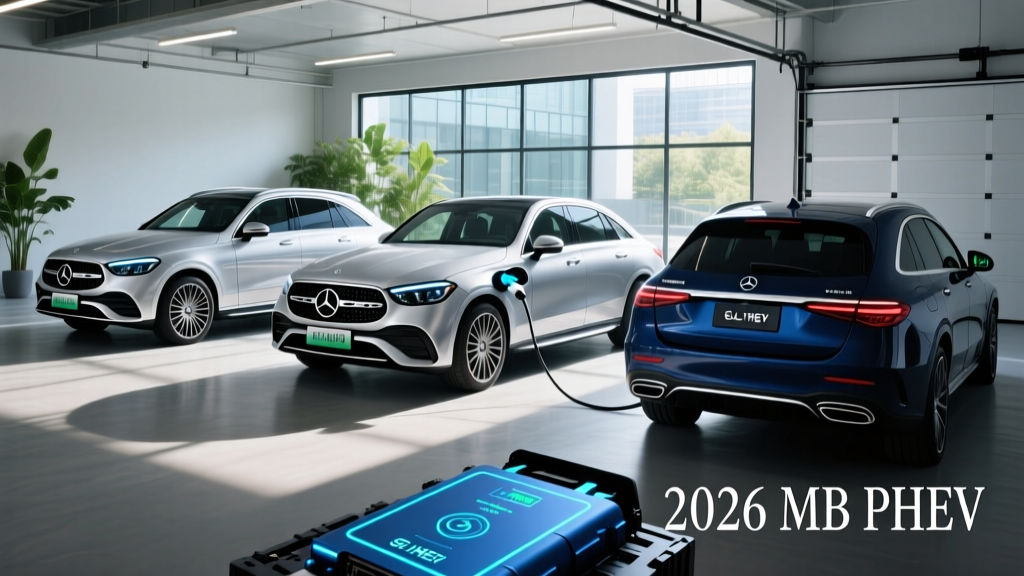
Mercedes-Benz has committed more aggressively to plug-in hybrid electric vehicles (PHEVs) than almost any other luxury automaker. For the 2026 model year, the three-pointed star offers PHEV variants across its most popular nameplates — from the compact GLC SUV to the flagship S-Class sedan. These vehicles pair turbocharged engines with substantial battery packs and electric motors, delivering between 22 and 54 miles of electric-only driving before the gasoline engine takes over.
This guide covers every current Mercedes-Benz plug-in hybrid available in the United States, with exact EPA figures, battery specifications, charging times, pricing, and federal tax credit eligibility under current IRS §30D rules. Whether you're cross-shopping a GLC 350e against a pure EV or weighing an S 580e against a conventional hybrid, the data below will help you decide.
Quick Refresher: HEV vs. PHEV — What's the Difference?
Conventional Hybrid (HEV): A small battery recharged by regenerative braking and the engine. You never plug it in. Electric-only driving is minimal (typically under 1 mile). Example: Toyota RAV4 Hybrid.
Plug-In Hybrid (PHEV): A larger battery (typically 15–30+ kWh) that you charge via a wall outlet or charging station. Delivers meaningful electric-only range (20–55+ miles) before the gas engine engages. Example: Mercedes-Benz GLC 350e.
Battery Electric Vehicle (BEV): No gasoline engine at all. Runs entirely on a large battery pack (60–100+ kWh). Example: Mercedes-Benz EQB or Tesla Model Y.
2026 Mercedes-Benz PHEV Models: Full Spec Comparison
| Model | Body Style | Battery (kWh usable) | EV Range (EPA mi) | Combined HP | 0–60 mph | MPG (gas-only) | MSRP (base) |
|---|---|---|---|---|---|---|---|
| GLC 350e 4MATIC | Compact SUV | 25.4 kWh (NMC) | 39 mi | 312 hp | 6.5 sec | 25/32/28 | $59,950 |
| S 580e 4MATIC | Full-size sedan | 22.7 kWh (NMC) | 38 mi | 502 hp | 4.9 sec | 22/29/25 | $124,850 |
| GLE 450e 4MATIC | Midsize SUV | 23.3 kWh (NMC) | 45 mi | 375 hp | 5.8 sec | 22/27/24 | $73,450 |
| C 300e (RWD) | Compact sedan | 25.4 kWh (NMC) | 54 mi | 312 hp | 6.1 sec | 27/35/30 | $56,550 |
Note: EPA figures sourced from fueleconomy.gov. EV range reflects combined city/highway driving. Real-world electric range in cold weather (below 32°F) typically drops 20–35% due to cabin heating demands and reduced battery chemistry efficiency.
Electric-Only Range: How Far Can Each Mercedes PHEV Go?
The headline advantage of a Mercedes-Benz plug-in hybrid over a conventional hybrid is usable electric-only range. Here's how each model performs:
- C 300e: 54 miles EPA electric-only — enough for most daily commutes without burning a drop of gasoline. This is class-leading among luxury compact PHEV sedans.
- GLE 450e: 45 miles EPA — covers the average American one-way commute (approximately 16 miles per the U.S. Census Bureau) with substantial buffer for errands.
- GLC 350e: 39 miles EPA — realistic for school runs, grocery trips, and moderate commutes.
- S 580e: 38 miles EPA — impressive for a 5,000+ lb flagship sedan with a twin-turbo V6.
Real-World Electric Range vs. EPA Sticker
EPA electric-range figures assume moderate temperatures, mixed driving, and no extreme HVAC load. Expect the following adjustments:
- Highway-only at 75 mph: Subtract 15–25% (aerodynamic drag is higher at speed, and regen braking opportunities are fewer).
- Cold weather (20–32°F): Subtract 20–35% (battery resistance increases, cabin heater draws 2–5 kW).
- Hot weather with A/C: Subtract 5–10%.
- City driving in mild weather: You may exceed the EPA figure by 5–15% thanks to frequent regenerative braking.
For the GLC 350e's 39-mile EPA rating, plan on roughly 28–32 miles of real-world electric range in winter highway driving, but potentially 42+ miles on a mild spring day in stop-and-go traffic.
Charging the Battery: Level 1, Level 2, and DC Fast Charging
Every 2026 Mercedes-Benz PHEV comes with a J1772/CCS-compatible charge port. Here's what charging looks like in practice:
| Charging Level | Power (kW) | Time to Full (approx.) | Miles of EV Range per Hour | Where You'll Find It |
|---|---|---|---|---|
| Level 1 (120V household) | 1.4 kW | 16–20 hours | 3–5 mi/hr | Any standard outlet |
| Level 2 (240V home/public) | 7.2–9.6 kW (varies by model) | 2.5–4 hours | 15–22 mi/hr | Home wallbox, workplace, shopping centers |
| DC Fast Charge | Not available on most trims* | N/A | N/A | N/A |
*The S 580e offers optional DC fast charging at up to 60 kW (0–80% in approximately 20 minutes) on certain packages. The GLC 350e, GLE 450e, and C 300e are limited to AC Level 2 charging. This is a common limitation among PHEVs — the smaller battery means DC fast charging is less critical than it is for a full BEV, but it does limit your ability to top up quickly on road trips.
Home charging recommendation: A 240V Level 2 home charger (such as a ChargePoint Home Flex or Mercedes-Benz branded wallbox) is strongly recommended. At 7.2 kW, the GLC 350e's 25.4 kWh battery charges from 10–100% in roughly 3 hours — plug in when you get home, and it's full by morning. Installation costs typically run $500–$1,500 for the charger plus $500–$2,000 for electrician labor, depending on your panel capacity and run length.
Powertrain Details: Engine + Electric Motor Specs
Mercedes-Benz PHEVs pair a turbocharged gasoline engine with a permanently excited synchronous electric motor integrated into the transmission housing. The combined system output is what matters:
GLC 350e 4MATIC
- 2.0L turbocharged inline-4: 215 hp
- Electric motor: 134 hp
- Combined system output: 312 hp / 406 lb-ft torque
- 9G-TRONIC 9-speed automatic, 4MATIC all-wheel drive
S 580e 4MATIC
- 3.0L turbocharged inline-6: 362 hp
- Electric motor: 148 hp
- Combined system output: 502 hp / 516 lb-ft torque
- 9G-TRONIC 9-speed automatic, 4MATIC all-wheel drive
GLE 450e 4MATIC
- 2.0L turbocharged inline-4: 255 hp
- Electric motor: 134 hp
- Combined system output: 375 hp / 479 lb-ft torque
- 9G-TRONIC 9-speed automatic, 4MATIC all-wheel drive
C 300e
- 2.0L turbocharged inline-4: 201 hp
- Electric motor: 127 hp
- Combined system output: 312 hp / 406 lb-ft torque
- 9G-TRONIC 9-speed automatic, rear-wheel drive
In EV mode, the engine decouples entirely, providing silent, zero-tailpipe-emission driving. When you demand full acceleration, both power sources combine for the rated horsepower. The transition between electric and gas is seamless — most drivers won't feel the engine engage.
Fuel Economy: EPA MPG and Real-World Expectations
| Model | EV Mode (MPGe) | Gas-Only City | Gas-Only Highway | Gas-Only Combined | Total Combined Range |
|---|---|---|---|---|---|
| GLC 350e | 65 MPGe | 25 | 32 | 28 | ~450 mi |
| S 580e | 56 MPGe | 22 | 29 | 25 | ~470 mi |
| GLE 450e | 58 MPGe | 22 | 27 | 24 | ~510 mi |
| C 300e | 72 MPGe | 27 | 35 | 30 | ~490 mi |
Real-world MPG vs. EPA: Hybrid and PHEV fuel economy often exceeds EPA estimates in city driving, where regenerative braking recaptures energy at every stop. On the highway, however, aerodynamic drag dominates and there's less regen opportunity — expect highway MPG to match or slightly fall below EPA figures. In mixed suburban driving with regular charging, many PHEV owners report going weeks without visiting a gas station.
The charging discipline factor: A PHEV's fuel economy depends entirely on how often you charge. If you plug in nightly and drive under 40 miles per day, you may use almost no gasoline. If you never plug in, you're driving a heavy conventional hybrid and will see MPG at or slightly below the gas-only figures above. PHEVs reward charging habits.
Pricing, Trims, and Federal Tax Credit Eligibility
Mercedes-Benz PHEVs carry a price premium over their gas-only counterparts, justified by the larger battery, electric motor, and added complexity. Here's the pricing landscape for 2026:
- C 300e: Starting at $56,550 (vs. ~$48,000 for the gas C 300)
- GLC 350e 4MATIC: Starting at $59,950 (vs. ~$49,000 for the gas GLC 300)
- GLE 450e 4MATIC: Starting at $73,450 (vs. ~$62,000 for the gas GLE 350)
- S 580e 4MATIC: Starting at $124,850 (vs. ~$118,000 for the gas S 500)
Federal Tax Credit Eligibility Under IRS §30D (2026 Rules)
The federal Clean Vehicle Credit provides up to $7,500 for qualifying new PHEVs, but strict requirements apply:
- MSRP cap: SUVs (GLC, GLE) must have an MSRP at or below $80,000. Sedans (C-Class, S-Class) must be at or below $55,000. This means the S 580e ($124,850) and most GLE 450e configurations do NOT qualify. The C 300e at $56,550 slightly exceeds the sedan cap at base — check your exact configuration.
- Battery capacity: Must be at least 7 kWh. All Mercedes PHEVs exceed this (22.7–25.4 kWh).
- Income limits: Modified AGI must not exceed $150,000 (single), $225,000 (head of household), or $300,000 (joint).
- Battery sourcing & critical minerals: A percentage of battery components must be manufactured or assembled in North America, and critical minerals must be sourced from the U.S. or FTA partners. These percentages increase annually. Mercedes-Benz has been working to localize supply chains, but eligibility can vary by model year and build date.
- Point-of-sale transfer: As of 2024, you can transfer the credit to the dealer at purchase, reducing your out-of-pocket cost immediately rather than waiting for tax filing.
Always verify current eligibility on fueleconomy.gov and consult a tax professional. Rules change, and individual circumstances vary.
Battery Warranty, Reliability, and Replacement Cost
Mercedes-Benz PHEV Battery Warranty
- High-voltage battery warranty: 6 years / 62,000 miles (whichever comes first) — this is shorter than the 8-year/100,000-mile standard you'll find on many competitors, including Toyota and Hyundai.
- Capacity retention threshold: Mercedes-Benz warrants the battery against falling below 70% of original capacity during the warranty period.
- Powertrain warranty: 4 years / 50,000 miles (standard Mercedes limited warranty).
Battery replacement cost: Out-of-warranty high-voltage battery replacement for a Mercedes PHEV typically ranges from $12,000 to $18,000 depending on the model, plus labor. This is a real consideration for long-term ownership, though PHEV batteries are smaller and less expensive to replace than full BEV packs.
Reliability track record: Mercedes-Benz PHEV powertrains have been generally reliable in the field, with the 9G-TRONIC transmission and turbocharged engines being well-proven designs. The primary risk areas are the high-voltage battery (degradation over 8–12 years) and the power electronics that manage the dual power sources. According to J.D. Power and Consumer Reports data, Mercedes-Benz brand reliability has been middling in recent years — not class-leading like Lexus or Toyota, but not problematic like some European competitors. The PHEV systems themselves have not shown widespread failure patterns.
Mercedes PHEV vs. Full EV vs. Gas: Which Is Right for You?
Choose a Mercedes-Benz PHEV if:
- Your daily driving is under 40–50 miles and you can charge at home or work every day.
- You regularly take road trips over 200 miles and don't want to plan around DC fast-charging infrastructure.
- You want to reduce gasoline consumption and emissions without committing to a full EV.
- You live in a region with harsh winters where EV range loss is a concern — the gas engine is your backup.
- You want a Mercedes-Benz specifically and aren't ready for the EQ electric lineup.
Choose a full EV (BEV) if:
- You have reliable home Level 2 charging and rarely drive more than 250 miles in a single day.
- You want zero tailpipe emissions and minimal maintenance (no oil changes, no spark plugs, no transmission fluid).
- You want access to the full $7,500 federal tax credit (more BEVs qualify than PHEVs under current sourcing rules).
- You're willing to plan road-trip charging stops (or primarily use Tesla Superchargers with a NACS-equipped vehicle).
Choose a conventional gas vehicle (or HEV) if:
- You cannot charge at home (apartment, street parking, no garage).
- Your budget doesn't accommodate the PHEV price premium.
- You drive very high annual mileage where the PHEV premium won't pay back through fuel savings.
- You prefer simplicity and don't want to manage charging habits.
Pros of Mercedes-Benz PHEVs
- 38–54 miles of electric-only range covers most daily driving
- Seamless gas-engine backup eliminates range anxiety
- Luxury interior, ride quality, and technology on par with gas models
- Strong combined horsepower for confident acceleration
- Lower operating costs when charged regularly
- Qualifies for some state HOV lane access and local incentives
Cons of Mercedes-Benz PHEVs
- $7,000–$11,000 price premium over equivalent gas models
- No DC fast charging on most models (S 580e excepted)
- Battery warranty (6 yr/62k mi) is shorter than many competitors
- Added weight from battery and motor reduces gas-only MPG vs. non-hybrid
- Federal tax credit eligibility is limited by MSRP caps and sourcing rules
- Two powertrains mean two systems that can require maintenance
Frequently Asked Questions
How many MPG does a Mercedes-Benz plug-in hybrid get?
Gas-only MPG varies by model: the C 300e achieves 27 city / 35 highway / 30 combined when running on gasoline alone. The GLC 350e gets 25/32/28. When driven primarily on electric power with regular charging, effective fuel economy can exceed 60–70 MPGe. Your actual MPG depends heavily on how often you charge and your driving mix.
How far can a Mercedes PHEV go on electric only?
The C 300e leads the lineup at 54 miles EPA electric-only, followed by the GLE 450e at 45 miles, the GLC 350e at 39 miles, and the S 580e at 38 miles. Real-world range varies with temperature, driving style, and HVAC use — expect 15–35% less in cold winter conditions.
Does a Mercedes-Benz plug-in hybrid qualify for the $7,500 federal tax credit?
It depends on the model and your specific situation. The GLC 350e at $59,950 is under the $80,000 SUV MSRP cap and may qualify if battery sourcing requirements are met. The S 580e at $124,850 exceeds all caps and does not qualify. The C 300e sedan slightly exceeds the $55,000 sedan cap. Income limits ($150K single / $300K joint) also apply. Always check IRS.gov and fueleconomy.gov for the most current eligibility before purchasing.
Is a Mercedes PHEV battery reliable, and what does replacement cost?
Mercedes PHEV batteries have shown reasonable reliability, with no widespread failure patterns reported. The high-voltage battery is warrantied for 6 years / 62,000 miles against dropping below 70% capacity. Out-of-warranty replacement costs $12,000–$18,000 depending on the model. With proper care (avoiding frequent 100% charges and deep discharges), PHEV batteries typically last 10–15 years before significant degradation.
Do I need to charge a Mercedes PHEV, or does the engine charge the battery?
You should plug in your Mercedes PHEV to get the full benefit of its electric range. While the gasoline engine and regenerative braking do recharge the battery during driving, this is far less efficient and economical than plugging in. If you never plug in, you're carrying a heavy battery for no benefit and will see fuel economy at or below the gas-only EPA rating. PHEVs reward daily charging.
Can a Mercedes PHEV DC fast charge?
Most 2026 Mercedes-Benz PHEVs (GLC 350e, GLE 450e, C 300e) are limited to AC Level 2 charging at up to 9.6 kW. The S 580e offers optional DC fast charging at up to 60 kW, which can take the battery from 0–80% in approximately 20 minutes. For most PHEV owners, overnight Level 2 home charging is sufficient given the smaller battery size.
Mercedes PHEV vs. a full EV like the EQE — which should I buy?
If you can charge at home and your daily driving stays under 250 miles, the EQE sedan (EPA range ~305 miles) offers a smoother, quieter, lower-maintenance experience with zero tailpipe emissions. Choose the PHEV if you frequently take long road trips, lack reliable public charging access in your area, or simply want the flexibility of a gas engine as backup. The PHEV is the pragmatic bridge; the BEV is the destination.