Why Mercedes-Benz PHEVs Deserve a Closer Look in 2026
Mercedes-Benz has invested heavily in plug-in hybrid technology, offering PHEV variants across its core lineup — from the compact GLC to the flagship S-Class and the midsize GLE SUV. For buyers not yet ready to commit to a battery-electric vehicle (BEV) but who want meaningful electric-only commuting, a Mercedes-Benz PHEV bridges the gap: short daily drives on grid electricity, with a gasoline engine eliminating range anxiety on longer trips.
This guide breaks down the current 2026 Mercedes-Benz PHEV portfolio with exact EPA figures, battery specifications, charging times, pricing, and tax credit eligibility. We'll also clarify where PHEVs differ from conventional hybrids (HEVs) and full EVs — so you can choose the right electrified powertrain for your driving pattern.
HEV vs PHEV vs EV: Which Mercedes-Benz Powertrain Fits You?
Before diving into specific models, it's critical to understand the three electrified options Mercedes-Benz offers and how they differ fundamentally.
| Attribute | HEV (Conventional Hybrid) | PHEV (Plug-In Hybrid) | BEV (Battery Electric) |
|---|---|---|---|
| Plugs in? | No — charges via engine & regen | Yes — Level 2 or DC fast charge | Yes — Level 2 or DC fast charge |
| Electric-only range | ~1 mi or less (low-speed assist) | 30–50+ mi (varies by model) | 200–400+ mi |
| Gas engine | Yes — always available | Yes — always available | No |
| Fueling | Gasoline only | Gasoline + electricity | Electricity only |
| Federal tax credit (§30D) | No | Up to $3,750 (if eligible) | Up to $7,500 (if eligible) |
| Best for | No home charging, want better MPG | Home charging + long trips | Home charging, mostly <250 mi trips |
A conventional hybrid (HEV) never plugs in. It uses a small battery charged by the engine and regenerative braking to assist acceleration and enable brief low-speed electric operation. You simply fill up with gas. A plug-in hybrid (PHEV) has a much larger battery (typically 20–30 kWh in Mercedes models) that you charge from the grid, enabling 30–50 miles of pure electric driving before the gas engine takes over. A battery-electric vehicle (BEV) has no gas engine at all.
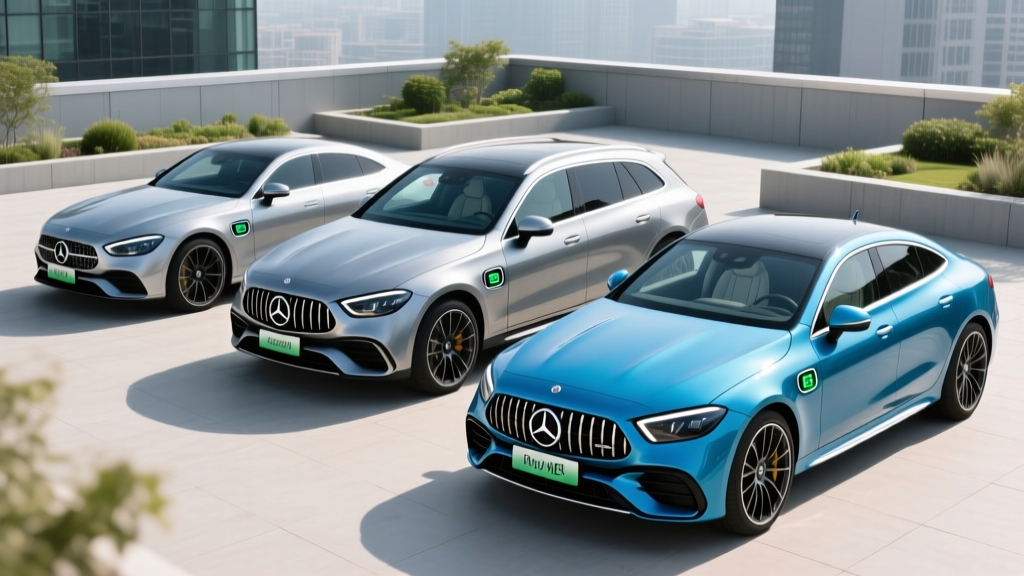
Mercedes-Benz currently offers PHEV variants in the U.S. market for the GLC 350e, S 580e, and GLE 450e. Conventional HEV options are limited in the U.S. lineup — most non-plug-in Mercedes models use a 48-volt mild-hybrid system (EQ Boost) that assists the engine but provides no meaningful electric-only range.
2026 Mercedes-Benz PHEV Lineup: Specifications at a Glance
| Spec | GLC 350e 4MATIC | S 580e 4MATIC | GLE 450e 4MATIC |
|---|---|---|---|
| Body style | Compact luxury SUV | Full-size luxury sedan | Midsize luxury SUV |
| Engine | 2.0L turbo I4 + electric motor | 3.0L turbo I6 + electric motor | 2.0L turbo I4 + electric motor |
| Combined HP | 312 hp | 443 hp | 375 hp |
| Combined torque | 406 lb-ft | 443 lb-ft | 479 lb-ft |
| Battery (usable kWh) | ~23.3 kWh (NMC) | ~28.6 kWh (NMC) | ~23.3 kWh (NMC) |
| EPA electric-only range | ~40 mi | ~37 mi | ~45 mi |
| EPA combined MPGe (electric) | ~66 MPGe | ~58 MPGe | ~56 MPGe |
| EPA MPG (gas, combined) | ~27 MPG | ~27 MPG | ~23 MPG |
| Total combined range | ~430 mi | ~480 mi | ~440 mi |
| Level 2 charge time (0–100%) | ~2.5 hr (11 kW onboard) | ~3 hr (11 kW onboard) | ~2.5 hr (11 kW onboard) |
| DC fast charge capable | Yes (optional, up to 60 kW) | Yes (standard, up to 60 kW) | Yes (optional, up to 60 kW) |
| 0–60 mph | 6.5 sec | 4.9 sec | 5.8 sec |
| Starting MSRP | ~$59,800 | ~$120,950 | ~$72,750 |
| Drivetrain | AWD (4MATIC) | AWD (4MATIC) | AWD (4MATIC) |
Source: fueleconomy.gov and Mercedes-Benz USA. Specs reflect 2026 model year; verify with dealer as configurations may vary.
Electric-Only Range: What You'll Actually Get
The EPA electric-only range figures above (37–45 miles) represent ideal combined-cycle testing. In real-world driving, expect variation:
- City / stop-and-go: Often matches or slightly exceeds EPA estimates thanks to regenerative braking recapturing energy at low speeds.
- Highway (70+ mph): Expect 20–30% less electric range — roughly 28–35 miles for the GLC 350e, 25–30 miles for the S 580e, and 32–38 miles for the GLE 450e. Aerodynamic drag at highway speeds drains the battery faster.
- Cold weather (below 35°F): Battery chemistry becomes less efficient and cabin heating draws significant power. Expect 25–40% range reduction. The GLC 350e may deliver only 24–30 electric miles on a frigid January morning.
- Hilly terrain: Climbing consumes energy rapidly; descending recovers some via regen, but net range typically drops 10–20%.
Real-world tip: If your daily commute is under 30 miles round-trip and you charge at home nightly, you may drive months without burning a drop of gasoline — even with cold-weather range loss. Many PHEV owners report using only 2–4 tanks of gas per year when they charge consistently.
Once the battery depletes, the gasoline engine engages seamlessly. The GLC 350e returns approximately 27 MPG combined as a hybrid, the S 580e around 27 MPG, and the GLE 450e approximately 23 MPG. These are respectable figures for their respective vehicle classes, though they don't match a dedicated hybrid like the Toyota RAV4 Hybrid (39 MPG combined).
Charging: Speeds, Connectors, and Home Setup
All three Mercedes-Benz PHEVs use a J1772 connector for Level 2 AC charging. The onboard charger is rated at 11 kW, meaning a full charge from empty on a Level 2 home charger (240V, 48A circuit) takes approximately 2.5 to 3 hours.
| Charging Level | Power (kW) | Time to Full (approx.) | Availability |
|---|---|---|---|
| Level 1 (120V household outlet) | ~1.4 kW | ~18–22 hours | Standard — included cord |
| Level 2 (240V home/public) | Up to 11 kW | ~2.5–3 hours | Home install or public stations |
| DC Fast Charge (where equipped) | Up to 60 kW | ~30 min (10–80%) | Optional on GLC/GLE, standard on S 580e |
DC fast charging is a notable PHEV advantage for Mercedes. The S 580e includes DC fast charging capability (up to 60 kW via CCS connector) as standard, while it's optional on the GLC 350e and GLE 450e. At 60 kW, you can recharge from 10–80% in roughly 30 minutes — useful on road trips if you want to maximize electric driving at your destination. However, 60 kW is far slower than a modern BEV's 150–350 kW peak rate; this is topping up a small battery, not filling a 100 kWh pack.
Home charging recommendation: A Level 2 home charger (such as a ChargePoint Home Flex or Wallbox Pulsar Plus) on a 48A / 60A circuit will fully recharge any of these PHEVs overnight — typically in under 3 hours. Installation costs range from $500 to $2,500 depending on your electrical panel's proximity to the garage and whether a panel upgrade is needed. Most PHEV owners find Level 2 essential; Level 1 (standard outlet) is too slow for daily turnover if your electric range is 30–45 miles.
Fuel Economy Breakdown: EPA vs Real-World MPG
| Model | EPA City MPG (gas) | EPA Highway MPG (gas) | EPA Combined MPG (gas) | MPGe (electric) |
|---|---|---|---|---|
| GLC 350e 4MATIC | ~25 | ~30 | ~27 | ~66 MPGe |
| S 580e 4MATIC | ~24 | ~31 | ~27 | ~58 MPGe |
| GLE 450e 4MATIC | ~21 | ~26 | ~23 | ~56 MPGe |
Source: fueleconomy.gov
Real-world MPG dynamics: Like most hybrids and PHEVs, Mercedes PHEVs tend to slightly exceed their EPA city MPG estimates in stop-and-go traffic, where regenerative braking recovers energy that would otherwise be wasted as heat. Highway MPG, however, often falls 1–3 MPG below the EPA sticker due to aerodynamic drag and sustained high-speed operation.
The critical variable is charging frequency. A PHEV's fuel economy is entirely dependent on how often you plug in. If you charge nightly and drive under 35 miles daily, your effective fuel consumption may be near zero for months. If you never plug in, you're carrying 400–600 lbs of dead battery weight and getting only the gas-only MPG figures above — which, for the GLE 450e at 23 MPG combined, is worse than a conventional gas GLE. The PHEV only saves fuel if you actually use the plug.
Performance and Powertrain Details
Mercedes-Benz PHEVs are not economy-first hybrids — they're performance-oriented luxury vehicles that happen to have electric assist. The integrated electric motors provide instant torque fill at low RPM, eliminating turbo lag and delivering smooth, linear acceleration.
- GLC 350e: The 2.0L turbo four-cylinder paired with a 134-hp electric motor produces a combined 312 hp and 406 lb-ft of torque. The 0–60 mph sprint takes 6.5 seconds — brisk for a compact luxury SUV. The electric motor is integrated into the 9-speed automatic transmission, providing seamless power blending.
- S 580e: The 3.0L turbocharged inline-six plus a 148-hp electric motor yields 443 hp and 443 lb-ft. Zero to 60 mph takes 4.9 seconds — genuinely quick for a full-size luxury sedan. The inline-six's smoothness combined with silent electric operation makes the S 580e one of the most refined PHEVs on the market.
- GLE 450e: The 2.0L turbo four plus electric motor delivers 375 hp and a robust 479 lb-ft of torque. The 0–60 time of 5.8 seconds is strong, and the high torque figure gives the GLE confident passing power and towing capability (up to 7,700 lbs when properly equipped).
All three models feature Mercedes' 4MATIC all-wheel drive and multiple drive modes, including an "Electric" mode that maximizes battery-only operation and a "Battery Hold" mode that preserves charge for later use — useful when entering a city center after a highway stretch.
Pricing, Tax Credits, and Total Cost of Ownership
Here's what the 2026 Mercedes-Benz PHEV lineup costs before incentives:
- GLC 350e 4MATIC: Starting at ~$59,800 (well-equipped models: $65,000–$72,000)
- S 580e 4MATIC: Starting at ~$120,950 (optioned examples: $130,000–$145,000+)
- GLE 450e 4MATIC: Starting at ~$72,750 (typical transaction: $78,000–$88,000)
Federal Tax Credit (§30D) Eligibility
Under current IRS §30D rules, plug-in hybrids may qualify for a federal tax credit of up to $3,750 — but eligibility depends on several conditions that change frequently:
- MSRP cap: SUVs (GLC, GLE) must have an MSRP at or below $80,000; sedans (S-Class) must be at or below $55,000. The S 580e at ~$120,950 exceeds the sedan cap and does not qualify. The GLC 350e and GLE 450e base MSRPs fall under the SUV cap, but optioned models may exceed it.
- Buyer income cap: Modified adjusted gross income must not exceed $150,000 (single), $225,000 (head of household), or $300,000 (joint filing).
- Battery sourcing: A percentage of critical minerals and battery components must be sourced from the U.S. or free-trade-agreement countries. This requirement tightens annually. As of 2026, many European-built vehicles face reduced or zero credit due to sourcing restrictions.
- Point-of-sale transfer: Eligible buyers can transfer the credit to the dealer at purchase, reducing the sale price directly rather than waiting for a tax refund.
Bottom line: Do not assume a flat $7,500 or even $3,750 credit. Verify current eligibility on fueleconomy.gov and consult a tax professional before purchase. Mercedes-Benz PHEVs generally receive a smaller credit than qualifying BEVs, and some configurations may receive nothing.
5-Year Ownership Cost Estimate
Compared to their gasoline counterparts (GLC 300, S 500, GLE 350), the PHEV variants carry a $5,000–$10,000 price premium. However, fuel savings can be substantial if you charge regularly:
- Electricity cost: At $0.15/kWh (national average), fully charging the GLC 350e's ~23.3 kWh battery costs about $3.50 — for 30–40 miles of driving, or roughly $0.09–$0.12 per mile.
- Gasoline cost: At $3.50/gallon and 27 MPG, the gas-only cost is about $0.13 per mile.
- Annual savings: If you drive 12,000 miles/year and charge for 80% of them, you might save $600–$900 annually on fuel versus the gas model. Over 5 years: $3,000–$4,500 in fuel savings, partially offsetting the purchase premium.
Insurance premiums for PHEVs tend to run 5–15% higher than their gas counterparts due to higher repair costs and vehicle values.
Reliability, Battery Warranty, and Long-Term Costs
Mercedes-Benz High-Voltage Battery Warranty: All 2026 Mercedes-Benz PHEVs come with a high-voltage battery warranty of 6 years or 62,000 miles (whichever comes first), covering defects and capacity loss below 70% of original capacity. This is shorter than the 8-year/100,000-mile warranty typical of most competitors (Toyota, Hyundai, BMW). Verify current terms with your dealer.
Battery degradation: Mercedes uses NMC (nickel-manganese-cobalt) lithium-ion cells in its PHEVs. Based on industry data for NMC chemistry in PHEV applications, expect approximately 10–15% capacity loss over 8–10 years of typical use. Because PHEV batteries are smaller and cycled more frequently than BEV batteries, thermal management is critical. Mercedes employs active liquid cooling/heating to mitigate degradation.
Battery replacement cost: Out-of-warranty high-voltage battery replacement for a Mercedes PHEV typically ranges from $8,000 to $15,000 depending on the model, including parts and labor. This is a significant potential cost, though few owners report needing replacement within the first 10 years. The smaller battery size (compared to a BEV) keeps replacement costs lower than a full EV battery swap.
General reliability: Mercedes-Benz PHEV powertrains have proven reasonably reliable, though the added complexity of dual powertrains (electric motor + combustion engine + high-voltage battery + power electronics) means more potential failure points than a pure BEV or a simple HEV. Common issues reported by owners include software glitches in the energy management system and occasional charging port communication errors. The gasoline engine and 9-speed transmission are well-proven components from the broader Mercedes lineup.
Who Should Choose a Mercedes-Benz PHEV (and Who Shouldn't)
Choose a Mercedes-Benz PHEV If:
- You can install a Level 2 charger at home and your daily commute is under 40 miles
- You regularly take road trips over 200 miles and don't want to rely on public charging infrastructure
- You want a luxury vehicle with electric daily driving but aren't ready for a full BEV
- You value the seamless power delivery of electric assist combined with a refined gasoline engine
- You live in an area with limited DC fast charging infrastructure
Consider a Full BEV or Gas Car Instead If:
- You cannot charge at home or work — a PHEV without charging is just a heavier, more expensive gas car
- Your daily driving consistently exceeds 50 miles — you'll burn gas every day and the electric range becomes less impactful
- You want to maximize federal tax credits — most BEVs qualify for higher credits than PHEVs
- You want the lowest possible maintenance cost — a BEV eliminates oil changes, spark plugs, and exhaust system maintenance entirely
- You prioritize maximum cargo space — PHEV battery packaging can reduce cargo volume versus gas variants (check specific model)
The bottom line: A Mercedes-Benz PHEV makes the most sense for luxury buyers who have reliable home charging, drive under 40 miles daily on most days, but take several long road trips per year. If you can't charge at home, skip the PHEV premium and buy the gasoline model. If you can charge at home and rarely drive over 200 miles, a BEV like the Mercedes EQE or EQS will deliver greater fuel savings and a larger tax credit.
Frequently Asked Questions
How many MPG does a Mercedes-Benz PHEV get?
On gasoline alone (after the battery is depleted), the 2026 GLC 350e achieves approximately 27 MPG combined (25 city / 30 highway), the S 580e gets about 27 MPG combined (24 city / 31 highway), and the GLE 450e returns roughly 23 MPG combined (21 city / 26 highway). When operating on electricity, efficiency is measured in MPGe: 56–66 MPGe depending on the model.
How far can a Mercedes-Benz PHEV go on electric only?
EPA-rated electric-only range is approximately 40 miles for the GLC 350e, 37 miles for the S 580e, and 45 miles for the GLE 450e. Real-world range varies: expect 25–35 miles at highway speeds, and 20–30 miles in cold weather (below 35°F). City driving with regenerative braking often matches or slightly exceeds the EPA figure.
Do Mercedes-Benz PHEVs qualify for a federal tax credit?
They may qualify for up to $3,750 under IRS §30D, but eligibility depends on MSRP caps (the S 580e exceeds the $55,000 sedan cap and does not qualify), buyer income limits, and battery component/critical mineral sourcing requirements that tighten annually. Always verify current eligibility on fueleconomy.gov and consult a tax professional before purchasing.
Is the Mercedes-Benz PHEV battery reliable, and what does replacement cost?
Mercedes covers the high-voltage battery with a 6-year/62,000-mile warranty (capacity retention above 70%). NMC chemistry in PHEV applications typically shows 10–15% degradation over 8–10 years. Out-of-warranty replacement costs range from approximately $8,000 to $15,000 depending on the model. Active thermal management helps extend battery life, but the PHEV's smaller battery cycles more frequently than a BEV's, which can accelerate wear.
Can I charge a Mercedes-Benz PHEV at a DC fast charger?
Yes — the S 580e includes DC fast charging capability (up to 60 kW, CCS connector) as standard equipment. The GLC 350e and GLE 450e offer DC fast charging as an option. At 60 kW, a 10–80% charge takes approximately 30 minutes. Note that DC fast charging capability is not universal on PHEVs — many competitors (BMW X5 xDrive50e, Toyota RAV4 Prime) offer only Level 2 AC charging.
What's the difference between the Mercedes 48V mild-hybrid system and a PHEV?
The 48-volt EQ Boost system found in many non-PHEV Mercedes models (like the GLC 300 or E 350) uses a small integrated starter-generator to provide brief torque assist (~20 hp for a few seconds) and enable smoother stop-start operation. It does not provide meaningful electric-only driving range and cannot be plugged in. A PHEV has a much larger high-voltage battery (23–29 kWh vs ~1 kWh), a more powerful electric motor (134–148 hp vs ~20 hp), and 30–45 miles of genuine electric-only range.
Should I buy a Mercedes-Benz PHEV or a full EV like the EQE?
If you have home charging, drive under 250 miles on most days, and want to eliminate gasoline entirely, the EQE sedan (EPA range ~300 miles) or EQE SUV (~270 miles) will offer lower operating costs, a larger federal tax credit (up to $7,500 if eligible), and zero tailpipe emissions. Choose the PHEV if you regularly exceed 300 miles per trip, frequently drive in areas with sparse charging infrastructure, or simply want the security blanket of a gasoline engine for long road trips.