Mercedes-Benz Hybrids in 2026: HEV vs PHEV Explained
If you're searching for a hybrid Benz, you're looking at one of the most electrified luxury lineups on the market — but not all Mercedes hybrids are created equal. For 2026, Mercedes-Benz offers two distinct flavors of electrification: conventional hybrids (HEVs) that never need plugging in, and plug-in hybrids (PHEVs) that deliver meaningful electric-only range before the gasoline engine kicks in. Understanding which type fits your driving pattern is the single most important decision before stepping into a dealership.
HEV vs PHEV: What's the Difference?
| Feature | Conventional Hybrid (HEV) | Plug-In Hybrid (PHEV) |
|---|---|---|
| Plugs in to charge? | No — charges via regenerative braking and engine | Yes — plug in for full electric range |
| Electric-only range | ~1 mile at low speed | 30–55 miles (model dependent) |
| Battery size | 1–2 kWh | 19–28 kWh usable |
| Federal tax credit | No | Potentially up to $7,500 (§30D) |
| Best for | Drivers who can't charge at home | Drivers with home/work charging who want EV-like daily commutes |
Mercedes-Benz has largely committed to the PHEV path for 2026, embedding its fourth-generation plug-in hybrid powertrain across the C-Class, E-Class, S-Class, GLC, and GLE families. The conventional mild-hybrid (EQ Boost 48-volt system) still appears on select AMG and inline-six models, but if you want the fuel-savings headline, the PHEV models are where the action is.
2026 Mercedes-Benz PHEV Lineup: Specs at a Glance
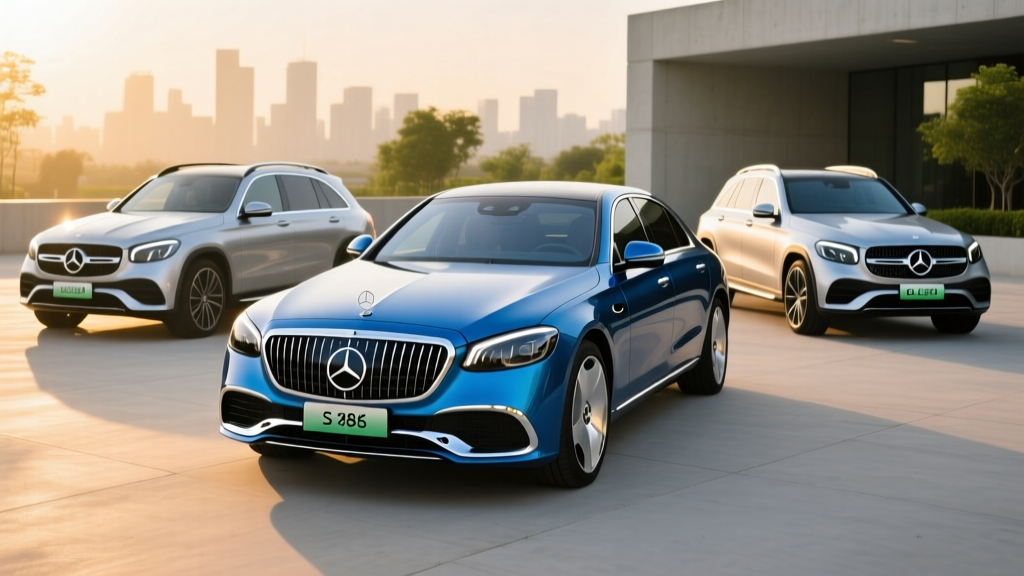
Below is the complete spec breakdown for every current Mercedes-Benz plug-in hybrid available in the U.S. for the 2026 model year. All figures reflect EPA-published data and Mercedes-Benz USA official specifications where available.
| Model | Powertrain | Combined HP | Battery (kWh usable) | EV Range (mi) | EPA MPGe | Combined MPG (gas) | Base MSRP |
|---|---|---|---|---|---|---|---|
| C 300e Sedan | 2.0L turbo I4 + electric motor | 312 hp | 25.4 kWh | ~54 mi | 80 MPGe | 35 MPG | $58,950 |
| E 350e Sedan | 2.0L turbo I4 + electric motor | 312 hp | 25.4 kWh | ~52 mi | 78 MPGe | 34 MPG | $68,500 |
| S 580e Sedan | 3.0L turbo I6 + electric motor | 442 hp | 28.6 kWh | ~48 mi | 65 MPGe | 28 MPG | $120,350 |
| GLC 350e SUV | 2.0L turbo I4 + electric motor | 312 hp | 25.4 kWh | ~45 mi | 72 MPGe | 31 MPG | $61,900 |
| GLE 350e SUV | 2.0L turbo I4 + electric motor | 302 hp | 23.3 kWh | ~48 mi | 56 MPGe | 24 MPG | $69,500 |
Sources: fueleconomy.gov, Mercedes-Benz USA press site. EV range and MPGe figures are EPA estimates; real-world results vary with temperature, terrain, and driving style.
Fuel Economy Deep Dive: Real-World MPG vs EPA Stickers
Mercedes-Benz PHEVs carry two separate efficiency ratings: an MPGe figure that accounts for electric-mode driving, and a standard MPG figure for gasoline-only operation once the battery is depleted. Here's how the numbers stack up in practice.
| Model | EPA City (gas) | EPA Highway (gas) | EPA Combined (gas) | Real-World Combined (gas) |
|---|---|---|---|---|
| C 300e | 37 MPG | 33 MPG | 35 MPG | 32–36 MPG |
| E 350e | 36 MPG | 32 MPG | 34 MPG | 30–34 MPG |
| S 580e | 30 MPG | 26 MPG | 28 MPG | 25–29 MPG |
| GLC 350e | 33 MPG | 29 MPG | 31 MPG | 28–32 MPG |
| GLE 350e | 26 MPG | 22 MPG | 24 MPG | 21–25 MPG |
The critical insight for PHEV buyers: if your daily commute falls within the electric-only range and you charge nightly, you may use almost zero gasoline. A C 300e owner with a 30-mile round-trip commute and home Level 2 charging could go months between fill-ups. Conversely, if you never plug in, you're simply driving a heavy, slightly less efficient hybrid — the S 580e returns roughly 25 MPG on the highway when running purely on its inline-six.
Real-World Electric Range Reality Check
EPA electric-only range is measured under ideal conditions. Expect 15–25% range reduction in cold weather (below 40°F) due to battery chemistry limitations and cabin heating demands. Highway driving at 75+ mph also cuts EV range by roughly 10–15% versus the EPA city-heavy test cycle. A GLC 350e rated at 45 miles EPA electric may deliver 34–38 miles on a cold winter highway commute.
Charging: How Long Does a Mercedes PHEV Take to Charge?
PHEV batteries are smaller than full EVs, so charging is faster — but not all Mercedes PHEVs support DC fast charging. Here's what to expect from the 2026 lineup's fourth-gen plug-in system.
| Charging Level | Power | Time (10–100%) | Miles of EV Range Added per Hour | Availability |
|---|---|---|---|---|
| Level 1 (120V household) | ~1.4 kW | ~18–22 hours | ~5–7 mi/hr | All models |
| Level 2 (240V home/public) | 7.4 kW (onboard charger) | ~3.5–4 hours | ~20–25 mi/hr | All models |
| DC Fast Charge (optional) | Up to 60 kW | ~30 min (10–80%) | N/A — session-based | Optional on most trims; standard on S 580e |
The 60 kW DC fast-charging capability is a standout feature. Most competing PHEVs from BMW and Audi top out at Level 2 AC charging. Mercedes' optional DC charging means you can replenish the battery during a lunch stop on a road trip — genuinely useful for drivers who want electric-mode driving on longer journeys.
Home charging setup: A 240V Level 2 wallbox (such as a ChargePoint Home Flex or Emporia Vue) installed on a 40-amp circuit will fully recharge any Mercedes PHEV overnight. Expect installation costs of $500–$1,500 if your electrical panel doesn't need an upgrade, per licensed electrician estimates.
Powertrain and Performance: Engine + Electric Motor Combined
Mercedes-Benz uses a P2 hybrid architecture across its PHEV lineup — the electric motor sits between the engine and the nine-speed automatic transmission (9G-TRONIC), allowing it to drive the wheels independently in EV mode or assist the engine under hard acceleration.
C 300e / E 350e / GLC 350e (2.0L I4 PHEV)
- Engine: 2.0L turbocharged inline-4, 201 hp / 236 lb-ft
- Electric motor: 129 hp / 325 lb-ft (integrated in transmission)
- Combined system output: 312 hp / 406 lb-ft
- 0–60 mph: 5.9 seconds (C 300e), 6.2 seconds (GLC 350e)
S 580e (3.0L I6 PHEV)
- Engine: 3.0L turbocharged inline-6 with EQ Boost, 362 hp / 369 lb-ft
- Electric motor: 148 hp / 325 lb-ft
- Combined system output: 442 hp / 516 lb-ft
- 0–60 mph: 5.0 seconds
GLE 350e (2.0L I4 PHEV)
- Engine: 2.0L turbocharged inline-4, 201 hp / 236 lb-ft
- Electric motor: 134 hp / 325 lb-ft
- Combined system output: 302 hp / 398 lb-ft
- 0–60 mph: 6.8 seconds
The electric motor's instant torque fills in the low-RPM gap before the turbo spools up, giving these PHEVs noticeably punchier off-the-line acceleration than their gas-only siblings. The S 580e in particular feels effortless — 442 hp in a luxury sedan that can commute silently on electric power.
Pricing, Tax Credits, and Total Cost of Ownership
Mercedes-Benz PHEVs carry a price premium over their gasoline counterparts, but the math can work in your favor — especially when factoring in fuel savings and potential tax incentives.
Federal Tax Credit Eligibility (§30D)
Under the current IRS §30D rules, plug-in hybrids with sufficient battery capacity can qualify for up to $7,500 in federal tax credits, split into two components: $3,750 for critical minerals sourcing and $3,750 for battery component manufacturing. However, eligibility is far from guaranteed and depends on several factors:
- MSRP cap: Sedans must be under $55,000; SUVs/vans/trucks under $80,000. This eliminates the S 580e and E 350e sedan from credit eligibility. The GLC 350e and GLE 350e (classified as SUVs) may qualify if under $80,000 MSRP.
- Buyer income cap: Modified AGI must not exceed $150,000 (single), $225,000 (head of household), or $300,000 (joint).
- Battery sourcing requirements: Critical minerals and battery components must meet increasing domestic/FtA-country sourcing thresholds that tighten annually through 2030.
- Point-of-sale transfer: Eligible buyers can transfer the credit to the dealer at purchase, reducing the out-of-pocket price immediately rather than waiting for tax filing.
- FEOC restriction: Vehicles with battery components from a "foreign entity of concern" (primarily Chinese suppliers) are disqualified — this has narrowed the eligible list significantly since 2024.
Always verify current eligibility on IRS.gov before purchasing. Rules change annually, and individual tax situations vary — consult a tax professional.
5-Year Ownership Cost Estimate
| Cost Category | GLC 350e PHEV | GLC 300 (Gas) | EQB 300 (Full EV) |
|---|---|---|---|
| Base MSRP | $61,900 | $48,250 | $54,500 |
| Est. Tax Credit | $0–$7,500* | $0 | $0–$7,500* |
| Fuel/Energy (5 yr / 75k mi) | ~$3,200 | ~$7,800 | ~$2,900 |
| Maintenance (5 yr) | ~$3,500 | ~$4,200 | ~$2,100 |
| Insurance (5 yr est.) | ~$12,500 | ~$10,800 | ~$11,900 |
| Est. Depreciation | ~$28,000 | ~$22,000 | ~$26,000 |
| 5-Year Total (est.) | ~$51,600–$59,100 | ~$51,050 | ~$47,500–$55,000 |
*Tax credit eligibility depends on sourcing rules, income caps, and MSRP caps. Fuel/energy costs based on national averages. Insurance estimates are approximate and vary by driver profile, state, and insurer.
The PHEV's advantage is flexibility: lower fuel costs than gas without the range limitations of a full EV. The trade-off is higher complexity (two powertrains to maintain) and a higher purchase price.
Battery Warranty, Reliability, and Replacement Costs
Battery longevity is the top concern for any hybrid buyer. Mercedes-Benz provides robust coverage, but understanding the fine print matters.
Mercedes-Benz PHEV Battery Warranty
- High-voltage battery warranty: 10 years or 155,000 miles (whichever comes first)
- Capacity retention threshold: Mercedes-Benz guarantees the battery will retain at least 70% of its original capacity during the warranty period. If degradation drops below this threshold, the battery will be repaired or replaced at no cost.
- Hybrid system components: Electric motor, power electronics, and onboard charger are covered under the same 10-year/155,000-mile warranty.
What About Replacement Cost?
Out-of-warranty high-voltage battery replacement for a Mercedes PHEV currently ranges from $12,000 to $18,000 depending on the model, including parts and labor. This is significantly less than a full EV battery replacement (which can exceed $20,000–$30,000) because PHEV batteries are smaller. However, real-world data from earlier-generation Mercedes PHEVs (2018–2022) suggests that the vast majority of batteries retain well above 85% capacity even at 100,000+ miles — catastrophic battery failure is rare.
Reliability Track Record
Mercedes-Benz PHEVs carry average-to-slightly-below-average reliability ratings from major evaluators. The complexity of managing two powertrains — a turbocharged engine plus high-voltage electric system — introduces more potential failure points than a pure EV or a conventional gas car. Common issues reported on earlier models include onboard charger faults, 12V auxiliary battery drain during extended EV-mode use, and software glitches in the hybrid management system. The 2026 fourth-generation system has shown improved stability based on early European-market data, but U.S.-specific long-term reliability remains to be established.
Safety ratings are strong: the GLC and S-Class platforms have earned top marks from both NHTSA and IIHS.
Mercedes-Benz Hybrid vs Full EV vs Gas: Which Should You Choose?
The right choice depends on your charging access, commute pattern, and willingness to adopt new technology. Here's a practical decision framework:
Choose a Mercedes PHEV If:
- You have access to Level 2 charging at home or work (essential to capture the EV-range benefit)
- Your daily commute is under 50 miles round-trip (you'll drive electric most days)
- You regularly take road trips over 200 miles and don't want to plan around DC fast-charger availability
- You want luxury, performance, and electric-mode commuting without full EV commitment
Choose a Full EV (e.g., EQE, EQS) If:
- You have reliable home charging and your daily driving is under 250 miles
- You want the lowest maintenance costs and zero tailpipe emissions
- You're comfortable with public DC fast-charging for road trips
Choose a Gas-Only Mercedes If:
- You cannot charge at home or work
- Your budget prioritizes lowest purchase price
- You drive in extreme cold climates where EV range loss is a consistent concern
Mercedes PHEV Pros
- 45–54 miles of real electric commuting range
- No range anxiety — gas engine covers long trips seamlessly
- Optional 60 kW DC fast charging (rare among PHEVs)
- Strong combined horsepower; electric torque fills turbo lag
- 10-year / 155,000-mile battery warranty
- Luxury interior, MBUX tech, and advanced ADAS standard
Mercedes PHEV Cons
- $10,000–$15,000 premium over gas-only equivalent trims
- Most sedans exceed the $55,000 MSRP cap for federal tax credit
- Heavier than gas-only models (reduces gas-only MPG slightly)
- Two powertrains = more maintenance complexity long-term
- Cargo space reduced by battery placement (especially trunk in sedans)
- EV range drops significantly in cold weather and at highway speeds
Frequently Asked Questions
How many MPG does a hybrid Mercedes-Benz get?
It depends on the model and whether you're driving in electric or gas mode. The C 300e PHEV achieves an EPA-rated 35 MPG combined on gasoline alone and 80 MPGe when factoring in electric driving. The S 580e returns 28 MPG combined on gas and 65 MPGe. Real-world gas-only MPG typically falls within 2–4 MPG of the EPA combined figure, with city driving sometimes exceeding the EPA city rating thanks to regenerative braking.
How far can a Mercedes PHEV go on electric only?
The 2026 lineup offers between 45 and 54 miles of EPA-rated electric-only range, depending on the model. The C 300e leads at approximately 54 miles, while the GLC 350e delivers about 45 miles. In cold weather (below 40°F), expect a 15–25% reduction — so the GLC 350e may deliver 34–38 real-world electric miles in winter.
Do Mercedes hybrids need to be plugged in?
Conventional Mercedes hybrids (mild hybrids with EQ Boost) do not need to be plugged in — they recharge through regenerative braking and the engine. Plug-in hybrids (PHEVs like the C 300e, S 580e, GLC 350e) can be driven without plugging in, but you'll miss the entire electric-range benefit and burn more gasoline. To get value from a PHEV, plan to plug in nightly at home or at work.
Is the Mercedes hybrid battery reliable and what does replacement cost?
Mercedes-Benz covers its PHEV high-voltage batteries with a 10-year / 155,000-mile warranty guaranteeing at least 70% capacity retention. Real-world data from earlier generations shows most batteries retain 85%+ capacity well past 100,000 miles. Out-of-warranty replacement costs range from $12,000 to $18,000 depending on the model. Catastrophic failure is uncommon.
Does a Mercedes-Benz hybrid qualify for a tax credit?
Under current IRS §30D rules, qualifying Mercedes PHEVs may be eligible for up to $7,500 in federal tax credits. However, the $55,000 MSRP cap for sedans disqualifies the C 300e, E 350e, and S 580e sedans. The GLC 350e and GLE 350e SUVs (capped at $80,000 MSRP) may qualify if their base MSRP and options stay under that threshold. Buyer income limits, battery sourcing requirements, and FEOC restrictions also apply. Always check the latest IRS clean vehicle credit page and consult a tax professional before relying on credit eligibility.
Can I DC fast-charge a Mercedes PHEV?
Yes — Mercedes offers an optional 60 kW DC fast-charging capability on most 2026 PHEV models, and it's standard on the S 580e. This enables a 10–80% charge in approximately 30 minutes, which is unusually fast for a PHEV. Most competitors (BMW X5 xDrive50e, Audi Q5 TFSI e) only support Level 2 AC charging.
What's the difference between Mercedes EQ Boost and a PHEV?
EQ Boost is Mercedes' 48-volt mild-hybrid system. It uses a small integrated starter-generator to provide a brief 21-hp electric assist during acceleration and enable smoother stop-start. It cannot drive the car on electric power alone and does not plug in. A PHEV has a much larger high-voltage battery (25+ kWh), a powerful electric motor (129+ hp), and can drive 45–54 miles on electricity alone before the gas engine engages.
Editorial note: All specifications, pricing, and tax-credit information reflect the 2026 model year and current IRS rules as of publication. Mercedes-Benz may adjust trims, pricing, and availability throughout the model year. Verify all figures with your local dealer and the Mercedes-Benz USA website before purchasing.