If you're researching a Mercedes-Benz hybrid in 2026, the German automaker offers a plug-in hybrid (PHEV) variant across several core models — but the landscape has shifted. Mercedes has moved away from conventional self-charging hybrids (HEVs) in the U.S. market, focusing instead on PHEVs with meaningful electric-only range and increasingly large battery packs. The result is a lineup that can genuinely function as a weekday EV with weekend gas-engine flexibility — if you understand what you're buying.
This guide covers the three most relevant 2026 Mercedes-Benz PHEV models available in the United States: the GLC 350e compact SUV, the GLE 350e midsize SUV, and the S 580e flagship sedan. We'll break down exact EPA MPG figures, electric-only range, battery specs, charging times, pricing, and federal tax credit eligibility so you can decide whether a Benz hybrid fits your driving life — or whether a full BEV or conventional gas model makes more sense.
HEV vs. PHEV: What Mercedes-Benz Actually Sells in 2026
Before diving into specific models, it's critical to understand the distinction between the two hybrid architectures — and where Mercedes stands.
Conventional Hybrid (HEV)
How it works: A small battery (typically 1–2 kWh) recharges via regenerative braking and the gas engine. You never plug it in. The electric motor assists the engine but cannot drive the car on electricity alone for meaningful distances.
Example: Toyota RAV4 Hybrid, Honda CR-V Hybrid
Mercedes status: Not currently offered in the U.S. market for 2026.
Plug-In Hybrid (PHEV)
How it works: A larger battery (13–31 kWh) that you plug in to recharge. Provides 30–50+ miles of electric-only driving before the gas engine takes over. Once the battery depletes, it operates like a conventional hybrid.
Example: Mercedes-Benz GLC 350e, BMW X5 xDrive50e
Mercedes status: The primary hybrid strategy in the U.S. for 2026.
Every current U.S.-spec Mercedes-Benz hybrid is a PHEV. This means you can plug in to access the full electric range, but you can also simply fill up with gas and drive it like a traditional vehicle — the hybrid system manages energy automatically. However, to get the efficiency and cost benefits Mercedes engineers designed into these cars, home or workplace charging is strongly recommended.
2026 Mercedes-Benz GLC 350e: The Entry-Point PHEV SUV
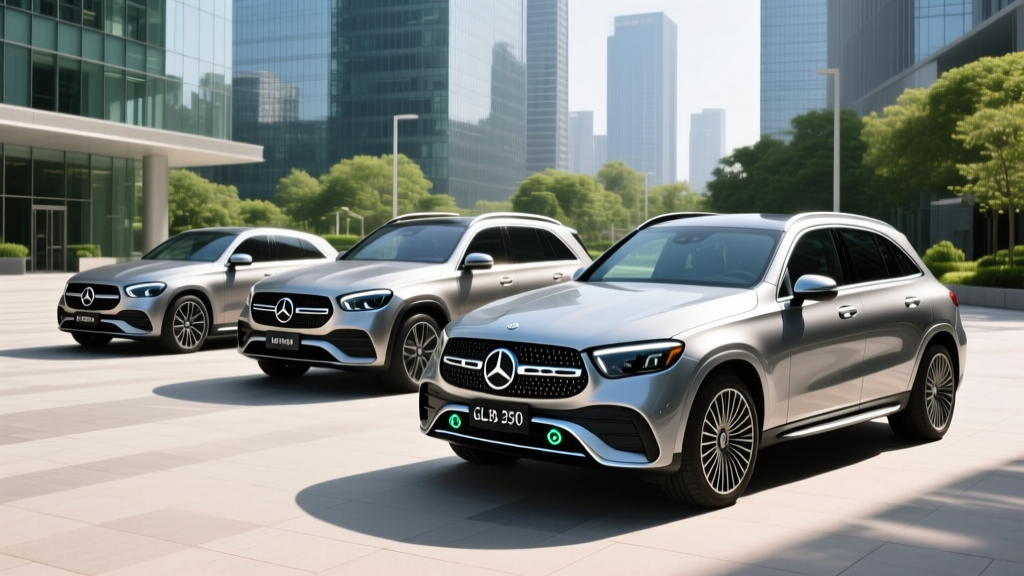
The GLC 350e is the highest-volume Mercedes-Benz hybrid in the U.S. and the most accessible entry into the brand's PHEV lineup. For 2026, it carries over the fourth-generation platform introduced for MY2024 with a 31.2 kWh gross battery pack (approximately 25.4 kWh usable) and a turbocharged 2.0-liter inline-four paired with a permanently excited synchronous electric motor integrated into the 9G-TRONIC transmission.
| Attribute | Value |
|---|---|
| Powertrain | 2.0L turbo I4 + electric motor |
| Combined System Output | 312 hp / 406 lb-ft torque |
| Battery (Gross / Usable) | 31.2 kWh / ~25.4 kWh (NMC) |
| EPA Electric-Only Range | 54 miles |
| EPA MPGe (Electric + Gas) | 65 MPGe combined |
| EPA MPG (Gas-Only, Charge-Sustaining) | 28 city / 30 hwy / 29 combined |
| Total Combined Range | ~430 miles |
| AC Charging (Level 2) | 9.6 kW (0–100% in ~2.5 hours) |
| DC Fast Charging | Available (60 kW max, 10–80% in ~25 min) |
| 0–60 mph | 6.5 seconds |
| Base MSRP | $59,900 (before destination) |
| Federal Tax Credit (§30D) | Up to $3,750 (see eligibility below) |
The GLC 350e's 54-mile electric range is a standout in the luxury compact PHEV segment, covering the average American's daily round-trip commute with margin to spare. If you charge at home overnight, you may not visit a gas station for weeks. The available 60 kW DC fast charging — still rare among PHEVs — means you can top up at a public charger during a lunch stop without waiting hours.
2026 Mercedes-Benz GLE 350e: Three-Row PHEV Practicality
For buyers needing more interior space, the GLE 350e 4MATIC pairs the same PHEV architecture with Mercedes' midsize SUV platform. The larger vehicle carries a similar 31.2 kWh gross battery but delivers slightly less electric range due to increased weight and aerodynamic drag.
| Attribute | Value |
|---|---|
| Powertrain | 2.0L turbo I4 + electric motor |
| Combined System Output | 375 hp / 479 lb-ft torque |
| Battery (Gross / Usable) | 31.2 kWh / ~25.4 kWh (NMC) |
| EPA Electric-Only Range | 48 miles |
| EPA MPGe (Electric + Gas) | 58 MPGe combined |
| EPA MPG (Gas-Only, Charge-Sustaining) | 24 city / 26 hwy / 25 combined |
| Total Combined Range | ~440 miles |
| AC Charging (Level 2) | 9.6 kW (0–100% in ~2.5 hours) |
| DC Fast Charging | Available (60 kW max, 10–80% in ~25 min) |
| 0–60 mph | 5.9 seconds |
| Base MSRP | $72,500 (before destination) |
| Federal Tax Credit (§30D) | Up to $3,750 (see eligibility below) |
The GLE 350e is a compelling option for families who want three rows of seating (with the optional third-row package), towing capability up to 7,700 lbs when properly equipped, and enough electric range to handle school runs and grocery trips without burning fuel. The 375 combined horsepower gives it confident passing power even at highway speeds with a full load.
2026 Mercedes-Benz S 580e: Flagship Sedan PHEV
The S-Class has long been Mercedes' technology showcase, and the S 580e PHEV is no exception. It uses a more powerful inline-six engine paired with a larger electric motor, delivering both performance and efficiency in a full-size luxury sedan.
| Attribute | Value |
|---|---|
| Powertrain | 3.0L turbo I6 + electric motor |
| Combined System Output | 442 hp / 413 lb-ft torque |
| Battery (Gross / Usable) | 28.6 kWh / ~23.3 kWh (NMC) |
| EPA Electric-Only Range | 46 miles |
| EPA MPGe (Electric + Gas) | 56 MPGe combined |
| EPA MPG (Gas-Only, Charge-Sustaining) | 25 city / 28 hwy / 26 combined |
| Total Combined Range | ~430 miles |
| AC Charging (Level 2) | 9.6 kW (0–100% in ~2.25 hours) |
| DC Fast Charging | Not available (AC only) |
| 0–60 mph | 5.0 seconds |
| Base MSRP | $120,850 (before destination) |
| Federal Tax Credit (§30D) | Not eligible (exceeds MSRP cap) |
The S 580e sacrifices DC fast charging capability — a notable omission — but compensates with a refined inline-six that delivers smooth, effortless acceleration. The 46-mile electric range is sufficient for most chauffeured or executive commutes, and the cabin remains whisper-quiet in EV mode. However, at a base price exceeding $120,000, it is not eligible for the federal §30D tax credit, which caps sedan eligibility at an MSRP of $55,000.
Fuel Economy Deep Dive: EPA vs. Real-World MPG
One of the most common questions from hybrid shoppers is whether EPA ratings reflect real-world driving. For Mercedes-Benz PHEVs, the answer depends heavily on how you use them.
| Model | Electric Range | MPGe (Combined) | Gas-Only MPG (City/Hwy/Combined) | Total Range |
|---|---|---|---|---|
| GLC 350e 4MATIC | 54 mi | 65 MPGe | 28 / 30 / 29 | ~430 mi |
| GLE 350e 4MATIC | 48 mi | 58 MPGe | 24 / 26 / 25 | ~440 mi |
| S 580e 4MATIC | 46 mi | 56 MPGe | 25 / 28 / 26 | ~430 mi |
Charge regularly, and the MPGe figures are real. If you plug in nightly and drive within the electric range most days, you'll see triple-digit equivalent efficiency. The EPA MPGe calculation assumes you start each trip with a full battery, which is realistic for home-charging owners.
Never charge, and you're driving a heavy hybrid. If you treat a PHEV like a conventional car and never plug it in, you'll get the gas-only MPG figures — which, for the GLE 350e at 25 MPG combined, are unremarkable for the segment. A PHEV's efficiency advantage is directly proportional to how often you charge it. Data from the U.S. Department of Energy's fueleconomy.gov confirms that PHEV owners who charge daily achieve 2–3× the fuel economy of those who don't.
City vs. highway behavior: In charge-sustaining (gas-only) mode, these Mercedes hybrids actually perform better in city driving than highway cruising — the opposite of conventional gas cars. Regenerative braking recaptures energy in stop-and-go traffic, and the electric motor handles low-speed acceleration more efficiently than the gas engine. Expect to beat EPA city estimates by 1–2 MPG in urban driving while falling slightly below EPA highway numbers on long road trips.
Charging Setup: What You Need to Know
All three Mercedes-Benz PHEVs use a standard J1772 connector for Level 1 (120V) and Level 2 (240V) AC charging. The GLC 350e and GLE 350e also support DC fast charging via CCS at up to 60 kW — a significant advantage for PHEV owners who take road trips or lack home charging.
| Charging Level | Power | GLC 350e / GLE 350e | S 580e |
|---|---|---|---|
| Level 1 (120V household) | ~1.4 kW | ~18 hours (0–100%) | ~17 hours (0–100%) |
| Level 2 (240V home/public) | 9.6 kW | ~2.5 hours (0–100%) | ~2.25 hours (0–100%) |
| DC Fast Charge (CCS) | 60 kW | ~25 min (10–80%) | Not available |
For daily use, a Level 2 home charger is the sweet spot. A 2.5-hour full charge means you can plug in when you get home at 6 PM and have a full battery by 8:30 PM — or simply set the car to charge during off-peak utility hours overnight. The onboard charger maxes out at 9.6 kW, so installing a 48-amp Level 2 unit (like a ChargePoint Home Flex or Tesla Wall Connector with J1772 adapter) will fully utilize the car's capability.
Level 1 charging from a standard 120V outlet is technically possible but impractical as a primary strategy — adding roughly 4–5 miles of range per hour of charging. It works as a backup or for occasional top-ups if you drive less than 20 miles daily.
Federal Tax Credit Eligibility (§30D) for Mercedes-Benz PHEVs
Under current IRS §30D rules, plug-in hybrids with at least 7 kWh of battery capacity and meeting North American final assembly requirements can qualify for up to $7,500 in federal tax credits. However, several constraints apply to the Mercedes-Benz lineup:
- MSRP Cap: SUVs, pickups, and vans must be ≤$80,000; sedans must be ≤$55,000. The GLC 350e and GLE 350e (SUVs) qualify under the $80K cap at base MSRP. The S 580e (sedan at $120,850) does NOT qualify.
- Buyer Income Limits: Modified AGI must not exceed $300,000 (joint filers), $225,000 (head of household), or $150,000 (single).
- Battery Component Sourcing: To receive the full $7,500, battery components must be manufactured or assembled in North America (phasing in percentages annually) AND critical minerals must be sourced from the U.S. or FTA partners. Mercedes-Benz PHEVs currently meet partial sourcing requirements, typically qualifying for $3,750 (half credit) rather than the full $7,500.
- North American Assembly: The GLC is assembled in Bremen, Germany. The GLE is assembled in Tuscaloosa, Alabama. The S-Class is assembled in Sindelfingen, Germany. Only the GLE 350e meets the final-assembly requirement for §30D eligibility as of early 2026.
- Point-of-Sale Transfer: Eligible buyers can transfer the credit to the dealer at purchase, reducing the purchase price directly rather than waiting for a tax refund.
Rules are subject to change. Consult a tax professional and verify current eligibility at fueleconomy.gov before purchasing.
The bottom line: The GLE 350e is the strongest tax-credit candidate in the Mercedes-Benz PHEV lineup due to its Alabama assembly, though even it may only qualify for $3,750 depending on battery sourcing compliance at time of purchase. The GLC 350e and S 580e face eligibility barriers (foreign assembly and MSRP cap, respectively). Always verify the specific VIN's eligibility with your dealer before committing.
Battery Warranty, Reliability, and Replacement Costs
Mercedes-Benz provides a high-voltage battery warranty of 6 years or 62,000 miles (whichever comes first) on its PHEV models, covering defects and capacity loss below a specified threshold (typically 70% state of health). This is shorter than the 8-year/100,000-mile warranties offered by competitors like BMW and Toyota, and it's an important factor for long-term ownership planning.
- Coverage: 6 years / 62,000 miles
- Capacity threshold: ~70% state of health
- Powertrain warranty: 4 years / 50,000 miles
- Estimated out-of-warranty battery replacement: $8,000–$14,000 (depending on model)
NMC (nickel manganese cobalt) chemistry is used across the lineup. NMC offers high energy density but is more sensitive to sustained high-SoC storage and extreme heat than LFP chemistry. To maximize longevity, Mercedes recommends setting charge limits to 80% for daily use and avoiding prolonged storage above 90% SoC.
On reliability, Mercedes-Benz PHEVs add complexity compared to both pure EVs (fewer moving parts) and conventional gas cars (no high-voltage system). The dual powertrain — turbocharged engine, electric motor, clutch between them, and a large battery pack — means more potential failure points. IIHS crash-test ratings for the GLC and GLE remain strong (Top Safety Pick designations where tested), but long-term reliability ratings from Consumer Reports have historically placed Mercedes in the mid-to-lower tier among luxury brands. The PHEV systems themselves have proven reasonably durable in European-market fleets, where higher-mileage examples have accumulated 100,000+ miles without major battery issues.
The $8,000–$14,000 battery replacement cost (out of warranty) is a real consideration if you plan to keep the vehicle past 100,000 miles. However, PHEV batteries experience less stress than full EV batteries because they operate in a narrower state-of-charge window — the car's software maintains a buffer at both the top and bottom to prevent degradation. Most PHEV batteries outlast their warranty periods with 85–90% capacity retention.
Mercedes-Benz Hybrid vs. Full EV vs. Gas: Which Should You Choose?
The right choice depends on your charging access, daily mileage, and how you use the vehicle.
Choose a Mercedes-Benz PHEV If:
- You can charge at home (Level 2 preferred) and your daily round-trip commute is under 50 miles
- You take road trips regularly and don't want to plan around DC fast-charger availability
- You want meaningful fuel savings without the range limitations of a pure EV
- You value Mercedes' interior quality, MBUX infotainment, and driver-assistance systems
Choose a Full EV (e.g., EQB, EQE SUV) If:
- You have reliable home charging and your daily driving is under 250 miles
- You want the lowest per-mile energy cost and minimal maintenance (no oil changes, no gas engine upkeep)
- You're eligible for the full $7,500 federal tax credit on a qualifying BEV
- You want the smoothest, quietest driving experience with instant torque
Choose a Conventional Gas Vehicle If:
- You cannot charge at home or work (apartment/condo without charging access)
- You drive more than 300 miles weekly in unpredictable patterns
- You want the lowest upfront purchase price and simplest maintenance schedule
- You plan to keep the vehicle 12+ years and want to avoid high-voltage battery replacement risk
Pros — Mercedes-Benz PHEVs
- 46–54 miles of electric-only range covers most daily commutes
- No range anxiety — gas engine provides 430+ total miles
- DC fast charging available on GLC and GLE (60 kW)
- Strong combined horsepower (312–442 hp)
- Premium interior, MBUX, and driver-assist technology
- Regenerative braking extends city MPG in gas mode
Cons — Mercedes-Benz PHEVs
- Higher base prices than gas-only equivalents ($10K–$15K premium)
- Battery warranty shorter than competitors (6 yr/62K mi vs. 8 yr/100K mi)
- Tax credit eligibility limited by assembly location and MSRP caps
- Complex dual powertrain = more potential maintenance points
- S 580e lacks DC fast charging
- Heavy curb weight reduces gas-only efficiency vs. lighter non-hybrid rivals
Frequently Asked Questions
How many MPG does a Mercedes-Benz hybrid get?
In gas-only (charge-sustaining) mode, the 2026 GLC 350e achieves an EPA-rated 29 MPG combined (28 city / 30 highway), the GLE 350e gets 25 MPG combined (24 city / 26 highway), and the S 580e earns 26 MPG combined (25 city / 28 highway). When regularly charged, MPGe ratings range from 56 to 65 MPGe combined depending on model. Real-world city MPG often exceeds EPA estimates by 1–2 MPG thanks to regenerative braking.
How far can the Mercedes-Benz PHEVs go on electric only?
The GLC 350e leads the lineup at 54 EPA-rated miles of electric-only range. The GLE 350e delivers 48 miles, and the S 580e provides 46 miles. In real-world driving, expect 85–100% of EPA range in mild conditions, dropping to 60–75% in cold weather or sustained highway driving above 70 mph.
Do Mercedes-Benz hybrids need to be plugged in?
They don't need to be — you can drive them indefinitely on gasoline alone, and the hybrid system will manage battery charge automatically. However, to access the electric-only range, fuel savings, and efficiency these vehicles are designed for, regular plug-in charging is strongly recommended. Without charging, you're carrying 600+ lbs of dead battery weight and getting mediocre gas-only MPG.
Does a Mercedes-Benz hybrid qualify for a tax credit?
Under 2026 IRS §30D rules, only PHEVs meeting North American final assembly, MSRP caps, buyer income limits, and battery sourcing requirements qualify. The GLE 350e (assembled in Alabama) is the strongest candidate, potentially eligible for up to $3,750. The GLC 350e (German assembly) and S 580e (exceeds sedan MSRP cap) face significant eligibility barriers. Always confirm VIN-level eligibility at fueleconomy.gov before purchasing.
Is the Mercedes-Benz PHEV battery reliable, and what does replacement cost?
Mercedes covers the high-voltage battery for 6 years/62,000 miles — shorter than most competitors. NMC chemistry is proven but benefits from careful management (avoiding prolonged 100% SoC storage, extreme heat exposure). Out-of-warranty replacement is estimated at $8,000–$14,000 depending on the model. Most PHEV batteries retain 85–90% capacity well past 100,000 miles due to conservative buffer management in the BMS.
How long does it take to charge a Mercedes-Benz PHEV at home?
On a Level 2 (240V) home charger at 9.6 kW, all three models charge from 0–100% in approximately 2.25–2.5 hours. On a standard 120V Level 1 outlet, expect 17–18 hours for a full charge — usable only as a slow overnight trickle. The GLC 350e and GLE 350e also support 60 kW DC fast charging (10–80% in ~25 minutes), but the S 580e is AC-only.
The 2026 Mercedes-Benz hybrid lineup offers genuine dual-personality capability: electric commuting during the week, gas-powered road trips on the weekend. The GLC 350e is the value pick with the best electric range; the GLE 350e adds space and tax-credit potential; and the S 580e delivers flagship luxury with PHEV efficiency. Your decision should hinge on charging access, budget, and whether the PHEV premium over a gas-only Mercedes justifies the fuel savings in your driving pattern.