If you're researching a Mercedes-Benz hybrid car in 2026, you're looking at a brand that has committed to plug-in hybrid (PHEV) technology across much of its lineup while quietly phasing out conventional hybrid (HEV) offerings. That distinction matters enormously: every current Mercedes-Benz hybrid you can buy new in the U.S. is a plug-in hybrid, meaning it carries a larger battery, an electric-only driving range, and eligibility for certain tax incentives that conventional hybrids don't qualify for.
This guide breaks down every 2026 Mercedes-Benz PHEV model available in the U.S. market — the S 580e sedan, the GLC 350e SUV, and the GLE 350e SUV — with exact EPA figures, real-world expectations, battery specs, charging data, pricing, and federal tax credit eligibility. Whether you're cross-shopping a full EV or trying to cut fuel costs without range anxiety, here's what the numbers actually say.
Mercedes-Benz Hybrid Strategy in 2026: PHEV-Only
Mercedes-Benz has made a deliberate choice: in the U.S. market, the brand does not sell a conventional hybrid (HEV) — the type that recharges its small battery solely through regenerative braking and the engine, requiring no plug. Instead, every Mercedes-Benz hybrid car sold stateside is a plug-in hybrid electric vehicle (PHEV).
HEV vs PHEV — What's the Difference?
| Feature | Conventional Hybrid (HEV) | Plug-in Hybrid (PHEV) |
|---|---|---|
| Plug-in charging | No — self-charging via engine/regen | Yes — plug in to charge battery |
| Battery size | ~1–2 kWh | ~13–26 kWh |
| Electric-only range | 0–1 miles at low speed | 20–50+ miles |
| Federal tax credit (§30D) | Not eligible | Eligible (up to $7,500, rules apply) |
| Gas engine | Yes — always available | Yes — always available |
| Best for | No home charging access | Home chargers who want EV + gas backup |
For Mercedes-Benz buyers, this means you'll need access to a Level 2 home charger (or at minimum a standard 120V outlet) to actually benefit from the electric-only driving these vehicles offer. Drive a PHEV without ever plugging it in, and you're just hauling around a heavy dead battery — fuel economy drops below what a comparable gas model achieves.
2026 Mercedes-Benz PHEV Models: Full Lineup at a Glance
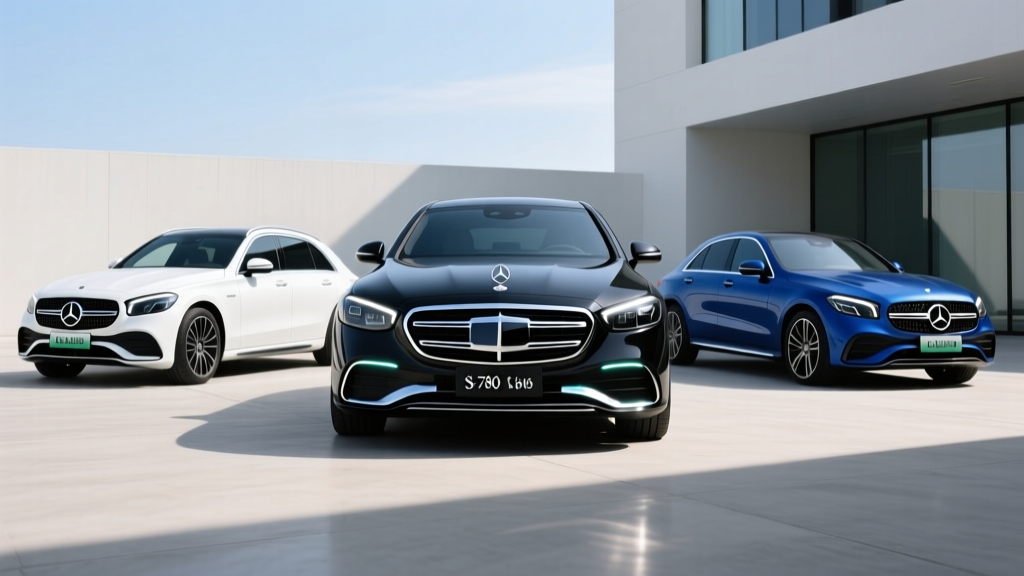
Mercedes-Benz currently offers three PHEV models in the U.S. for the 2026 model year. Here's how they compare on the specs that matter most.
| Spec | S 580e Sedan | GLC 350e SUV | GLE 350e SUV |
|---|---|---|---|
| Body style | Full-size luxury sedan | Compact luxury SUV | Mid-size luxury SUV |
| Engine | 3.0L turbo I6 + electric motor | 2.0L turbo I4 + electric motor | 2.0L turbo I4 + electric motor |
| Combined HP | 443 hp | 312 hp | 302 hp |
| Battery (usable) | ~22.0 kWh | ~19.7 kWh | ~19.7 kWh |
| EPA electric-only range | ~35 mi (est.) | ~39 mi | ~38 mi |
| Total combined range | ~470 mi (est.) | ~420 mi | ~440 mi |
| EPA combined MPGe | ~56 MPGe (est.) | 63 MPGe | 56 MPGe |
| Gas-only combined MPG | ~27 MPG | ~28 MPG | ~25 MPG |
| Max AC charge rate | 7.4 kW (Level 2) | 7.4 kW (Level 2) | 7.4 kW (Level 2) |
| DC fast charging | Not available | Not available | Not available |
| Level 2 charge time (0–100%) | ~3.5 hours | ~3.25 hours | ~3.25 hours |
| Level 1 charge time (120V) | ~10 hours | ~9 hours | ~9 hours |
| 0–60 mph | 4.9 sec | 6.2 sec | 6.6 sec |
| Starting MSRP | ~$120,500 | ~$59,900 | ~$64,350 |
| Drivetrain | RWD / 4MATIC AWD | 4MATIC AWD | 4MATIC AWD |
Sources: fueleconomy.gov, Mercedes-Benz USA press specifications. Figures marked (est.) reflect preliminary or calculated values for the 2026 model year.
How Many MPG Does a Mercedes-Benz Hybrid Get?
Because every Mercedes-Benz hybrid car is a PHEV, fuel economy depends entirely on how you use it. The EPA provides two numbers for PHEVs: MPGe (miles per gallon equivalent, measured while running on electricity) and gas-only MPG (what you get once the battery is depleted).
| Model | City MPG (gas) | Highway MPG (gas) | Combined MPG (gas) | Combined MPGe (electric) |
|---|---|---|---|---|
| S 580e | ~24 | ~30 | ~27 | ~56 MPGe |
| GLC 350e | ~26 | ~30 | ~28 | 63 MPGe |
| GLE 350e | ~23 | ~27 | ~25 | 56 MPGe |
Real-world MPG vs EPA: Plug-in hybrids reward city driving. If you charge nightly and your commute is under 35 miles, you may use almost zero gasoline on a daily basis. The GLC 350e, for example, can cover a typical 25-mile round-trip commute entirely on electricity. On long highway road trips with a depleted battery, expect the gas-only combined MPG to drop 2–4 MPG below the EPA sticker — aerodynamic drag and the weight of the battery work against highway efficiency. Conversely, in stop-and-go city driving with a charged battery, your effective "MPG" is essentially infinite for the first 35–39 miles.
Real-World Electric Range Expectations
EPA sticker: 38–39 miles (GLC 350e / GLE 350e)
Real-world summer, mixed driving: ~33–37 miles
Real-world winter (below 32°F): ~24–30 miles (battery chemistry loses efficiency in cold)
Highway-only at 75 mph: ~27–32 miles
Mercedes-Benz PHEVs use a battery buffer — the system never fully depletes or fully charges the pack to protect longevity. This means the usable capacity is slightly less than the gross kWh rating.
How Far Can a Mercedes-Benz PHEV Go on Electric Only?
Electric-only range is the headline spec for any PHEV buyer. Here's what the 2026 lineup delivers:
- S 580e: Approximately 35 miles EPA electric-only range — enough for most urban commutes but the heaviest vehicle in the lineup, so real-world range skews lower.
- GLC 350e: 39 miles EPA — the efficiency leader of the group, benefiting from a relatively compact form factor and the same ~19.7 kWh battery as the larger GLE.
- GLE 350e: 38 miles EPA — only one mile less than the GLC despite being substantially larger, thanks to similar battery capacity.
For context, the average American one-way commute is approximately 16 miles according to U.S. Census data. All three Mercedes-Benz PHEVs can cover a typical round-trip commute without using a drop of gasoline — provided you plug in each night.
Charging logistics: None of these models support DC fast charging. You're limited to Level 2 (240V) at 7.4 kW or Level 1 (120V) at roughly 1.4 kW. A full Level 2 charge takes about 3.25 hours, meaning you can easily top up during the workday or overnight. Level 1 charging from a standard household outlet takes 9–10 hours — feasible overnight but slow for mid-day top-ups.
Powertrain and Performance Breakdown
Mercedes-Benz has standardized its PHEV architecture around a turbocharged gasoline engine paired with an electric motor integrated into the transmission housing. The result is seamless power delivery with no noticeable transition between electric and gas modes.
S 580e — The Flagship
The S 580e pairs Mercedes' smooth 3.0-liter turbocharged inline-six with a 110 kW (148 hp) electric motor for a combined 443 horsepower. The 0–60 mph sprint takes 4.9 seconds — genuinely quick for a full-size luxury sedan. The inline-six provides refinement the four-cylinder models can't match, and the larger ~22.0 kWh battery gives it comparable electric range despite its weight disadvantage.
GLC 350e — The Volume Seller
A 2.0-liter turbo four-cylinder and electric motor combine for 312 hp. The GLC 350e is the lightest PHEV in the lineup and the most efficient. The four-cylinder is audible under hard acceleration but well-insulated during normal driving. At 6.2 seconds to 60 mph, it's adequately quick.
GLE 350e — The Family Hauler
Identical powertrain hardware to the GLC 350e (2.0L turbo + electric motor, 302 hp combined) but in a larger, heavier package. The 6.6-second 0–60 time feels appropriate for the vehicle's character. The GLE's air suspension and larger cabin make it the comfort pick for families.
Pricing and Federal Tax Credit Eligibility
Mercedes-Benz PHEVs command a premium over their gas-only counterparts, but federal tax incentives can partially close the gap.
| Model | Base MSRP | Gas-only equivalent MSRP | Premium for PHEV |
|---|---|---|---|
| S 580e | ~$120,500 | ~$118,000 (S 500) | ~$2,500 |
| GLC 350e | ~$59,900 | ~$48,250 (GLC 300) | ~$11,650 |
| GLE 350e | ~$64,350 | ~$62,650 (GLE 350) | ~$1,700 |
Federal §30D Tax Credit — Current Rules (2026)
The IRS §30D New Clean Vehicle Credit offers up to $7,500 for qualifying PHEVs, but eligibility depends on multiple factors that change frequently:
- Battery component sourcing: A percentage of battery components must be manufactured or assembled in North America (threshold increases annually).
- Critical minerals: A percentage of critical minerals must be sourced from the U.S. or FTA partners.
- MSRP cap: SUVs (GLC 350e, GLE 350e) must be under $80,000; sedans (S 580e) under $55,000 — the S 580e exceeds this cap and is not eligible.
- Buyer income cap: AGI must not exceed $150,000 (single), $225,000 (head of household), or $300,000 (joint).
- Point-of-sale transfer: As of 2024+, the credit can be transferred to the dealer as a down payment reduction at purchase, rather than claimed at tax time.
Bottom line: The GLC 350e and GLE 350e may qualify for a partial or full credit depending on current-year sourcing rules. The S 580e is disqualified by its MSRP. Always verify current eligibility at IRS.gov and consult a tax professional before purchasing.
Battery Warranty, Reliability, and Replacement Cost
Hybrid battery longevity is consistently the top concern among buyers considering their first PHEV. Here's what Mercedes-Benz covers and what real-world data shows.
Mercedes-Benz High-Voltage Battery Warranty
| Coverage period | 6 years or 62,000 miles (whichever comes first) |
| Capacity retention guarantee | ~70% of original capacity |
| What's covered | Defects, excessive capacity loss below threshold |
| What's not covered | Normal degradation above 70%, damage from accidents or improper charging |
Note: Mercedes-Benz's PHEV battery warranty of 6 years/62,000 miles is shorter than the 8-year/100,000-mile warranties offered by many competitors (Toyota, Hyundai, BMW). Factor this into long-term ownership planning.
Reliability outlook: Mercedes-Benz PHEV powertrains have proven generally reliable, though the brand's overall vehicle reliability ratings from sources like J.D. Power and Consumer Reports tend to trail Japanese and Korean competitors. The high-voltage battery itself rarely fails catastrophically — gradual capacity loss is the norm. Based on NMC lithium-ion chemistry degradation data, expect approximately 10–15% capacity loss over 8–10 years of typical use with regular Level 2 charging.
Battery replacement cost: If the high-voltage battery requires full replacement outside warranty, expect a cost in the range of $8,000–$14,000 including parts and labor at a Mercedes-Benz dealer. This is a significant expense, though it's rarely needed within the first decade of ownership. Third-party hybrid battery repair shops can sometimes replace individual modules for $2,000–$5,000.
Who Should Buy a Mercedes-Benz Hybrid — And Who Shouldn't
A Mercedes-Benz PHEV is a specific tool for a specific buyer. Here's the decision framework:
Choose a Mercedes-Benz PHEV If:
- You have home Level 2 charging access and a commute under 40 miles round-trip.
- You want luxury, brand prestige, and build quality with reduced daily fuel costs.
- You take regular road trips where a full EV's charging logistics would be inconvenient.
- You want to reduce gasoline consumption without fully committing to electric-only driving.
- You value the seamless torque delivery of an electric motor in stop-and-go traffic.
Choose a Full EV Instead If:
- You want zero gasoline expenses and zero oil changes, ever.
- You have reliable home and workplace charging and rarely drive more than 250 miles in a day.
- You want access to DC fast charging for road trips (Mercedes PHEVs lack this).
- Lower long-term maintenance costs are a priority (EVs have fewer moving parts).
Stick with a Gas-Only Mercedes If:
- You have no access to any form of plug-in charging at home or work.
- You want the lowest possible purchase price (the GLC 300 costs ~$11,650 less than the GLC 350e).
- Your driving is almost entirely long-distance highway, where PHEV efficiency advantages diminish.
Pros — Mercedes-Benz PHEVs
- 35–39 miles of electric-only range covers most commutes
- Luxury interior, ride quality, and brand cachet
- Gas engine eliminates range anxiety on road trips
- GLC 350e and GLE 350e may qualify for federal tax credit
- Smooth electric motor torque in city driving
- 4MATIC AWD standard on SUVs
Cons — Mercedes-Benz PHEVs
- No DC fast charging on any model
- Battery warranty (6 yr/62k mi) shorter than competitors
- S 580e exceeds §30D MSRP cap — no federal credit
- GLC 350e carries an $11,650 premium over gas-only GLC 300
- Mercedes-Benz reliability ratings trail Japanese/Korean brands
- Gas-only MPG unremarkable once battery depletes (25–28 combined)
Frequently Asked Questions
Does Mercedes-Benz make a conventional hybrid (non-plug-in)?
Not in the U.S. market for 2026. Every Mercedes-Benz hybrid car sold in the United States is a plug-in hybrid (PHEV) that requires charging to access its electric-only range. In some European markets, Mercedes offers mild-hybrid (MHEV) systems that assist the gas engine but cannot drive on electricity alone — these are not true hybrids and are not available stateside.
How much does it cost to charge a Mercedes-Benz PHEV at home?
At the U.S. average residential electricity rate of approximately $0.16/kWh, fully charging the GLC 350e's ~19.7 kWh battery costs roughly $3.15. That provides about 39 miles of electric driving — equivalent to about $0.08 per mile. Compare that to gasoline at $3.50/gallon in a vehicle getting 28 MPG combined, which costs about $0.125 per mile. Daily savings add up to roughly $1.65 per 39-mile charge cycle, or about $600/year if you charge every weekday.
Can I use a regular 120V outlet to charge my Mercedes PHEV?
Yes, but slowly. Level 1 charging at 120V delivers approximately 1.4 kW, meaning a full charge takes 9–10 hours. This works for overnight charging if your daily electric driving is under 30 miles. For faster replenishment, a Level 2 (240V) home charger at 7.4 kW completes a full charge in about 3.25 hours. Expect a Level 2 home installation to cost $500–$2,000 depending on your electrical panel and run length — consult a licensed electrician for an exact quote.
What happens if I never plug in my Mercedes PHEV?
The car will operate purely as a gasoline vehicle, but with a significant weight penalty from the unused battery and electric motor. Fuel economy will drop to roughly 22–26 MPG combined — worse than a comparable gas-only Mercedes model. You'll also miss the entire value proposition of the PHEV premium you paid at purchase. If you cannot charge regularly, a gas-only model is the more economical choice.
Is the Mercedes-Benz PHEV battery reliable long-term?
Mercedes-Benz uses NMC (nickel manganese cobalt) lithium-ion chemistry in its PHEV batteries, which offers strong energy density and proven cycle life. Real-world data from earlier-generation Mercedes PHEVs (2018–2022) shows typical capacity loss of 8–12% over 5–7 years. The 6-year/62,000-mile warranty covers capacity loss below approximately 70% of original. While this is shorter than Toyota's 10-year/150,000-mile hybrid battery warranty, catastrophic battery failures are extremely rare. Budget for potential replacement ($8,000–$14,000) if you plan to keep the vehicle beyond 10 years.
How does a Mercedes PHEV compare to a full EV like the EQE or EQS?
Mercedes' all-electric EQE sedan offers approximately 300 miles of EPA range and DC fast charging up to 170 kW — far more capability for electric-only driving. However, the EQE starts above $75,000 and requires commitment to charging infrastructure. A PHEV like the S 580e gives you 35 miles of electric commuting plus unlimited gas-powered range for road trips, at a lower entry price and with no charging-desert anxiety. The trade-off: more maintenance (oil changes, gas engine service) and no DC fast charging.
Always verify current specifications, pricing, and tax credit eligibility with Mercedes-Benz USA, fueleconomy.gov, and the IRS before purchasing. Rules and specs are subject to change.