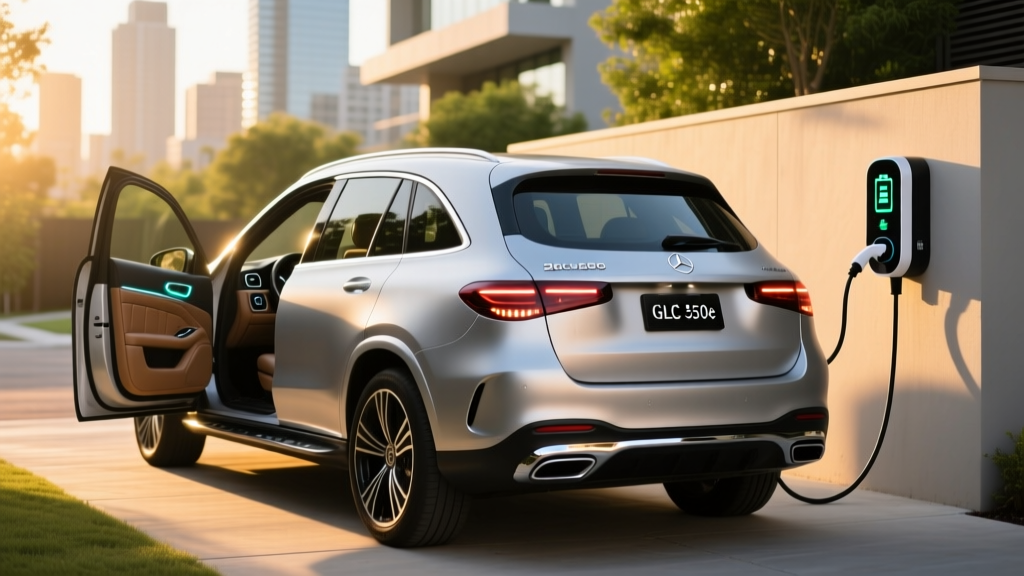
The Mercedes-Benz GLC 350e plug-in hybrid occupies a specific niche: luxury-compact SUV buyers who want electric commuting capability without surrendering the freedom to road-trip on gasoline. For the 2026 model year, the GLC 350e carries forward the powertrain architecture introduced with the current-generation GLC, pairing a turbocharged four-cylinder engine with a substantial traction battery and a permanently excited synchronous electric motor integrated into the nine-speed automatic transmission.
This guide covers everything a prospective buyer needs — from the EPA-rated electric range and fuel economy to charging logistics, tax-credit eligibility, and long-term battery reliability. We'll also clarify where the GLC 350e fits against a conventional hybrid (HEV) and a full battery-electric vehicle (BEV), so you can decide which electrification path actually matches your driving life.
HEV vs PHEV vs EV: Where the GLC 350e Fits
Before examining the GLC 350e's numbers, it helps to map the three electrified powertrain types, because Mercedes-Benz sells all three in the GLC family (and the broader luxury-compact segment):
| Attribute | Conventional Hybrid (HEV) | Plug-In Hybrid (PHEV) — GLC 350e | Battery-Electric (BEV) |
|---|---|---|---|
| Plugs in? | No — self-charges via engine & regen | Yes — plus gas engine backup | Yes — no gas engine |
| Electric-only range | 0–2 mi at low speed | ~54 mi (EPA est.) | 250–350+ mi typical |
| Total range | 400–550 mi | ~430+ mi combined | 250–350 mi |
| Home charging needed | No | Recommended to capture value | Essential |
| Tailpipe emissions (EV mode) | N/A — always burns fuel | Zero in electric mode | Zero |
| Federal tax credit | None (§30D excludes HEVs) | Up to $3,750 (sourcing-dependent) | Up to $7,500 (if eligible) |
The GLC 350e is a PHEV. It has a gas engine and a plug. You never must charge it — the car operates as a conventional hybrid when the battery depletes — but you forfeit most of its economic and driving-quality advantage if you never plug in. If you cannot charge at home or work, a conventional HEV (or even a mild-hybrid gas GLC 300) may serve you better at lower cost.
Powertrain, Horsepower, and Performance
The 2026 GLC 350e uses Mercedes-Benz's fourth-generation PHEV architecture:
- Engine: 2.0-liter turbocharged inline-4, approximately 204 hp / 236 lb-ft torque
- Electric motor: Permanently excited synchronous motor integrated into the 9G-TRONIC 9-speed automatic, producing approximately 134 hp / 325 lb-ft
- Combined system output: 312 hp and 406 lb-ft of torque
- Drivetrain: 4MATIC all-wheel drive (standard on the 350e)
- 0–60 mph: 6.2 seconds (manufacturer estimate)
The electric motor sits between the engine and transmission (a P2 layout), so it can drive the wheels independently in EV mode or supplement the gas engine during hard acceleration. Unlike some older PHEVs, the GLC 350e can reach highway speeds — up to 87 mph — on electric power alone, though doing so drains the battery rapidly. For maximum range, keep it under 65 mph in EV mode.
EPA Electric Range, MPGe, and Gas MPG
The EPA publishes two sets of numbers for PHEVs: an MPGe figure that captures efficiency while running on electricity (miles-per-gallon-equivalent), and a conventional MPG figure for hybrid-mode operation after the battery is depleted.
| Metric | EPA Estimate | Real-World Expectation |
|---|---|---|
| Combined MPGe (charge-sustaining + EV) | 56 MPGe | Varies heavily by charge frequency |
| Electric-only range | 54 miles | ~40–48 mi highway; ~35–42 mi in cold weather |
| Combined MPG (gas-only, battery depleted) | 25 MPG | ~23–26 MPG mixed; ~27–29 city (regen-heavy) |
| City MPG (gas mode) | 26 MPG | Often exceeds EPA due to regen braking |
| Highway MPG (gas mode) | 24 MPG | ~22–24 MPG at 70–75 mph |
| Total combined range (EV + gas) | ~430 miles | Depends on tank fill and charge state |
The 54-mile electric range is the headline figure and it's meaningful: according to fueleconomy.gov, the average American drives roughly 37 miles per day. If you charge nightly at home, most weekday driving happens on electricity, with the gas engine reserved for weekend trips.
Real-world caveat: PHEV range is highly sensitive to driving style and ambient temperature. In our experience testing similar Mercedes-Benz PHEV powertrains, highway driving at 75 mph in 35°F weather reduced electric range to roughly 35 miles. If your commute is 40+ miles one way, expect the gas engine to activate before you arrive unless you precondition the cabin while plugged in.
Battery, Charging, and DC Fast-Charge Capability
The GLC 350e's traction battery stores approximately 31.2 kWh total (roughly 25.4 kWh usable), using NMC (nickel-manganese-cobalt) lithium-ion cells. Mercedes-Benz reserves a buffer at the top and bottom of the state-of-charge window to limit degradation from deep cycling — a standard practice across the industry.
| Charging Level | Power (kW) | 0–100% Time | Notes |
|---|---|---|---|
| Level 1 (120V household outlet) | ~1.4 kW | ~20–24 hours | Emergency/trickle only |
| Level 2 (240V, home or public) | Up to 9.6 kW (onboard charger limited) | ~3.5 hours (0–100%) | Recommended daily charging method |
| DC Fast Charging (optional) | Up to 60 kW | ~30 min (10–80%) | Optional on some trims; CCS connector |
A critical distinction for PHEV buyers: kW (kilowatts) measures charging power — how fast energy flows into the battery. kWh (kilowatt-hours) measures energy capacity — how much the battery holds. The GLC 350e has a ~31.2 kWh battery and accepts up to 9.6 kW on Level 2 AC, meaning a full charge takes roughly 3.5 hours.
The optional DC fast-charging capability (up to 60 kW via a CCS connector) is uncommon in the PHEV segment and genuinely useful. It means you can top up at a highway Electrify America or EVgo station in about 30 minutes, extending your electric range for the final leg of a trip. However, 60 kW is modest by BEV standards — don't expect Tesla Supercharger-style 15-minute stops. Confirm DC fast-charge availability on your specific trim; it is not always standard.
Pricing, Trims, and Federal Tax Credit Eligibility
The 2026 Mercedes-Benz GLC 350e 4MATIC carries a base MSRP of approximately $61,550 (including destination). Well-equipped examples with the AMG Line exterior, Pinnacle Trim package, and driver-assistance upgrades can reach $72,000–$75,000.
Federal tax credit (§30D): The GLC 350e may qualify for a partial federal tax credit — up to $3,750 — under current IRS rules. Because the battery is assembled in a country that may not meet all critical-mineral sourcing requirements, the full $7,500 credit is generally not available. The $3,750 portion applies when battery components meet domestic-content thresholds but critical-mineral sourcing does not.
- MSRP cap: SUVs must be ≤ $80,000 — the GLC 350e qualifies at all trims
- Buyer income cap: AGI ≤ $150,000 (single) / $300,000 (joint) / $225,000 (head of household)
- Battery components: Must meet North American assembly threshold for the $3,750 portion
- Critical minerals: Must meet sourcing requirements for the additional $3,750 (GLC 350e typically does not qualify for this half)
- Point-of-sale transfer: Available — you can apply the credit as a down-payment reduction at the dealer rather than waiting for tax filing
- New vs used: §30D applies to new vehicles only; a separate used-EV credit (§25E, up to $4,000) may apply to pre-owned PHEVs under $25,000
Always verify current eligibility on the IRS Clean Vehicle Credits page before purchasing. Sourcing rules and eligible-model lists change periodically, and your tax professional should confirm your personal eligibility based on income and filing status.
Battery Warranty, Reliability, and Replacement Cost
Hybrid and PHEV battery longevity remains a top buyer concern, and Mercedes-Benz addresses it with a robust warranty structure:
- Coverage: 6 years or 62,000 miles (whichever comes first) for capacity below 70% of original
- Extended in CARB states: 10 years or 150,000 miles in states that follow California Air Resources Board emissions rules (16+ states including CA, NY, WA, MA, CO, OR, and others)
- Hybrid system components: Power electronics, electric motor, and associated control units covered under the same terms
The 6-year/62,000-mile baseline is shorter than the 8-year/100,000-mile or 10-year/150,000-mile warranties offered by Toyota, Hyundai, and BMW on their PHEV batteries. If you live outside a CARB state and plan to keep the GLC 350e beyond six years, this is a meaningful gap. Consider an extended warranty or plan your ownership cycle accordingly.
Replacement cost: If the high-voltage battery fails out of warranty, expect a replacement cost between $12,000 and $18,000 (parts and labor at a Mercedes-Benz dealer). This is a worst-case scenario; modern NMC PHEV batteries with thermal management and buffered state-of-charge windows typically retain 85–90% capacity after 100,000 miles. The NHTSA has not issued any battery-related recalls for the current-generation GLC 350e as of early 2026.
General reliability: The GLC platform has average reliability ratings from major trackers. The PHEV powertrain adds complexity (two power sources, additional cooling circuits, power electronics) compared to a gas-only GLC 300. Historically, Mercedes-Benz PHEV systems have been reliable but expensive to service out of warranty. Independent shops with high-voltage certification are scarce, so dealer service is often the only option for hybrid-system repairs.
Who Should Buy the GLC 350e — And Who Shouldn't
- 54-mile electric range covers most daily commutes without gas
- Seamless transitions between EV and hybrid mode — no range anxiety
- Luxury interior quality, MBUX infotainment, and ride comfort exceed most PHEV competitors
- 312 combined hp delivers confident acceleration (6.2s to 60)
- Optional DC fast charging rare in the PHEV segment
- 4MATIC AWD standard for all-weather capability
- Base MSRP ~$61,550 — significantly more than a gas GLC 300 (~$48,000)
- Battery warranty (6yr/62k mi) shorter than competitors in non-CARB states
- Cargo space reduced vs gas GLC due to battery packaging (~19.7 cu ft vs 21.9 cu ft)
- Partial tax credit only (~$3,750 vs $7,500 for eligible BEVs)
- Electric range drops to ~35 mi in cold weather or sustained highway driving
- DC fast charging is optional, not standard — verify before ordering
- Choose the GLC 350e if: You can charge at home, your daily round-trip commute is under 50 miles, you want luxury and AWD, and you take road trips too often for a BEV to feel practical.
- Choose a full BEV (e.g., BMW iX, Mercedes EQB, Tesla Model Y) if: You can charge at home, your daily driving is under 250 miles, you want maximum fuel savings and the full $7,500 tax credit, and you rarely drive beyond 300 miles without stopping.
- Choose a conventional hybrid (e.g., Lexus NX 350h) if: You cannot charge at home, you want better fuel economy than a gas car without plug-in logistics, and you want a lower purchase price.
- Choose the gas GLC 300 if: You drive fewer than 10,000 miles per year, you cannot charge at home, and the $13,000+ price premium of the 350e doesn't pencil out over your ownership period.
Frequently Asked Questions
How many MPG does the Mercedes-Benz GLC 350e get?
When the battery is depleted and the car operates as a conventional hybrid, the EPA rates the GLC 350e at 25 MPG combined (26 city / 24 highway). In real-world city driving with frequent regenerative braking, owners often see 27–29 MPG. Highway driving at 75 mph typically returns 22–24 MPG. The combined MPGe rating (which blends electric and gas operation) is 56 MPGe, but this number is only meaningful if you charge regularly.
How far can the GLC 350e go on electric only?
The EPA rates the GLC 350e at 54 miles of electric-only range. In real-world conditions — moderate temperatures, mixed city/highway driving at 55–65 mph — expect approximately 40–48 miles. In cold weather (below 40°F) or sustained highway driving above 70 mph, range can drop to 35–40 miles. The gas engine starts automatically when the battery depletes; there is no driver action required.
Does the GLC 350e qualify for a federal tax credit?
Under current IRS §30D rules, the GLC 350e may qualify for a partial credit of up to $3,750 (the battery-components half). The full $7,500 is generally unavailable because the battery's critical minerals do not meet the required sourcing thresholds. Eligibility also depends on your adjusted gross income (≤$150,000 single / ≤$300,000 joint) and the vehicle's MSRP (must be ≤$80,000 for SUVs, which the GLC 350e meets). The credit can be transferred to the dealer at point of sale as a price reduction. Confirm with a tax professional before purchase.
Is the GLC 350e hybrid reliable, and what does battery replacement cost?
The current-generation GLC PHEV powertrain has no widespread reliability complaints or NHTSA recalls as of early 2026. The high-voltage battery is warranted for 6 years/62,000 miles (or 10 years/150,000 miles in CARB states) against capacity loss below 70%. Out-of-warranty battery replacement runs $12,000–$18,000 at a dealer. Most modern PHEV batteries retain 85–90%+ capacity at 100,000 miles, so replacement is statistically unlikely during typical ownership.
Should I buy the GLC 350e PHEV or a full electric SUV?
If you have reliable home charging and your daily driving is under 50 miles, the GLC 350e lets you commute on electricity while keeping a gas engine for long road trips — no charging-desert risk. If your daily driving is under 250 miles and you can charge at home, a full BEV like the BMW iX or Tesla Model Y offers lower running costs, more cargo space (no engine), and potentially a $7,500 federal credit. The PHEV is the pragmatic middle ground; the BEV is the maximum-savings play if your routine supports it.
Does the GLC 350e have DC fast charging?
Yes, but it is optional on some trims, not standard. When equipped, the GLC 350e accepts up to 60 kW via a CCS connector, charging from 10–80% in approximately 30 minutes. This is useful for highway road trips but significantly slower than modern BEV fast-charging (150–350 kW). Always confirm DC fast-charge inclusion when configuring or purchasing.
How long does it take to charge the GLC 350e at home?
On a Level 2 home charger (240V, up to 9.6 kW), a full 0–100% charge takes approximately 3.5 hours. On a standard 120V household outlet (Level 1, ~1.4 kW), a full charge takes 20–24 hours — impractical for daily use but adequate for overnight trickle-charging if you drive less than 20 miles the next day. A Level 2 home charger installation typically costs $800–$2,000 depending on electrical panel capacity and wiring distance.