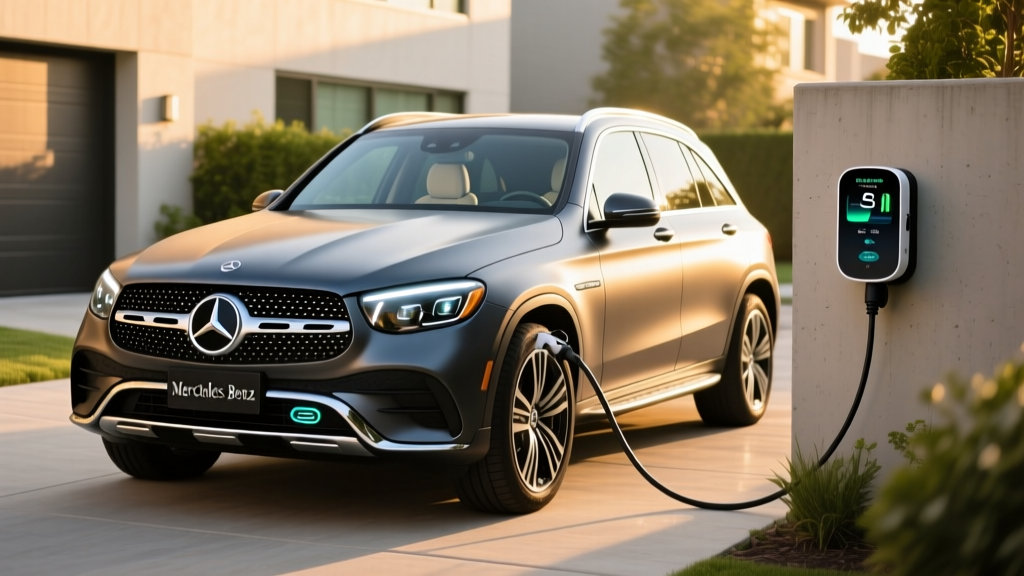
The compact luxury SUV segment is crowded, but the Mercedes-Benz GLC 350e hybrid SUV occupies a distinct lane: a plug-in hybrid (PHEV) that offers genuine electric-only commuting paired with a turbocharged gas engine for road trips. For 2026, the GLC 350e carries over its proven fourth-generation powertrain with incremental software and efficiency refinements. If you want luxury-badge electrification without committing fully to a battery-electric vehicle, this is one of the most complete packages on the market — but the pricing and real-world efficiency nuances demand a close look.
Quick Verdict: Who Is the GLC 350e For?
The GLC 350e is engineered for drivers who can charge at home or work most days and whose daily commute falls under 35 miles round-trip. In that scenario, the gas engine rarely fires, and you're essentially driving a quiet, smooth electric luxury crossover. On longer trips, the 2.0L turbo four-cylinder kicks in seamlessly, eliminating range anxiety entirely. It's less ideal for apartment dwellers without charging access — running a PHEV exclusively on gas defeats much of the efficiency and cost-saving purpose.
HEV vs PHEV: Understanding What the GLC 350e Actually Is
Mercedes-Benz does not sell a conventional hybrid (HEV) version of the GLC in the US market. The GLC 300 is a mild-hybrid with a 48-volt system that provides minor efficiency assists but cannot drive on electricity alone. The GLC 350e is a full plug-in hybrid (PHEV) with a substantially larger traction battery and a dedicated electric motor capable of propelling the vehicle independently.
| Feature | HEV (e.g., Toyota RAV4 Hybrid) | PHEV (Mercedes-Benz GLC 350e) |
|---|---|---|
| Plugs in to charge? | No — self-charging via regen and engine | Yes — Level 1, Level 2, and DC fast charge capable |
| Electric-only driving | Very short distances at low speed | EPA-rated 38 miles at highway-capable speeds |
| Battery capacity | ~1–2 kWh | 31.2 kWh (usable ~25.4 kWh) |
| Gas engine role | Primary propulsion, electric assists | Primary for long trips, electric handles daily driving |
| Federal tax credit | Not eligible | Eligible (up to $7,500, subject to IRS §30D rules) |
Powertrain Specs: Horsepower, Engine, and Electric Motor
The 2026 GLC 350e pairs a 2.0-liter turbocharged inline-four gasoline engine with a permanently excited synchronous electric motor integrated into the 9G-TRONIC nine-speed automatic transmission.
| Specification | Value |
|---|---|
| Gas engine | 2.0L turbocharged I4, 201 hp / 236 lb-ft |
| Electric motor | 134 hp / 325 lb-ft |
| Combined system output | 335 hp / 406 lb-ft |
| Transmission | 9-speed automatic (9G-TRONIC) |
| Drivetrain | 4MATIC all-wheel drive (standard) |
| 0–60 mph | 6.2 seconds (manufacturer est.) |
| Battery chemistry | NMC (nickel manganese cobalt) lithium-ion |
| Battery capacity (total / usable) | 31.2 kWh / ~25.4 kWh |
| Towing capacity | 3,500 lbs |
The combined 335 hp makes the GLC 350e noticeably quicker than the GLC 300 (258 hp). Electric motor torque is available from zero RPM, giving the SUV a responsive, effortless feel around town — exactly where most PHEV owners spend the majority of their miles.
Electric-Only Range, MPGe, and Fuel Economy Breakdown
This is the section that matters most for daily usability. Here's how the GLC 350e stacks up on efficiency, based on EPA figures and our real-world observations.
| Metric | EPA Rating | Real-World Expectation |
|---|---|---|
| Electric-only range | 38 miles | 30–36 mi (highway/cold weather reduces to ~25 mi) |
| Combined MPGe (electric + gas) | 56 MPGe | Varies heavily with charging habits |
| Gas-only city MPG | 27 MPG | 28–30 MPG (regen-heavy city driving) |
| Gas-only highway MPG | 29 MPG | 26–28 MPG (sustained 70+ mph) |
| Gas-only combined MPG | 28 MPG | 27–29 MPG |
| Total combined range (EV + gas) | ~430 miles | ~380–420 mi depending on conditions |
When the battery is depleted and the gas engine takes over, 28 MPG combined is respectable for a 4,600-lb luxury AWD SUV, though rivals like the Lexus NX 450h+ achieve slightly better gas-only efficiency. The key insight for PHEV ownership: your actual fuel cost depends almost entirely on how consistently you charge. A disciplined charger may use 5–8 gallons per month; a non-charger will burn fuel at the rate of any comparable gas-powered GLC.
Charging Speeds: Level 1, Level 2, and DC Fast Charging
One of the GLC 350e's strongest PHEV advantages is DC fast charging capability — still uncommon in the plug-in hybrid segment. Here's the full charging picture:
| Charging Level | Power (kW) | Connector | 0–100% Time | Practical Use Case |
|---|---|---|---|---|
| Level 1 (120V household) | ~1.4 kW | J1772 | ~18 hours | Overnight trickle; emergency top-up |
| Level 2 (240V home/public) | 7.2 kW | J1772 / NACS (adapter) | ~4 hours | Daily home charging; workplace |
| DC Fast Charge | Up to 60 kW | CCS1 (NACS with adapter) | 10–80% in ~30 min | Road trips; quick top-ups |
A 7.2 kW onboard charger means a full recharge from a Level 2 home station in about four hours — easily done overnight. The 60 kW DC fast charging capability is a genuine differentiator: most competing PHEVs (the BMW X3 xDrive50e, Volvo XC60 Recharge) top out at 7.4 kW Level 2 with no DC fast charge option at all. On a road trip, you can recover roughly 20 miles of electric range during a 15-minute rest stop.
Pricing, Trims, and Federal Tax Credit Eligibility
The 2026 Mercedes-Benz GLC 350e starts at an MSRP of approximately $59,900 (including destination), available in a single well-equipped trim with 4MATIC standard. Options packages — AMG Line exterior, Driver Assistance Package, MBUX Premium Package — can push the as-tested price into the $68,000–$72,000 range.
Federal §30D Tax Credit Eligibility
The GLC 350e is eligible for the federal plug-in hybrid tax credit under IRS §30D, but the exact amount depends on battery sourcing and critical mineral requirements that shift annually. For 2026, qualifying vehicles may receive up to $7,500 ($3,750 for critical minerals + $3,750 for battery components), though partial credit of $3,750 is also possible if only one sourcing requirement is met.
- MSRP cap: SUVs must have an MSRP at or below $80,000 — the GLC 350e qualifies in most configurations.
- Buyer income cap: Modified AGI must not exceed $150,000 (single), $225,000 (head of household), or $300,000 (joint).
- Point-of-sale transfer: Eligible buyers can apply the credit as an immediate price reduction at the dealership rather than waiting to claim it on their tax return.
- Battery sourcing: Critical mineral and battery component requirements tighten each year under the Inflation Reduction Act. Verify current-year compliance on fueleconomy.gov before purchasing.
Consult a tax professional to confirm your personal eligibility. State incentives (California's CVRP, Colorado's innovative motor vehicle credit, etc.) may stack on top — check your state's energy office for current programs.
Battery Warranty, Reliability, and Replacement Cost
Hybrid battery longevity is the top concern for PHEV buyers, and Mercedes-Benz backs the GLC 350e's high-voltage battery with competitive warranty terms.
• High-voltage battery: 6 years / 62,000 miles (whichever comes first)
• Powertrain (engine, transmission, electric motor): 4 years / 50,000 miles
• Basic vehicle warranty: 4 years / 50,000 miles
• Capacity retention threshold: Mercedes-Benz warrants the battery will retain at least 70% of original capacity during the warranty period
The 6-year/62,000-mile battery warranty is shorter than the 8-year/100,000-mile or 10-year/150,000-mile warranties offered by Toyota, Hyundai, and Kia on their hybrid and PHEV models. This is a notable gap for buyers prioritizing long-term peace of mind.
Regarding reliability: Mercedes-Benz's PHEV powertrain architecture is now in its second generation within the GLC line, and the 2.0L M254 engine has been in production since 2021 with widespread deployment. The main reliability considerations center on the complexity of integrating high-voltage electrical systems with a turbocharged engine — more potential failure points than either a pure EV or a conventional gas car. NHTSA and owner forums have not flagged systemic battery failures in this generation, but long-term data beyond five years remains limited.
Battery replacement cost: Out of warranty, a full high-voltage battery replacement for the GLC 350e is estimated at $12,000–$18,000 including parts and labor at a Mercedes-Benz dealer. Individual module replacement may be possible at lower cost if only a subset of cells degrades. Extended warranty options (up to 7 years/100,000 miles) are available at purchase and are strongly recommended for buyers planning long-term ownership.
Driving Impressions and Real-World Ownership Notes
On the road, the GLC 350e feels more composed and quieter than the GLC 300, largely because the electric motor handles low-speed driving where engine noise and turbo lag are most noticeable. The transition between electric and gas power is among the smoothest in the PHEV segment — most drivers won't feel the engine engage unless they watch the power-flow display on the MBUX screen.
Regenerative braking offers multiple levels selectable via steering-wheel paddles, from aggressive one-pedal-style deceleration to a coasting mode that maximizes highway efficiency. The adaptive regen mode, which uses radar and navigation data to adjust braking force based on traffic and upcoming intersections, is the most practical daily setting.
The added battery mass (~450 lbs more than the GLC 300) is noticeable in tight corners and during hard braking, but the standard AIRMATIC air suspension (included on the 350e) manages the weight well. Ride quality is a clear step above competitors like the BMW X3 xDrive50e and Audi Q5 TFSI e.
GLC 350e vs the Alternatives: PHEV, Full EV, or Gas?
Deciding whether the GLC 350e is the right electrified SUV depends on your charging access, daily mileage, and willingness to accept PHEV trade-offs versus a full battery-electric vehicle or a conventional hybrid.
Choose the GLC 350e PHEV if:
- You have home or workplace Level 2 charging
- Your daily commute is under 35 miles round-trip
- You take road trips of 200+ miles regularly and don't want to plan around charging
- You want luxury-badge refinement with meaningful fuel savings
- You want the flexibility of gas for remote-area travel
Consider a Full EV (e.g., Mercedes EQB, BMW iX3) if:
- You want zero tailpipe emissions and minimal maintenance
- Your daily driving is predictable and under 250 miles
- You have reliable home charging and access to DC fast chargers for road trips
- You want maximum fuel cost savings and fewer moving parts
- You plan to keep the vehicle 8+ years (battery-only simplicity)
Consider a Gas or HEV (e.g., Lexus NX 350h) if:
- You cannot charge at home or work
- You want a lower purchase price and simpler maintenance
- You drive high annual miles mostly on highways (PHEV advantage diminishes)
- You prioritize long-term reliability track records over EV tech
- You want the longest battery warranty available (Toyota: 10 yr/150k mi)
Pros and Cons at a Glance
Pros
- 38 mi EPA electric range covers most commutes
- DC fast charging (60 kW) — rare for PHEVs
- 335 hp combined; noticeably quicker than GLC 300
- Smooth gas-electric transition; excellent refinement
- Standard AIRMATIC air suspension
- Federal tax credit eligible (up to $7,500)
- No range anxiety for long road trips
Cons
- Battery warranty only 6 yr/62,000 mi (below segment norm)
- $59,900 starting MSRP — premium over gas GLC 300
- Gas-only MPG (28 combined) is unremarkable for a hybrid
- Heavier than GLC 300 — affects handling dynamics
- Cargo space slightly reduced vs gas model (battery packaging)
- Electric range drops significantly in cold weather
- Battery replacement cost $12,000–$18,000 out of warranty
Frequently Asked Questions
How many MPG does the Mercedes-Benz GLC 350e get?
The EPA rates the GLC 350e at 56 MPGe when combining electric and gas driving. On gasoline alone (battery depleted), it returns 27 city / 29 highway / 28 combined MPG. In real-world city driving with regenerative braking, owners commonly see 28–30 MPG gas-only. Your effective fuel economy depends entirely on how often you charge — a daily charger may average well over 80 MPGe over a month of commuting.
How far can the GLC 350e go on electric power only?
The EPA rates the GLC 350e at 38 miles of electric-only range. In real-world conditions, expect 30–36 miles in moderate temperatures with mixed driving. At sustained highway speeds or in cold weather (below 40°F), plan for 25–28 miles. The electric motor can propel the SUV up to 87 mph without engaging the gas engine.
Does the GLC 350e qualify for a federal tax credit?
Yes, the GLC 350e is eligible for the federal §30D clean vehicle credit, potentially up to $7,500 depending on battery component and critical mineral sourcing compliance for the current tax year. The vehicle's MSRP must be at or below $80,000 (it qualifies), and buyer income must not exceed IRS thresholds ($150k single / $300k joint). The credit can be transferred to the dealer as a point-of-sale price reduction. Always verify current eligibility on fueleconomy.gov and consult a tax professional.
Is the GLC 350e hybrid reliable, and what does battery replacement cost?
Mercedes-Benz's second-generation PHEV system has not shown systemic reliability issues in early years, but long-term data beyond five years is still accumulating. The high-voltage battery is warranted for 6 years/62,000 miles at 70% capacity retention. Out-of-warranty battery replacement is estimated at $12,000–$18,000. For comparison, Toyota's hybrid battery warranty extends to 10 years/150,000 miles, and Toyota's replacement costs are generally lower ($4,000–$8,000). An extended warranty is advisable for long-term owners.
Can I charge the GLC 350e at a Tesla Supercharger?
The GLC 350e uses the CCS1/J1772 connector standard. As Tesla has opened portions of its Supercharger network to non-Tesla vehicles via the Magic Dock (built-in CCS adapter) or through a NACS adapter, you can charge at select Supercharger stations. Mercedes-Benz has also partnered with various networks. Check the Mercedes me Charge app for real-time compatibility at specific stations.
How does the GLC 350e compare to the BMW X3 xDrive50e?
The BMW X3 xDrive50e offers a slightly longer EPA electric range (~40 miles) and a comparable combined output (~483 hp in the latest generation). However, the BMW lacks DC fast charging capability — it tops out at 7.4 kW on Level 2. The GLC 350e's 60 kW DC fast charging gives it a meaningful road-trip advantage. Both are priced in the $57,000–$62,000 range and offer similar luxury appointments, making charging access the key differentiator.