Quick Verdict: The E 350e PHEV Bridges Luxury and Electrification
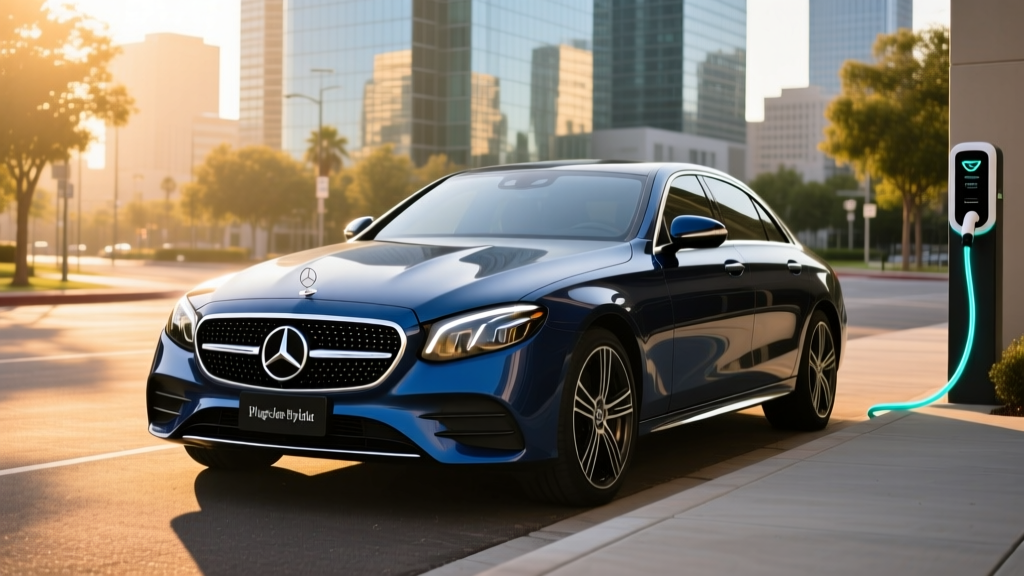
The 2026 Mercedes-Benz E 350e is not a conventional hybrid — it is a plug-in hybrid electric vehicle (PHEV) with a substantial 25.4 kWh battery pack that delivers meaningful electric-only commuting range before the turbocharged inline-four ever fires up. For luxury sedan buyers who want EV-like daily driving without range anxiety on long trips, the E-Class PHEV occupies a compelling middle ground. But with a starting MSRP pushing past $66,000 and federal tax credit eligibility that depends on battery sourcing and buyer income, the math requires careful scrutiny.
This guide covers the E 350e sedan's powertrain, real-world efficiency, charging behavior, warranty protection, and how it stacks up against both full battery-electric vehicles (BEVs) and conventional gas-only luxury sedans.
HEV vs. PHEV: Why the E 350e Is Strictly a Plug-In
Mercedes-Benz does not currently offer the E-Class as a conventional hybrid (HEV) in the United States. The electrified E-Class is exclusively the E 350e PHEV, meaning it has a charge port, a large traction battery, and the ability to drive on electricity alone for a meaningful distance.
| Feature | Conventional Hybrid (HEV) | Plug-In Hybrid (E 350e PHEV) |
|---|---|---|
| Plug-in charging | No — charges via regen and engine | Yes — AC Level 2, regen, and engine |
| Battery size | ~1–2 kWh | 25.4 kWh |
| Electric-only range | 0–1 mile at low speed | EPA-est. ~58 miles |
| DC fast charging | N/A | Not available (AC only) |
| Federal tax credit (§30D) | Not eligible | Up to $3,750 (sourcing-dependent) |
| Best for | No home charging access | Home/workplace Level 2 charging |
If you cannot plug in at home or work, the E 350e still functions as a highly efficient hybrid once the battery depletes — but you lose the primary benefit of the PHEV architecture: zero-tailpipe-emission commuting.
Powertrain Specs: 312 Combined Horsepower
The E 350e pairs a 2.0-liter turbocharged inline-four gasoline engine with a permanently excited synchronous electric motor integrated into the 9G-TRONIC nine-speed automatic transmission.
| Specification | 2026 E 350e (RWD Sedan) |
|---|---|
| Gas engine | 2.0L turbo I-4, 201 hp / 329 lb-ft |
| Electric motor | 127 hp / 325 lb-ft |
| Combined system output | 312 hp / 406 lb-ft |
| Transmission | 9-speed automatic (9G-TRONIC) |
| Drivetrain | Rear-wheel drive (4MATIC AWD optional) |
| 0–60 mph | ~6.0 seconds (RWD), ~5.8s (4MATIC) |
| Battery capacity | 25.4 kWh (usable) |
| Battery chemistry | NMC (nickel manganese cobalt) |
| EPA electric-only range | ~58 miles (RWD est.) |
| Total combined range | ~470 miles (electric + gas) |
| EPA MPGe (electric + gas) | ~75 MPGe combined |
| Charge-depleted MPG | ~30 MPG combined (est.) |
| Onboard AC charger | 7.4 kW (single-phase) |
| DC fast charging | Not available |
| Level 2 charge time (0–100%) | ~3 hours 30 minutes |
| Base MSRP (sedan RWD) | ~$66,850 |
| 4MATIC AWD MSRP | ~$69,350 |
| Battery warranty | 6 years / 62,000 miles |
| Powertrain warranty | 4 years / 50,000 miles |
Fuel Economy: EPA Numbers and Real-World MPG
The E 350e's efficiency depends entirely on your driving and charging habits. Here is the breakdown:
| Mode | City | Highway | Combined |
|---|---|---|---|
| Electric-only (MPGe) | ~80 MPGe | ~70 MPGe | ~75 MPGe |
| Charge-depleted (gas hybrid) | ~32 MPG | ~28 MPG | ~30 MPG |
Real-world expectation: PHEVs like the E 350e typically exceed EPA city estimates in electric mode because regenerative braking recaptures energy in stop-and-go traffic. On the highway at 75+ mph, electric range drops to roughly 45–50 miles due to higher aerodynamic drag. In charge-depleted hybrid mode, expect approximately 28–32 MPG combined depending on driving style, terrain, and climate control use — broadly consistent with the EPA estimate.
EPA Electric-Only Range: ~58 miles
Real-World Expectation: 45–55 miles in mixed driving; as low as 38–42 miles in cold weather (below 32°F) due to cabin heating load and reduced battery efficiency. Highway-only at 75 mph: ~45 miles.
For comparison, the gas-only E 350 (mild-hybrid 48V system) achieves roughly 25 MPG combined per fueleconomy.gov. The PHEV's advantage is substantial — but only if you charge regularly.
Charging the E 350e: Level 2 Only, No DC Fast Charge
The E 350e supports AC charging only. There is no DC fast-charge port — a deliberate engineering trade-off that keeps weight and cost down but means long road trips rely entirely on the gasoline engine once the battery depletes.
| Charging Level | Power (kW) | Time (0–100%) | Typical Use Case |
|---|---|---|---|
| Level 1 (120V household) | ~1.4 kW | ~18 hours | Emergency / overnight trickle |
| Level 2 (240V, 32A) | 7.4 kW | ~3.5 hours | Home wallbox / workplace |
| DC Fast Charge | N/A | N/A | Not supported |
Practical charging note: Most E 350e owners will plug in at home each evening using a Level 2 wallbox (a 240V/32A circuit). A full charge in roughly 3.5 hours means you can easily top up during the workday or overnight. Mercedes includes a portable Level 1/Level 2 charging cord with the vehicle. For home Level 2 installation, budget $500–$1,500 for a quality wallbox and $500–$2,000 for electrician labor depending on panel proximity and local permit requirements.
The 25.4 kWh battery is large enough that Level 1 charging (standard 120V outlet) is impractical as a daily strategy — it would take roughly 18 hours for a full charge, adding only about 3–4 miles of range per hour of charging.
Federal Tax Credit and Pricing Breakdown
Under current IRS §30D rules, the E 350e PHEV may qualify for a partial federal tax credit. The credit amount depends on critical-mineral and battery-component sourcing requirements, which have tightened significantly since 2024. As of the 2026 tax year, most luxury PHEVs with non-domestic battery sourcing qualify for $3,750 (meeting one of the two sourcing thresholds) or $0 (meeting neither). The full $7,500 credit requires meeting both thresholds.
Additionally, §30D imposes the following caps:
- MSRP cap: Sedans must be under $55,000 — the E 350e at ~$66,850 exceeds this cap, making it ineligible for the new-vehicle §30D credit.
- Buyer income cap: AGI must not exceed $150,000 (single) / $300,000 (joint).
- Point-of-sale transfer: Available only for eligible vehicles under the MSRP cap.
Bottom line: The 2026 E 350e does not qualify for the federal §30D new-vehicle tax credit due to its MSRP exceeding the $55,000 sedan cap. Some buyers may benefit from state-level PHEV incentives (California, Colorado, and others offer rebates — check your state's energy office) or from employer workplace-charging benefits. Always consult a tax professional and verify current rules at IRS.gov.
Battery Warranty, Reliability, and Replacement Cost
E 350e High-Voltage Battery Warranty: 6 years / 62,000 miles (whichever comes first), covering defects and capacity loss below a specified threshold (typically ~70% state-of-health). This is shorter than the 8-year/100,000-mile warranties offered by some competitors. Mercedes-Benz's standard new-vehicle warranty covers 4 years / 50,000 miles.
Reliability: Mercedes-Benz PHEV powertrains have matured significantly. The 2.0L turbo engine and 9-speed transmission are well-proven across the lineup. The primary reliability risk for any PHEV is the high-voltage battery, onboard charger, and power electronics — components that are expensive to replace out of warranty.
Battery replacement cost: If the 25.4 kWh pack requires full replacement out of warranty, expect a dealer quote in the range of $8,000–$14,000 (parts and labor). This is a realistic worst-case scenario typically occurring at 12–15+ years or 150,000+ miles. NMC chemistry batteries in PHEVs typically degrade 10–15% over 10 years under normal use — meaning your 58-mile electric range might shrink to ~49–52 miles over a decade of ownership.
Key care tip: PHEV batteries benefit from avoiding prolonged 100% state-of-charge storage in hot weather and from regular use (cycling between 20–80% SoC). Mercedes' battery management system includes a buffer that protects against extreme states, but mindful charging habits extend longevity.
Who Should Choose the E 350e PHEV?
Choose the E 350e PHEV if:
- Your daily commute is under 50 miles round-trip and you can charge at home
- You want luxury-sedan refinement with frequent zero-emission driving
- You take regular road trips beyond 300 miles and don't want to plan around DC chargers
- You value the E-Class interior, MBUX tech, and ride quality over maximum efficiency
Choose a full BEV (e.g., Mercedes EQE, BMW i5, Tesla Model S) if:
- Your daily driving exceeds 60 miles and you want zero gas use
- You have reliable home and workplace charging plus access to DC fast chargers
- You want lower maintenance (no oil changes, fewer moving parts)
- You prioritize the lowest per-mile fuel cost (~$0.04/mi electric vs ~$0.12/mi gas)
Choose the gas-only E 350 if:
- You have no access to home or workplace charging
- Your budget is closer to $58,000–$62,000 (the E 350 starts lower)
- You drive mostly highway miles where PHEV electric-range advantage is minimal
Pros
- ~58 miles electric range covers most commutes gas-free
- 312 hp provides confident acceleration and passing power
- Seamless transitions between electric and gas modes
- Total range ~470 miles eliminates road-trip range anxiety
- Class-leading interior quality, MBUX infotainment, and ride comfort
- Regenerative braking extends range in city driving
Cons
- No DC fast charging — road trips run on gas only once battery depletes
- MSRP exceeds $55,000 sedan cap — no federal §30D tax credit
- Battery warranty (6 yr/62k mi) is shorter than some competitors
- Charge-depleted MPG (~30) is only modestly better than gas E 350
- Premium fuel recommended for optimal performance
- Trunk space slightly reduced vs. gas model due to battery placement
Frequently Asked Questions
How many MPG does the Mercedes-Benz E 350e hybrid get?
In charge-depleted (hybrid) mode, the E 350e returns approximately 30 MPG combined (est. 32 city / 28 highway). In electric mode, it achieves roughly 75 MPGe combined. Your actual fuel consumption depends entirely on how often you charge — owners who plug in daily and commute under 50 miles may use gasoline only a few times per month.
How far can the E 350e go on electric only?
The EPA-estimated electric-only range is approximately 58 miles. In real-world mixed driving, expect 45–55 miles. Cold weather (below freezing) can reduce this to 38–42 miles due to cabin heating demand and reduced battery efficiency. Highway driving at 75 mph yields roughly 45 miles of electric range.
Does the E 350e qualify for a federal tax credit?
No. Under current IRS §30D rules, the new-vehicle clean vehicle credit is capped at $55,000 MSRP for sedans. The E 350e starts at approximately $66,850, making it ineligible. State incentives may apply depending on your jurisdiction — check your state energy office or the fueleconomy.gov tax center for details.
Is the E 350e a conventional hybrid or a plug-in hybrid?
The E 350e is exclusively a plug-in hybrid (PHEV). It has a charge port and a 25.4 kWh battery designed for regular plug-in charging. Mercedes-Benz does not offer the current E-Class as a conventional (non-plug-in) hybrid in the US market.
What is the battery warranty and replacement cost?
Mercedes-Benz covers the high-voltage battery for 6 years or 62,000 miles. Out-of-warranty replacement costs are estimated at $8,000–$14,000. Under normal use, NMC PHEV batteries typically retain 85–90% capacity after 10 years, meaning meaningful electric range remains well into the vehicle's second decade.
Can the E 350e DC fast charge?
No. The E 350e supports AC charging only, at up to 7.4 kW on a Level 2 (240V) connection. A full charge takes approximately 3.5 hours. On long road trips, the vehicle operates as a conventional hybrid once the battery is depleted — no charging stop required.
How does the E 350e compare to the EQE electric sedan?
The Mercedes EQE is a fully electric sedan with ~260 miles of EPA range, DC fast charging up to 170 kW, and no gasoline engine. It costs roughly $75,000+ and eliminates gas entirely but requires charging infrastructure. The E 350e is the better choice for buyers who need gasoline flexibility; the EQE suits those ready for full electrification.
Sources: EPA fuel economy data via fueleconomy.gov; Mercedes-Benz USA specifications via mbusa.com; IRS §30D clean vehicle credit rules via irs.gov. All specifications reflect 2026 model-year estimates and are subject to change. Verify exact figures with your dealer and tax professional before purchase.