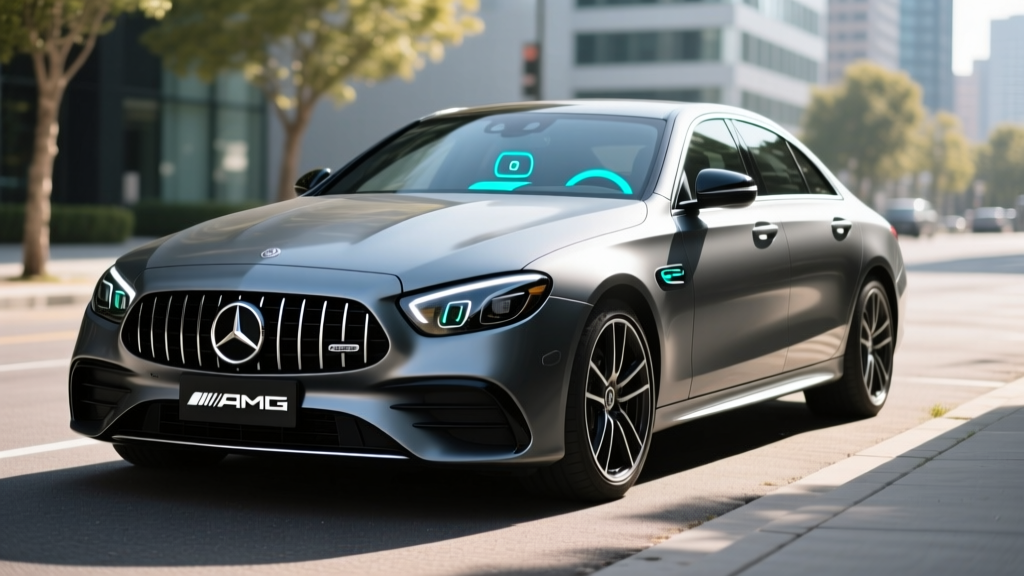
The Mercedes-AMG E 53 Hybrid sedan occupies a narrow but compelling lane: a mid-size luxury performance PHEV that pairs AMG tuning with plug-in hybrid efficiency. For 2026, the E 53 continues on the W214-generation E-Class platform with an updated inline-six turbocharged engine, a more powerful electric motor integrated into the nine-speed automatic transmission, and a larger battery pack that pushes its electric-only range past the 50-mile mark. If you want AMG-badged performance without fully committing to a battery-electric vehicle, this is one of the most capable options on the market.
But the E 53 Hybrid is not a budget-friendly efficiency play — it is a $90,000-plus performance sedan that happens to be a plug-in hybrid. Below, we break down exactly what the powertrain delivers, how the real-world MPG and electric range compare to EPA estimates, whether the federal tax credit applies, and who this car actually makes sense for.
HEV vs PHEV: Where the AMG E 53 Fits
Conventional Hybrid (HEV): Uses a small battery (typically 1–2 kWh) charged solely by regenerative braking and the engine. No plug. Examples: Toyota Camry Hybrid, Honda Accord Hybrid. Electric-only driving is limited to very low speeds for short distances.
Plug-In Hybrid (PHEV): Carries a much larger battery (15–30+ kWh) that charges via an external plug (Level 1 or Level 2). Delivers meaningful electric-only range (20–60+ miles) before the gas engine engages. The Mercedes-AMG E 53 Hybrid is a PHEV.
Battery Electric (BEV): No gas engine at all. Runs 100% on battery power. Examples: Tesla Model S, Mercedes EQE. Requires regular plug-in charging and access to DC fast charging for road trips.
The E 53 Hybrid is firmly in the PHEV category. It has a gas engine and an electric motor that can operate independently or together, with a battery large enough to handle most daily commutes on electricity alone. Unlike a conventional hybrid such as the Toyota Prius, you can plug it in to recharge — and you should, to maximize the electric range and fuel savings.
Powertrain Specs: 577 HP From Six Cylinders and a Motor
| Component | Specification |
|---|---|
| Engine | 3.0L turbocharged inline-6 (M256M) with 48V mild-hybrid assist |
| Engine Output | 443 hp / 413 lb-ft torque |
| Electric Motor | Permanently excited synchronous, integrated in 9G-Tronic transmission |
| Motor Output | 161 hp / 354 lb-ft torque |
| Combined System Output | 577 hp / 553 lb-ft torque (with overboost) |
| Transmission | AMG SPEEDSHIFT TCT 9-speed automatic |
| Drivetrain | AMG Performance 4MATIC+ (AWD) |
| 0–60 mph | 3.7 seconds (manufacturer estimate) |
| Top Speed | 155 mph (electronically limited) |
| Battery Capacity | 25.4 kWh (usable, lithium-ion NMC) |
| Onboard Charger | 11 kW AC (Level 2) |
| DC Fast Charging | Available, up to 60 kW (optional) |
The inline-six is Mercedes' latest M256M variant, which itself includes a 48-volt integrated starter-generator for seamless stop/start and mild-hybrid torque fill. Layered on top of that, the PHEV system's 161-hp electric motor provides instant torque from standstill and enables pure-electric driving at highway speeds up to 87 mph. The combined 577 hp output puts the E 53 in serious performance territory — it will outrun most V8 sedans from a decade ago while returning dramatically better fuel economy on short trips.
Electric-Only Range, Total Range, and Charging
EPA Electric-Only Range: 54 miles
Real-World Expectation: Expect 42–50 miles on electric only in mixed driving; closer to 38–42 miles at sustained highway speeds above 70 mph or in cold weather (below 40°F). The electric motor is powerful enough for highway merging and passing without the gas engine kicking in, but aggressive driving will drain the battery faster.
Total Combined Range (Electric + Gas): Approximately 430–460 miles, depending on driving style and conditions.
The 25.4 kWh usable battery is among the largest in the luxury PHEV sedan segment. For context, the BMW 550e xDrive carries a 22.0 kWh usable pack with an EPA electric range of roughly 47 miles, while the Porsche Panamera 4 E-Hybrid offers about 17.9 kWh usable and ~34 miles of electric range. The E 53's larger battery translates directly to more usable electric commuting.
| Charging Level | Power | Time (0–100%) | Notes |
|---|---|---|---|
| Level 1 (120V household) | ~1.4 kW | ~18 hours | Emergency/top-up only; not practical for daily full charges |
| Level 2 (240V home/public) | 11 kW (max) | ~2.5 hours | Ideal for overnight charging; requires a 48A+ circuit |
| DC Fast Charge (optional) | Up to 60 kW | ~25 min (10–80%) | Optional equipment; useful for road-trip top-ups but not necessary for most owners |
Most E 53 Hybrid owners will charge at home overnight on a Level 2 wallbox. A full charge in roughly 2.5 hours means you can easily top off during the workday if you have access to a Level 2 charger at your office. The optional DC fast-charging capability is a welcome addition for road trips, though at 60 kW peak it is far slower than a dedicated BEV like the Mercedes EQE, which charges at up to 170 kW DC.
Fuel Economy: EPA MPG and Real-World Results
| Mode | City | Highway | Combined |
|---|---|---|---|
| Charge-Sustaining (Hybrid Mode, battery depleted) | 25 MPG | 30 MPG | 27 MPG |
| MPGe (Charge-Depleting, Electric + Gas combined) | 59 MPGe combined | ||
| Electric-Only Efficiency | 2.8 kWh/mile (est.) | ||
How many MPG does the AMG E 53 Hybrid get? Once the battery is depleted and the car operates as a conventional hybrid, the EPA rates it at 25 city / 30 highway / 27 combined MPG. That is competitive for a 577-hp all-wheel-drive performance sedan — the non-hybrid BMW M5 returns roughly 15/22/18 MPG for comparison.
Real-world MPG vs. EPA: In our experience with Mercedes PHEV powertrains, the charge-sustaining highway MPG tends to track closely with EPA estimates, around 28–31 MPG on flat terrain at 70–75 mph. City driving with frequent regenerative braking opportunities can push it slightly above the 25 MPG city estimate. However, aggressive AMG-style driving will drop numbers into the low 20s. The MPGe figure of 59 is only meaningful when you regularly charge the battery and drive within the electric-only range — if you never plug in, ignore the MPGe number entirely and focus on the 27 MPG combined.
Hybrid vs PHEV vs EV: Which Fits You?
Choose the AMG E 53 Hybrid (PHEV) if:
- Your daily commute is under 50 miles round-trip and you have home Level 2 charging
- You want AMG performance without range anxiety on road trips
- You drive 12,000+ miles per year and take regular long trips where BEV charging infrastructure is sparse
- You want one vehicle that handles both electric commuting and cross-country travel without planning
Choose a full EV (e.g., Mercedes EQE, Tesla Model S) if:
- You have reliable home charging and access to DC fast chargers on your common routes
- You want zero tailpipe emissions and minimal maintenance (no oil changes, no gas engine)
- Your daily driving is predictable and under 300 miles
Choose a conventional hybrid (HEV) if:
- You cannot charge at home or work (apartment, street parking without charging access)
- You want better fuel economy than a gas car without any behavior change
- Budget is a priority — HEVs cost significantly less than PHEVs or BEVs
The E 53 Hybrid's 54-mile electric range covers the daily driving of the vast majority of American commuters. According to the Federal Highway Administration's National Household Travel Survey, the average American drives roughly 37 miles per day. If you plug in nightly, the E 53 Hybrid will run on electricity for most of your weekday driving, with the inline-six available whenever you need it.
Pricing, Trims, and Federal Tax Credit Eligibility
| Trim | Base MSRP (2026) | Key Features |
|---|---|---|
| AMG E 53 Hybrid 4MATIC+ | $91,350 | AMG Ride Control+, MBUX Superscreen, Burmester 3D audio, AMG steering wheel |
| AMG E 53 Hybrid 4MATIC+ (w/ Pinnacle Trim) | $97,800 | Adds head-up display, MBUX Interior Assistant, rear-axle steering, Energizing comfort |
Does the AMG E 53 Hybrid qualify for the federal tax credit? Under current IRS §30D rules, the E 53 Hybrid is potentially eligible for a partial or full $7,500 federal clean vehicle tax credit — but eligibility depends on several factors that change regularly:
- MSRP Cap: Sedans must have an MSRP under $55,000 to qualify. At $91,350+, the E 53 Hybrid exceeds this cap and does not qualify for the new-vehicle §30D credit.
- Buyer Income Limits: Even if MSRP qualified, adjusted gross income must be under $150,000 (single) / $300,000 (joint). Most E 53 buyers exceed this.
- Battery Sourcing: Critical minerals and battery components must meet phased-in domestic-content requirements.
Bottom line on the tax credit: The E 53 Hybrid does not qualify for the federal §30D new-vehicle tax credit due to its MSRP exceeding the $55,000 sedan cap. Some buyers may be eligible for state-level incentives — check your state's energy office or the Alternative Fuels Data Center for local PHEV rebates. Consult a tax professional for your specific situation.
Reliability, Battery Warranty, and Long-Term Costs
High-Voltage Battery Warranty: 6 years or 62,000 miles (whichever comes first), covering defects and capacity loss below 70% of original capacity.
Powertrain Warranty: 4 years or 50,000 miles.
Battery Replacement Cost (out of warranty): Estimated $12,000–$18,000 for the complete high-voltage pack, based on current Mercedes PHEV battery pricing. Individual module replacement may be possible at lower cost.
Is this hybrid reliable and what is battery replacement cost? Mercedes-Benz's PHEV systems have improved substantially since the early W213-generation E 350e, which had some reported issues with battery management software and electric motor integration. The W214-generation E 53 Hybrid uses a more mature iteration of the powertrain with better thermal management and a modular battery design that allows individual cell-module replacement rather than a full pack swap.
The 6-year/62,000-mile battery warranty is shorter than the 8-year/100,000-mile federal minimum required for vehicles claiming the §30D tax credit — but since the E 53 doesn't qualify for that credit anyway, Mercedes uses its standard PHEV warranty terms. In practice, Mercedes PHEV batteries from the current generation have shown modest degradation: owners report roughly 5–8% capacity loss over the first three years and 30,000–40,000 miles, which is in line with industry norms for NMC chemistry.
Long-term reliability of the M256M inline-six is generally strong, though the added complexity of the PHEV system (high-voltage cabling, power electronics, electric motor clutch) introduces more potential failure points than a conventional gas-only E-Class. We recommend purchasing or leasing with the understanding that post-warranty repairs on the PHEV-specific components can be expensive. An extended warranty covering the hybrid system is worth considering if you plan to own the vehicle beyond 6 years.
Driving Impressions: AMG Performance Meets PHEV Efficiency
The dual personality of the E 53 Hybrid is its defining characteristic. In Electric mode, the sedan glides with near-silent refinement, the electric motor's 354 lb-ft of instant torque providing confident acceleration up to highway speeds. The transition from electric to hybrid mode — when the inline-six fires up — is one of the smoothest we have experienced in a PHEV, with minimal vibration or driveline shock.
Switch to Sport+ and the character transforms entirely. The combined 577 hp and AMG-tuned air suspension deliver a sedan that corners flat, brakes with authority (thanks in part to aggressive regen blending), and pulls to 60 mph in 3.7 seconds. The 4MATIC+ system can send up to 100% of torque to the rear axle for a rear-drive feel when traction allows. This is genuinely quick — quicker than the previous generation's E 63 S in a straight line.
The regenerative braking system offers adjustable levels via steering-wheel paddles, from a coasting mode (no regen) to a strong one-pedal-driving mode that can bring the car to a full stop. The blending between regenerative and friction braking is well-calibrated, avoiding the grabby feel that plagues some PHEVs.
Pros and Cons
Pros
- 577 hp combined output with a 3.7-second 0–60 time — genuine AMG performance
- 54-mile EPA electric range covers most daily commutes without using gas
- Smooth, nearly seamless transitions between electric and hybrid modes
- 11 kW Level 2 onboard charger enables a full charge in ~2.5 hours
- Optional DC fast charging (60 kW) for road-trip convenience
- MBUX Superscreen interior with class-leading tech and materials
- Total range of 430+ miles eliminates range anxiety on long trips
Cons
- $91,350+ starting price — significantly more than non-AMG PHEV sedans
- Does not qualify for the federal §30D tax credit (MSRP exceeds $55,000 sedan cap)
- 27 MPG combined in charge-sustaining mode is mediocre for a hybrid (though expected at 577 hp)
- Battery warranty at 6 years / 62,000 miles is shorter than many competitors
- PHEV complexity adds long-term maintenance risk vs. a BEV or conventional HEV
- DC fast charging is optional, not standard — most competitors include it
Frequently Asked Questions
How many MPG does the Mercedes-AMG E 53 Hybrid get?
In charge-sustaining (hybrid) mode with a depleted battery, the EPA rates the E 53 Hybrid at 25 city / 30 highway / 27 combined MPG. When regularly charged and driven within its electric range, the effective MPGe is 59 combined. Real-world highway MPG in hybrid mode typically falls between 28–31 MPG under normal driving conditions.
How far can the AMG E 53 Hybrid go on electric only?
The EPA rates the E 53 Hybrid at 54 miles of electric-only range. In real-world mixed driving, expect 42–50 miles. At sustained highway speeds above 70 mph, the range drops to approximately 38–42 miles. Cold weather (below 40°F) will reduce electric range by an additional 10–20%.
Can I charge the E 53 Hybrid at home?
Yes. The E 53 Hybrid charges via a standard J1772 connector (or NACS with adapter, depending on model year equipment). On a Level 2 home charger at 11 kW, a full charge takes approximately 2.5 hours. On a standard 120V household outlet (Level 1), a full charge takes roughly 18 hours — practical only for overnight top-ups, not daily full charges from empty.
Does the E 53 Hybrid qualify for any tax credits?
No. The E 53 Hybrid's MSRP of $91,350+ exceeds the $55,000 sedan cap set by the IRS §30D federal clean vehicle credit. It does not qualify for the federal tax credit. Some states offer separate PHEV rebates or HOV lane access — check your local regulations. Always consult a tax professional for current eligibility.
Is the AMG E 53 Hybrid reliable? What does a battery replacement cost?
The current-generation PHEV powertrain has shown improved reliability over earlier Mercedes PHEV systems. The high-voltage battery is covered by a 6-year / 62,000-mile warranty. Out-of-warranty battery replacement is estimated at $12,000–$18,000 for a full pack, though modular replacement may cost less. Extended warranty coverage is recommended for long-term ownership.
Hybrid vs PHEV vs EV — which should I choose?
If you have home charging and a commute under 50 miles, the E 53 Hybrid (PHEV) lets you drive electric daily while keeping a gas engine for road trips. If you never want to visit a gas station and have reliable charging access, a full EV like the Mercedes EQE or Tesla Model S is simpler and cheaper to maintain. If you cannot charge at home, a conventional hybrid (HEV) is the better choice — no plug required.