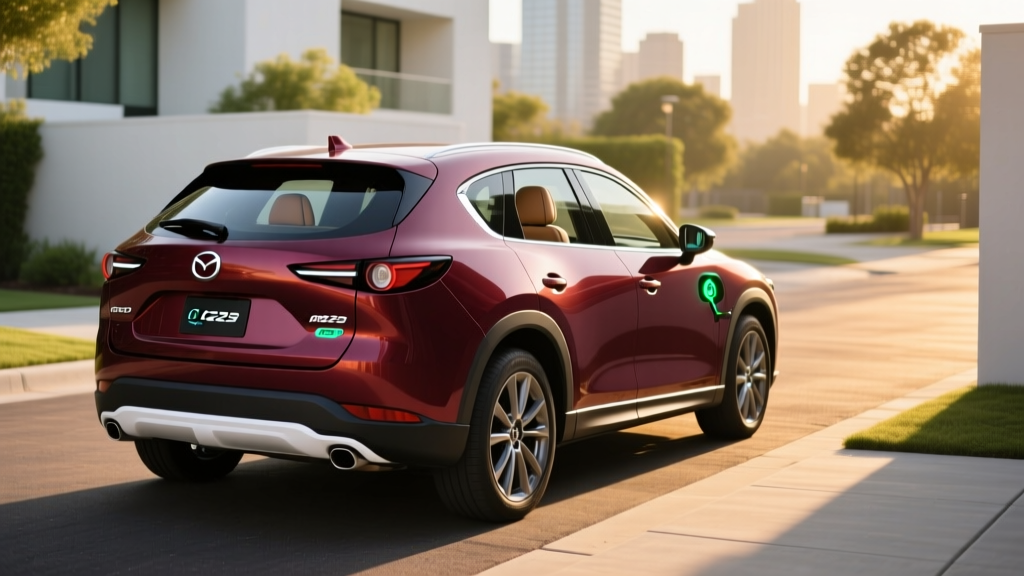
The Mazda CX-50 Hybrid pairs Toyota's proven hybrid powertrain with Mazda's rugged styling and driving dynamics. It's a conventional hybrid (HEV)—meaning no plug, no charging cables, just fill up with gas and drive. For 2026, the CX-50 Hybrid remains Mazda's answer to buyers who want hybrid efficiency without the lifestyle changes a plug-in hybrid (PHEV) or full electric vehicle (BEV) demands.
But does the real-world fuel economy match the EPA sticker? How does the Toyota-sourced drivetrain hold up in Mazda's heavier, more off-road-oriented chassis? And at what price does the math actually work? Here's the data-driven breakdown.
HEV vs PHEV: What the CX-50 Hybrid Actually Is
Before diving into specs, it's critical to understand what the CX-50 Hybrid is—and isn't.
Conventional Hybrid (HEV) — CX-50 Hybrid
- No plug required. The battery recharges via regenerative braking and the gas engine.
- Self-charging. You never need to find a charger or install home charging equipment.
- No electric-only driving range beyond very low-speed creep (under 1 mile at parking-lot speeds).
- No federal tax credit under IRS §30D (that credit is reserved for PHEVs and BEVs with plug-in capability and minimum battery capacity).
Plug-In Hybrid (PHEV) — Not Offered on CX-50
- Requires plugging in to access electric-only range (typically 25-40 miles).
- Larger battery (typically 14-20 kWh usable).
- May qualify for up to $7,500 federal tax credit if MSRP, buyer income, and battery-sourcing requirements are met.
- Mazda does not currently offer a CX-50 PHEV in the US market for 2026.
The CX-50 Hybrid is strictly a conventional HEV. If you're looking for plug-in electric-only commuting, you'll need to look at competitors like the Toyota RAV4 Prime or the Ford Escape PHEV.
EPA Fuel Economy and Real-World MPG
The headline number for the 2026 Mazda CX-50 Hybrid is its EPA-rated fuel economy, sourced directly from the Toyota RAV4 Hybrid powertrain that underpins it.
| Driving Cycle | EPA Rating | Real-World Expectation |
|---|---|---|
| City | 39 MPG | 38–42 MPG (hybrids often exceed EPA in stop-and-go) |
| Highway | 37 MPG | 33–36 MPG (aerodynamic drag, higher speeds reduce efficiency) |
| Combined | 38 MPG | 35–39 MPG depending on driving mix |
According to fueleconomy.gov, the CX-50 Hybrid's 38 MPG combined puts it within striking distance of the Toyota RAV4 Hybrid (39 MPG combined), though the Mazda's slightly heavier curb weight and boxier profile cost it roughly 1 MPG on the combined cycle.
Why Real-World Highway MPG Falls Short
Hybrids shine in city driving where regenerative braking recaptures energy at every stop light. On sustained highway runs above 70 mph, the electric motor contributes less and the 2.5-liter four-cylinder engine does most of the work. Expect 33–36 MPG on long interstate trips. In cold weather (below 30°F), the engine runs more frequently to provide cabin heat, further reducing efficiency by 3–5 MPG in city driving.
Annual Fuel Cost Estimate
At 15,000 miles per year and $3.40/gallon (national average), the CX-50 Hybrid costs approximately $1,342 annually in fuel. Compare that to the gas-only CX-50 Turbo (24 MPG combined), which would cost roughly $2,125 per year—a savings of about $780 per year with the hybrid.
Powertrain: Toyota's Hybrid System in a Mazda Chassis
| Specification | 2026 Mazda CX-50 Hybrid |
|---|---|
| Engine | 2.5L inline-4 (Atkinson cycle) |
| Electric Motor | Permanent-magnet synchronous (front + rear) |
| Combined Horsepower | 219 hp (net system output) |
| Drivetrain | AWD (electronic on-demand rear axle) |
| Transmission | eCVT (planetary gearset, no fixed gears) |
| Hybrid Battery | ~1.6 kWh nickel-metal hydride (NiMH), self-charging |
| 0–60 mph | ~7.5 seconds (est.) |
| Towing Capacity | 1,500 lbs (hybrid); gas CX-50 Turbo tows up to 3,500 lbs |
| Cargo Volume | 31.4 cu ft (rear seats up) / 56.4 cu ft (rear seats folded) |
The powertrain is essentially the fourth-generation Toyota Hybrid System (THS), the same architecture found in the RAV4 Hybrid. Mazda pairs it with their own suspension tuning, steering calibration, and all-wheel-drive logic. The result is a vehicle that feels more planted and responsive than its Toyota donor, though it sacrifices a small amount of efficiency to do so.
The eCVT is not a belt-driven CVT like those in some Nissan products—it's a planetary gearset that seamlessly blends engine and motor power. There are no rubber bands or slipping sensations. Acceleration is linear and predictable.
Pricing, Trims, and Tax Credit Eligibility
The 2026 CX-50 Hybrid is offered across multiple trims, all with standard AWD:
| Trim | MSRP (incl. destination) |
|---|---|
| Preferred Hybrid | $35,395 |
| Premium Hybrid | $38,595 |
| Premium Plus Hybrid | $41,795 |
Federal Tax Credit: Not Eligible
The CX-50 Hybrid does not qualify for the IRS §30D Clean Vehicle Credit. That credit (up to $7,500) applies only to plug-in electric vehicles—BEVs and PHEVs—that meet battery capacity, critical-mineral sourcing, MSRP caps, and buyer income limits. Conventional hybrids like the CX-50 Hybrid are excluded under current IRS rules.
Some states may offer modest incentives for hybrid purchases, but these vary widely. Check your state's energy or environmental agency for current programs.
Reliability and Battery Warranty
Hybrid Battery Warranty
Mazda covers the CX-50 Hybrid's battery and hybrid-system components for 8 years / 100,000 miles (whichever comes first), in compliance with federal emissions warranty requirements. In California-emissions states (CA, CT, ME, MA, NJ, NY, OR, RI, VT, WA), the hybrid battery warranty extends to 10 years / 150,000 miles.
Toyota-Sourced Reliability
The hybrid powertrain is manufactured by Toyota, which has built millions of hybrid systems since the 1997 Prius. The 2.5L Dynamic Force engine and THS hybrid transaxle have an excellent long-term track record. The NiMH battery pack is smaller and less stressed than those in PHEVs or BEVs, contributing to longevity.
Based on Toyota RAV4 Hybrid data, hybrid battery replacement (out of warranty) typically costs between $2,500 and $4,000 including labor. However, most Toyota/Mazda hybrid batteries last well beyond 150,000 miles with normal use. Degradation in conventional hybrids is minimal because the battery operates in a narrow state-of-charge window (roughly 40–80%), which dramatically reduces wear compared to a BEV battery that cycles from 10–100%.
General Vehicle Reliability
Mazda as a brand consistently ranks in the top third of reliability surveys. The CX-50's non-hybrid components (suspension, electronics, interior build) carry Mazda's standard 3-year/36,000-mile bumper-to-bumper and 5-year/60,000-mile powertrain warranties.
Who Should Choose the CX-50 Hybrid vs a Full EV or Gas Car
Pros
- 38 MPG combined with zero lifestyle changes—no charging needed
- Standard AWD with competent light-off-road capability
- Toyota hybrid reliability with Mazda driving dynamics
- Strong city MPG (39 EPA; often exceeds in real-world stop-and-go)
- Lower annual fuel cost vs gas CX-50 (~$780/year savings)
- 8-year/100,000-mile hybrid battery warranty (10 yr in CARB states)
Cons
- No federal tax credit eligibility (HEV, not PHEV/BEV)
- Towing limited to 1,500 lbs (vs 3,500 lbs for gas CX-50 Turbo)
- Highway MPG drops to 33–36 in real-world driving
- No electric-only driving mode for short commutes
- Premium trims push past $41,000 without tax-credit offset
- Hybrid battery replacement ($2,500–$4,000) if it fails post-warranty
Decision Framework
Choose the CX-50 Hybrid if: You want 35+ MPG without plugging in, you don't have reliable home or workplace charging access, you drive a mix of city and highway miles, and you value AWD for weather or light trails.
Choose a PHEV (like the RAV4 Prime) if: You have home Level 2 charging, your daily commute is under 40 miles round-trip, and you want to drive mostly on electricity while keeping a gas backup for road trips.
Choose a full EV (like the Hyundai Ioniq 5) if: You have reliable home charging, your daily driving is under 250 miles, you want to eliminate gas entirely, and you want access to the $7,500 federal tax credit (subject to eligibility).
Stick with the gas CX-50 Turbo if: You need maximum towing capacity (3,500 lbs), you drive predominantly highway miles where the hybrid advantage shrinks, or you want a lower purchase price below $33,000.
How the CX-50 Hybrid Compares to Key Rivals
| Vehicle | Type | EPA Combined MPG | Combined HP | Base MSRP | Federal Credit |
|---|---|---|---|---|---|
| Mazda CX-50 Hybrid | HEV | 38 MPG | 219 hp | $35,395 | None |
| Toyota RAV4 Hybrid | HEV | 39 MPG | 219 hp | $33,975 | None |
| Honda CR-V Hybrid | HEV | 37 MPG | 204 hp | $35,395 | None |
| Toyota RAV4 Prime | PHEV | 94 MPGe / 38 MPG (gas) | 302 hp | $44,515 | Up to $7,500* |
| Ford Escape PHEV | PHEV | 105 MPGe / 40 MPG (gas) | 210 hp | $40,500 | Up to $7,500* |
*PHEV federal credit eligibility depends on MSRP caps, buyer income limits, battery critical-mineral sourcing, and point-of-sale transfer rules under IRS §30D. Consult a tax professional.
Frequently Asked Questions
How many MPG does the Mazda CX-50 Hybrid get?
The 2026 Mazda CX-50 Hybrid is EPA-rated at 39 MPG city, 37 MPG highway, and 38 MPG combined. In real-world driving, expect 38–42 MPG in city conditions and 33–36 MPG on sustained highway trips above 70 mph.
Does the CX-50 Hybrid need to be plugged in?
No. The CX-50 Hybrid is a conventional hybrid (HEV). The battery charges automatically through regenerative braking and the gasoline engine. There is no plug, no charging cable, and no need for home charging equipment.
Does the Mazda CX-50 Hybrid qualify for a federal tax credit?
No. Under current IRS §30D rules, only plug-in electric vehicles (BEVs and PHEVs) with sufficient battery capacity qualify for the federal Clean Vehicle Credit. Conventional hybrids like the CX-50 Hybrid are not eligible. Some states may offer separate hybrid incentives—check your state's energy agency.
Is the CX-50 Hybrid reliable, and what does battery replacement cost?
The hybrid powertrain is Toyota-sourced, with a decades-long reliability track record. The hybrid battery is warranted for 8 years/100,000 miles (10 years/150,000 miles in CARB states). Out-of-warranty battery replacement typically costs $2,500–$4,000. Most hybrid batteries in Toyota/Mazda systems last well beyond 150,000 miles due to the narrow state-of-charge operating window that minimizes degradation.
How far can the CX-50 Hybrid drive on electric power alone?
Effectively zero miles at meaningful speeds. The CX-50 Hybrid can creep on electric power at very low speeds (parking lots, traffic jams) for less than a mile, but it has no usable electric-only driving range. For 25–40 miles of electric-only commuting, you'd need a plug-in hybrid like the Toyota RAV4 Prime.
Can the CX-50 Hybrid tow?
Yes, but with limitations. The CX-50 Hybrid is rated to tow up to 1,500 lbs. If you need heavier towing, the gas-only CX-50 Turbo handles up to 3,500 lbs.
Is the CX-50 Hybrid a Toyota underneath?
The hybrid powertrain (2.5L engine, eCVT, hybrid battery, AWD rear motor) is sourced from Toyota and is the same system in the RAV4 Hybrid. However, the chassis, suspension, steering, interior, exterior design, and infotainment are Mazda-engineered. It's a collaboration, not a rebadge.