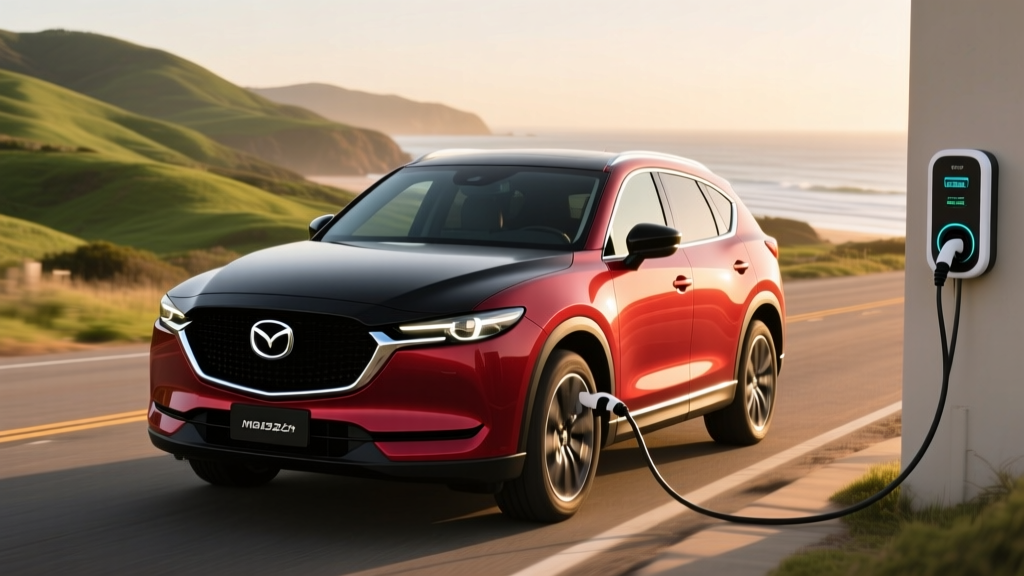
The Mazda CX-90 PHEV occupies a specific niche: a three-row luxury SUV that lets you commute on electricity and road-trip on gasoline without a second thought. For buyers not ready to commit to a full battery-electric vehicle but tired of paying premium fuel prices on a 100-mile daily round trip, the CX-90 plug-in hybrid offers a pragmatic bridge. This guide breaks down exactly what the 2026 model delivers in range, efficiency, charging practicality, and ownership cost — with the real-world caveats the window sticker won't tell you.
2026 Mazda CX-90 PHEV: Core Specifications at a Glance
| Attribute | Value |
|---|---|
| Powertrain | 2.5L inline-4 + permanent-magnet electric motor |
| Combined Output | 327 hp / 369 lb-ft torque |
| Transmission | 8-speed automatic (no torque converter — clutch-based) |
| Drivetrain | i-Activ AWD (standard) |
| Battery (Usable) | 17.8 kWh lithium-ion |
| EPA Electric Range | 26 miles |
| EPA MPGe (EV mode) | 56 MPGe combined |
| EPA MPG (gas-only, charge-sustaining) | 25 city / 28 hwy / 25 combined |
| Total Combined Range | ~430 miles (EV + gas) |
| Max AC Charging (Level 2) | 7.2 kW |
| DC Fast Charging | Not available |
| Level 2 Charge Time (0–100%) | ~2.5 hours |
| Level 1 Charge Time (120V) | ~11 hours |
| 0–60 mph | 5.9 seconds (est.) |
| Towing Capacity | 3,500 lbs |
| Seating | 6- or 7-passenger |
| Cargo (behind 3rd row) | 14.9 cu ft |
| Starting MSRP | $51,470 (Preferred Plus) |
| Battery Warranty | 8 years / 100,000 miles |
Understanding the CX-90: PHEV vs. Conventional Hybrid vs. Full EV
Before evaluating the CX-90 PHEV specifically, it's worth clarifying what separates it from the other electrified options in Mazda's lineup and the broader market.
HEV vs. PHEV vs. BEV — What's the Difference?
- Conventional Hybrid (HEV): A small battery recharged only by regenerative braking and the engine. You never plug it in. Electric-only driving is limited to brief low-speed moments. Example: Toyota Highlander Hybrid (35 MPG combined, zero plug-in capability).
- Plug-In Hybrid (PHEV): A larger battery you can charge from a wall outlet or charging station, giving 20–40 miles of pure electric range before the gas engine takes over. Once depleted, it operates as a conventional hybrid. Example: Mazda CX-90 PHEV (26 miles electric, then 25 MPG gas).
- Battery Electric (BEV): No gasoline engine at all. 100% electric, 200–400 miles of range, requires regular charging. Example: Tesla Model X or Rivian R1S.
The CX-90 PHEV is strictly a plug-in hybrid. Mazda does not offer a conventional HEV version of the CX-90 — the non-PHEV models use either the turbocharged inline-6 gasoline engine or the inline-6 mild-hybrid (which is not a full hybrid and does not provide meaningful electric-only driving). If you want a Mazda three-row SUV you never plug in, you'd be looking at the CX-90 Turbo, not a hybrid variant.
Electric-Only Range and Real-World Efficiency
The EPA rates the CX-90 PHEV at 26 miles of electric-only range and 56 MPGe when operating in EV mode. Once the battery depletes, the inline-4 and electric motor work together in charge-sustaining mode, delivering an EPA-estimated 25 MPG combined (25 city / 28 highway).
Real-World Range Expectations
EPA Electric Range: 26 miles
In real-world driving, expect 20–24 miles of electric range in moderate temperatures with mixed city/highway use. In cold weather (below 35°F), that figure drops to roughly 16–19 miles due to cabin heating demands and reduced battery efficiency. Highway-only driving at 70+ mph will also reduce electric range below the EPA figure, since the EPA cycle includes substantial low-speed city driving where EV mode is most efficient.
Gas-Only (Charge-Sustaining) MPG: 25 combined
On long road trips with a depleted battery, owners report 24–27 MPG on the highway at 70–75 mph, roughly in line with EPA estimates. City driving in charge-sustaining mode can edge slightly higher thanks to regenerative braking recapturing energy at stops.
| Mode | City | Highway | Combined |
|---|---|---|---|
| Electric (MPGe) | — | — | 56 MPGe |
| Gas Only (charge-sustaining) | 25 MPG | 28 MPG | 25 MPG |
For context, the gas-only CX-90 Turbo mild-hybrid achieves 24 MPG combined. So even with a fully depleted battery, the PHEV variant matches or slightly exceeds the non-hybrid model — and on short commutes within its 26-mile electric envelope, it uses zero gasoline.
Charging: Level 2 at Home, No DC Fast Charging
The CX-90 PHEV comes with a 17.8 kWh lithium-ion battery pack and a 7.2 kW onboard charger. Here's what charging looks like in practice:
| Level | Source | Power | Full Charge Time | Miles Added per Hour |
|---|---|---|---|---|
| Level 1 | Standard 120V outlet | ~1.3 kW | ~11 hours | ~2–3 mi/hr |
| Level 2 | 240V home charger / public AC | 7.2 kW | ~2.5 hours | ~10–12 mi/hr |
| DC Fast Charge | — | Not supported | N/A | N/A |
Critical note: The CX-90 PHEV does not support DC fast charging. This is typical for PHEVs — their smaller batteries don't justify the cost and weight of DC hardware. You will charge exclusively via AC (Level 1 or Level 2).
For daily use, a Level 2 home charger is the practical choice. Plug in when you get home, and the battery is full by morning — well within the ~2.5-hour window. Level 1 (a standard household outlet) works if you drive less than 20 miles per day and can tolerate an overnight charge, but it's slow enough that you may not fully replenish if you drain the battery completely.
A quality Level 2 home charger (such as a ChargePoint Home Flex or Emporia Vue) costs $500–$700 for the unit, plus $300–$1,200 for professional installation depending on your electrical panel's capacity and the distance from panel to garage. If your home has a 200-amp panel with spare capacity, expect a straightforward install. Older homes with 100-amp service may require a panel upgrade ($1,500–$3,000) — get a quote from a licensed electrician before committing.
Powertrain Performance and Driving Impressions
The CX-90 PHEV pairs a 2.5-liter naturally aspirated inline-4 with a permanent-magnet electric motor integrated into the 8-speed automatic transmission. Combined output is 327 horsepower and 369 lb-ft of torque, routed through Mazda's i-Activ all-wheel-drive system.
The result is a 0–60 mph time in the high-five-second range — respectable for a 4,800-pound three-row SUV. More importantly, the electric motor fills in the torque gap that the naturally aspirated four-cylinder would otherwise leave at low RPMs. Around town and in EV mode, the CX-90 PHEV feels genuinely quiet and refined, with the engine staying off entirely on short trips.
Mazda's decision to use a clutch-based 8-speed automatic (rather than a conventional torque-converter or CVT) gives shifts a direct, almost manual feel. Some drivers notice a slight hesitation from a stop as the clutch engages — a tradeoff for the sportier shift character. The inline-6 turbocharged CX-90 models (non-PHEV) feel smoother in this regard, but they lack the electric-only commuting advantage.
Pricing, Trims, and Federal Tax Credit Eligibility
The 2026 Mazda CX-90 PHEV is available in three trims:
| Trim | MSRP | Notable Features |
|---|---|---|
| Preferred Plus | $51,470 | Leatherette, heated front seats, 10.25" display, power liftgate |
| Premium Plus | $56,100 | Nappa leather, ventilated front seats, 12.3" display, head-up display |
| Premium Plus w/ Navigation & Packages | $59,920 | All above + advanced packages, 21" wheels |
Federal Tax Credit (§30D): Does the CX-90 PHEV Qualify?
The Mazda CX-90 PHEV is assembled in Hofu, Japan. Under the current IRS §30D clean vehicle credit rules, the battery sourcing and critical minerals requirements have become increasingly stringent. As of the 2026 tax year, the CX-90 PHEV's eligibility for the full $7,500 credit depends on Mazda's supply-chain compliance — specifically whether the battery components and critical minerals meet the phased-in thresholds.
§30D Credit Requirements (2026)
- MSRP Cap: SUVs must be under $80,000 — all CX-90 PHEV trims qualify.
- Buyer Income Cap: Modified AGI ≤ $150,000 (single) / ≤ $300,000 (joint).
- North American Assembly: Not required for the credit, but battery component and critical-mineral sourcing thresholds apply and increase annually.
- Battery Capacity: Must be ≥ 7 kWh — the CX-90's 17.8 kWh pack qualifies.
- Point-of-Sale Transfer: Eligible buyers can transfer the credit to the dealer for an upfront price reduction.
Always verify current eligibility on fueleconomy.gov and consult a tax professional. Sourcing requirements change annually and can disqualify previously eligible models.
If the CX-90 PHEV qualifies for the partial or full credit, the effective price on the Preferred Plus trim drops to roughly $44,000–$47,500 — putting it in competition with non-hybrid luxury midsize SUVs that can't match its electric-commute capability.
Battery Warranty, Reliability, and Long-Term Costs
Mazda PHEV Battery Warranty
Coverage: 8 years / 100,000 miles (whichever comes first)
Capacity Retention Threshold: Mazda warrants the hybrid battery against defects and excessive capacity loss. If the battery drops below approximately 70% of original capacity within the warranty period, Mazda will repair or replace it at no cost.
Out-of-Warranty Replacement Cost: Based on comparable PHEV battery packs, expect $6,000–$9,000 for a full replacement at a Mazda dealer (parts + labor). However, PHEV batteries are smaller and less stressed than full EV packs, and real-world failure rates within 10–15 years remain low for modern lithium-ion chemistry.
Mazda's hybrid system is relatively new compared to Toyota's two-decade track record, but the 2.5L inline-4 is a proven, naturally aspirated engine with minimal complexity — no turbocharger to fail, no high-stress components. The electric motor and clutch-based transmission add some new failure points, but Mazda has been conservative with the powertrain calibration, prioritizing durability over maximum performance.
For reliability data, NHTSA and owner forums are worth monitoring as the CX-90 PHEV accumulates real-world mileage. Early model years (2024–2025) saw some software-related complaints around infotainment and charge scheduling, but no widespread powertrain failures have been reported as of this writing.
Who Should Buy the CX-90 PHEV — And Who Shouldn't?
Choose the Mazda CX-90 PHEV If:
- Your daily commute is under 25 miles round-trip and you can charge at home — you'll drive most days on electricity alone.
- You need three rows for family but don't want to commit to a full EV due to road-trip flexibility concerns.
- You value Mazda's interior quality and driving dynamics and are willing to pay a premium over mainstream PHEVs like the Toyota Highlander Hybrid (which is HEV-only, not plug-in).
- You want AWD as standard without the range-loss penalty that AWD imposes on full EVs.
Look Elsewhere If:
- Your commute exceeds 30 miles — the 26-mile EV range will leave you burning gas daily. Consider a longer-range PHEV like the Toyota RAV4 Prime (42 miles EV) or a full EV.
- You can't install a Level 2 charger at home — without regular plug-in charging, you're paying a premium for battery weight you're not using, and the gas-only MPG (25 combined) isn't meaningfully better than the CX-90 Turbo.
- You prioritize third-row space — the CX-90's third row is tight for adults. The Kia Sorento PHEV or a minivan PHEV may serve larger families better.
- You want DC fast charging for road trips — no PHEV offers this. If fast charging matters, you're shopping for a BEV.
Pros
- Premium interior with genuine Nappa leather on higher trims
- Standard AWD with 327 hp — confident in all weather
- 26-mile EV range covers most daily commutes
- Quiet, refined EV-mode driving around town
- Eligible for §30D federal tax credit (verify current sourcing rules)
- 8-year / 100,000-mile hybrid battery warranty
Cons
- No DC fast charging
- 26-mile EV range is shorter than rivals (RAV4 Prime: 42 mi, Sorento PHEV: 32 mi)
- Third row is cramped for adults
- Starting price above $51K — premium over non-hybrid CX-90
- Clutch-based 8-speed can hesitate from a stop
- Cold weather reduces EV range by 25–30%
Frequently Asked Questions
How many MPG does the Mazda CX-90 PHEV get?
With a full battery, the CX-90 PHEV achieves 56 MPGe combined in electric mode. Once the battery is depleted and the vehicle operates on gasoline alone, it returns an EPA-estimated 25 MPG combined (25 city / 28 highway). Real-world highway driving yields roughly 24–27 MPG depending on speed and terrain.
How far can the CX-90 PHEV go on electric only?
The EPA rates it at 26 miles of electric-only range. In real-world conditions with moderate temperatures and mixed driving, expect 20–24 miles. Cold weather (below 35°F) can reduce that to 16–19 miles due to battery chemistry limitations and cabin heating load.
Does the Mazda CX-90 PHEV qualify for a federal tax credit?
It may qualify for up to $7,500 under the IRS §30D clean vehicle credit, but eligibility depends on the buyer's income (≤$300K joint / ≤$150K single), the vehicle's MSRP (under $80K — all trims qualify), and current battery-sourcing and critical-minerals requirements. These rules tighten annually. Verify on fueleconomy.gov and consult a tax professional before purchasing.
Is the CX-90 PHEV reliable, and what does a battery replacement cost?
The 2.5L naturally aspirated engine is low-stress and proven. Mazda's hybrid system is newer than Toyota's but has shown no widespread failures. The hybrid battery is warranted for 8 years / 100,000 miles. Out-of-warranty replacement is estimated at $6,000–$9,000, though PHEV batteries tend to degrade slowly given their smaller size and conservative use.
Hybrid vs. PHEV vs. EV — which should I choose?
If you can charge at home and your daily driving is under 30 miles, a PHEV like the CX-90 lets you commute electrically while keeping gas for road trips. If you can't charge at home, a conventional hybrid (HEV) avoids the PHEV premium without requiring a plug. If you have reliable charging access and want zero tailpipe emissions, a full EV eliminates gasoline entirely — but requires planning for longer trips.
Can the CX-90 PHEV use DC fast chargers?
No. The CX-90 PHEV charges via AC only — Level 1 (120V, ~11 hours) or Level 2 (240V, ~2.5 hours). This is standard for plug-in hybrids. DC fast charging is available only on full battery-electric vehicles.