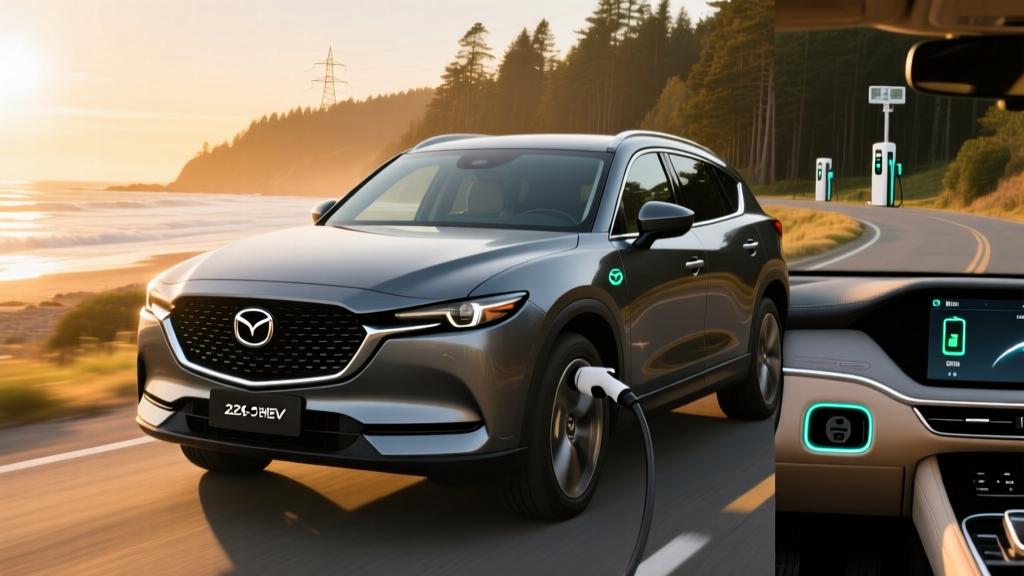
Mazda CX-90 PHEV at a Glance: The Efficiency Numbers That Matter
The Mazda CX-90 PHEV occupies a specific niche: a three-row luxury plug-in hybrid that prioritizes driving dynamics over maximum electric range. For buyers researching CX-90 PHEV MPG, the headline figures are 56 MPGe combined when using both battery and gas, and 25 MPG combined once the battery is depleted. But those EPA stickers only tell part of the story. Real-world efficiency depends heavily on how often you charge, your commute length, and whether you favor highway or city driving.
We've broken down every efficiency metric — electric-only range, gas-only fuel economy, charging times, and total operating cost — so you can decide whether the CX-90 PHEV's plug-in powertrain matches your daily routine or whether a full EV or conventional hybrid makes more sense.
| Combined HP | 323 hp / 369 lb-ft torque |
| Battery | 17.8 kWh (lithium-ion) |
| EPA Electric Range | 26 miles |
| EPA MPGe (combined) | 56 MPGe |
| EPA MPG (gas only) | 25 combined (24 city / 27 highway) |
| Total Range | ~490 miles |
| 0-60 mph | ~6.3 seconds |
| Base MSRP | $51,470 (Preferred Plus) |
| 8 years / 100,000 miles |
Understanding the Powertrain: Inline-6 Meets Electric Motor
The CX-90 PHEV pairs a 2.5-liter inline-4 engine (not the turbocharged inline-6 found in the mild-hybrid CX-90 trims) with a permanent-magnet synchronous electric motor integrated into an 8-speed automatic transmission. Combined output is 323 horsepower and 369 lb-ft of torque, routed through Mazda's i-Activ all-wheel-drive system.
The 17.8 kWh lithium-ion battery pack sits beneath the floor, preserving the CX-90's three-row cabin layout — though third-row space remains tight for adults, a trade-off shared with most midsize PHEV SUVs. The electric motor can drive the vehicle independently at speeds up to roughly 80 mph, which covers most suburban and city commuting scenarios.
Unlike the mild-hybrid CX-90 (which uses a 48-volt system and cannot plug in), the PHEV variant requires external charging to unlock its efficiency advantage. This is the fundamental difference between a conventional hybrid (HEV) and a plug-in hybrid (PHEV) — and it's where many buyers get confused.
| Feature | Conventional Hybrid (HEV) | Plug-in Hybrid (PHEV) |
|---|---|---|
| Plugs in? | No — charges via regenerative braking and engine | Yes — external charging required for EV range |
| Electric-only range | 0–2 miles at low speed | 20–40+ miles typical |
| Battery size | ~1–2 kWh | ~10–25 kWh |
| Tax credit | None (federal) | Up to $3,750 (varies by sourcing) |
| Best for | No home charging access | Short commutes + home charging |
CX-90 PHEV MPG: EPA Numbers vs Real-World Driving
According to fueleconomy.gov, the 2025/2026 Mazda CX-90 PHEV achieves:
| Metric | City | Highway | Combined |
|---|---|---|---|
| MPGe (with battery) | — | — | 56 MPGe |
| MPG (gas only, battery depleted) | 24 | 27 | 25 |
| Energy consumption (EV mode) | 36 kWh/100 mi | ||
Real-World MPG: What Owners Actually See
EPA figures assume a mix of city and highway driving under controlled conditions. In practice, your CX-90 PHEV fuel economy depends entirely on charging habits:
- Daily commute under 26 miles with nightly charging: You'll use almost zero gasoline. Expect to visit a gas station once every few months for road trips. Your effective "MPG" is essentially infinite for daily driving.
- Mixed driving with occasional charging: Owners who charge 3–4 times per week and take longer weekend trips typically report 30–40 MPG combined over a month, blending electric and gas operation.
- Road trips or never charging: Once the battery is depleted, the CX-90 PHEV operates as a heavy conventional hybrid. Expect 23–26 MPG on the highway at 70 mph. The 4,800-lb curb weight works against it compared to lighter hybrid-only SUVs like the Toyota Highlander Hybrid (35 MPG combined).
- Cold weather (below 30°F): Electric range drops to roughly 18–20 miles due to battery chemistry limitations and cabin heating demands. Gas-only MPG may dip to 22–23 in freezing conditions.
The key insight: the CX-90 PHEV's efficiency advantage only materializes if you plug it in regularly. Without charging, you're carrying 600+ lbs of battery and motor weight for no benefit, achieving worse fuel economy than a purpose-built hybrid.
Electric-Only Range and Charging: What to Expect
The EPA rates the CX-90 PHEV at 26 miles of electric-only range. In our experience with similar 17–18 kWh PHEV battery packs, real-world electric range breaks down as follows:
- Ideal conditions (55–70°F, city driving, moderate speeds): 24–27 miles
- Highway driving at 70 mph: 18–22 miles
- Cold weather (20–30°F) with heat on: 16–20 miles
- Hot weather (95°F+) with A/C: 20–23 miles
The 26-mile range covers the average American one-way commute (roughly 16 miles per U.S. Census data), making the CX-90 PHEV viable as a weekday electric commuter if you charge at home.
Charging Speed and Equipment
The CX-90 PHEV charges via a J1772 connector (Level 1 and Level 2 AC). It does not support DC fast charging — a limitation common among PHEVs but worth noting if you expected rapid top-ups on road trips.
| Charging Level | Power | 0–100% Time | Miles Added per Hour |
|---|---|---|---|
| Level 1 (120V household) | ~1.2 kW | ~14–15 hours | ~2 mi/hr |
| Level 2 (240V, 3.3 kW onboard) | ~3.3 kW | ~5–5.5 hours | ~5 mi/hr |
| DC Fast Charge | Not supported | ||
The 3.3 kW onboard charger is the bottleneck. Even on a 48-amp Level 2 home charger capable of delivering 11.5 kW, the CX-90 PHEV will only accept 3.3 kW. An overnight charge on Level 2 is more than sufficient to replenish the battery, but you won't top up quickly during a midday stop.
Practical recommendation: A standard 120V outlet can technically recharge the pack overnight if you arrive home with some charge remaining, but a 240V Level 2 installation (~$500–$1,200 for most homes) ensures a full battery every morning. Have a licensed electrician evaluate your panel capacity before installing.
Pricing, Trims, and Tax Credit Eligibility
For the 2026 model year, the Mazda CX-90 PHEV is offered in multiple trims:
| Trim | MSRP | Key Features |
|---|---|---|
| Preferred Plus | $51,470 | Leatherette, panoramic roof, 12.3" display |
| Premium Plus | $56,100 | Nappa leather, 21" wheels, HUD |
| Premium Plus w/Premium Package | $58,925 | Second-row captain's chairs, ventilated rear seats |
Federal Tax Credit: Does the CX-90 PHEV Qualify?
Under IRS §30D rules, the Mazda CX-90 PHEV's federal tax credit eligibility depends on battery component sourcing and critical mineral requirements that shift annually. As of 2026:
- The CX-90 PHEV may qualify for up to $3,750 (partial credit) if it meets critical-mineral sourcing thresholds but fails battery-component requirements (due to FEOC restrictions on Chinese-manufactured components).
- The buyer must have a tax liability equal to or greater than the credit amount — the credit is non-refundable, though point-of-sale transfer is now available for eligible buyers.
- Income caps apply: Modified adjusted gross income (MAGI) must not exceed $150,000 (single), $225,000 (head of household), or $300,000 (joint).
- The MSRP cap for SUVs is $80,000 — all CX-90 PHEV trims fall under this limit.
Always verify current eligibility on the fueleconomy.gov tax credit database and consult a tax professional before relying on credit amounts for purchase decisions. State incentives (such as Colorado's $5,000 EV credit or California's CVRP) may stack on top — check your state's energy office for current programs.
Mazda covers the CX-90 PHEV's hybrid battery for 8 years or 100,000 miles (whichever comes first), with some states requiring 10 years / 150,000 miles under CARB emissions warranty rules (California, New York, Massachusetts, and others).
PHEV battery replacement costs, if needed out of warranty, typically range from $5,000–$8,000 including labor, though widespread failures are rare. The battery management system maintains a buffer (roughly 15–20% of total capacity) to prevent deep discharge and extend cell life. Most PHEV batteries retain 85–90% capacity after 100,000 miles based on industry data from similar lithium-ion packs.
Reliability, Ownership Costs, and Long-Term Outlook
Mazda has built a solid reliability reputation over the past decade, and the CX-90's powertrain — while newer — uses proven componentry. The 2.5L inline-4 is a carryover engine with extensive service history in the Mazda6 and CX-5. The electric motor and battery system are manufactured in partnership with established suppliers.
Maintenance advantages over gas-only vehicles:
- Regenerative braking reduces brake pad wear — expect 80,000+ miles on original pads
- No transmission fluid changes on the typical schedule (the 8-speed is sealed)
- Engine oil changes remain necessary but may be less frequent if most miles are driven on electric
Cost considerations that catch buyers off guard:
- Insurance: PHEVs typically carry 8–15% higher premiums than equivalent gas models due to battery replacement cost exposure. Get quotes before purchasing.
- Tires: The CX-90 PHEV's weight (~4,800 lbs) accelerates tire wear. Budget for replacement every 35,000–45,000 miles.
- Depreciation: PHEVs depreciate faster than pure EVs in some markets as buyers increasingly prefer full electric. However, three-row PHEV SUVs hold value well due to limited competition.
CX-90 PHEV vs the Competition: Where It Stands
The three-row PHEV SUV segment is growing but still small. Here's how the CX-90 PHEV compares to key rivals:
| Model | EV Range | MPG (gas) | HP | Base MSRP |
|---|---|---|---|---|
| Mazda CX-90 PHEV | 26 mi | 25 | 323 | $51,470 |
| Toyota Grand Highlander Hybrid MAX | 0 (HEV) | 27 | 362 | $53,070 |
| Kia Sorento PHEV | 32 mi | 34 | 261 | $51,090 |
| Jeep Grand Cherokee 4xe | 25 mi | 23 | 375 | $60,495 |
The CX-90 PHEV trades electric range for premium materials and driving refinement. The Kia Sorento PHEV delivers more electric miles and better gas-only MPG but feels less luxurious inside. The Grand Cherokee 4xe offers more power and off-road capability at a significantly higher price with worse fuel economy.
- Premium interior materials rival BMW/Audi at lower price
- 323 hp provides confident highway merging and passing
- Three-row seating with usable (if tight) third row
- Standard AWD with rear-biased torque distribution
- Inline-4 PHEV powertrain is smooth and well-integrated
- 26-mile EV range covers most daily commutes
- Only 3.3 kW onboard charger — slow Level 2 charging
- No DC fast charging capability
- 25 MPG gas-only is unimpressive for a hybrid
- Third row is cramped for adults on longer trips
- 26-mile EV range trails the Sorento PHEV (32 mi)
- Infotainment relies on a rotary dial, no touchscreen (base)
Who Should Buy the CX-90 PHEV — And Who Shouldn't
Choose the CX-90 PHEV if:
- Your daily round-trip commute is under 30 miles and you can charge at home nightly
- You want three rows but don't need adult-sized third-row space regularly
- You value interior quality and driving dynamics over maximum efficiency
- You take 2–4 road trips per year and want zero range anxiety
- You want to reduce gas consumption without committing to a full EV
Choose a full EV instead if:
- You have reliable home charging and rarely drive more than 250 miles in a day
- You want to eliminate oil changes and reduce maintenance entirely
- Your budget allows for a Kia EV9 (300+ mi range, three rows) or similar
Choose a conventional hybrid (HEV) instead if:
- You cannot install a home charger (apartment, street parking, no garage)
- You want simplicity — no charging cables, no plug-in routine
- A Toyota Highlander Hybrid (35 MPG combined, no plug) meets your space needs
Frequently Asked Questions
How many MPG does the Mazda CX-90 PHEV get?
The EPA rates the CX-90 PHEV at 25 MPG combined (24 city / 27 highway) when running on gasoline after the battery is depleted. When factoring in electric-only driving, the combined rating is 56 MPGe. Real-world gas-only MPG typically falls between 23–26 depending on driving style and conditions.
How far can the CX-90 PHEV go on electric only?
The EPA rates it at 26 miles of electric-only range. In real-world driving, expect 24–27 miles in mild city conditions, 18–22 miles on the highway, and 16–20 miles in cold weather. This covers most daily commutes if you charge overnight.
Does the CX-90 PHEV qualify for a federal tax credit?
It may qualify for a partial federal tax credit of up to $3,750 under IRS §30D, depending on battery sourcing compliance and your income level. Income caps are $150K single / $300K joint. MSRP caps ($80K for SUVs) are not an issue. Verify current eligibility on fueleconomy.gov and consult a tax professional, as sourcing requirements change annually.
Is the CX-90 PHEV reliable? What does battery replacement cost?
Mazda's reliability track record is strong, and the 2.5L engine has extensive service history. The hybrid battery is warranted for 8 years / 100,000 miles (10 years / 150,000 miles in CARB states). Out-of-warranty replacement would cost roughly $5,000–$8,000, but PHEV battery failures before 150,000 miles are uncommon based on industry data.
Can the CX-90 PHEV DC fast charge?
No. The CX-90 PHEV only supports AC charging via a J1772 connector — Level 1 (120V, ~1.2 kW) and Level 2 (240V, up to 3.3 kW). A full charge takes roughly 5–5.5 hours on Level 2. This is typical for PHEVs, which prioritize overnight home charging over rapid public top-ups.
Hybrid vs PHEV vs EV — which is right for me?
A conventional hybrid (HEV) is best if you lack home charging and want better MPG with zero behavior change. A PHEV like the CX-90 is ideal if you have home charging, a short commute, and occasional long road trips — you get electric daily driving with gas-engine backup. A full EV (BEV) makes sense if you can charge at home, drive under 250 miles daily, and want the lowest operating and maintenance costs long-term.