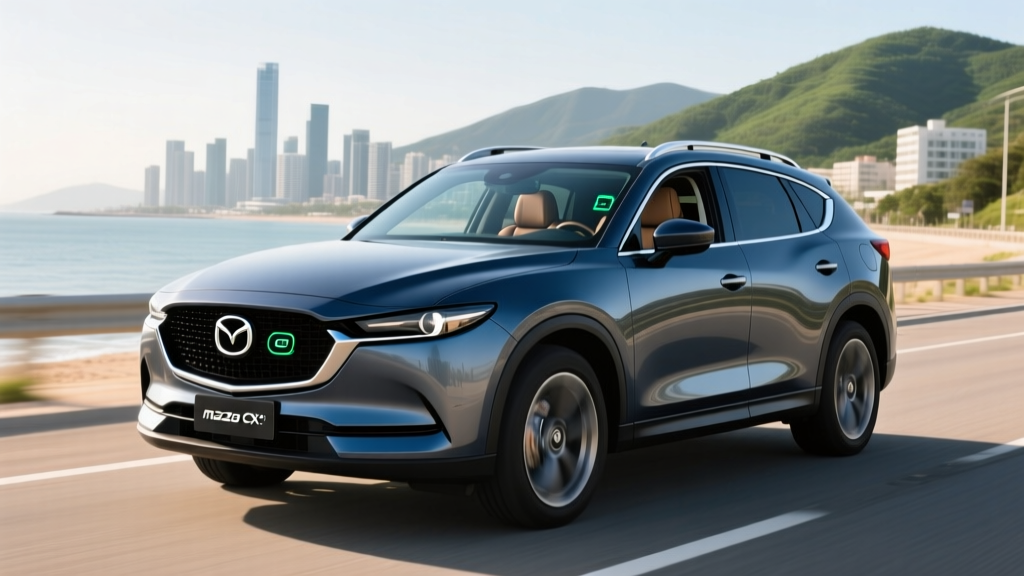
The Mazda CX-90 PHEV occupies a specific niche in the three-row SUV market: it offers genuine electric-only commuting for short trips, a turbocharged inline-six for highway passing, and the premium interior Mazda has been chasing for a decade. But with a relatively small 17.8 kWh battery and no DC fast charging, it demands a buyer who understands exactly what a plug-in hybrid can and cannot do.
This guide covers the 2026 Mazda CX-90 hybrid lineup — specifically the PHEV (plug-in hybrid) variant — with exact EPA numbers, real-world efficiency observations, charging logistics, and ownership economics that brochures leave out.
HEV vs PHEV: What Mazda Actually Offers in the CX-90
The CX-90 comes in two electrified flavors, and confusing them is the most common buyer mistake:
CX-90 MHEV (Mild Hybrid)
The standard CX-90 uses a 3.3L turbocharged inline-six with a 48-volt mild-hybrid system. It cannot plug in and has no electric-only driving mode. The mild-hybrid system smooths stop-start and provides marginal torque fill — it does not meaningfully reduce fuel consumption. EPA: 24 city / 28 hwy / 25 combined MPG.
CX-90 PHEV (Plug-In Hybrid)
The PHEV pairs a 2.5L four-cylinder engine with a 100 kW electric motor and a 17.8 kWh battery. It plugs in, drives up to 26 miles on electricity alone, and qualifies for partial federal tax incentives. This is the model most buyers mean when searching for the "Mazda CX-90 hybrid."
For the rest of this article, we focus on the PHEV — the variant that actually changes your fueling routine and ownership cost.
EPA MPG, Electric Range, and Real-World Efficiency
| Metric | EPA Rating | Real-World Expectation |
|---|---|---|
| Combined MPGe (charge-sustaining + EV) | 56 MPGe | 48–54 MPGe with regular charging |
| Gas-only combined MPG | 25 MPG | 23–27 MPG depending on terrain |
| City MPG (gas-only) | 24 MPG | 25–28 MPG (regen helps in stop-and-go) |
| Highway MPG (gas-only) | 27 MPG | 24–26 MPG at 75+ mph |
| Electric-only range | 26 miles | 20–24 mi (highway/cold); 26–28 mi (city/warm) |
| Total combined range | ~430 miles | ~380–420 miles mixed driving |
The 26-mile EPA electric range is modest by 2026 PHEV standards — the Toyota RAV4 Prime delivers 42 miles, and the Hyundai Tucson PHEV manages 33. But 26 miles covers the average American's one-way commute, according to FHWA data showing a median daily drive of roughly 30 miles round-trip.
Where the CX-90 PHEV surprises is gas-only efficiency. Once the battery depletes, the 2.5L four-cylinder and 8-speed automatic deliver 25 MPG combined in a 4,800-pound vehicle. That's competitive with the non-hybrid V6 versions of competitors like the Kia Telluride (21 combined) and significantly better than the gas-only CX-90 MHEV's 25 combined, particularly in city driving where regenerative braking recaptures energy.
Real-world note: In cold weather (below 35°F), expect electric-only range to drop 20–30%, to roughly 18–21 miles. The cabin heater draws heavily from the battery unless you precondition while plugged in. Gas-only MPG also drops 1–3 MPG in winter due to cold-start enrichment and increased rolling resistance.
Powertrain Specs: 327 Horsepower, Inline-Six Character
| Specification | 2026 CX-90 PHEV |
|---|---|
| Engine | 2.5L DOHC 4-cylinder + AC synchronous motor |
| Combined output | 327 hp / 369 lb-ft torque |
| Transmission | 8-speed automatic (no torque converter — clutch-based) |
| Drivetrain | AWD standard (i-Activ) |
| 0–60 mph | ~6.3 seconds |
| Battery (gross / usable) | 17.8 kWh / ~14.2 kWh usable |
| Battery chemistry | NMC (nickel manganese cobalt) |
| Towing capacity | 3,500 lbs |
| Cargo (behind 3rd / 2nd row) | 14.9 / 75.2 cu ft |
The PHEV powertrain is the most powerful CX-90 you can buy, exceeding even the turbo-six MHEV's 340 hp rating only on paper — in practice, the PHEV's instant electric torque makes it feel quicker off the line. The 8-speed automatic ditches a traditional torque converter for a multi-clutch design, which sharpens shifts but can feel slightly abrupt at low speeds compared to a conventional automatic.
Charging: Level 2 Only, No DC Fast Charge
This is the CX-90 PHEV's biggest practical limitation, and it's non-negotiable:
| Charging Level | Power | Time (0–100%) | Notes |
|---|---|---|---|
| Level 1 (120V household) | ~1.4 kW | ~11–12 hours | Works for overnight if you drive <20 mi/day |
| Level 2 (240V, 16A) | ~3.8 kW | ~4.5 hours | Typical home wall connector |
| Level 2 (240V, 32A) | ~7.2 kW (vehicle limited to ~5 kW) | ~3.5 hours | Vehicle onboard charger caps intake |
| DC Fast Charge | — | Not supported | No CCS or NACS DC port |
The onboard charger maxes out around 5 kW, meaning even a 48-amp Level 2 home charger won't fill the battery faster than a 20-amp circuit. For most PHEV owners, a standard 120V outlet in the garage is sufficient — plug in when you get home, and 11 hours later the battery is full. If your commute exceeds 20 miles each way, a 240V Level 2 installation (~$500–$1,200 depending on electrical panel proximity) ensures you start every morning with a full battery.
The absence of DC fast charging is standard for PHEVs in this class — the RAV4 Prime and Tucson PHEV also lack it. DC fast charging on a 17.8 kWh battery adds cost and weight for minimal benefit, since a full charge takes under 5 hours on Level 2.
Pricing, Trims, and Federal Tax Credit Eligibility
| Trim | 2026 MSRP (est.) | Key Features |
|---|---|---|
| PHEV Preferred Plus | $51,450 | Leatherette, panoramic roof, 10.25" display |
| PHEV Premium | $55,950 | Nappa leather, 12.3" display, Bose audio |
| PHEV Premium Plus | $60,450 | Quilting, 2nd-row captain's chairs, HUD |
Federal tax credit eligibility for the CX-90 PHEV is nuanced under current IRS §30D rules:
- Credit amount: Up to $3,750 (partial credit — the PHEV battery does not meet full critical-mineral and battery-component sourcing thresholds for the full $7,500).
- MSRP cap: SUVs must be under $80,000 — all CX-90 PHEV trims qualify.
- Buyer income cap: AGI must not exceed $150,000 (single) / $300,000 (joint).
- Point-of-sale transfer: You can apply the credit as a down-payment reduction at the dealer, per IRS §30D rules.
- Battery sourcing: Mazda sources battery cells from suppliers that may not meet all critical-mineral thresholds — confirm current-year eligibility on the fueleconomy.gov tax credit tracker before purchasing.
State incentives vary widely. California, Colorado, and New York offer additional rebates for PHEVs, often $1,000–$2,000. Check your state energy office or the AFDC state law database for current programs.
Battery Longevity, Warranty, and Replacement Cost
Mazda PHEV Battery Warranty: 8 years / 100,000 miles (whichever comes first) for capacity below 70% of original. This is industry-standard and federally mandated for emissions-related components in PZEV states (CA, NY, MA, and others — coverage extends to 10 years / 150,000 miles).
NMC batteries in PHEVs typically degrade 1.5–2.5% per year under normal use. For a 17.8 kWh pack, that means losing roughly 2–4 miles of electric range over 8 years. Most CX-90 PHEV owners will never approach the 70% warranty threshold unless they consistently charge to 100% and leave the vehicle parked in extreme heat.
If out-of-warranty replacement becomes necessary (unlikely before 150,000+ miles based on current PHEV fleet data), expect a cost of $4,000–$6,500 for the battery pack plus labor. Mazda has not published official replacement pricing; these figures are based on comparable PHEV packs from Toyota and Hyundai.
The conventional hybrid (MHEV) battery is far smaller — roughly 0.5 kWh — and replacement costs $1,500–$2,500. It also carries the same 8-year/100,000-mile warranty.
Who Should Buy the CX-90 PHEV (and Who Shouldn't)
Choose the CX-90 PHEV if:
- Your daily driving is under 30 miles and you can charge at home overnight.
- You want three rows but refuse to drive something that looks like a minivan.
- You take 2–4 road trips per year where EV charging infrastructure is sparse.
- You value interior material quality (Nappa leather, real wood, excellent NVH) over maximum electric range.
- You want AWD standard without the $10,000+ premium of a luxury-brand PHEV SUV.
Choose a full EV instead if:
- You have reliable home Level 2 charging and rarely drive more than 250 miles in a day.
- You want to eliminate oil changes, spark plugs, and transmission fluid entirely.
- Your budget allows for the Rivian R1S, Tesla Model X, or Hyundai Ioniq 9 — all offer more cargo space and lower running costs.
Choose the gas CX-90 MHEV instead if:
- You cannot charge at home (apartment, street parking, no garage).
- Your daily commute exceeds 50 miles, negating the PHEV's electric advantage.
- You want to save $5,000–$7,000 on purchase price and don't care about electric-only driving.
Pros
- Premium interior rivals BMW X5 and Genesis GV80 at a lower price point
- 327 hp with instant electric torque — genuinely quick for a three-row
- 25 MPG gas-only is excellent for the weight and class
- Standard AWD with rear-biased torque distribution (feels RWD on dry pavement)
- Qualifies for partial federal tax credit ($3,750) plus state incentives
Cons
- 26-mile electric range trails RAV4 Prime (42 mi) and Tucson PHEV (33 mi)
- No DC fast charging — irrelevant for most PHEV buyers, but limits public charging utility
- Third row is tight for adults — best for children or short trips
- Cargo space (14.9 cu ft behind 3rd row) is below class average
- Infotainment uses a rotary dial, not touchscreen — divisive for smartphone-native buyers
Frequently Asked Questions
How many MPG does the Mazda CX-90 hybrid get?
The CX-90 PHEV achieves 56 MPGe combined when operating in mixed electric-gas mode, and 25 MPG combined once the battery is depleted and you're driving on gasoline alone. The mild-hybrid (MHEV) version gets 25 MPG combined but cannot plug in or drive on electric power.
How far can the CX-90 PHEV go on electric only?
The EPA rates the CX-90 PHEV at 26 miles of electric-only range. In real-world driving, expect 20–24 miles on the highway or in cold weather, and up to 28 miles in warm-weather city driving where regenerative braking is maximized.
Does the Mazda CX-90 hybrid qualify for a tax credit?
The CX-90 PHEV qualifies for a partial federal tax credit of up to $3,750 under IRS §30D, subject to buyer income limits ($150K single / $300K joint) and battery-sourcing requirements. The MHEV version does not qualify for any federal plug-in credit. State incentives may add $1,000–$2,000 depending on your jurisdiction.
Is the CX-90 PHEV reliable? What about battery replacement cost?
Mazda's 2.5L four-cylinder is one of the most proven engines in their lineup, and the PHEV system adds complexity but not fragility. The high-voltage battery is warranted for 8 years / 100,000 miles (10 years / 150,000 miles in PZEV states). Out-of-warranty battery replacement, if ever needed, is estimated at $4,000–$6,500 based on comparable PHEV packs.
Should I get the CX-90 PHEV or a full EV?
If you can charge at home, drive under 30 miles daily, and take occasional road trips where charging is sparse, the PHEV is a pragmatic bridge. If you have reliable home charging and rarely exceed 250 miles in a day, a full EV like the Hyundai Ioniq 5 or Kia EV9 will deliver lower long-term running costs and a smoother driving experience with no engine noise or maintenance.
Can I charge the CX-90 PHEV at a public DC fast charger?
No. The CX-90 PHEV does not support DC fast charging. It charges exclusively via Level 1 (120V) or Level 2 (240V) AC power. A full charge takes roughly 3.5–4.5 hours on a Level 2 home charger, or 11–12 hours on a standard household outlet.