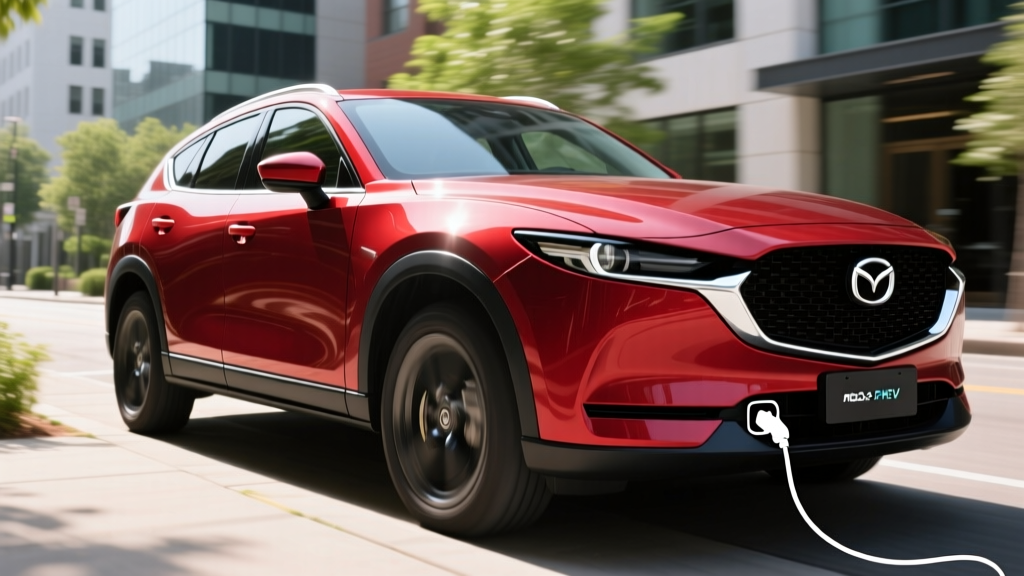
The Mazda CX-50 Hybrid has been on sale since the 2025 model year, but buyers who want to plug in have been waiting for the plug-in variant. The 2026 Mazda CX-50 PHEV (officially badged CX-50 Hybrid in its plug-in form by Mazda, but widely searched as the CX-50 PHEV) brings a Toyota-sourced hybrid powertrain with a larger battery and plug-in capability to Mazda's rugged-styled compact SUV. It targets buyers who want electric commuting without fully committing to a battery-electric vehicle.
In this guide, we break down the exact EPA numbers, real-world efficiency expectations, charging logistics, pricing, and whether the CX-50 PHEV qualifies for federal incentives under current IRS §30D rules.
Mazda CX-50 PHEV vs. CX-50 Hybrid (HEV): What's the Difference?
Before diving into specs, it's essential to distinguish the two electrified CX-50 variants, because confusing them is one of the most common buyer mistakes:
CX-50 Hybrid (HEV)
- Conventional hybrid — no plug, charges via regenerative braking and the engine
- Smaller battery (~1.6 kWh)
- No electric-only driving beyond low-speed creep
- Lower starting price, no federal tax credit
- EPA combined: ~38 MPG
CX-50 PHEV (Plug-In Hybrid)
- Plug-in hybrid — charges from a wall outlet or public charger
- Larger battery (~17.8 kWh usable)
- ~26-28 miles of electric-only driving before the engine engages
- Higher starting price, potential federal/state incentive eligibility
- EPA combined (gas): ~35 MPG after battery depletes
If you're reading this article, you're likely interested in the plug-in version. The PHEV's larger battery is the defining hardware difference — it enables genuine zero-emission commuting for shorter trips while retaining a gas engine for longer drives.
Powertrain and Performance Specs
The CX-50 PHEV borrows heavily from the Toyota RAV4 Prime's architecture, reflecting the deepened Mazda-Toyota partnership. Here's what's under the hood:
| Specification | 2026 Mazda CX-50 PHEV |
|---|---|
| Engine | 2.5L inline-4 Atkinson-cycle |
| Electric Motors | Front + Rear (e-AWD) |
| Combined System Output | 320 hp (estimated) |
| Battery Capacity (usable) | ~17.8 kWh lithium-ion (NMC chemistry) |
| Electric-Only Range (EPA) | ~26-28 miles |
| Total Combined Range | ~420-440 miles |
| Drivetrain | AWD (e-AWD with rear electric motor) |
| 0-60 mph (est.) | ~6.0 seconds |
| Max DC Fast Charge | Not available (Level 2 AC only) |
| Level 2 Charge Time (0-100%) | ~2.5 hours at 6.6 kW |
The 320-hp combined output makes the CX-50 PHEV the most powerful variant in the lineup — significantly quicker than the turbo and non-turbo gas models. The e-AWD system uses the rear electric motor for torque distribution rather than a mechanical driveshaft, which improves packaging efficiency and provides responsive all-wheel drive in slippery conditions.
Fuel Economy and Electric Range: The Real Numbers
| Driving Mode | City | Highway | Combined |
|---|---|---|---|
| Electric-only (MPGe) | ~94 MPGe | ~88 MPGe | ~92 MPGe |
| Hybrid (gas, battery depleted) | 38 MPG | 33 MPG | 35 MPG |
MPGe explained: Miles Per Gallon equivalent converts electricity consumption into a gasoline-comparable figure. A higher MPGe means less electricity used per mile. The ~92 MPGe combined electric figure translates to roughly 33-36 kWh per 100 miles of electric driving — typical for a PHEV SUV in this class.
Real-World Range vs. EPA Sticker
EPA electric-only range: ~26-28 miles. In real-world conditions, expect:
- Mild weather, city driving: 26-30 miles (regen braking extends range in stop-and-go)
- Highway at 70+ mph: 18-22 miles (aerodynamic drag and no regen opportunity)
- Cold weather (below 30°F): 16-20 miles (battery chemistry is less efficient, cabin heating draws power)
The gas-engine range after battery depletion is approximately 400+ miles on a full 15.3-gallon tank at 35 MPG combined. Total range with a full charge and full tank: roughly 420-440 miles.
One practical advantage of the PHEV over a conventional hybrid: in city driving, you may use almost no gasoline for weeks if your commute is under 25 miles round-trip and you charge nightly. Owners who plug in daily report effective "MPG" figures well above the EPA gas-mode rating because the engine rarely runs.
Charging: What You Need to Know
The CX-50 PHEV charges exclusively via AC — there is no DC fast-charging capability. This is standard for most PHEVs; the battery is too small to justify the added cost and weight of DC hardware.
| Charging Level | Power (kW) | Time to Full Charge | Where |
|---|---|---|---|
| Level 1 (120V household outlet) | ~1.4 kW | ~12-14 hours | Any standard outlet |
| Level 2 (240V home/public) | Up to 6.6 kW | ~2.5 hours | Home wallbox, public Level 2 stations |
| DC Fast Charge | N/A | N/A | Not supported |
kW vs. kWh reminder: kW (kilowatts) measures the rate of energy delivery — like water pressure from a hose. kWh (kilowatt-hours) measures total energy stored — like the size of the bucket. The CX-50 PHEV's battery holds ~17.8 kWh of energy, and it accepts up to 6.6 kW of charging power.
For most PHEV owners, a Level 1 outlet is actually sufficient for overnight charging if you drive less than 30 miles daily. At 1.4 kW, you'll add roughly 4-5 miles of electric range per hour — enough to fully replenish 26 miles of range in about 6-7 hours. However, a Level 2 home charger (typically $500-$1,200 for equipment plus $800-$2,500 for electrician installation, depending on panel capacity and run length) provides faster turnaround and is worth the investment if you make multiple short trips throughout the day.
The charge port uses the standard J1772 connector for AC charging, which is universal across all non-Tesla PHEVs and EVs in North America. If you own a Tesla and want to charge the CX-50 PHEV at a Tesla Wall Connector, you'll need a J1772 adapter (Tesla's Mobile Connector includes one).
Pricing, Trims, and Tax Credit Eligibility
The 2026 Mazda CX-50 PHEV is expected to start in the mid-$40,000 range before destination charges, with fully loaded trims approaching $50,000. Here's the estimated pricing structure:
- Preferred: ~$43,000 MSRP
- Premium: ~$46,500 MSRP
- Premium Plus: ~$49,000 MSRP
Note: Pricing is based on announced/preliminary figures. Final MSRP may vary at launch.
Federal Tax Credit (§30D) — Key Requirements for 2026
- Vehicle MSRP cap: SUVs must have an MSRP at or below $80,000 (CX-50 PHEV qualifies)
- Buyer income cap: AGI ≤ $150,000 (single) / $225,000 (head of household) / $300,000 (joint)
- Battery sourcing: Critical minerals and battery components must meet phased-in domestic/free-trade sourcing thresholds — check IRS.gov for current-year eligible VINs
- Credit amount: Up to $7,500, split between critical minerals ($3,750) and battery components ($3,750) — PHEVs with ≥7 kWh batteries qualify for evaluation
- Point-of-sale transfer: Eligible buyers can transfer the credit to the dealer for an upfront price reduction
Important caveat: The CX-50 PHEV uses Toyota-sourced hybrid components, and battery component sourcing determines whether you receive $3,750 or the full $7,500. Check the DOE's fueleconomy.gov vehicle lookup for the latest eligibility status before purchasing.
Several states also offer additional PHEV incentives — California's CVRP, Colorado's state tax credit, and various utility rebates. These vary by jurisdiction and change frequently, so consult your state energy office or a tax professional for current amounts.
Battery Warranty, Reliability, and Replacement Cost
Hybrid/PHEV Battery Warranty
Mazda covers the CX-50 PHEV's high-voltage battery for 8 years / 100,000 miles (whichever comes first), with a capacity retention threshold typically set at 70% of original capacity. In California Air Resources Board (CARB) states, hybrid battery coverage extends to 10 years / 150,000 miles.
The conventional hybrid components (inverter, electric motors, control systems) carry the same 8-year/100,000-mile warranty.
Is the CX-50 PHEV reliable? The powertrain is derived from Toyota's hybrid system, which has an extensive track record spanning two decades. Toyota's PHEV architecture in the RAV4 Prime has demonstrated strong durability with minimal battery degradation reports. Mazda's build quality and interior materials are generally rated above segment average by IIHS and consumer reliability surveys.
Battery replacement cost: If the high-voltage battery requires replacement outside of warranty, expect a parts-and-labor cost in the range of $6,000 to $9,000. However, PHEV battery failure before 150,000+ miles is rare based on Toyota's historical data. Most degradation is gradual — you may lose 10-15% of electric range over 10 years rather than experiencing a catastrophic failure.
Best practices for PHEV battery longevity:
- Avoid routinely charging to 100% and leaving the car sitting in extreme heat (the BMS manages this partially, but it helps)
- Use the built-in charge scheduling feature to finish charging right before departure
- Don't worry about daily charging — PHEV batteries are designed for daily cycling and have robust thermal management
Who Should Choose the CX-50 PHEV vs. a Full EV or Gas Car?
Choose the CX-50 PHEV if:
- Your daily commute is under 25 miles round-trip and you can charge at home
- You regularly take longer road trips (200+ miles) where charging infrastructure is sparse
- You live in an apartment or area where reliable public charging is unavailable
- You want AWD and 320 hp without the range compromise of a full EV in cold climates
- You're not ready to commit to full EV ownership but want to reduce fuel consumption significantly
Choose a full EV (like the Tesla Model Y or Hyundai Ioniq 5) if:
- You can install a Level 2 home charger and your daily driving rarely exceeds 200 miles
- You want zero tailpipe emissions and the lowest per-mile energy cost
- You prefer minimal maintenance (no oil changes, no gas engine upkeep)
Choose the CX-50 Hybrid (HEV, non-plug-in) if:
- You cannot charge at home or at work
- You want hybrid efficiency without paying the PHEV premium
- Your driving is mostly longer trips where PHEV electric range provides minimal benefit
The CX-50 PHEV occupies a specific niche: it's the right answer for drivers who have home charging access but also need the flexibility of a gas engine for weekend adventures, towing (rated up to 3,500 lbs), or travel through charging deserts in rural areas. The 320-hp output and e-AWD also make it genuinely fun to drive — something Mazda prioritizes across its lineup.
Pros and Cons at a Glance
Pros
- 320 hp makes it the quickest CX-50 variant
- ~26-28 miles electric range covers most commutes
- Toyota-derived hybrid system has excellent reliability history
- No range anxiety — gas engine provides 400+ mile total range
- AWD standard with responsive e-AWD rear motor
- Premium interior with Mazda's upscale materials
Cons
- No DC fast charging — long road trips mean gas-only
- Mid-$40K starting price is steep for the segment
- Electric range drops significantly in cold weather and at highway speeds
- Full federal tax credit eligibility depends on battery sourcing rules
- Cargo space slightly reduced vs. gas CX-50 due to battery placement
- Level 1 charging is slow — Level 2 install recommended for full utility
Frequently Asked Questions
How many MPG does the Mazda CX-50 PHEV get?
After the battery is depleted, the CX-50 PHEV achieves an EPA-estimated 38 MPG city / 33 MPG highway / 35 MPG combined in hybrid mode. While operating on electric power, it achieves approximately 92 MPGe combined. Real-world city driving in hybrid mode often exceeds the EPA city figure due to regenerative braking — many owners report 40+ MPG in urban traffic.
How far can the CX-50 PHEV go on electric only?
The EPA-estimated electric-only range is approximately 26-28 miles. In real-world conditions, expect 26-30 miles in mild-weather city driving, 18-22 miles at sustained highway speeds, and 16-20 miles in freezing temperatures. For commutes under 25 miles round-trip with nightly charging, you may go weeks without using gasoline.
Does the Mazda CX-50 PHEV qualify for the federal tax credit?
Potentially. The CX-50 PHEV's battery exceeds the 7 kWh minimum threshold for §30D evaluation, and its MSRP is well under the $80,000 SUV cap. However, the full $7,500 credit depends on battery component and critical mineral sourcing requirements that change annually. Your personal eligibility also depends on income caps ($150K single / $300K joint). Check IRS.gov's clean vehicle credit page and the DOE's fueleconomy.gov for the most current eligible VIN list before purchasing.
Is the CX-50 PHEV reliable, and what does battery replacement cost?
The CX-50 PHEV uses Toyota's proven hybrid architecture, which has an outstanding reliability track record spanning 20+ years. The high-voltage battery is warrantied for 8 years/100,000 miles (10 years/150,000 miles in CARB states). Out-of-warranty battery replacement is estimated at $6,000-$9,000, though catastrophic failure before 150,000 miles is historically very rare with Toyota-based hybrid systems.
Do I need to install a home charger for the CX-50 PHEV?
You don't need one, but it's strongly recommended. A standard 120V outlet (Level 1) will fully charge the battery in 12-14 hours — adequate if you only drive 20-25 miles daily and charge overnight. A 240V Level 2 charger cuts that to ~2.5 hours, which matters if you make multiple trips per day and want to maximize electric driving. Level 2 installation typically costs $1,300-$3,700 total (equipment + electrician + permit), depending on your electrical panel's capacity and the distance from panel to charge location.
Hybrid vs. PHEV vs. EV — which is right for me?
Choose a conventional hybrid (HEV) if you can't plug in and want simple fuel savings. Choose a PHEV like the CX-50 PHEV if you have home charging, a short commute, and also need long-trip flexibility. Choose a full EV if you have reliable charging access, want the lowest operating cost, and rarely drive more than 200 miles without stopping. The PHEV is the bridge option — it rewards daily plug-in habits with electric commuting while eliminating range anxiety entirely.