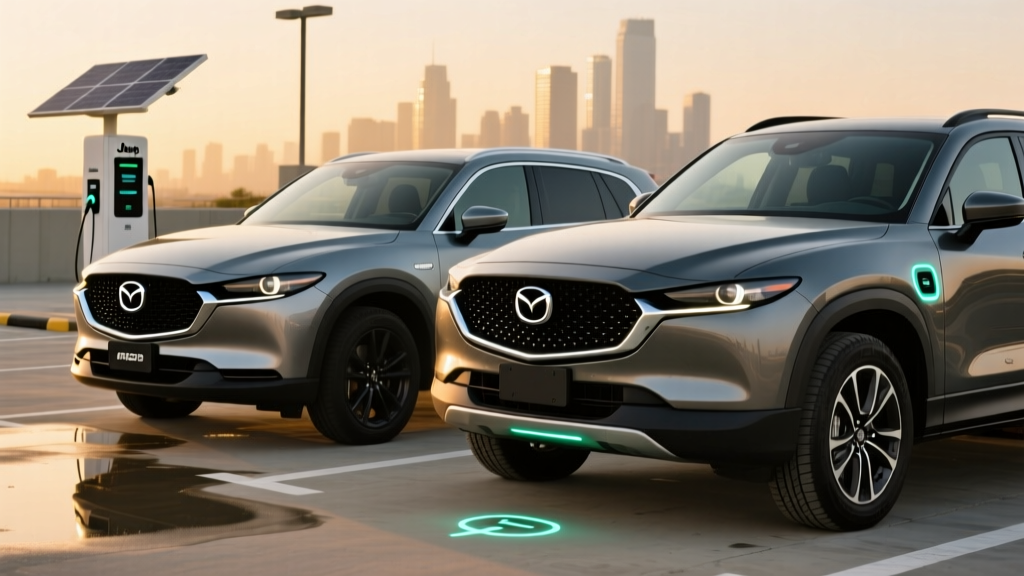
Shoppers cross-shopping the Mazda CX-50 Hybrid against the Jeep Cherokee face a choice between two very different hybrid philosophies. Mazda pairs its CX-50 with Toyota's proven hybrid system for maximum fuel economy. Jeep's Cherokee lineup leans on a turbocharged powertrain with available 4xe plug-in hybrid capability in related models. This guide breaks down every number that matters — EPA MPG, real-world expectations, powertrain output, battery warranty, and whether either qualifies for a federal tax credit in 2026.
HEV vs PHEV: Know What You're Buying
Conventional Hybrid (HEV): The Mazda CX-50 Hybrid uses a gasoline engine paired with electric motors and a small battery (typically ~1.6 kWh). It charges itself through regenerative braking and the engine — you never plug it in. Expect seamless transitions between gas and electric power with no change to your fueling routine.
Plug-In Hybrid (PHEV): Jeep's 4xe plug-in hybrid system (available in the Grand Cherokee 4xe, and anticipated for future Cherokee variants) uses a much larger battery (~17.3 kWh) that you charge via a wall outlet or Level 2 charger. This delivers 25–30 miles of electric-only driving before the gas engine takes over. If your daily commute falls within that electric range, you may go weeks without visiting a gas station.
The standard Jeep Cherokee (non-4xe) sold in recent model years has been offered with conventional powertrains. As of the 2026 model year, Jeep has signaled a redesigned Cherokee with hybrid and potential 4xe PHEV variants. Specs below reflect the latest confirmed data; check Jeep's official site for final production specs if the new Cherokee PHEV launches mid-year.
Mazda CX-50 Hybrid: MPG, Powertrain & Specs
The 2026 Mazda CX-50 Hybrid carries over the powertrain introduced for the 2025 model year — a 2.5-liter four-cylinder engine mated to Toyota's hybrid transaxle with two electric motors. This is the same architecture found in the Toyota RAV4 Hybrid, which speaks to its proven reliability.
| Spec | Mazda CX-50 Hybrid (2026) |
|---|---|
| Engine | 2.5L inline-4 + 2 electric motors |
| Combined Horsepower | 219 hp |
| EPA MPG (City / Hwy / Combined) | 38 / 33 / 35 MPG |
| Battery Capacity | ~1.6 kWh (NiMH, self-charging) |
| Electric-Only Range | N/A (conventional HEV) |
| Total Range | ~500 miles (14.5-gal tank) |
| Drivetrain | AWD standard (e-motor rear axle) |
| 0–60 mph | ~7.5 seconds (est.) |
| Base MSRP | ~$35,395 |
Real-World MPG: What to Actually Expect
The EPA rates the CX-50 Hybrid at 35 MPG combined, but conventional hybrids routinely beat their EPA city estimates in stop-and-go traffic where regenerative braking and low-speed electric assist do the heavy lifting. Expect 36–40 MPG in city driving and closer to 30–32 MPG on sustained highway trips at 75+ mph. In cold weather (below 30°F), plan for a 5–10% drop as the engine runs more frequently to heat the cabin.
Jeep Cherokee: Powertrain Options & Hybrid Outlook
The Jeep Cherokee occupies a different space — it prioritizes off-road capability and rugged utility. The outgoing Cherokee was offered with a 2.4L turbo (270 hp) or a 3.2L V6 (271 hp), neither electrified. For the redesigned 2026 Cherokee, Jeep has confirmed a turbocharged four-cylinder base engine and has teased hybrid variants.
| Spec | Jeep Cherokee (2026 Base Turbo) | Jeep Cherokee 4xe PHEV (Projected) |
|---|---|---|
| Engine | 2.0L turbo inline-4 | 2.0L turbo + electric motors |
| Combined Horsepower | ~270 hp | ~375 hp (est.) |
| EPA MPG (Combined) | ~25 MPG (est.) | ~56 MPGe (est.) |
| Battery Capacity | N/A | ~17.3 kWh (projected) |
| Electric-Only Range | N/A | ~25–28 miles (projected) |
| Plug-In Charging | No | Yes — Level 1 (~12 hrs) / Level 2 (~2.5 hrs) |
| DC Fast Charge | N/A | No (most PHEVs lack DCFC) |
| Base MSRP | ~$38,000 (est.) | ~$45,000 (est.) |
Important: The Cherokee 4xe PHEV figures above are projected based on the Grand Cherokee 4xe powertrain architecture. Final EPA numbers will be confirmed closer to on-sale date. We will update this article when official data is published on fueleconomy.gov.
Side-by-Side: Mazda CX-50 Hybrid vs Cherokee
| Category | Mazda CX-50 Hybrid | Jeep Cherokee (Turbo) | Cherokee 4xe (Projected) |
|---|---|---|---|
| Combined MPG / MPGe | 35 MPG | ~25 MPG | ~56 MPGe |
| City MPG | 38 MPG | ~22 MPG | N/A (electric in city) |
| Highway MPG | 33 MPG | ~28 MPG | ~30 MPG (gas-only mode) |
| Electric-Only Range | N/A | N/A | ~25–28 mi |
| Horsepower | 219 hp | ~270 hp | ~375 hp |
| AWD | Standard | Available | Standard |
| Towing Capacity | 3,500 lbs | ~4,000 lbs | ~3,500 lbs (est.) |
| Plug-In Required? | No | No | Yes (for EV range) |
| Starting MSRP | ~$35,395 | ~$38,000 | ~$45,000 |
Battery Warranty & Reliability
Mazda CX-50 Hybrid: Mazda covers the hybrid battery for 8 years / 100,000 miles (10 years / 150,000 miles in California-emissions states). The Toyota-sourced hybrid system has an exceptional reliability track record — the RAV4 Hybrid powertrain has logged billions of real-world miles with very low failure rates. Battery replacement cost, should it be needed out of warranty, is estimated at $2,500–$4,000.
Jeep Cherokee 4xe (projected): Stellantis typically covers PHEV batteries for 8 years / 100,000 miles with a capacity retention threshold of ~70%. The Grand Cherokee 4xe's larger 17.3 kWh battery would cost significantly more to replace — estimated at $6,000–$9,000 out of warranty. Early 4xe models in the Wrangler and Grand Cherokee had some software-related recalls; check NHTSA for the latest recall status on any specific VIN.
Is the Hybrid Battery a Long-Term Risk?
For the CX-50 Hybrid, the answer is reassuring. Toyota's hybrid battery technology (used under license by Mazda) has demonstrated 150,000–200,000+ mile lifespans routinely. Degradation in a conventional HEV is minimal because the battery operates in a narrow state-of-charge window (roughly 40–60%), which dramatically reduces wear. The small 1.6 kWh pack simply doesn't cycle deeply enough to degrade quickly.
For the Cherokee 4xe PHEV, the larger battery sees deeper cycles (charging from 0–100% and depleting fully), which accelerates wear compared to an HEV. Expect 8–12% capacity loss over 100,000 miles based on data from the Grand Cherokee 4xe and similar PHEVs. This primarily reduces your electric-only range over time, not overall drivability.
Tax Credit Eligibility: What Applies in 2026?
This is where the distinction between HEV and PHEV matters most for your wallet.
- Mazda CX-50 Hybrid (HEV): Does NOT qualify for the federal §30D clean vehicle credit. Conventional hybrids are excluded — only plug-in vehicles with ≥7 kWh battery capacity are eligible. No federal tax credit applies.
- Jeep Cherokee 4xe PHEV (projected): MAY qualify for up to $7,500 under §30D, but eligibility depends on several factors that change frequently:
- MSRP must be ≤ $80,000 (SUVs/trucks) — likely met
- Buyer AGI must be ≤ $150,000 (single) / $300,000 (joint)
- Battery components and critical minerals must meet phased-in sourcing thresholds (stricter each year through 2032)
- Credit can be transferred to the dealer at point of sale as a purchase discount
Because critical-mineral and battery-component sourcing rules tighten annually, a PHEV that qualifies in early 2026 may not qualify later. Always verify current eligibility on IRS.gov before purchasing, and confirm the specific VIN's eligibility with the dealer.
Who Should Choose Which?
Mazda CX-50 Hybrid — Choose This If:
- You want maximum MPG without ever plugging in
- Your commute is mixed city/highway and you value 35+ MPG consistently
- You prioritize proven reliability (Toyota hybrid architecture)
- You don't have access to home or workplace charging
- You want a lower starting price (~$35,395)
- You plan to keep the vehicle 8–10+ years (low battery risk)
Jeep Cherokee 4xe PHEV — Choose This If:
- You have home charging (Level 2 strongly recommended)
- Your daily commute is under 25 miles round-trip (run mostly on electricity)
- You want serious horsepower (~375 hp) and off-road capability
- You want to qualify for the $7,500 federal tax credit (if VIN-eligible)
- You take longer road trips on weekends (gas engine covers unlimited range)
- You value Jeep's Trail Rated off-road pedigree
What About a Full EV Instead?
If you're considering either of these hybrids, you may also be weighing a battery-electric vehicle (BEV) like the Tesla Model Y, Hyundai Ioniq 5, or Ford Mustang Mach-E. A full EV makes sense if:
- You have reliable home Level 2 charging
- Your daily driving is under 250 miles
- You want the lowest per-mile fuel cost (electricity at ~$0.04–0.06/mile vs. gas at ~$0.12–0.16/mile for a 35 MPG hybrid)
- You want to eliminate oil changes, transmission fluid, and exhaust maintenance entirely
A hybrid — whether HEV or PHEV — remains the better choice if you lack home charging, frequently drive 300+ miles between stops, live in an area with sparse public charging infrastructure, or want the lowest upfront cost.
Frequently Asked Questions
How many MPG does the Mazda CX-50 Hybrid get?
The EPA rates the 2026 CX-50 Hybrid at 38 city / 33 highway / 35 combined MPG. In real-world city driving with frequent stops, owners often see 36–40 MPG. Highway cruising at 75+ mph typically yields 30–32 MPG.
How far can the Jeep Cherokee 4xe go on electric only?
Based on the Grand Cherokee 4xe's EPA rating and projected specs, expect approximately 25–28 miles of electric-only range. This covers most daily commutes. Once the battery is depleted, the gas engine provides unlimited range at roughly 30 MPG.
Does the Mazda CX-50 Hybrid need to be plugged in?
No. The CX-50 Hybrid is a conventional hybrid (HEV). It charges its small battery through regenerative braking and the gasoline engine. You fuel it like any other car — no plug, no charging cable, no behavioral changes required.
Is the CX-50 Hybrid battery reliable, and what does replacement cost?
Very reliable. The Toyota-sourced hybrid system has an industry-leading track record. Mazda covers the hybrid battery for 8 years/100,000 miles (10 years/150,000 miles in CARB states). Out-of-warranty replacement is estimated at $2,500–$4,000 — far less than a PHEV or BEV battery.
Does either vehicle qualify for a federal tax credit in 2026?
The Mazda CX-50 Hybrid does not qualify — conventional hybrids are excluded from the §30D credit. The Jeep Cherokee 4xe PHEV may qualify for up to $7,500, subject to MSRP caps, buyer income limits, and battery-sourcing requirements that tighten yearly. Verify on IRS.gov before purchase.
Can the Cherokee 4xe DC fast charge?
No. Like most PHEVs, the Cherokee 4xe is limited to Level 1 (120V, ~12 hours for a full charge) and Level 2 (240V, ~2.5 hours). DC fast charging is generally not available on PHEVs because the smaller battery makes the added cost and weight impractical.
Hybrid vs PHEV vs EV — which should I choose?
Choose a conventional hybrid (HEV) if you want better MPG with zero lifestyle changes and no charging access. Choose a PHEV if you have home charging and a short commute but want gas-engine range for road trips. Choose a full EV if you have reliable charging, want the lowest operating cost, and rarely exceed 250 miles between stops.