Quick Verdict: Can the Mazda CX-50 Hybrid Actually Tow?
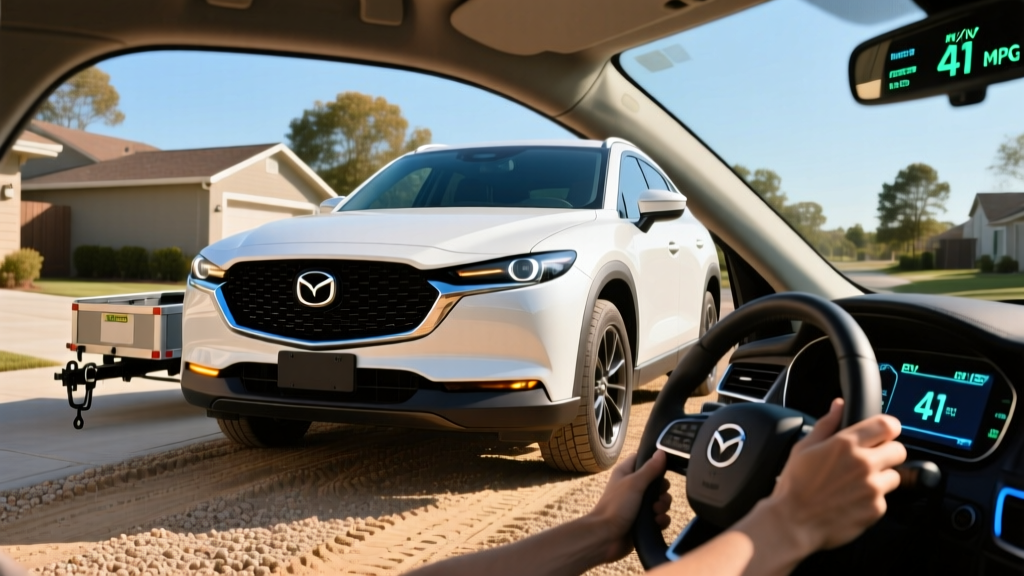
The 2026 Mazda CX-50 Hybrid pairs Toyota's proven 2.5-liter hybrid powertrain with Mazda's rugged crossover platform, delivering a maximum towing capacity of 3,500 pounds when properly equipped. That figure puts it on par with most compact hybrid SUVs and is enough for a small camper, jet skis, or a lightweight utility trailer. But towing is only part of the story — the CX-50 Hybrid's 38 MPG combined EPA rating, all-wheel-drive standard, and starting price near $34,000 make it one of the most practical hybrid SUVs in its class.
This guide breaks down every number that matters: EPA and real-world MPG, powertrain output, towing specs by trim, battery warranty, and how it stacks up against a plug-in hybrid or full EV for buyers who need utility without range anxiety.
Mazda CX-50 Hybrid Towing Capacity by Trim
Every 2026 CX-50 Hybrid trim shares the same powertrain and AWD system, so towing capacity does not vary by trim level. However, you must have the factory tow package (receiver hitch, wiring harness, and transmission cooler) installed to reach the maximum rating.
| Specification | Value |
|---|---|
| Max Towing Capacity (with tow package) | 3,500 lbs |
| Max Towing Capacity (without tow package) | 1,500 lbs |
| Max Tongue Weight | 350 lbs |
| Drivetrain | AWD (standard, electronic) |
| Trailer Sway Control | Standard on all trims |
| Transmission Cooler | Included with tow package |
The 3,500-pound rating is competitive within the compact hybrid SUV segment. The Toyota RAV4 Hybrid, which shares the same powertrain architecture, also tows 3,500 lbs. The Ford Escape Hybrid manages 3,500 lbs as well. For comparison, the non-hybrid CX-50 Turbo can tow up to 3,500 lbs, so the hybrid gives up nothing in utility while gaining significant fuel economy.
Fuel Economy: EPA MPG vs. Real-World Results
The CX-50 Hybrid's headline number is its fuel efficiency. Because it's a conventional hybrid (HEV), not a plug-in, there's no electric-only range to manage — you simply fill up with gas and drive. The hybrid system recovers energy during braking and low-speed driving to reduce fuel consumption.
| Cycle | EPA Estimate | Real-World Expectation |
|---|---|---|
| City | 39 MPG | 40–43 MPG (hybrids excel in stop-and-go) |
| Highway | 37 MPG | 33–36 MPG (aerodynamic drag, sustained speed) |
| Combined | 38 MPG | 36–39 MPG (mixed driving) |
| While Towing (~2,500 lbs) | N/A | 24–28 MPG (estimated) |
Source: EPA Fuel Economy
Hybrids consistently exceed their EPA city ratings in real-world stop-and-go driving because regenerative braking recovers energy that a conventional car wastes as heat. On the highway, where the gasoline engine does most of the work, expect a slight shortfall versus the sticker. Over a 14.2-gallon tank, 38 MPG combined yields roughly 540 miles of total range — enough for most road trips without a mid-journey fuel stop.
HEV (Hybrid Electric Vehicle): The CX-50 Hybrid is a conventional hybrid. It has a small battery (1.6 kWh) that recharges through regenerative braking and the engine. You never plug it in. It cannot drive on electric power alone for meaningful distances.
PHEV (Plug-in Hybrid Electric Vehicle): A PHEV has a larger battery (typically 15–20 kWh) that you plug in to charge. It offers 25–40 miles of electric-only driving before the gas engine kicks in. The Mazda CX-50 does NOT currently offer a PHEV variant — if you want plug-in capability from Mazda, look at the CX-70 PHEV or CX-90 PHEV.
Powertrain Specs: Toyota Hybrid Muscle in a Mazda Body
The CX-50 Hybrid uses Toyota's fourth-generation hybrid system, a partnership that gives Mazda access to one of the most reliable and proven hybrid architectures on the market. Here are the exact numbers:
| Specification | Value |
|---|---|
| Engine | 2.5L 4-cylinder Atkinson-cycle |
| Engine Output | 176 hp / 163 lb-ft torque |
| Electric Motor (front) | 134 hp |
| Electric Motor (rear, AWD) | 54 hp |
| Combined System Output | 219 hp |
| Transmission | eCVT (planetary gearset, no belt) |
| Hybrid Battery | 1.6 kWh, nickel-metal hydride (NiMH) |
| Drivetrain | Electronic AWD (e-AWD, rear motor) |
| 0–60 mph | ~7.2 seconds (est.) |
The 219 combined horsepower is delivered through a planetary gearset eCVT — not a traditional belt-and-cone CVT. This design has no belts to slip or wear, contributing to the powertrain's long-term durability. The rear electric motor provides on-demand AWD without a mechanical driveshaft, reducing weight and parasitic loss.
Compared to the non-hybrid CX-50's 2.5L turbo (256 hp on premium fuel), the hybrid sacrifices some peak power but delivers far better fuel economy and smoother low-speed operation. For towing, the hybrid's instant electric torque at low RPMs actually provides confident launch feel, even if the turbo model has a higher peak output.
Pricing, Trims, and Tax Credit Eligibility
The 2026 CX-50 Hybrid is offered across three trims. All trims include AWD, the hybrid powertrain, and Mazda's full suite of i-Activsense safety features as standard.
| Trim | MSRP (incl. destination) | Key Features |
|---|---|---|
| Preferred Hybrid | $34,350 | 10.25" display, heated seats, power liftgate |
| Premium Hybrid | $37,550 | Bose audio, panoramic roof, leather, HUD |
| Premium Plus Hybrid | $40,150 | Nappa leather, ventilated seats, 360° camera |
| Tow Package (add-on) | ~$600 | Receiver hitch, wiring, transmission cooler |
No. Under current IRS §30D rules, the federal clean vehicle credit ($3,750–$7,500) is available only for battery electric vehicles (BEVs) and plug-in hybrids (PHEVs) with a minimum battery capacity of 7 kWh. The CX-50 Hybrid's 1.6 kWh battery does not meet this threshold. Conventional hybrids (HEVs) are not eligible for the §30D credit.
Some states offer separate incentives for hybrid purchases — check your state energy office or AFDC state incentive database for local programs. These vary widely by jurisdiction and change frequently.
Battery Warranty, Lifespan, and Replacement Cost
Hybrid battery longevity is the number one concern for first-time hybrid buyers. The CX-50 Hybrid uses a nickel-metal hydride (NiMH) pack — a mature chemistry with decades of real-world data behind it, particularly from Toyota's hybrid fleet.
• Hybrid battery: 10 years / 150,000 miles (in CARB states: CA, NY, MA, and others adopting California emissions standards)
• Hybrid battery: 8 years / 100,000 miles (in non-CARB states)
• Hybrid system components (inverter, motor, eCVT): 8 years / 100,000 miles
• Bumper-to-bumper: 3 years / 36,000 miles
• Powertrain (engine): 5 years / 60,000 miles
Toyota's hybrid batteries in the RAV4 Hybrid and Camry Hybrid — which share this architecture — routinely last 150,000–200,000+ miles before significant degradation. The NiMH chemistry is less energy-dense than lithium-ion but extremely tolerant of the shallow charge/discharge cycles that hybrids use (typically cycling between 40% and 80% state of charge). This shallow cycling is the primary reason hybrid batteries outlast early expectations.
If replacement is eventually needed out of warranty, expect $2,500–$4,000 for a new OEM hybrid battery pack, or $1,500–$2,500 for a refurbished unit. Independent hybrid shops can often replace individual cells within the pack for $800–$1,500, extending battery life at a fraction of the full-replacement cost.
Who Should Choose the CX-50 Hybrid vs. a PHEV or Full EV?
The CX-50 Hybrid occupies a specific niche. Here's a decision framework to determine if it's the right electrified vehicle for your situation:
- You don't have access to home or workplace charging
- You want zero behavior change — just fill up with gas
- You tow a small trailer or carry kayaks regularly
- You want AWD with minimal fuel penalty
- Your budget is under $40K before incentives
- You have Level 2 home charging and a short commute (PHEV: 25–40 mi electric)
- You want federal tax credit eligibility ($3,750–$7,500)
- You want zero tailpipe emissions on daily drives (BEV)
- You drive more than 40 miles daily and can charge at home (BEV saves more on fuel)
- You want one-pedal driving and instant full torque (BEV)
For buyers who tow on weekends but commute efficiently on weekdays, the CX-50 Hybrid's combination of 3,500-lb towing, 38 MPG, and sub-$35K entry price is difficult to beat. A PHEV like the Toyota RAV4 Prime offers 42 miles of electric range and similar towing, but starts above $44,000 and has limited availability. A full EV like the Hyundai Ioniq 5 offers superior fueling cost savings but maxes out at 2,300 lbs of towing capacity and starts at a higher price point.
Pros and Cons
- 3,500-lb towing capacity matches non-hybrid competitors
- 38 MPG combined with AWD standard — no FWD compromise
- Toyota-sourced hybrid powertrain with proven long-term reliability
- Strong 10yr/150K-mi battery warranty in CARB states
- Regenerative braking assists during downhill towing
- No plug-in required — zero infrastructure dependency
- Not eligible for federal §30D clean vehicle tax credit
- No PHEV variant available (no electric-only driving)
- eCVT can drone under heavy acceleration or towing load
- Rear cargo space slightly reduced vs. non-hybrid (battery placement)
- Tow package is a dealer-installed add-on, not standard
- Infotainment lacks native wireless Apple CarPlay on base trim
Frequently Asked Questions
How many MPG does the Mazda CX-50 Hybrid get?
The 2026 CX-50 Hybrid achieves an EPA-estimated 39 MPG city, 37 MPG highway, and 38 MPG combined. In real-world city driving, many owners report 40–43 MPG thanks to regenerative braking. Highway driving typically yields 33–36 MPG at sustained speeds above 65 mph.
Can the CX-50 Hybrid tow a camper trailer?
Yes, with the factory tow package installed, it can tow up to 3,500 lbs. This covers most teardrop campers (1,500–2,500 lbs), pop-up tent trailers (1,500–3,000 lbs), and small boat trailers. It cannot handle most full-size travel trailers, which typically exceed 4,500 lbs.
Does the Mazda CX-50 Hybrid need to be plugged in?
No. The CX-50 Hybrid is a conventional hybrid (HEV), not a plug-in hybrid (PHEV). Its 1.6 kWh battery recharges entirely through regenerative braking and the gasoline engine. You fuel it like any other gas car — there is no charging port.
Is the CX-50 Hybrid reliable?
The hybrid powertrain is sourced from Toyota, which has over 25 years and 20 million+ hybrid vehicles in the field. The 2.5L hybrid system is among the most proven in the industry. Mazda's conventional components (suspension, interior, electronics) carry average-to-above-average reliability ratings. The hybrid battery carries an 8-year/100,000-mile warranty (10 years/150,000 miles in CARB states).
What does a CX-50 Hybrid battery replacement cost?
Out-of-warranty replacement for the 1.6 kWh NiMH hybrid battery runs $2,500–$4,000 for a new OEM pack, or $1,500–$2,500 for a refurbished unit. Individual cell replacement at a hybrid specialist shop can cost $800–$1,500. Given the shallow-cycling NiMH chemistry and Toyota's track record, most hybrid batteries outlast 150,000 miles without replacement.
Does the CX-50 Hybrid qualify for any tax credit?
It does not qualify for the federal §30D clean vehicle credit, which requires a minimum 7 kWh battery (the CX-50 Hybrid has 1.6 kWh). Some states offer separate hybrid purchase incentives — check the AFDC state incentive database for programs in your area. These vary by state and change frequently.
How does CX-50 Hybrid towing compare to the RAV4 Hybrid?
Both vehicles share the same Toyota 2.5L hybrid powertrain and both are rated for 3,500 lbs of towing capacity when properly equipped. The CX-50 Hybrid offers a slightly more premium interior and Mazda's driving dynamics; the RAV4 Hybrid has marginally more cargo space and a longer track record. Efficiency is nearly identical (RAV4 Hybrid: 39 MPG combined).