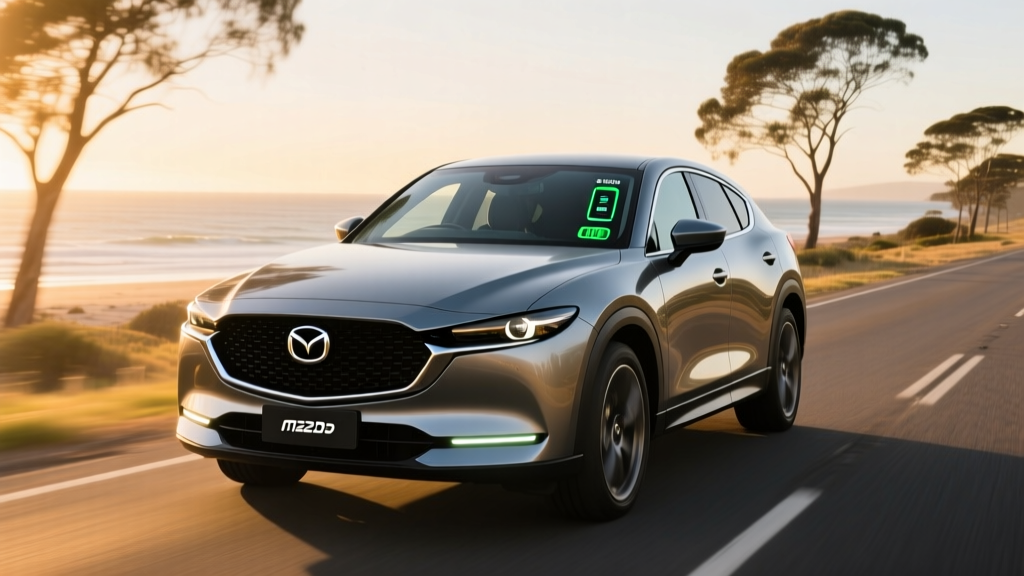
The Mazda CX-50 Hybrid pairs Mazda's rugged styling with Toyota's proven hybrid powertrain — a combination that immediately raises questions about long-term dependability. With the hybrid system borrowed directly from the RAV4 Hybrid lineage, the 2026 CX-50 Hybrid enters its second model year carrying one of the most battle-tested electrified drivetrains on the market. But does that translate to real-world reliability for buyers?
We break down every metric that matters: EPA and real-world fuel economy, the hybrid battery warranty and replacement economics, powertrain durability signals, and how this HEV stacks up against PHEV and full-EV alternatives.
2026 Mazda CX-50 Hybrid Powertrain and Fuel Economy
The CX-50 Hybrid uses a conventional hybrid (HEV) architecture — meaning it never needs to be plugged in. The system combines a 2.5-liter four-cylinder engine with two electric motor-generators and a 1.6 kWh nickel-metal hydride (NiMH) hybrid battery pack, routing power through an electronically controlled continuously variable transmission (eCVT). Total system output is 219 horsepower.
This is the same hybrid synergy drive system Toyota has refined across millions of RAV4 Hybrids, Camrys, and Highlanders since the early 2000s. Mazda's implementation is mechanically identical to the Toyota source, with Mazda-tuned suspension, steering, and exterior/interior design layered on top.
| Metric | EPA Rating |
|---|---|
| City MPG | 39 MPG |
| Highway MPG | 37 MPG |
| Combined MPG | 38 MPG |
| Fuel Tank Capacity | 14.5 gallons |
| Estimated Total Range | ~550 miles |
Source: EPA Fuel Economy
Real-World MPG vs. EPA Sticker
Conventional hybrids frequently exceed their EPA city rating in stop-and-go driving because regenerative braking recaptures energy that a gas-only vehicle wastes as heat. In real-world city commuting, owners of the Toyota-sourced 2.5L hybrid system consistently report 40–43 MPG. Highway driving at sustained 70+ mph speeds tends to land closer to 34–36 MPG, slightly below the EPA highway estimate, since the electric motor assists less at constant high speeds.
Cold weather reduces hybrid efficiency by roughly 5–10% due to increased engine idling for cabin heat and reduced battery charge acceptance. Expect combined figures around 34–36 MPG in sub-freezing conditions.
HEV vs. PHEV vs. EV: Which CX-50 Fits You?
Mazda does not currently offer a plug-in hybrid (PHEV) variant of the CX-50. If you need electric-only driving, you'll be looking at either a full EV from a different brand or waiting to see if Mazda expands the lineup. Here's how the three electrified paths compare for a compact SUV buyer:
| Factor | HEV (CX-50 Hybrid) | PHEV (e.g., RAV4 Prime) | BEV (e.g., Tesla Model Y) |
|---|---|---|---|
| Plug-in Required? | No | Yes (Level 1 or 2) | Yes (Level 2 recommended) |
| Electric-Only Range | N/A (EV mode ~1 mi) | 35–42 miles typical | 260–330 miles (EPA) |
| Combined Efficiency | 38 MPG | 38 MPG + 94 MPGe | 110–130 MPGe |
| Home Charging Needed? | No | Recommended | Essential |
| Upfront Price (approx.) | $35,000–$42,000 | $44,000–$50,000 | $44,000–$55,000 |
| Federal Tax Credit (§30D) | Not eligible | Up to $7,500* | Up to $7,500* |
| Maintenance Complexity | Low (proven system) | Moderate (two powertrains) | Low (fewer moving parts) |
* Federal §30D credit eligibility depends on MSRP caps, buyer income limits, battery critical-mineral sourcing, and point-of-sale transfer rules. Check IRS §30D guidelines for current-year qualification.
Choose the CX-50 Hybrid (HEV) if: You want maximum fuel savings without changing your fueling habits, don't have home charging access, or want the lowest-complexity electrified vehicle.
Choose a PHEV if: You have home Level 2 charging, commute under 40 miles daily, and want electric-only driving most days with gas backup for road trips.
Choose a full BEV if: You have reliable home charging, want the lowest per-mile fuel cost, and drive under 300 miles between stops (or can plan DC fast-charging breaks).
Mazda CX-50 Hybrid Reliability: The Toyota Factor
The single biggest reliability advantage the CX-50 Hybrid carries is its powertrain lineage. Toyota's hybrid synergy drive system has been in continuous production since the 1997 Prius, with cumulative global sales exceeding 25 million hybrid vehicles. The 2.5L A25A-FXS engine and accompanying eCVT used in the CX-50 Hybrid are the same units found in the RAV4 Hybrid, Camry Hybrid, and Highlander Hybrid — powertrains that consistently earn top reliability marks from Consumer Reports and J.D. Power.
Why Toyota Hybrid Systems Score High on Reliability
- No traditional transmission: The eCVT uses a planetary gearset with no belts, clutches, or bands to wear out. Failure rates are extremely low.
- Conservative battery management: The hybrid system never fully charges or fully depletes the 1.6 kWh NiMH battery, keeping it in a narrow state-of-charge window (roughly 40–80%) that dramatically extends cycle life.
- Engine stress reduction: The electric motor handles initial acceleration load, reducing wear on the gasoline engine during its highest-stress operating phase.
- Regenerative braking: Regen braking reduces wear on the friction brake pads and rotors, often extending brake service intervals to 80,000–100,000+ miles.
For the 2026 model year, Mazda has not issued any major technical service bulletins (TSBs) specific to the hybrid system, and the carryover powertrain means there are no first-year engineering unknowns.
Battery Warranty and Replacement Costs
Hybrid battery longevity is the top concern for buyers considering any HEV. Here's the warranty coverage and cost picture:
- Hybrid Battery Coverage: 10 years / 150,000 miles (in CARB states); 8 years / 100,000 miles (non-CARB states)
- Hybrid System Components: 8 years / 100,000 miles (all states)
- Powertrain Warranty: 5 years / 60,000 miles
- Battery Type: 1.6 kWh Nickel-Metal Hydride (NiMH)
- Capacity Retention Threshold: Warranty covers failure or significant capacity loss below functional thresholds
Hybrid Battery Replacement Cost
If the hybrid battery fails outside warranty — a relatively rare event given Toyota's track record — replacement costs typically fall in the $2,000–$4,000 range for a new OEM NiMH battery pack, plus labor. Refurbished or reconditioned packs are available for $1,000–$2,000. Individual cell replacement (if only one or two modules have degraded) can cost $500–$1,000 at a hybrid-specialist shop.
For context, Toyota Prius and RAV4 Hybrid batteries routinely last 150,000–200,000+ miles before significant degradation. The conservative state-of-charge management means the NiMH pack in the CX-50 Hybrid should follow the same longevity pattern. Most owners will sell or trade the vehicle before the hybrid battery requires replacement.
Pricing, Trims, and Tax Credit Eligibility
The 2026 Mazda CX-50 Hybrid is offered across multiple trim levels. Pricing reflects Mazda's positioning as a near-premium brand:
| Trim | MSRP (est.) |
|---|---|
| Preferred Hybrid | ~$35,500 |
| Premium Hybrid | ~$38,500 |
| Premium Plus Hybrid | ~$41,500 |
Pricing includes destination. Final MSRP subject to Mazda's official 2026 release.
Federal Tax Credit Status
The CX-50 Hybrid is a conventional hybrid (HEV), not a plug-in vehicle. It does not qualify for the federal §30D New Clean Vehicle Credit, which requires a minimum battery capacity of 7 kWh and plug-in capability. HEVs are also ineligible for most state EV rebates and HOV lane access programs that target PHEVs and BEVs.
However, the CX-50 Hybrid's lower purchase price (typically $5,000–$10,000 less than a comparable PHEV or EV) and strong fuel economy often produce a faster payback period for buyers who don't qualify for or don't want to navigate incentive paperwork.
5-Year Total Cost of Ownership Snapshot
To put the CX-50 Hybrid's economics in perspective, here's a 5-year / 75,000-mile ownership estimate compared to the gas-only CX-50 (2.5L turbo AWD):
| Category | CX-50 Hybrid (38 MPG) | CX-50 2.5T Gas (24 MPG) |
|---|---|---|
| Fuel Cost (75k mi @ $3.40/gal) | ~$6,710 | ~$10,625 |
| Fuel Savings vs. Gas | $3,915 saved over 5 years | |
| Maintenance (est.) | ~$2,800 | ~$3,400 |
| Insurance (est. avg) | ~$7,500 | ~$7,200 |
| Price Premium for Hybrid | ~$2,500 | — |
| Net 5-Year Savings | ~$2,315 (after hybrid premium) | |
The hybrid pays for its price premium within roughly 3–4 years of average driving, with savings accelerating if gas prices rise. Brake pad savings from regenerative braking and reduced engine wear add incremental long-term value.
Who Should Buy the Mazda CX-50 Hybrid?
✓ Ideal For
- Commuters with mixed city/highway driving who want 38+ MPG without plugging in
- Apartment dwellers or street parkers with no home charging access
- Buyers who want proven hybrid reliability with a 10-year battery warranty
- Drivers who prefer Mazda's driving dynamics and interior quality over Toyota's
- Those who want AWD capability (standard on all CX-50 Hybrid trims)
✗ Look Elsewhere If
- You want electric-only driving or zero tailpipe emissions (consider a PHEV or BEV)
- You want to qualify for the $7,500 federal tax credit
- You primarily drive short trips under 5 miles (hybrids are least efficient when cold)
- You need third-row seating (CX-50 is a two-row compact SUV)
- Towing is a priority (hybrid rated at 3,500 lbs vs. turbo gas at 3,500 lbs — no advantage)
Frequently Asked Questions
How many MPG does the 2026 Mazda CX-50 Hybrid get?
The EPA rates the CX-50 Hybrid at 39 MPG city, 37 MPG highway, and 38 MPG combined. Real-world city driving often yields 40–43 MPG thanks to regenerative braking. Sustained highway driving at 70+ mph typically returns 34–36 MPG.
Is the Mazda CX-50 Hybrid reliable?
The CX-50 Hybrid uses Toyota's 2.5L hybrid powertrain — one of the most proven hybrid systems in the world, with over 25 million units sold globally. The eCVT has no wear-prone transmission components, and the NiMH battery is managed conservatively to maximize lifespan. Based on the Toyota system's track record, reliability expectations should be high.
What is the hybrid battery replacement cost?
Out-of-warranty replacement of the 1.6 kWh NiMH hybrid battery typically costs $2,000–$4,000 for a new OEM pack. Refurbished packs run $1,000–$2,000. However, Toyota-sourced hybrid batteries routinely last 150,000–200,000+ miles, and the battery is covered under warranty for 8–10 years / 100,000–150,000 miles depending on your state.
Does the CX-50 Hybrid qualify for any tax credit?
No. The CX-50 Hybrid is a conventional hybrid (HEV), not a plug-in vehicle, so it does not qualify for the federal §30D Clean Vehicle Credit or most state EV incentives. Its value proposition is lower fuel cost and a lower purchase price compared to PHEVs and EVs.
Do I need to plug in the CX-50 Hybrid?
No. The CX-50 Hybrid is a self-charging conventional hybrid. The battery recharges through regenerative braking and the gasoline engine. You fuel it like any other gas car — no plug, no charging cable, no home charger installation required.
How does the CX-50 Hybrid compare to the RAV4 Hybrid?
Both use the same 2.5L Toyota hybrid powertrain producing 219 HP. The RAV4 Hybrid is rated at 39–41 MPG combined (depending on trim) and offers more cargo space. The CX-50 Hybrid trades a small MPG penalty for Mazda's more upscale interior, sportier driving dynamics, and standard AWD across all trims. Reliability expectations are equivalent.