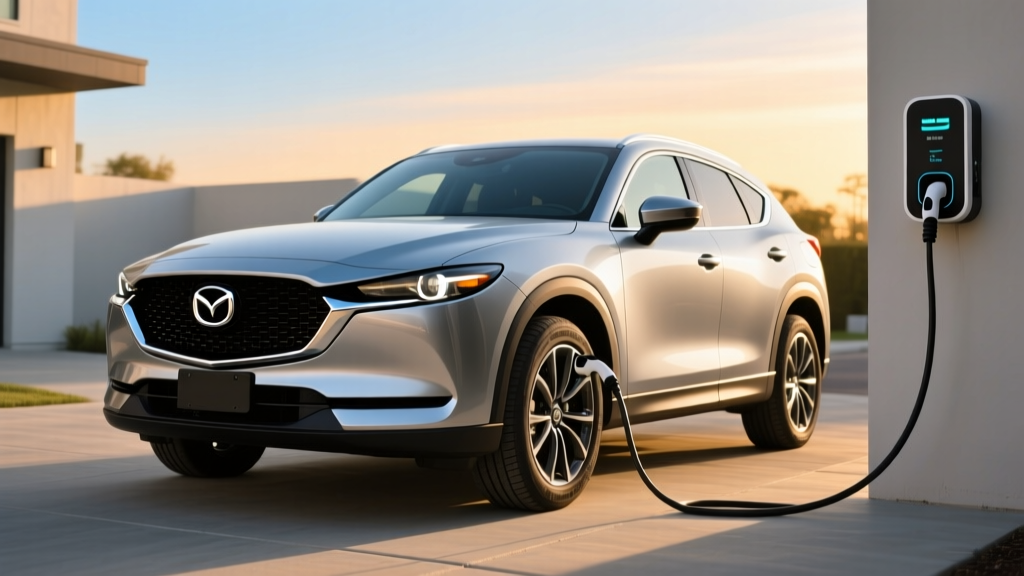
The Mazda CX-50 Hybrid pairs Toyota's proven hybrid powertrain with Mazda's premium interior and rugged styling. For the 2026 model year, the CX-50 Hybrid Premium trim sits near the top of the lineup, offering buyers a compelling middle ground between a conventional gas SUV and a full electric vehicle — without ever needing to plug in. This is a conventional hybrid (HEV), not a plug-in hybrid (PHEV), meaning it recharges its small battery through regenerative braking and the gas engine alone.
If you've been searching for a Mazda CX-50 Hybrid Premium and wondering whether its fuel-economy claims hold up in real driving, whether the Toyota-sourced hybrid system is reliable long-term, or how it stacks up against plug-in alternatives, this guide covers every number that matters.
What Is the Mazda CX-50 Hybrid Premium?
The CX-50 Hybrid uses a powertrain borrowed directly from the Toyota RAV4 Hybrid: a 2.5-liter four-cylinder engine paired with two electric motors and a continuously variable transmission (CVT). Mazda tunes the suspension, steering, and interior to its own standard, but the hybrid hardware is Toyota's fifth-generation system — one of the most widely deployed and thoroughly tested hybrid architectures on the road.
The Premium trim adds features over lower hybrid trims: a panoramic moonroof, ventilated front seats, a 12-speaker Bose audio system, Nappa leather, and a head-up display. It also includes Mazda's full i-Activsense safety suite as standard.
| Spec | Value |
|---|---|
| Powertrain | 2.5L 4-cyl + 2 electric motors (HEV) |
| Combined Horsepower | 219 hp |
| Drivetrain | AWD (electronic rear motor) |
| Transmission | eCVT |
| EPA MPG (City / Hwy / Combined) | 39 / 37 / 38 |
| Fuel Tank Capacity | 14.5 gal |
| Total Driving Range | ~551 miles |
| 0–60 mph | ~7.8 sec (est.) |
| Towing Capacity | 3,500 lbs |
| Cargo Volume (behind rear seats) | 31.4 cu ft |
| Battery Type | Nickel-metal hydride (NiMH), ~1.6 kWh |
| Base MSRP (Premium trim) | $43,350 |
| Hybrid Battery Warranty | 8 years / 100,000 miles |
How Many MPG Does the CX-50 Hybrid Premium Actually Get?
The EPA rates the 2026 CX-50 Hybrid at 39 mpg city, 37 mpg highway, and 38 mpg combined. These numbers are identical to the Toyota RAV4 Hybrid, which shares the same powertrain and is confirmed on fueleconomy.gov.
| Driving Condition | EPA Estimate | Real-World Expectation |
|---|---|---|
| City | 39 mpg | 38–42 mpg (hybrids excel in stop-and-go) |
| Highway (70 mph cruise) | 37 mpg | 33–36 mpg (aerodynamic drag, less regen benefit) |
| Combined | 38 mpg | 35–40 mpg depending on driving mix |
| Cold Weather (below 32°F) | — | 32–35 mpg (engine runs more for cabin heat) |
Real-world note: Like most Toyota-derived hybrids, the CX-50 Hybrid tends to match or slightly exceed its EPA city rating in actual urban driving because regenerative braking recaptures energy at every stop. Highway efficiency drops more noticeably — at sustained 75–80 mph speeds, expect closer to 33–35 mpg. In cold weather, the gas engine runs longer to provide cabin heat and warm the catalytic converter, shaving 3–5 mpg off combined figures. These are well-understood hybrid behaviors, not deficiencies.
For context, the non-hybrid CX-50 with the turbo 2.5L engine is rated at 23/29/25 mpg (city/highway/combined). The hybrid nearly doubles city fuel economy and improves combined efficiency by over 50%.
HEV vs PHEV vs EV: Where Does the CX-50 Hybrid Fit?
Understanding the difference between a conventional hybrid (HEV), a plug-in hybrid (PHEV), and a battery-electric vehicle (BEV) is essential before committing to any purchase. The CX-50 Hybrid is an HEV — it cannot be plugged in, has no meaningful electric-only range, and runs on gasoline at all times.
| Feature | HEV (CX-50 Hybrid) | PHEV (e.g., RAV4 Prime) | BEV (e.g., Tesla Model Y) |
|---|---|---|---|
| Plug-in Required? | No | Yes (for EV range) | Yes (always) |
| Electric-Only Range | ~1 mile at low speed | 35–42 miles | 250–330 miles |
| Fuel / Energy | Gasoline only | Gasoline + electricity | Electricity only |
| Home Charging Needed? | No | Recommended (Level 2) | Required (Level 2 ideal) |
| Federal Tax Credit (§30D) | Not eligible | Up to $7,500 (if eligible) | Up to $7,500 (if eligible) |
| Best For | No home charging, long trips | Short commutes + road trips | Home charging access, daily driving |
Choose the CX-50 Hybrid (HEV) if: You don't have access to home or workplace charging, you take frequent long road trips, you want significantly better fuel economy without changing your refueling habits, or you live in an apartment or condo where installing a charger is impractical.
Look at a PHEV instead if: You have a garage or driveway where you can install a Level 2 charger, your daily commute is under 40 miles round-trip (meaning you'd rarely burn gas on weekdays), and you still want the freedom to drive cross-country without route-planning for chargers.
Go full EV if: You have reliable home charging, your daily driving is under 250 miles, you want the lowest per-mile fuel cost, and you're ready to plan longer road trips around DC fast-charging stops.
Powertrain Deep Dive: Toyota Hybrid Muscle in a Mazda Suit
The CX-50 Hybrid's powertrain produces a combined 219 horsepower from its 2.5-liter Atkinson-cycle engine and two electric motors. The front motor handles primary propulsion and regenerative braking, while the rear motor provides electronic all-wheel drive — there's no mechanical driveshaft connecting the front and rear axles.
This system is the same one found in the RAV4 Hybrid, Toyota Highlander Hybrid, and Lexus NX 350h. It's been in production since 2019 in this generation and has accumulated billions of real-world miles across Toyota's lineup. The eCVT isn't a traditional belt-and-pulley CVT; it uses a planetary gearset that seamlessly blends engine and motor power with no fixed gear ratios, which is why Toyota hybrids have a distinctive drone under hard acceleration but are exceptionally smooth in normal driving.
The 0–60 mph time of approximately 7.8 seconds places the CX-50 Hybrid in line with competitors like the Honda CR-V Hybrid (7.6 sec) and slightly ahead of the Subaru Forester Hybrid. It's not quick by EV standards, but it's perfectly adequate for merging and passing.
Pricing, Trims, and Tax Credit Eligibility
The 2026 Mazda CX-50 Hybrid is offered in several trims. The Premium trim is positioned near the top:
| Trim | MSRP |
|---|---|
| Select Hybrid | $35,350 |
| Preferred Hybrid | $37,850 |
| Premium Hybrid | $43,350 |
| Premium Plus Hybrid | $46,150 |
Federal tax credit: The CX-50 Hybrid is a conventional hybrid (HEV), which means it does not qualify for the federal §30D Clean Vehicle Credit. That credit — up to $7,500 — is reserved for plug-in hybrids (PHEVs) with at least 7 kWh of battery capacity and battery-electric vehicles (BEVs). The CX-50 Hybrid's ~1.6 kWh NiMH battery falls far below this threshold. The IRS outlines full eligibility requirements at irs.gov.
Some states offer separate incentives for conventional hybrids, though these are increasingly rare as programs shift focus to PHEVs and BEVs. Check your state's energy office or DMV for current programs.
Battery Warranty, Reliability, and Replacement Cost
Hybrid battery longevity is consistently the top concern among first-time hybrid buyers. Here's what the data shows:
2026 CX-50 Hybrid Battery Warranty
- Hybrid Battery: 8 years / 100,000 miles (10 years / 150,000 miles in CARB states including CA, NY, MA, and others)
- Hybrid System Components: 8 years / 100,000 miles
- Powertrain (engine, transmission): 5 years / 60,000 miles
- Capacity retention threshold: Warranty covers failure or significant capacity loss below functional thresholds
The CX-50 Hybrid uses a nickel-metal hydride (NiMH) battery pack, not the lithium-ion chemistry found in EVs. NiMH is less energy-dense but extremely durable — Toyota's hybrid battery packs routinely last 150,000–200,000+ miles with minimal degradation. The battery is small (~1.6 kWh), so even significant capacity loss doesn't dramatically affect fuel economy the way EV battery degradation affects range.
Replacement cost: If the hybrid battery does need replacement out of warranty (uncommon before 150,000 miles), a new OEM pack from Mazda/Toyota typically runs $2,500–$4,000 including labor. Refurbished or aftermarket options can bring this down to $1,500–$2,500. This is dramatically cheaper than EV battery replacement ($8,000–$20,000+), largely because the pack is so much smaller.
Toyota's hybrid system has an outstanding reliability track record. The RAV4 Hybrid powertrain — identical to the CX-50's — consistently earns above-average reliability scores from Consumer Reports and J.D. Power. Mazda's overall build quality and interior materials add an additional layer of ownership satisfaction.
Real-World Ownership: What to Expect
Fuel cost savings: At 38 mpg combined versus the non-hybrid CX-50's 25 mpg combined, the hybrid saves roughly 1.7 gallons per 100 miles driven. At $3.50/gallon, that's about $595 saved per year for a driver covering 12,000 miles annually. Over a 5-year ownership period, the fuel savings total approximately $2,975 — enough to offset the hybrid's modest price premium over the turbo gas model.
Maintenance: Hybrids generally require less maintenance than gas-only vehicles. Regenerative braking reduces brake pad wear significantly (many hybrid owners report original brake pads lasting 80,000+ miles). There's no alternator, starter motor, or accessory belt to replace. Oil changes are still required at standard intervals.
Driving feel: The CX-50 Hybrid drives like a well-tuned compact SUV with seamless electric assist off the line. The transition between electric and gas power is nearly imperceptible in normal driving. Mazda's steering calibration gives it a slightly sportier feel than the RAV4 Hybrid, though the fundamental character is Toyota-smooth rather than Mazda-sporty.
Pros
- 38 mpg combined — nearly double the gas CX-50 in city driving
- Proven Toyota hybrid powertrain with exceptional reliability data
- No plug-in charging required — works with your existing routine
- Premium interior with Nappa leather, Bose audio, ventilated seats
- 3,500-lb towing capacity (rare for a hybrid crossover)
- Standard AWD across all hybrid trims
- Low long-term maintenance costs (brake savings, no starter/alternator)
Cons
- No federal tax credit eligibility (HEV, not PHEV/BEV)
- Highway MPG drops noticeably above 70 mph
- eCVT drone under hard acceleration
- Premium trim pushes past $43K without tax-credit offset
- No electric-only driving mode for zero-emission zones
- Cold-weather fuel economy drops 3–5 mpg
- Rear cargo slightly reduced vs. non-hybrid (battery placement)
Who Should Buy the CX-50 Hybrid Premium?
Decision Framework
Buy the CX-50 Hybrid Premium if:
- You want 35+ mpg without plugging in or changing habits
- You live in an apartment or lack home-charging access
- You value premium interior materials and a quiet cabin
- You regularly tow light trailers or boats (3,500-lb capacity)
- You plan to keep the vehicle 8+ years (battery warranty covers you)
Skip it and consider a PHEV or EV if:
- You have a garage and can install a Level 2 charger (a PHEV gives you 35+ miles of electric commuting)
- You want to qualify for the $7,500 federal tax credit
- Your daily commute is under 30 miles and you want zero tailpipe emissions on weekdays
- You want one-pedal driving or EV-quick acceleration
Frequently Asked Questions
How many MPG does the 2026 Mazda CX-50 Hybrid get?
The EPA rates it at 39 mpg city, 37 mpg highway, and 38 mpg combined. Real-world city driving often matches or slightly exceeds the EPA figure thanks to regenerative braking. Highway driving at 70+ mph typically returns 33–36 mpg. Cold weather reduces combined efficiency by roughly 3–5 mpg.
Does the CX-50 Hybrid need to be plugged in?
No. The CX-50 Hybrid is a conventional hybrid (HEV). Its small battery recharges through regenerative braking and the gas engine. You simply fill it with gasoline like any other car. There is no plug, no charging cable, and no electric-only range to manage.
Does the Mazda CX-50 Hybrid qualify for a federal tax credit?
No. The federal §30D Clean Vehicle Credit requires a battery capacity of at least 7 kWh and plug-in capability. The CX-50 Hybrid's ~1.6 kWh NiMH battery does not meet these requirements. Only PHEVs and BEVs are eligible. See current rules at irs.gov.
Is the CX-50 Hybrid reliable? What about battery replacement?
The CX-50 Hybrid uses Toyota's fifth-generation hybrid system, one of the most reliable powertrains in the industry. The hybrid battery is warrantied for 8 years/100,000 miles (10 years/150,000 miles in CARB states). Out-of-warranty replacement runs $2,500–$4,000 for a new OEM pack, though most Toyota hybrid batteries last well beyond 150,000 miles.
How does the CX-50 Hybrid compare to the RAV4 Hybrid?
They share the same 219-hp hybrid powertrain, EPA ratings, and AWD system. The CX-50 Hybrid has a slightly more premium interior, a more rugged exterior design, and Mazda's tuning for steering and suspension. The RAV4 Hybrid offers slightly more cargo space and a lower starting price. Both are excellent choices; the CX-50 Hybrid appeals to buyers who prioritize interior quality and styling.
What's the difference between the CX-50 Hybrid and the CX-50 turbo?
The turbo CX-50 (2.5L turbo, 256 hp) is faster (0–60 in ~6.3 sec) and more powerful but gets just 25 mpg combined. The Hybrid (219 hp, 38 mpg combined) is more efficient, less expensive to fuel, and smoother in daily driving. Choose the turbo for performance and towing heavy loads; choose the hybrid for efficiency and lower running costs.