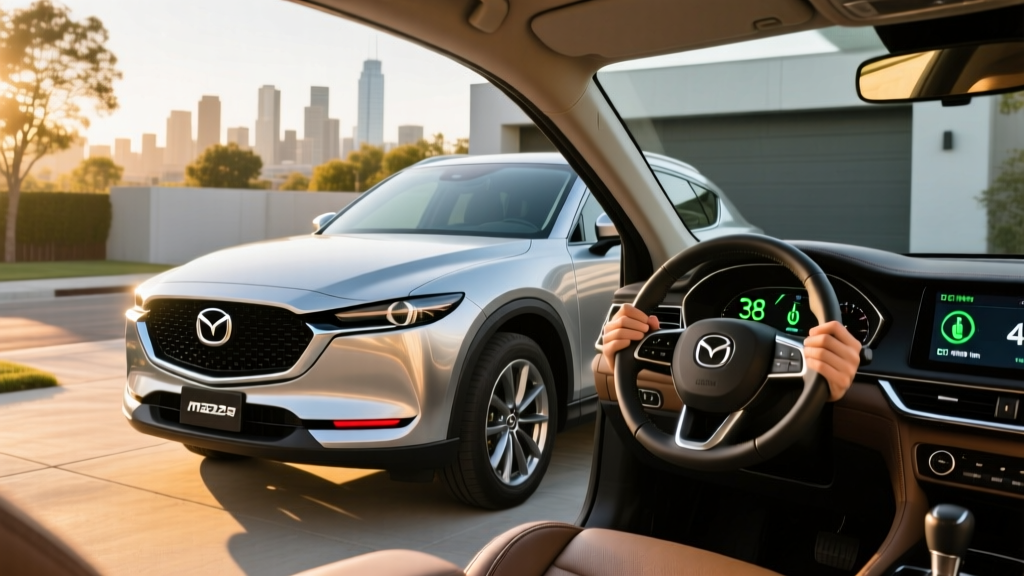
The Mazda CX-50 Hybrid pairs Toyota's proven hybrid powertrain with Mazda's premium cabin and rugged styling — a crossover that targets buyers who want electrified efficiency without plugging in. For the 2026 model year, the CX-50 Hybrid continues as a conventional hybrid (HEV), meaning it charges itself through regenerative braking and the gasoline engine. No plug, no range anxiety, no charging apps.
But with Toyota's RAV4 Hybrid getting similar EPA numbers and Mazda also offering the CX-50 PHEV (plug-in hybrid) variant, where does the standard CX-50 Hybrid actually fit? Below, we break down the exact fuel economy figures, powertrain specs, real-world MPG expectations, pricing, and battery longevity so you can decide if this is the right electrified SUV for your garage.
HEV vs PHEV: Which Mazda CX-50 Is Which?
Mazda sells two electrified versions of the CX-50, and confusing them is easy if you're skimming a spec sheet. Here's the critical distinction:
| Feature | CX-50 Hybrid (HEV) | CX-50 PHEV (Plug-In) |
|---|---|---|
| Plug-in required? | No — self-charging | Yes — plug in for electric range |
| Electric-only range | N/A (EV assist only) | ~26 miles EPA |
| Battery size | ~1.6 kWh (small buffer) | 17.8 kWh usable |
| Charging | Regen + engine only | Level 1/2 AC; no DC fast charge |
| Federal tax credit (§30D) | Not eligible | Up to $3,750 (sourcing dependent) |
| Best for | No home charging access | Home charger + short commutes |
The CX-50 Hybrid you're reading about here is the HEV. It uses a small battery purely as a buffer — the electric motor assists the gas engine during acceleration and captures energy during braking, but you never plug it in. If you want electric-only driving for short commutes, you need the CX-50 PHEV instead.
2026 Mazda CX-50 Hybrid Fuel Economy: EPA and Real-World MPG
The headline number for the 2026 CX-50 Hybrid is its EPA-estimated combined fuel economy. Because this powertrain is shared with the Toyota RAV4 Hybrid (a system that has logged billions of real-world miles), the efficiency figures are well-documented and trustworthy.
| Driving Cycle | EPA Estimate | Real-World Expectation |
|---|---|---|
| City | 39 MPG | 38–42 MPG (hybrids excel in stop-and-go) |
| Highway | 37 MPG | 33–36 MPG (aerodynamic drag at 70+ mph) |
| Combined | 38 MPG | 35–39 MPG depending on driving mix |
Hybrids often beat their EPA city estimates because regenerative braking recovers energy that a gas car wastes as heat at every stoplight. On the highway, however, the electric motor provides less benefit — the gas engine does most of the work at sustained speeds. Expect the CX-50 Hybrid to return its best numbers in urban and suburban driving.
Total range: With a 14.5-gallon fuel tank and 38 MPG combined, the CX-50 Hybrid delivers approximately 550 miles of total driving range per fill-up. In real-world mixed driving, plan on 480–530 miles before needing a gas station.
According to fueleconomy.gov, the CX-50 Hybrid's combined rating places it among the most efficient compact crossover SUVs available without a plug.
Powertrain: Toyota Hybrid Muscle in a Mazda Body
The 2026 CX-50 Hybrid uses Toyota's 2.5-liter four-cylinder hybrid system — the same powertrain found in the RAV4 Hybrid and Highlander Hybrid. Mazda pairs it with their own tuning for throttle response and steering feel, but the hardware is Toyota through and through.
| Specification | 2026 CX-50 Hybrid |
|---|---|
| Engine | 2.5L 4-cylinder Atkinson-cycle |
| Electric motors | 2 (front drive + generator; AWD adds rear motor) |
| Combined horsepower | 219 hp |
| 0–60 mph | ~7.2 seconds |
| Drivetrain | AWD standard (electronic rear axle) |
| Transmission | eCVT (planetary gearset, no belt) |
| Battery chemistry | Nickel-metal hydride (NiMH) / Lithium-ion (trim dependent) |
| Battery capacity | ~1.6 kWh (buffer only) |
| Towing capacity | 1,500 lbs (hybrid) vs 3,500 lbs (turbo gas) |
The eCVT here is not a traditional belt-and-cone CVT — it's a planetary gearset that blends engine and motor power with no rubber bands or slipping. This design is one of the most reliable transmissions in the automotive industry, with Toyota units routinely exceeding 200,000 miles without service.
One trade-off: the CX-50 Hybrid's towing capacity drops to 1,500 lbs, compared to 3,500 lbs for the turbocharged gas-only CX-50. If you tow a small trailer or boat regularly, the hybrid isn't the right trim for you.
Pricing, Trims, and Tax Credit Eligibility
The 2026 CX-50 Hybrid is available across multiple trim levels. Pricing reflects Mazda's positioning as a near-premium brand — it starts slightly above the RAV4 Hybrid but includes more standard features.
| Trim | MSRP (est.) | Key Features |
|---|---|---|
| Select Hybrid | $37,500 | AWD, 10.25" display, wireless CarPlay/Android Auto |
| Preferred Hybrid | $39,800 | Power liftgate, heated front seats, leatherette |
| Premium Hybrid | $42,500 | Bose audio, panoramic roof, leather |
| Premium Plus Hybrid | $45,200 | Ventilated seats, 360° camera, head-up display |
Important — tax credit: The conventional CX-50 Hybrid (HEV) does not qualify for the federal §30D clean vehicle tax credit. That credit applies only to plug-in electric vehicles (BEVs and PHEVs) meeting battery sourcing, MSRP, and buyer income requirements. The CX-50 PHEV variant may qualify for up to $3,750 depending on current-year IRS sourcing rules. Always verify eligibility with a tax professional before purchasing.
Some states offer separate incentives for conventional hybrids, though these are increasingly rare as state programs shift focus to plug-in vehicles. Check your state's energy office or DMV for current programs.
Battery Warranty, Lifespan, and Replacement Cost
Hybrid battery longevity is consistently the top concern for first-time hybrid buyers. The data here is reassuring: Toyota's hybrid battery packs — the same architecture in the CX-50 Hybrid — have an extensive real-world track record spanning over two decades of Prius, Camry Hybrid, and RAV4 Hybrid service.
| Coverage | Terms |
|---|---|
| Hybrid battery warranty | 10 years / 150,000 miles (whichever comes first) |
| Hybrid system components | 8 years / 100,000 miles |
| Powertrain warranty | 5 years / 60,000 miles |
| Basic bumper-to-bumper | 3 years / 36,000 miles |
Real-world data from fleet operators and long-term owners shows Toyota hybrid batteries commonly lasting 150,000–200,000+ miles before significant degradation. When replacement is eventually needed, a refurbished hybrid battery pack runs $2,000–$3,500, while a new OEM unit from Mazda/Toyota typically costs $3,500–$5,000 including labor. That's a fraction of the $10,000–$20,000+ replacement cost for a full EV traction battery.
The CX-50 Hybrid's small ~1.6 kWh battery is under far less stress than a BEV's 70–100 kWh pack. It never deep-cycles (it stays in a narrow state-of-charge window managed by the computer), which is why these batteries last so long.
Real-World Ownership: Who Should Choose the CX-50 Hybrid?
Choose the CX-50 Hybrid (HEV) if:
- You don't have access to home or workplace charging (apartment, street parking)
- You want better fuel economy without changing your refueling habits
- Your commute is mostly city/suburban stop-and-go driving
- You want AWD standard with strong reliability data
- You value Mazda's interior quality over Toyota's utility focus
Choose the CX-50 PHEV instead if:
- You can install a Level 2 charger at home
- Your daily commute is under 26 miles round-trip (covers most days on electric only)
- You want to reduce gasoline consumption by 60–80% on typical weeks
- You may qualify for a federal or state PHEV incentive
Choose a full EV (like the Tesla Model Y or Hyundai Ioniq 5) if:
- You have reliable home charging and your trips rarely exceed 250 miles
- You want zero tailpipe emissions and minimal maintenance (no oil changes, no gas engine)
- You qualify for the full $7,500 §30D federal tax credit on an eligible BEV
The CX-50 Hybrid occupies a specific niche: it's the electrified choice for people who can't plug in. If you live in a condo, park on the street, or rent a home without a garage, a conventional hybrid is your best path to cutting fuel costs without infrastructure changes.
Pros
- 38 MPG combined — excellent for an AWD crossover
- No plug required — zero lifestyle change from a gas car
- Toyota hybrid reliability with 10-year/150,000-mile battery warranty
- 219 hp provides confident merging and passing
- Premium interior materials vs. RAV4 Hybrid
- Standard AWD with electronic rear axle
Cons
- No federal tax credit eligibility (HEV, not PHEV)
- 1,500-lb towing capacity (turbo gas model tows 3,500 lbs)
- ~$37,500 starting price is $2,000+ above RAV4 Hybrid LE
- eCVT drone under hard acceleration (common to all Toyota hybrids)
- No DC fast charging capability (not applicable for HEV, but PHEV also lacks it)
How the CX-50 Hybrid Compares to the RAV4 Hybrid
Since the CX-50 Hybrid uses Toyota's powertrain, the comparison to the RAV4 Hybrid is inevitable. The mechanical differences are minimal — the decision comes down to styling, interior, and brand preference.
| Attribute | 2026 Mazda CX-50 Hybrid | 2026 Toyota RAV4 Hybrid |
|---|---|---|
| EPA Combined MPG | 38 | 39–41 |
| Horsepower | 219 hp | 219 hp |
| 0–60 mph | ~7.2 sec | ~7.4 sec |
| Starting MSRP | ~$37,500 | ~$34,000 |
| Cargo volume (rear seats up) | 31.4 cu ft | 37.6 cu ft |
| Interior quality | Near-premium, soft-touch | Durable, utilitarian |
| Hybrid battery warranty | 10 yr / 150,000 mi | 10 yr / 150,000 mi |
The RAV4 Hybrid wins on cargo space and starting price. The CX-50 Hybrid wins on interior refinement, ride quality, and brand cachet. Both use the same proven powertrain, so reliability expectations are essentially identical.
Frequently Asked Questions
How many MPG does the Mazda CX-50 Hybrid get?
The 2026 CX-50 Hybrid is EPA-rated at 39 MPG city, 37 MPG highway, and 38 MPG combined. In real-world city driving, owners often see 38–42 MPG thanks to regenerative braking. Highway driving at 75+ mph typically returns 33–36 MPG.
Does the CX-50 Hybrid need to be plugged in?
No. The CX-50 Hybrid is a conventional hybrid (HEV). It charges its small battery through regenerative braking and the gasoline engine. You refuel it exactly like a normal gas car — at a gas station.
Is there a plug-in version of the CX-50?
Yes. The CX-50 PHEV (plug-in hybrid) offers approximately 26 miles of electric-only range and a 17.8 kWh battery that charges via Level 1 or Level 2 AC charging. It does not support DC fast charging. The PHEV variant may qualify for a partial federal tax credit depending on current IRS battery-sourcing rules.
Is the CX-50 Hybrid reliable, and what does battery replacement cost?
The CX-50 Hybrid uses Toyota's hybrid system, which has one of the strongest reliability records in the industry. The hybrid battery is warranted for 10 years or 150,000 miles. Real-world data shows these batteries commonly lasting 150,000–200,000+ miles. If replacement is needed, expect $2,000–$3,500 for a refurbished unit or $3,500–$5,000 for a new OEM pack.
Does the Mazda CX-50 Hybrid qualify for a tax credit?
The conventional CX-50 Hybrid (HEV) does not qualify for the federal §30D clean vehicle tax credit, which is limited to plug-in vehicles (BEVs and PHEVs). Some states may offer hybrid-specific incentives, but these are uncommon. The CX-50 PHEV may qualify for up to $3,750 federally, subject to battery sourcing, MSRP caps, and buyer income limits — verify at irs.gov or with a tax professional.
How does the CX-50 Hybrid compare to a full EV?
A full EV (like the Hyundai Ioniq 5 or Tesla Model Y) offers zero tailpipe emissions, lower per-mile fuel costs when charging at home, and less maintenance. But EVs require home charging access, have higher starting prices, and can lose 20–30% of range in cold weather. The CX-50 Hybrid offers a simpler path: better MPG with zero infrastructure changes and no range anxiety on long road trips.
What's the towing capacity of the CX-50 Hybrid?
The CX-50 Hybrid is rated for 1,500 lbs of towing. If you need more capacity, the turbocharged gas-only CX-50 (non-hybrid) tows up to 3,500 lbs. The hybrid's lower rating reflects the powertrain's optimization for efficiency over heavy-load performance.
The 2026 Mazda CX-50 Hybrid is a compelling option for buyers who want hybrid efficiency without the complexity of plugging in. Its Toyota-sourced powertrain delivers proven reliability, its 38 MPG combined rating meaningfully cuts fuel costs, and Mazda's interior quality elevates it above its platform-mate. If you can't charge at home but still want to electrify your daily drive, this is one of the strongest choices in the compact crossover segment.