Quick Verdict: The CX-50 Hybrid's Cabin and Efficiency Case
The Mazda CX-50 Hybrid borrows its powertrain from Toyota's proven RAV4 Hybrid system but wraps it in a distinctly more premium, adventure-oriented package. For buyers searching for Mazda CX-50 hybrid interior details, the headline is this: Mazda's Takumi-grade materials, standard panoramic moonroof on upper trims, and a 10.25-inch center display set it apart from its Toyota donor — while the hybrid system delivers an EPA-estimated 38 MPG combined. This is a conventional hybrid (HEV), not a plug-in. You never plug it in. It charges its own small battery through regenerative braking and the gasoline engine.
Starting around $35,000 MSRP for the Hybrid Select trim, the CX-50 Hybrid undercuts luxury compact crossovers while offering near-luxury interior quality. It won't qualify for the federal §30D EV tax credit (that's reserved for plug-in vehicles), but its lower purchase price and strong fuel economy deliver a compelling total-cost-of-ownership story for drivers who want efficiency without charging infrastructure.
Hybrid vs. Plug-In Hybrid: What the CX-50 Actually Is
Before diving into specs, it's critical to understand what the CX-50 Hybrid is — and what it isn't. Mazda offers this model strictly as a conventional hybrid (HEV). There is no plug, no electric-only driving mode, and no external charging port.
| Attribute | HEV (CX-50 Hybrid) | PHEV (e.g., RAV4 Prime) | Full BEV (e.g., Tesla Model Y) |
|---|---|---|---|
| Plug in to charge? | No — self-charging | Yes — 120V or 240V | Yes — Level 2 or DC fast |
| Electric-only range | ~1 mile (low-speed creep) | 30–42 miles typical | 250–350+ miles (EPA) |
| Gasoline engine? | Yes (primary power) | Yes (backup + highway) | No |
| Federal tax credit (§30D) | Not eligible | Up to $7,500 (if eligible) | Up to $7,500 (if eligible) |
| Home charger needed? | No | Recommended (Level 2) | Essential (Level 2) |
| Best for | Apartment dwellers, no charging access | Home chargers, short commutes | Home chargers, low-cost fueling |
The CX-50 Hybrid's 1.6 kWh nickel-metal hydride (NiMH) traction battery is small by design. It buffers energy recovered from braking and assists the engine during acceleration, but it cannot propel the vehicle on electricity alone for meaningful distances. If you want 30+ miles of electric-only commuting before the gas engine kicks in, you'd need to look at a PHEV like the Toyota RAV4 Prime or the Mazda CX-70 PHEV instead.
Fuel Economy: EPA Ratings and Real-World MPG
The 2026 Mazda CX-50 Hybrid carries over the powertrain introduced for the 2025 model year, rated by the EPA at:
| Cycle | EPA Rating | Real-World Expectation |
|---|---|---|
| City | 39 MPG | 40–43 MPG (hybrids excel in stop-and-go) |
| Highway | 37 MPG | 34–36 MPG (aerodynamic drag, sustained speeds) |
| Combined | 38 MPG | 36–40 MPG (depends on driving mix) |
Source: fueleconomy.gov
Why real-world city MPG often exceeds the EPA sticker: Hybrids recapture kinetic energy every time you brake, feeding it back into the battery to assist the next acceleration. In urban driving with frequent stops, this regen cycle fires constantly, squeezing more miles from each gallon. Highway driving, by contrast, demands sustained power with fewer braking events, so the engine works harder and efficiency drops slightly.
Over a 14.5-gallon fuel tank, expect a total driving range of approximately 520–580 miles before refueling — enough for most road trips without range anxiety of any kind.
Powertrain: Toyota Bones, Mazda Tuning
Mazda partnered with Toyota to source the CX-50 Hybrid's powertrain — the same 2.5-liter four-cylinder hybrid system found in the RAV4 Hybrid. Mazda engineers retuned the throttle mapping, steering weight, and suspension damping to deliver a more engaging drive than the Toyota, but the core hardware is shared.
| Specification | Value |
|---|---|
| Engine | 2.5L inline-4 Atkinson-cycle |
| Electric motors | Front motor + rear motor (e-AWD) |
| Combined system output | 219 horsepower |
| Traction battery | 1.6 kWh NiMH (sealed, self-charging) |
| Transmission | eCVT (electronically controlled) |
| Drivetrain | Standard AWD (electronic rear axle) |
| 0–60 mph | ~6.8 seconds (est.) |
| Towing capacity | 1,500 lbs |
| Fuel tank | 14.5 gallons |
The electronic AWD system uses a separate rear-axle electric motor rather than a mechanical driveshaft. This means there's no torque loss through a physical connection — the rear motor engages in milliseconds when the front wheels slip, providing confident traction in rain and light snow without the parasitic drag of a traditional AWD system.
Mazda CX-50 Hybrid Interior: Materials, Space, and Tech
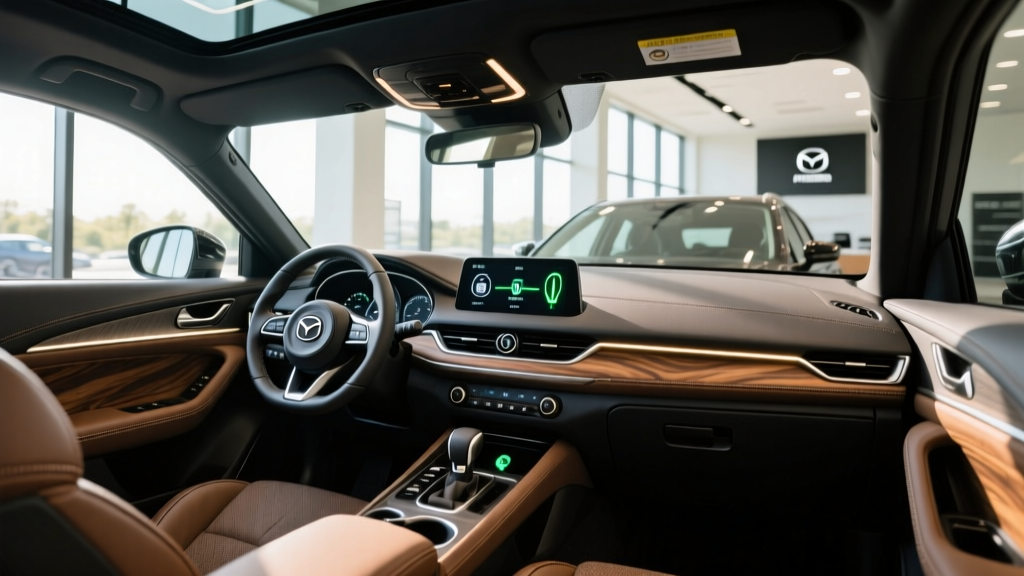
This is where the CX-50 Hybrid justifies its price premium over the RAV4 Hybrid. Mazda's interior design philosophy emphasizes tactile quality — soft-touch surfaces, available Nappa leather, and real aluminum or wood trim on upper trims. The cabin feels a half-step above mainstream competitors and encroaches on entry-level luxury territory.
Front row: Heated front seats are standard on the Hybrid Select trim. The driver gets a 10.25-inch center infotainment display operated primarily through a rotary dial on the center console (touchscreen functionality is available when the vehicle is stationary). Wireless Apple CarPlay and Android Auto are standard. The driving position is upright and commanding, with good outward visibility.
Second row: Rear legroom measures 36.3 inches — adequate for adults on shorter trips but tighter than the Honda CR-V Hybrid (39.3 inches). The rear seats recline slightly and include USB-C charging ports. A panoramic moonroof, standard on the Hybrid Premium and above, floods the cabin with light and reduces the closed-in feeling that some compact SUVs suffer from.
Cargo space: 31.4 cubic feet behind the second row, expanding to 56.4 cubic feet with the rear seats folded. The hybrid battery packaging doesn't meaningfully intrude on cargo volume compared to the gas-only CX-50, though the under-floor storage area is slightly shallower to accommodate the NiMH pack.
Technology: Mazda Connect infotainment with navigation is available, along with a 12-speaker Bose audio system on the Premium Plus trim. A 7-inch digital gauge cluster supplements the analog speedometer, displaying hybrid energy flow, battery state of charge, and fuel economy data. Wireless phone charging is available on mid-range and upper trims.
Pricing, Trims, and Tax Credit Eligibility
The 2026 Mazda CX-50 Hybrid is offered in four trims. Pricing below reflects MSRP before destination charges (~$1,420):
- Hybrid Select: ~$35,350 — base hybrid with heated seats, power liftgate, 10.25-inch display
- Hybrid Preferred: ~$37,850 — adds leatherette, power moonroof, wireless CarPlay
- Hybrid Premium: ~$40,550 — panoramic moonroof, Bose audio, heated steering wheel
- Hybrid Premium Plus: ~$43,550 — Nappa leather, ventilated front seats, head-up display
Federal Tax Credit (§30D): The CX-50 Hybrid does not qualify for the federal EV tax credit. Under current IRS §30D rules, the credit is reserved for plug-in electric vehicles (PHEVs and BEVs) with battery capacities of at least 7 kWh. The CX-50 Hybrid's 1.6 kWh NiMH battery falls far below this threshold. Some states offer separate hybrid incentives — check your state's energy office or DMV for current programs.
Despite the lack of a federal credit, the CX-50 Hybrid's lower starting price and strong fuel economy narrow the gap with plug-in alternatives when you factor in the cost of home charger installation ($500–$2,000+) that a PHEV or BEV would require.
Battery Warranty, Reliability, and Replacement Cost
Hybrid battery longevity is consistently the top concern for first-time hybrid buyers. Here's what the data shows:
| Component | Warranty |
|---|---|
| Hybrid battery (NiMH) | 8 years / 100,000 miles (10 yr / 150,000 mi in CARB states) |
| Hybrid system components | 8 years / 100,000 miles |
| Powertrain (engine, eCVT) | 5 years / 60,000 miles |
| Bumper-to-bumper | 3 years / 36,000 miles |
Real-world reliability outlook: Because the CX-50 Hybrid uses Toyota's hybrid system — a powertrain with over 25 years of continuous refinement and millions of units on the road — the failure risk is exceptionally low. Toyota Prius and RAV4 Hybrid batteries routinely last 150,000–200,000+ miles before capacity degradation becomes noticeable. The NiMH chemistry used here is less energy-dense than lithium-ion but is extremely tolerant of the shallow charge-discharge cycles that hybrids impose, which is precisely why Toyota has stuck with it.
Replacement cost if out of warranty: A refurbished hybrid battery pack for this system typically runs $2,000–$3,500 including labor. A brand-new OEM pack from Mazda/Toyota may cost $4,000–$6,000 installed. Given the proven longevity of this hardware, most owners will trade or sell the vehicle long before a battery replacement is needed.
Who Should Choose the CX-50 Hybrid vs. a PHEV or Full EV?
Choose the Mazda CX-50 Hybrid if:
- You live in an apartment or lack access to home charging (no plug needed)
- You want 38 MPG without changing your fueling habits at all
- You value a premium interior at a mainstream price point
- You frequently drive in cold climates where EV range loss is a concern
- Your daily commute is under 40 miles and you don't want to think about charging
Choose a PHEV (like the RAV4 Prime or CX-70 PHEV) if:
- You can install a Level 2 home charger (240V outlet)
- Your commute is under 40 miles and you want electric-only daily driving
- You want eligibility for the up-to-$7,500 federal tax credit
- You want the option of zero-emission driving while retaining gas-engine flexibility for road trips
Choose a full EV (like the Tesla Model Y or Hyundai Ioniq 5) if:
- You have reliable home charging and want the lowest per-mile fuel cost (~$0.04–$0.06/mile vs. ~$0.13/mile for the hybrid at 38 MPG and $3.50/gal)
- You want zero tailpipe emissions and minimal drivetrain maintenance (no oil changes, no transmission fluid)
- You qualify for the federal tax credit and state rebates, offsetting the higher upfront price
Pros and Cons
Pros
- 38 MPG combined with no plug-in requirement — effortless efficiency
- Premium interior materials rival entry-level luxury brands
- Toyota-sourced hybrid system with proven long-term reliability
- Standard AWD with electronic rear axle — no fuel-economy penalty
- Strong real-world city MPG (often exceeds EPA in stop-and-go traffic)
- No home charger installation cost or electrical panel upgrade needed
Cons
- No federal tax credit eligibility (HEV, not a plug-in vehicle)
- Rear legroom is tighter than Honda CR-V Hybrid and Toyota RAV4 Hybrid
- Towing limited to 1,500 lbs (gas-only CX-50 Turbo tows 3,500 lbs)
- Rotary-dial infotainment control is less intuitive than a touchscreen for some users
- No electric-only driving mode — the gas engine is always available
- NiMH battery chemistry is heavier and less energy-dense than lithium-ion
Frequently Asked Questions
How many MPG does the Mazda CX-50 Hybrid get?
The EPA rates the CX-50 Hybrid at 39 MPG city, 37 MPG highway, and 38 MPG combined. In real-world city driving with frequent stops, many owners report 40–43 MPG thanks to aggressive regenerative braking. Highway cruising at 70+ mph typically yields 34–36 MPG.
Does the CX-50 Hybrid need to be plugged in?
No. The CX-50 Hybrid is a conventional (self-charging) hybrid. Its small 1.6 kWh battery recharges through regenerative braking and the gasoline engine. There is no charging port and no plug. You fuel it exactly like a conventional car.
Does the Mazda CX-50 Hybrid qualify for any tax credit?
The CX-50 Hybrid does not qualify for the federal §30D clean vehicle tax credit, which requires a plug-in vehicle with at least 7 kWh of battery capacity. Some states and local utilities offer separate incentives for efficient hybrids — check afdc.energy.gov for state-level programs.
Is the hybrid battery reliable, and what does replacement cost?
Very reliable. The Toyota-sourced NiMH hybrid system has decades of proven durability, with batteries commonly lasting 150,000–200,000+ miles. Mazda covers the hybrid battery for 8 years/100,000 miles (10 years/150,000 miles in CARB states). Out-of-warranty replacement runs $2,000–$6,000 depending on whether you choose a refurbished or new OEM pack.
How does the CX-50 Hybrid compare to the RAV4 Hybrid?
They share the same 219 hp hybrid powertrain and similar EPA ratings (RAV4 Hybrid: 39–41 MPG combined depending on trim). The CX-50 Hybrid offers a more premium interior, slightly sportier tuning, and a more rugged exterior design. The RAV4 Hybrid offers more rear legroom, a larger cargo area, and a lower starting price (~$33,000). Both are excellent; the choice comes down to interior preference and styling.
Hybrid vs. PHEV vs. EV — which should I buy?
If you can't charge at home, the CX-50 Hybrid (HEV) is the clear winner — no infrastructure changes needed. If you have a garage and can install a 240V outlet, a PHEV gives you 30–40 miles of electric commuting plus gas flexibility. If you have home charging and want the lowest operating cost, a full EV like the Model Y or Ioniq 5 delivers fuel costs around $0.04–$0.06 per mile versus the hybrid's ~$0.13 per mile.
Can the CX-50 Hybrid drive on electric power alone?
Only in very limited low-speed scenarios (under ~15 mph, light throttle, battery sufficiently charged). The electric motor assists the gas engine during normal driving but cannot propel the vehicle independently for any meaningful distance. This is by design for a conventional hybrid — meaningful electric-only range requires a PHEV or BEV.