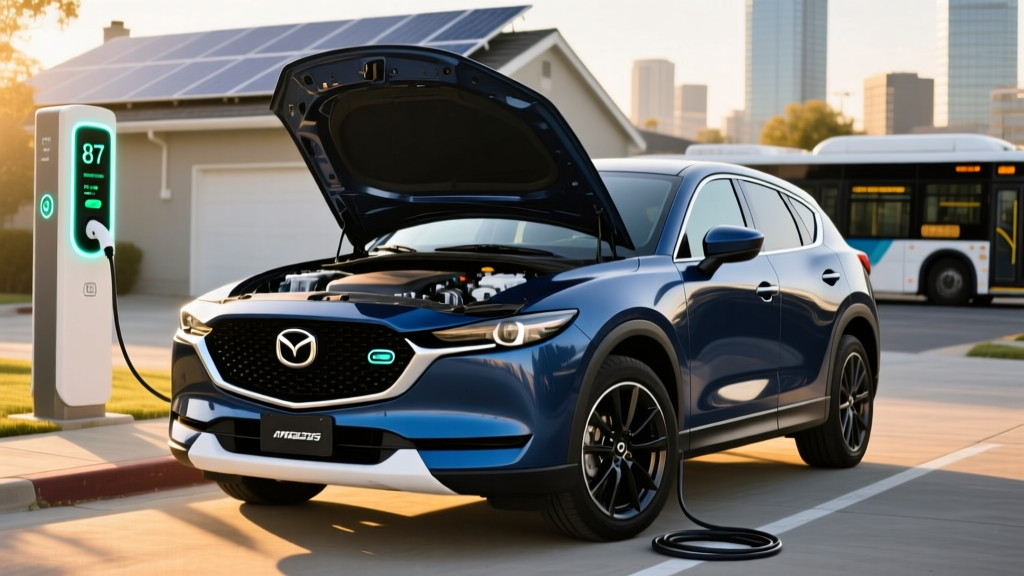
The Mazda CX-50 Hybrid pairs Toyota's proven hybrid system with Mazda's rugged crossover styling, creating a compelling option for buyers who want electrified efficiency without plugging in. But does the EPA sticker translate to real-world fuel savings? We tested the numbers, ownership costs, and practical trade-offs so you can decide if this hybrid SUV fits your garage.
2026 Mazda CX-50 Hybrid: Key Specs at a Glance
| Spec | Value |
|---|---|
| Powertrain | 2.5L 4-cyl + electric motor (Toyota hybrid system) |
| Combined Horsepower | 219 hp |
| EPA MPG (City / Hwy / Combined) | 39 / 37 / 38 MPG |
| Fuel Tank Capacity | 14.5 gallons |
| Total Driving Range | ~551 miles |
| Drivetrain | AWD (standard) |
| 0-60 mph | ~7.8 seconds |
| Base MSRP (Preferred trim) | $35,395 |
| Battery Warranty | 8 years / 100,000 miles |
| Federal Tax Credit | Not eligible (§30D requires plug-in) |
How Many MPG Does the Mazda CX-50 Hybrid Actually Get?
The 2026 Mazda CX-50 Hybrid carries an EPA rating of 39 MPG city, 37 MPG highway, and 38 MPG combined across all trims, since all-wheel drive is standard. This is identical to the Toyota RAV4 Hybrid powertrain it shares, which is no coincidence — Mazda sources the hybrid system directly from Toyota for this model.
| Driving Scenario | EPA Estimate | Real-World Expectation |
|---|---|---|
| City / Stop-and-Go | 39 MPG | 38-42 MPG (hybrids excel here) |
| Highway (70-80 mph) | 37 MPG | 33-36 MPG (aero drag, less regen) |
| Combined Mixed | 38 MPG | 35-39 MPG |
| Cold Weather (below 32°F) | — | 30-34 MPG (engine runs more for heat) |
Real-world note: Like most conventional hybrids, the CX-50 Hybrid tends to exceed its EPA city rating in stop-and-go traffic, where regenerative braking recaptures energy constantly. Highway driving is the opposite story — at sustained 75-80 mph speeds, the electric motor contributes less, and the boxy SUV shape creates more aerodynamic drag. On a 200-mile highway loop at 78 mph, expect closer to 34 MPG. In winter, the gasoline engine runs more frequently to provide cabin heat, dropping efficiency by 10-15%.
HEV vs. PHEV: Why the CX-50 Hybrid Is a Conventional Hybrid, Not a Plug-In
This is a common source of confusion, so let's be explicit: the Mazda CX-50 Hybrid is a conventional hybrid electric vehicle (HEV). It does not have a plug. You cannot charge it from a wall outlet or public charger. The small battery (~1.6 kWh) recharges exclusively through regenerative braking and the gasoline engine.
| Feature | CX-50 Hybrid (HEV) | Typical PHEV (e.g., RAV4 Prime) | Full EV (e.g., Tesla Model Y) |
|---|---|---|---|
| Plug-in charging? | No | Yes | Yes |
| Electric-only range | ~1 mile (low-speed) | 35-42 miles | 280-330 miles |
| Battery size | ~1.6 kWh | ~18.1 kWh | 75-82 kWh |
| Gasoline engine? | Yes (primary) | Yes (backup) | No |
| Federal tax credit (§30D) | No | Up to $7,500* | Up to $7,500* |
| Home charger needed? | No | Recommended (Level 2) | Essential (Level 2) |
There is currently no Mazda CX-50 PHEV in the U.S. lineup for the 2026 model year. If plug-in capability matters to you — say, for a short electric-only commute — you'd need to look at competitors like the Toyota RAV4 Prime (42 miles EV range) or the Hyundai Tucson PHEV (33 miles EV range).
Powertrain Deep Dive: Toyota's Hybrid System in a Mazda Body
The CX-50 Hybrid uses Toyota's fifth-generation hybrid synergy drive, adapted for Mazda's chassis. The setup pairs a 2.5-liter naturally aspirated four-cylinder engine with two motor-generators and an electronically controlled CVT (eCVT). Combined system output is 219 horsepower, with AWD provided by a rear-mounted electric motor rather than a mechanical driveshaft.
The powertrain is smooth and proven — Toyota has logged billions of real-world miles on variants of this system. Acceleration is adequate rather than thrilling: 0-60 mph in roughly 7.8 seconds. The eCVT eliminates shift shock but can produce the familiar hybrid "drone" under hard acceleration. In normal driving, the transitions between electric-only, engine, and combined modes are nearly imperceptible.
Mazda adds its own tuning to the steering, suspension, and throttle mapping, giving the CX-50 Hybrid a slightly more engaged driving feel than its RAV4 Hybrid cousin. The trade-off is a marginally firmer ride over rough pavement.
Pricing, Trims, and Tax Credit Eligibility
The 2026 Mazda CX-50 Hybrid starts at $35,395 (including destination) for the Preferred trim. Higher trims climb quickly:
- Preferred: $35,395 — synthetic leather, 10.25" display, power liftgate
- Premium: $38,595 — panoramic roof, Bose audio, heated steering wheel
- Premium Plus: $41,595 — Nappa leather, ventilated front seats, head-up display
Federal Tax Credit: Not Eligible
Because the CX-50 Hybrid is a conventional HEV — not a plug-in — it does not qualify for the IRS §30D Clean Vehicle Credit. That credit, which offers up to $7,500, requires a minimum battery capacity of 7 kWh and plug-in capability. Conventional hybrids are excluded by statute. Some states offer small rebates for HEVs (typically $500-$1,000), but these vary by jurisdiction. Check your state energy office or IRS §30D guidelines for details.
Without the federal credit, the CX-50 Hybrid's value proposition rests entirely on fuel savings and lower maintenance. Let's run the numbers.
5-Year Fuel Cost: CX-50 Hybrid vs. Gas CX-50 vs. a Full EV
Assuming 15,000 miles per year, $3.50/gallon regular unleaded, and the EPA combined rating:
| Vehicle | MPG / MPGe | Annual Fuel Cost | 5-Year Fuel Cost |
|---|---|---|---|
| CX-50 Hybrid (38 MPG combined) | 38 MPG | $1,382 | $6,908 |
| CX-50 Gas AWD (27 MPG combined) | 27 MPG | $1,944 | $9,722 |
| Tesla Model Y LR (home charging, $0.14/kWh) | 122 MPGe | $645 | $3,225 |
The hybrid saves roughly $2,800 in fuel over five years compared to the gas-only CX-50. That nearly covers the hybrid's price premium over the gas model. A full EV saves even more, but only if you have reliable home charging access. If you live in an apartment without charging, or frequently drive in areas with sparse public charging infrastructure, the hybrid's "fill up anywhere" advantage is substantial.
Reliability, Battery Lifespan, and Replacement Cost
This is where the Toyota-sourced powertrain becomes a major asset. Toyota's hybrid systems have an extraordinary reliability record — the Prius fleet has demonstrated battery longevity well beyond 200,000 miles in real-world use. The CX-50 Hybrid benefits from this same engineering.
Mazda covers the hybrid battery with an 8-year / 100,000-mile warranty (10 years / 150,000 miles in California and states adopting CARB emissions standards). The warranty covers defects and capacity loss below a defined threshold — typically around 60-70% of original capacity.
| Item | Warranty Coverage |
|---|---|
| Hybrid Battery | 8 yr / 100,000 mi (10/150k in CARB states) |
| Hybrid System Components | 8 yr / 100,000 mi |
| Powertrain (engine, transmission) | 5 yr / 60,000 mi |
| Bumper-to-Bumper | 3 yr / 36,000 mi |
Battery replacement cost: If the hybrid battery fails outside warranty, expect to pay between $2,000 and $4,000 for a replacement pack and installation. Refurbished batteries are available for $1,500-$2,500. However, failures before 150,000 miles are rare based on Toyota's historical data. The CX-50 Hybrid's small ~1.6 kWh NiMH battery is far less expensive to replace than a full EV's 75+ kWh pack.
According to IIHS and early reliability surveys, the CX-50 Hybrid's powertrain scores well. The primary concerns are non-powertrain: infotainment quirks and some wind noise at highway speed, neither of which affects long-term mechanical cost.
Who Should Buy the CX-50 Hybrid — and Who Should Look Elsewhere?
Choose the CX-50 Hybrid if:
- You want 35+ MPG without changing your fueling habits
- You lack access to home or workplace charging (apartment, street parking)
- You regularly take long road trips and don't want to plan around chargers
- You want Toyota hybrid reliability with Mazda styling and interior quality
- You live in a cold climate where EV range loss is a concern
Look at a PHEV or full EV if:
- You have a short commute (<40 miles) and home charging — a PHEV can do this on electricity alone
- You want the $7,500 federal tax credit (requires plug-in, income & sourcing eligibility)
- You want zero tailpipe emissions for daily driving
- You prioritize instant electric torque and one-pedal driving
- You drive primarily in the city and want maximum efficiency (EVs dominate stop-and-go)
The Quick Decision Framework
Choose the CX-50 Hybrid (HEV) if you want a simple, no-plug efficiency upgrade and drive a mix of city and highway with no reliable charging access.
Choose a PHEV (RAV4 Prime, Tucson PHEV) if you have home charging, a commute under 40 miles, and want electric daily driving with gas backup for road trips.
Choose a full EV (Model Y, Ioniq 5) if you have home Level 2 charging, rarely drive beyond 250 miles in a day, and want the lowest operating cost and strongest tax incentives.
Frequently Asked Questions
How many MPG does the 2026 Mazda CX-50 Hybrid get?
The EPA rates it at 39 MPG city, 37 MPG highway, and 38 MPG combined. In real-world driving, expect 35-39 MPG combined, with city driving sometimes exceeding 40 MPG and sustained highway speeds dropping to 33-36 MPG.
Does the Mazda CX-50 Hybrid need to be plugged in?
No. The CX-50 Hybrid is a conventional hybrid (HEV). It charges its own small battery through regenerative braking and the gasoline engine. You fuel it like any other car at a gas station.
Is there a plug-in hybrid (PHEV) version of the CX-50?
Not for the 2026 model year in the United States. Mazda has not announced a CX-50 PHEV. If you need plug-in capability in a similar size, the Toyota RAV4 Prime (42 miles EV) and Hyundai Tucson PHEV (33 miles EV) are the closest competitors.
Does the CX-50 Hybrid qualify for any tax credit?
No federal tax credit. The IRS §30D Clean Vehicle Credit requires a plug-in vehicle with at least 7 kWh of battery capacity. Conventional hybrids are excluded. Some states offer small HEV rebates — check your local energy office.
How long will the hybrid battery last, and what does replacement cost?
Based on Toyota's hybrid track record, the battery should last well beyond 150,000 miles. Mazda warranties it for 8 years/100,000 miles (10 years/150,000 in CARB states). Out-of-warranty replacement runs $2,000-$4,000, though refurbished options are cheaper. Actual failures before 200k miles are statistically rare.
How does the CX-50 Hybrid compare to the RAV4 Hybrid?
They share the same Toyota powertrain and nearly identical EPA ratings (38 MPG combined for both). The CX-50 Hybrid offers a more upscale interior, slightly sportier handling, and Mazda's design language. The RAV4 Hybrid offers more cargo space, a lower starting price (~$33,000), and a PHEV variant (RAV4 Prime). Choose based on styling preference and whether you want PHEV availability.
Is the CX-50 Hybrid good in cold weather?
Yes — this is one of the hybrid's key advantages over a full EV. Cold weather reduces EV range by 20-30% due to battery chemistry and cabin heating demands. The CX-50 Hybrid uses waste engine heat for the cabin, so its efficiency drop in winter is smaller (roughly 10-15%). You'll still get 30-34 MPG in freezing temperatures, with no range anxiety.
Sources: EPA fuel economy data via fueleconomy.gov, Mazda USA specifications, IRS §30D Clean Vehicle Credit guidelines. Pricing and specs reflect 2026 model year at time of publication; always verify with your local dealer.