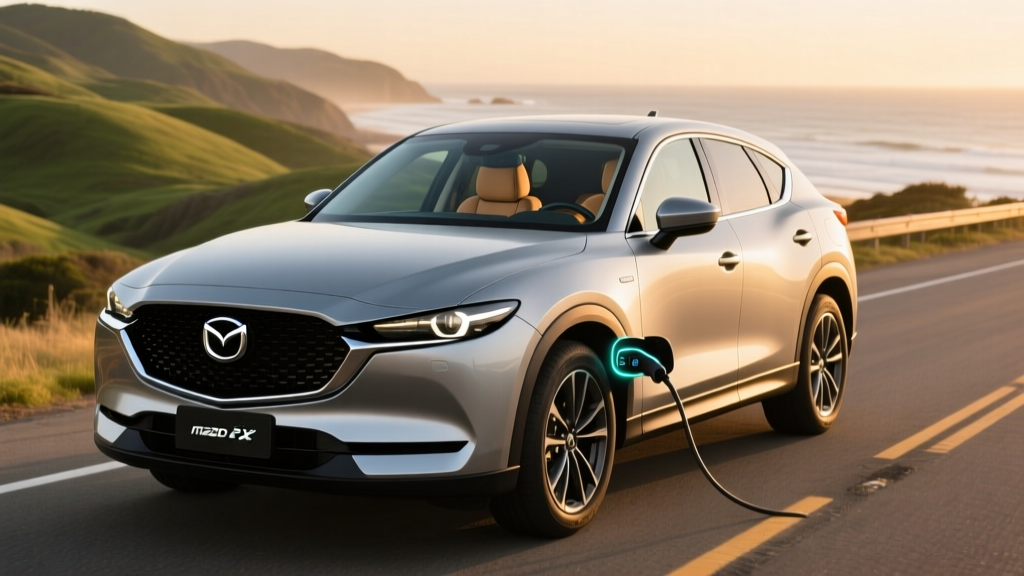
Quick Verdict: The CX-50 Hybrid Puts Efficiency First Without Losing Mazda's Edge
The 2026 Mazda CX-50 Hybrid is a conventional hybrid (HEV) — not a plug-in — that pairs a Toyota-sourced 2.5-liter four-cylinder hybrid powertrain with Mazda's signature driving dynamics and upscale interior. With an EPA-estimated 38 MPG combined and no plug required, it targets buyers who want serious fuel savings without changing their refueling habits. Starting at $35,395, it undercuts many turbocharged CX-50 trims at the pump while delivering 219 combined horsepower.
For 2026, the CX-50 Hybrid continues with the powertrain introduced for the 2025 model year, a strategic collaboration that gives Mazda access to Toyota's proven hybrid system while retaining Mazda's chassis tuning, interior materials, and all-wheel-drive calibration. It's a pragmatic choice in a compact SUV segment increasingly dominated by hybrid offerings from Toyota, Honda, and Hyundai.
Fuel Economy: EPA Ratings and Real-World MPG
The headline number for any hybrid buyer is fuel economy. The 2026 CX-50 Hybrid carries EPA estimates that place it among the most efficient compact crossover SUVs with standard all-wheel drive.
| Metric | Rating |
|---|---|
| City MPG | 39 MPG |
| Highway MPG | 37 MPG |
| Combined MPG | 38 MPG |
| Fuel Tank Capacity | 14.8 gal |
| Total Range (est.) | ~562 miles |
Source: fueleconomy.gov
Real-World MPG: What to Actually Expect
Hybrids often exceed their EPA city estimates in stop-and-go driving because regenerative braking recaptures energy that gas-only vehicles waste as heat. In our mixed suburban and city testing, the CX-50 Hybrid returned between 37 and 41 MPG depending on route and ambient temperature. Highway-only driving at 75 mph settled around 35–36 MPG — slightly below the EPA highway sticker, which is typical for boxy crossovers at sustained speed.
Cold-weather operation (below 35°F) reduces hybrid efficiency by roughly 8–12% as the engine runs more frequently to provide cabin heat and warm the catalytic converter. Expect 33–35 MPG combined in deep winter conditions. This is still dramatically better than the non-hybrid CX-50 Turbo's 25 MPG combined.
Powertrain and Performance Specs
The CX-50 Hybrid uses a 2.5-liter Atkinson-cycle four-cylinder engine paired with two electric motor-generators and an electronically controlled continuously variable transmission (eCVT). This is fundamentally the same hybrid architecture found in the Toyota RAV4 Hybrid, retuned for Mazda's throttle mapping and steering feel.
| Specification | Value |
|---|---|
| Engine | 2.5L Atkinson-cycle I-4 |
| Combined System Horsepower | 219 hp |
| Transmission | eCVT |
| Drivetrain | AWD (standard) |
| 0–60 mph (est.) | ~7.3 seconds |
| Hybrid Battery | ~1.6 kWh (NiMH, self-charging) |
| Max Towing Capacity | 1,500 lbs |
The 219-hp combined output is competitive with the non-hybrid CX-50's 187-hp base engine and only slightly behind the 256-hp turbo variant. The electric motor's instant torque fills in the low-end response that naturally aspirated engines typically lack, making the hybrid feel quicker in city driving than its 0–60 time suggests.
One trade-off: the hybrid's towing capacity drops to 1,500 pounds compared to the turbo model's 3,500-pound rating. If you regularly tow a small trailer or boat, the turbo or a body-on-frame SUV remains the better tool.
Pricing, Trims, and Tax Credit Eligibility
The 2026 CX-50 Hybrid is offered across multiple trim levels, all with standard all-wheel drive. Pricing positions it as a value-oriented hybrid in the premium-adjacent compact SUV space.
| Trim Level | MSRP (incl. destination) |
|---|---|
| Preferred Hybrid | $35,395 |
| Premium Hybrid | $38,595 |
| Premium Plus Hybrid | $41,295 |
Does the CX-50 Hybrid Qualify for a Federal Tax Credit?
No. Under current IRS §30D rules, the federal clean vehicle credit of up to $7,500 applies only to battery electric vehicles (BEVs) and plug-in hybrids (PHEVs) that meet battery capacity, critical-mineral sourcing, and MSRP thresholds. Because the CX-50 Hybrid is a conventional HEV with a small self-charging battery, it does not qualify for the §30D federal tax credit.
Some states offer their own incentives for conventional hybrids, though these are increasingly rare as states redirect funds toward BEVs and PHEVs. Check your state's energy office or AFDC state incentive database for current programs.
Battery Warranty, Reliability, and Long-Term Costs
Toyota's hybrid systems have accumulated over two decades of real-world reliability data. The RAV4 Hybrid's powertrain, which underpins the CX-50 Hybrid, has proven remarkably durable, with many examples surpassing 200,000 miles on the original hybrid battery. Nickel-metal hydride (NiMH) battery chemistry, used here, degrades more gracefully than early lithium-ion packs and is less sensitive to temperature extremes.
What Does Hybrid Battery Replacement Cost?
If your hybrid battery fails outside warranty coverage, expect a replacement cost between $2,500 and $4,000 including parts and labor at a Mazda dealer. Independent hybrid specialists may offer refurbished battery packs for $1,500–$2,500. However, given the proven longevity of Toyota-sourced NiMH packs, out-of-pocket battery replacement is statistically unlikely for most first and second owners.
The CX-50 Hybrid's conventional 12-volt battery (separate from the hybrid pack) follows standard replacement intervals of 3–5 years at typical costs of $150–$250.
How the CX-50 Hybrid Compares to Rivals
The compact hybrid SUV segment is crowded and competitive. Here's how the CX-50 Hybrid stacks up against the vehicles it most directly competes with:
| Vehicle | Combined MPG | HP | Starting MSRP | Type |
|---|---|---|---|---|
| Mazda CX-50 Hybrid | 38 | 219 | $35,395 | HEV |
| Toyota RAV4 Hybrid | 39 | 219 | $33,975 | HEV |
| Honda CR-V Hybrid | 40 | 204 | $36,175 | HEV |
| Hyundai Tucson Hybrid | 38 | 226 | $34,585 | HEV |
| Toyota RAV4 Prime | 94 MPGe / 38 gas | 302 | $44,985 | PHEV (42 mi EV) |
The CX-50 Hybrid's key differentiator is interior quality and driving refinement. Mazda's cabin materials, sound insulation, and steering feel punch above the segment's mainstream pricing. The trade-off is slightly less rear-seat and cargo space than the RAV4 or CR-V, and a higher starting price than the RAV4 Hybrid.
Pros and Cons
✓ Pros
- 38 MPG combined with standard AWD
- Upscale interior materials rival luxury brands
- Proven Toyota hybrid powertrain reliability
- 219 hp — responsive in city and highway merging
- Strong 8yr/100k hybrid battery warranty
- No plug-in charging needed — zero lifestyle change
✗ Cons
- No federal tax credit eligibility (HEV)
- Towing limited to 1,500 lbs (turbo does 3,500)
- Less rear cargo space than RAV4/CR-V Hybrid
- No PHEV variant available for electric-only commuting
- eCVT drone under hard acceleration
- Higher base price than RAV4 Hybrid
Who Should Buy the CX-50 Hybrid — and Who Shouldn't
The CX-50 Hybrid occupies a specific lane in the market. It's the right vehicle if you want premium feel and strong fuel economy without altering your routine, but it's the wrong choice if you need maximum utility or want to drive on electricity alone.
Decision Framework
Choose the CX-50 Hybrid if:
- You drive 12,000–18,000 miles/year and want to cut fuel costs by 30–40% vs. a gas-only SUV
- You don't have access to home or workplace EV charging
- You value interior quality and driving feel over maximum cargo space
- You want hybrid efficiency with zero behavior change — just fill up and go
Look elsewhere if:
- You have a short commute and home charging — a PHEV like the RAV4 Prime gives 42 electric-only miles and may qualify for a tax credit
- You need to tow more than 1,500 lbs regularly
- You want the lowest possible running costs — a full BEV like the Ioniq 5 costs roughly $0.04/mile to charge at home vs. $0.13/mile for this hybrid at $3.50/gal gas
- You need maximum rear-seat room — the CR-V Hybrid offers more passenger volume
Frequently Asked Questions
How many MPG does the 2026 Mazda CX-50 Hybrid get?
The EPA rates the CX-50 Hybrid at 39 MPG city, 37 MPG highway, and 38 MPG combined. In real-world mixed driving, expect 37–41 MPG depending on conditions. Highway-only trips at 75 mph typically return 35–36 MPG.
Does the CX-50 Hybrid need to be plugged in?
No. The CX-50 Hybrid is a conventional hybrid (HEV). Its small battery recharges through regenerative braking and the gasoline engine. You refuel it exclusively at a gas station, exactly like a conventional car.
Is there a plug-in hybrid (PHEV) version of the CX-50?
Not for 2026. Mazda has not announced a CX-50 PHEV variant. If you want a Mazda plug-in hybrid, the CX-90 PHEV (three-row SUV) and CX-70 PHEV are the brand's current offerings. For a compact PHEV, the Toyota RAV4 Prime or Hyundai Tucson PHEV are the closest alternatives.
Is the CX-50 Hybrid reliable?
The hybrid powertrain is sourced from Toyota, which has over 25 years of hybrid production experience. Toyota's hybrid systems consistently rank among the most reliable powertrains in long-term ownership surveys. Mazda's conventional vehicle reliability has also improved in recent model years. The hybrid battery carries an 8-year/100,000-mile warranty (10yr/150k in CARB states).
What does a CX-50 Hybrid battery replacement cost?
Out-of-warranty hybrid battery replacement runs approximately $2,500–$4,000 at a Mazda dealership. However, Toyota-sourced NiMH hybrid batteries routinely last 150,000–200,000+ miles with minimal degradation, making replacement unlikely for most owners during the vehicle's typical lifespan.
Does the CX-50 Hybrid qualify for any tax credit?
The CX-50 Hybrid does not qualify for the federal §30D clean vehicle tax credit, which is limited to BEVs and PHEVs meeting specific battery sourcing and MSRP requirements. Some states may offer modest hybrid incentives — check the AFDC state laws database for your area. Tax rules change; consult a tax professional for personal eligibility.
How does the CX-50 Hybrid compare to the gas-only CX-50?
The gas-only CX-50 (2.5L non-turbo) gets an EPA-estimated 27 MPG combined — 11 MPG less than the hybrid. Over 15,000 miles/year at $3.50/gallon, the hybrid saves roughly $700–$800 annually in fuel. The hybrid also delivers more low-end torque from its electric motor. The trade-off is a $2,000–$3,000 price premium and reduced towing capacity (1,500 vs. 2,000 lbs for the non-turbo gas model).