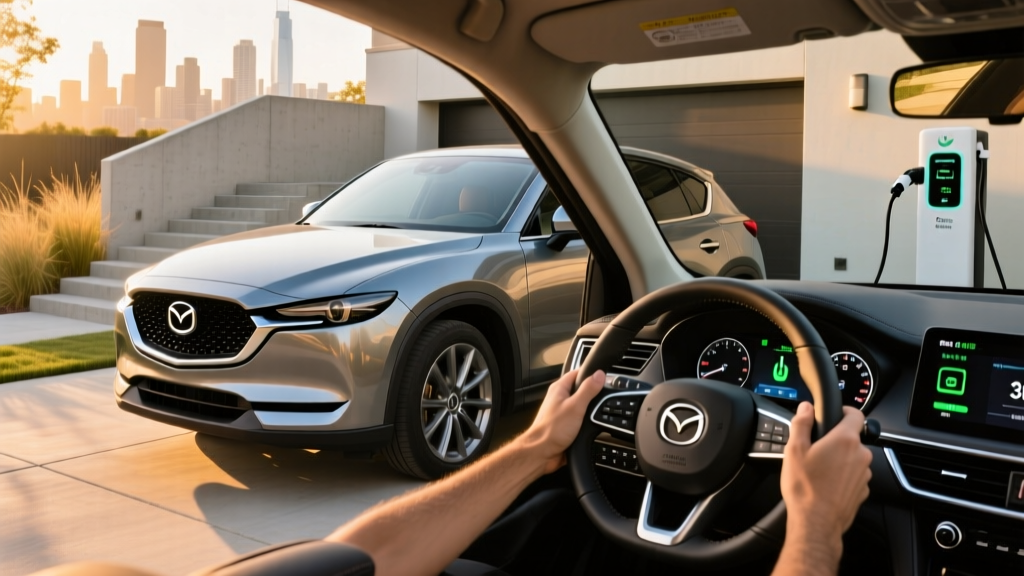
For years, the Mazda CX-5 has been the driver's pick in the compact SUV segment — sharp handling, upscale interior, and a willing turbocharged engine. But it has also been one of the thirstiest, with the turbo models returning as little as 23 MPG combined. The 2025 Mazda CX-5 Hybrid changes that equation entirely, pairing Mazda's proven chassis with Toyota's fourth-generation hybrid system to deliver an EPA-estimated 38 MPG combined without sacrificing the brand's signature dynamics.
But is borrowing Toyota's hybrid guts enough to make the CX-5 Hybrid the default choice in a segment now crowded with electrified options? We've analyzed the powertrain specs, real-world efficiency data, pricing, and ownership economics to give you the full picture.
2025 Mazda CX-5 Hybrid: Core Specifications
| Specification | Value |
|---|---|
| Powertrain Type | Conventional Hybrid (HEV) — no plug required |
| Engine | 2.5L inline-4 + electric motor |
| Combined Horsepower | 219 hp |
| Drivetrain | AWD (electronic rear motor assist) |
| EPA MPG (City / Hwy / Combined) | 39 / 37 / 38 MPG |
| Fuel Tank Capacity | 14.8 gallons |
| Estimated Total Range | ~562 miles |
| 0–60 mph | ~7.8 seconds (est.) |
| Starting MSRP (Preferred trim) | $33,970 (incl. destination) |
| Hybrid Battery Warranty | 8 years / 100,000 miles |
| Federal Tax Credit Eligibility | Not eligible (§30D requires plug-in) |
HEV vs PHEV vs EV: What the CX-5 Hybrid Actually Is
Before we go further, it's critical to understand what the CX-5 Hybrid is not. This is a conventional hybrid (HEV), meaning it charges its small battery pack exclusively through regenerative braking and the gasoline engine. There is no plug, no charging port, and no electric-only driving mode of any meaningful distance.
- HEV (Conventional Hybrid): Small battery (~1–2 kWh), self-charging via regen + engine. No plug. Boosts MPG by 30–50% over gas-only. Example: CX-5 Hybrid, Toyota RAV4 Hybrid.
- PHEV (Plug-In Hybrid): Larger battery (~15–20 kWh), charges via plug. 25–40 miles electric-only before the gas engine kicks in. Example: Toyota RAV4 Prime, Hyundai Tucson PHEV.
- BEV (Battery Electric): No gas engine. 200–400+ miles on battery alone. Requires charging infrastructure. Example: Tesla Model Y, Hyundai IONIQ 5.
The CX-5 Hybrid competes directly with the Toyota RAV4 Hybrid (39 MPG combined), Honda CR-V Hybrid (40 MPG combined AWD), and Hyundai Tucson Hybrid (38 MPG combined). None of these require a plug — they simply sip less fuel while operating exactly like a conventional car.
Fuel Economy: EPA Ratings vs Real-World MPG
The EPA rates the 2025 CX-5 Hybrid AWD at 39 city / 37 highway / 38 combined, according to fueleconomy.gov. That's a massive 65% improvement over the CX-5 Turbo's 23 MPG combined, and it lands within 1–2 MPG of the segment leaders.
| Model | City | Highway | Combined |
|---|---|---|---|
| 2025 Mazda CX-5 Hybrid AWD | 39 | 37 | 38 |
| 2025 Toyota RAV4 Hybrid AWD | 41 | 38 | 39 |
| 2025 Honda CR-V Hybrid AWD | 40 | 39 | 40 |
| 2025 Hyundai Tucson Hybrid AWD | 38 | 38 | 38 |
| 2025 Mazda CX-5 Turbo AWD (gas) | 22 | 27 | 23 |
Real-world expectations: Hybrid systems shine in stop-and-go city driving where regenerative braking constantly recaptures energy. Expect the CX-5 Hybrid to meet or slightly exceed its 39 MPG city rating in urban and suburban use. Highway driving at sustained 70–80 mph speeds will likely yield 33–35 MPG — the electric motor assists less at constant velocity, and the CX-5's aerodynamic profile is less slippery than the RAV4 Hybrid's. In cold weather (below 30°F), expect a 5–8% drop across the board as the engine runs more frequently to provide cabin heat.
Over a 15,000-mile year, the CX-5 Hybrid's 38 MPG combined translates to roughly 395 gallons of fuel. At $3.40/gallon (national average), that's approximately $1,343 annually — versus $2,230 for the CX-5 Turbo at 23 MPG. The hybrid saves roughly $887 per year in fuel.
Powertrain Deep Dive: Toyota's Hybrid System in a Mazda Chassis
The 2025 CX-5 Hybrid uses Toyota's proven hybrid synergy drive — a 2.5-liter naturally aspirated inline-4 producing 176 hp and 163 lb-ft of torque, paired with an electric motor integrated into the transaxle. Combined system output is 219 hp, routed to all four wheels through an electronically controlled AWD system that uses a rear-mounted electric motor for rear-axle propulsion when needed.
This is the same fundamental architecture found in the Toyota RAV4 Hybrid and Camry Hybrid, which collectively have accumulated billions of real-world miles. Toyota's hybrid system is widely regarded as the most proven and reliable in the industry, with many examples exceeding 200,000 miles on the original hybrid battery.
The driving experience is distinctly Mazda, however. The CX-5's steering weight, suspension tuning, and chassis rigidity carry over, and the hybrid powertrain's seamless electric torque fill actually enhances the car's responsiveness at low speeds. The CVT-style transmission behavior (a characteristic of Toyota's planetary-gear hybrid system) is the one compromise — it lacks the simulated shift feel Mazda has engineered into its conventional automatics, and hard acceleration produces the familiar "drone" as engine RPM holds steady while the vehicle catches up.
Pricing, Trims, and Tax Credit Reality
The 2025 CX-5 Hybrid is offered in two trims:
- Preferred: $33,970 (includes $1,420 destination) — synthetic leather, 10.25-inch infotainment, heated front seats, power liftgate
- Premium Plus: $37,220 — Nappa leather, ventilated front seats, heated steering wheel, Bose 10-speaker audio, head-up display
Both trims come standard with AWD and the full hybrid powertrain — there is no FWD-only base model and no hybrid surcharge to calculate separately.
The 2025 Mazda CX-5 Hybrid does not qualify for the federal §30D clean vehicle tax credit (up to $7,500). Per IRS rules, the §30D credit is available only for plug-in electric vehicles (PHEVs and BEVs) with a minimum battery capacity of 7 kWh. Conventional hybrids like the CX-5 Hybrid have batteries far below this threshold.
Some states and municipalities offer separate incentives for hybrid vehicles, but these are uncommon and vary widely. Check your state's energy office or Alternative Fuels Data Center for local programs.
Battery Warranty, Lifespan, and Replacement Costs
Hybrid battery longevity is consistently the top concern among first-time hybrid buyers. Here's what you need to know about the CX-5 Hybrid's battery:
- Warranty: 8 years / 100,000 miles (whichever comes first) — covers defects and capacity loss below a defined threshold
- Battery Chemistry: Nickel-metal hydride (NiMH) — proven, thermally stable, less energy-dense than lithium-ion but extremely durable
- Expected Lifespan: Based on Toyota's hybrid track record (the CX-5 uses the same system), most hybrid batteries last 150,000–200,000+ miles before significant degradation
- Replacement Cost (out of warranty): $2,000–$4,000 for a refurbished or new battery pack, plus ~$500–$800 labor
The CX-5 Hybrid's battery pack is relatively small (approximately 1.6 kWh usable) because it doesn't need to store energy for plug-in electric driving — it only buffers energy captured from regenerative braking and engine generation. This small size means lower replacement cost compared to PHEV or BEV battery packs, which can run $8,000–$20,000+.
Toyota's hybrid battery track record provides strong reassurance. The Prius, RAV4 Hybrid, and Camry Hybrid have demonstrated that NiMH hybrid batteries routinely outlast their 8-year/100,000-mile warranties by substantial margins. Individual cell replacement (rather than the entire pack) is also possible at specialized hybrid repair shops for $500–$1,500, further reducing worst-case costs.
Who Should Buy the CX-5 Hybrid — And Who Shouldn't
- You want 38 MPG without changing your fueling habits (no plug needed)
- You prioritize driving dynamics and interior quality over maximum cargo space
- You drive 12,000–15,000 miles/year and want ~$887 annual fuel savings vs the turbo CX-5
- You don't have reliable access to home or workplace EV charging
- You want Toyota-proven hybrid reliability in a more engaging chassis
- You want electric-only driving for short commutes (consider a PHEV like the RAV4 Prime)
- You want the $7,500 federal tax credit (requires a PHEV or BEV)
- Maximum cargo space is a priority (RAV4 Hybrid offers 37.5 cu ft vs CX-5's 30.8 cu ft)
- You prioritize the absolute highest MPG in the segment (CR-V Hybrid edges ahead at 40 combined)
- You want a fully electric vehicle for zero tailpipe emissions
Hybrid vs PHEV vs EV: Which Powertrain Fits Your Life?
The CX-5 Hybrid sits at one end of the electrification spectrum. Here's a decision framework to help you determine whether a conventional hybrid, plug-in hybrid, or full EV is the right move:
| Factor | HEV (CX-5 Hybrid) | PHEV (e.g., RAV4 Prime) | BEV (e.g., Model Y) |
|---|---|---|---|
| Home Charging Needed? | No | Recommended (120V minimum) | Essential (240V Level 2) |
| Electric-Only Range | None (motor assists only) | 30–42 miles | 250–330 miles |
| Annual Fuel Cost (15K mi) | ~$1,343 | ~$600–$900* | ~$450–$650 (electricity) |
| Federal Tax Credit | $0 | Up to $7,500** | Up to $7,500** |
| Upfront Price Premium | +$1,500–$2,500 vs gas | +$5,000–$8,000 vs gas | +$5,000–$15,000 vs gas |
| Road-Trip Convenience | Identical to gas car | Identical (gas engine backup) | Requires DC fast-charging stops |
*PHEV fuel cost assumes most daily driving is within electric-only range and regular home charging. **Tax credit eligibility depends on MSRP caps, buyer income limits, and battery sourcing requirements per IRS §30D rules.
Frequently Asked Questions
How many MPG does the 2025 Mazda CX-5 Hybrid get?
The EPA rates the CX-5 Hybrid AWD at 39 city / 37 highway / 38 combined MPG. In real-world city and suburban driving, many owners will meet or slightly exceed the 39 MPG city figure thanks to regenerative braking. Highway-only driving at 75+ mph will likely return 33–35 MPG.
Does the CX-5 Hybrid need to be plugged in?
No. The CX-5 Hybrid is a conventional hybrid (HEV). Its battery charges automatically through regenerative braking and the gasoline engine. You fuel it exactly like any other car — there is no charging port.
Does the 2025 CX-5 Hybrid qualify for any tax credit?
The CX-5 Hybrid does not qualify for the federal §30D clean vehicle tax credit, which is reserved for plug-in vehicles (PHEVs and BEVs) with battery packs of at least 7 kWh. Some states may offer minor hybrid incentives, but these are rare. Check the Alternative Fuels Data Center for state-specific programs.
How long will the CX-5 Hybrid battery last, and what does replacement cost?
Mazda covers the hybrid battery for 8 years / 100,000 miles. Based on Toyota's identical hybrid system track record, most hybrid batteries last 150,000–200,000+ miles. Out-of-warranty replacement runs $2,000–$4,000 for the battery plus $500–$800 in labor. Individual cell repair at a hybrid specialist can cost as little as $500–$1,500.
Is the CX-5 Hybrid slower than the turbo CX-5?
The hybrid's 219 combined horsepower and ~7.8-second 0–60 time are slightly behind the CX-5 Turbo's 256 hp and ~6.5-second sprint. However, the hybrid's electric motor provides instant low-end torque, making it feel responsive and eager in city driving. The difference is most noticeable during highway passing maneuvers, where the turbo has a clear advantage.
Should I get the CX-5 Hybrid or the RAV4 Hybrid?
Choose the CX-5 Hybrid if driving dynamics, interior material quality, and a quieter cabin are your priorities. Choose the RAV4 Hybrid if you need more cargo space (37.5 vs 30.8 cu ft), slightly better MPG (39 vs 38 combined), or want the option of the RAV4 Prime PHEV variant with 42 miles of electric-only range. Both use Toyota's proven hybrid system and carry similar reliability expectations.