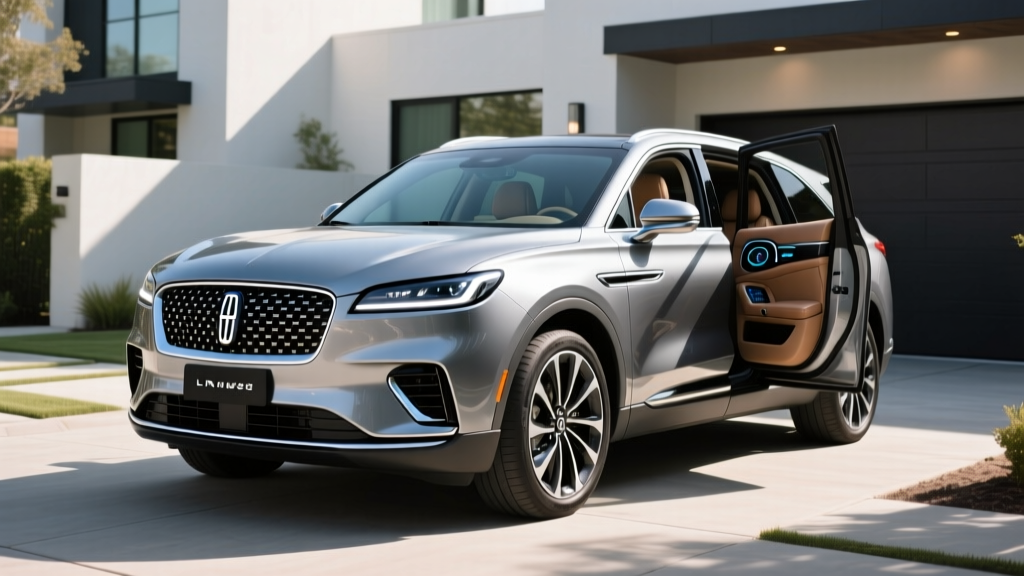
The midsize luxury crossover segment has no shortage of electrified options, but the Lincoln Nautilus Hybrid 2025 occupies a specific niche: a conventional hybrid (HEV) that prioritizes cabin serenity and low-effort ownership over plug-in complexity. With a turbocharged 2.0-liter engine paired with an electric motor, Lincoln targets buyers who want meaningful fuel savings without changing their fueling habits. After examining EPA data, real-world driving patterns, and Lincoln's powertrain warranty terms, here is what the 2025 Nautilus Hybrid actually delivers.
HEV vs PHEV: What the 2025 Nautilus Actually Is
Before evaluating fuel economy or pricing, it is essential to clarify the powertrain type. The 2025 Lincoln Nautilus Hybrid is a conventional hybrid electric vehicle (HEV), not a plug-in hybrid (PHEV). This distinction drives every ownership expectation:
| Feature | HEV (Nautilus Hybrid) | PHEV (e.g., Lincoln Corsair Grand Touring) |
|---|---|---|
| Plug-in charging required? | No — refuels at gas station only | Yes — plugs in for electric-only range |
| Electric-only driving | Brief low-speed assist only | 20–30+ miles typical |
| Battery size | ~1.1 kWh (small buffer) | 14–19 kWh typical |
| Home charger needed? | No | Yes (Level 2 recommended) |
| Federal tax credit (§30D) | Not eligible | May qualify (subject to sourcing/income rules) |
| Best for | Drivers without home charging access | Drivers with home charging + short commutes |
The Nautilus Hybrid captures energy through regenerative braking and the gasoline engine to charge its small battery pack. You never plug it in. You simply drive it like any other vehicle and stop at gas stations — just less frequently than a non-hybrid equivalent.
EPA Fuel Economy and Real-World MPG
According to fueleconomy.gov, the 2025 Lincoln Nautilus Hybrid AWD carries the following EPA estimates:
| Driving Cycle | EPA Estimate | Real-World Expectation |
|---|---|---|
| City | 30 MPG | 31–34 MPG (hybrids excel in stop-and-go) |
| Highway | 31 MPG | 27–29 MPG (sustained 75+ mph reduces regen benefit) |
| Combined | 30 MPG | 28–32 MPG depending on driving mix |
Real-world note: Conventional hybrids like the Nautilus frequently exceed their EPA city estimate because stop-and-go traffic maximizes regenerative braking and electric motor assist. Highway driving is where hybrids lose their advantage — at sustained 70–80 mph speeds, the gasoline engine does most of the work. Expect roughly 480–510 miles of total range from the 16.0-gallon fuel tank under mixed driving. In cold weather (below 30°F), expect a 5–10% fuel economy reduction as the engine runs more frequently for cabin heat.
Powertrain Specs: 310 Horsepower from a Turbo-Motor Pairing
| Specification | 2025 Nautilus Hybrid |
|---|---|
| Engine | 2.0L turbocharged 4-cylinder |
| Electric motor | Permanent-magnet synchronous, integrated in transaxle |
| Combined system output | 310 hp / 330 lb-ft torque |
| Drivetrain | AWD (standard) |
| Transmission | eCVT (power-split device) |
| 0–60 mph | ~6.8 seconds (est.) |
| Towing capacity | Not recommended (check owner's manual) |
| Fuel tank | 16.0 gallons |
| Cargo volume (rear seats up) | 33.7 cu ft |
| Cargo volume (rear seats folded) | 70.4 cu ft |
The power-split eCVT is not a traditional belt-driven CVT. It uses a planetary gearset to blend engine and motor power seamlessly. There are no fixed gear ratios to shift through, which eliminates shift shock but produces a characteristic engine drone under hard acceleration — a tradeoff common to Toyota, Ford, and Lincoln hybrid systems. Under light throttle, the Nautilus Hybrid can operate in electric-only mode at low speeds (typically under 25 mph in parking lots or heavy traffic), but this is measured in hundreds of feet, not miles.
2025 Nautilus Hybrid Pricing by Trim
| Trim Level | MSRP (includes destination) |
|---|---|
| Premiere | $56,630 |
| Reserve | $62,265 |
| Black Label | $73,480 |
The hybrid powertrain is standard across all 2025 Nautilus trims — there is no non-hybrid gasoline-only version for this generation. This means every Nautilus buyer gets the 30 MPG combined powertrain regardless of trim selection.
Federal Tax Credit Eligibility
Does the 2025 Nautilus Hybrid qualify for the §30D federal tax credit?
- No. The IRS §30D Clean Vehicle Credit applies only to plug-in electric vehicles (BEVs and PHEVs) with battery capacities of at least 7 kWh that meet critical-mineral and battery-component sourcing requirements.
- The Nautilus Hybrid is a conventional HEV with a ~1.1 kWh battery. It does not plug in and is categorically ineligible for §30D.
- Some state-level incentives exist for hybrids, but these vary by jurisdiction. Check your state energy office or Alternative Fuels Data Center for local programs.
Battery Warranty and Long-Term Reliability
Hybrid battery longevity is the single most common concern among first-time hybrid buyers. Here is what Lincoln provides:
| Warranty Component | Coverage |
|---|---|
| Hybrid battery (high-voltage) | 8 years / 100,000 miles (10 yr/150,000 mi in CARB states) |
| Hybrid system components (motor, inverter) | 8 years / 100,000 miles |
| Powertrain (engine, transmission) | 6 years / 70,000 miles |
| Bumper-to-bumper | 4 years / 50,000 miles |
CARB states (California, Colorado, Connecticut, Maine, Maryland, Massachusetts, New Jersey, New York, Oregon, Rhode Island, Vermont, Virginia, Washington) mandate extended hybrid/emissions component coverage of 10 years/150,000 miles. Confirm your state's status with your dealer.
Real-World Hybrid Battery Lifespan
The Nautilus Hybrid uses Ford's latest-generation hybrid system, which shares architecture with the Ford Maverick Hybrid and Escape Hybrid. Ford's hybrid battery packs in similar vehicles have demonstrated strong longevity — many first-generation Escape Hybrids (introduced 2005) exceeded 200,000 miles on original battery packs. The small ~1.1 kWh nickel-metal-hydride or lithium-ion buffer battery in the Nautilus is never fully charged or fully depleted; the system maintains a state-of-charge window (roughly 40–80%) that dramatically reduces cycle wear.
If replacement is needed out of warranty, hybrid battery replacement costs for vehicles in this class typically range from $2,500 to $4,500 including labor, based on comparable Ford/Lincoln hybrid service estimates. However, given the warranty terms and historical reliability data, most original owners will never face this expense.
Nautilus Hybrid vs EV vs Gas: Which Powertrain Fits You?
Choose the 2025 Nautilus Hybrid if:
- You do not have access to home Level 2 charging (apartment, street parking, no garage)
- You want lower fuel costs without changing your fueling routine
- You regularly drive 300+ mile trips and do not want to plan around DC fast-charging stops
- You value the Nautilus's 48-inch panoramic display and luxury cabin and want it with the most efficient available powertrain
Choose a PHEV (e.g., BMW X5 xDrive50e, Volvo XC60 Recharge) if:
- You have home Level 2 charging and a commute under 30 miles round-trip
- You want electric-only daily driving with gasoline backup for road trips
- You want potential §30D tax credit eligibility (verify sourcing and income requirements)
Choose a full BEV (e.g., Tesla Model Y, BMW iX, Rivian R1S) if:
- You have reliable home charging and your daily driving is under 250 miles
- You want zero tailpipe emissions and the lowest per-mile energy cost
- You are comfortable with DC fast-charging logistics on road trips
- You want full §30D tax credit eligibility ($7,500, subject to MSRP/income/sourcing rules)
What It's Like to Live With: Ownership Practicalities
The 2025 Nautilus Hybrid's strongest ownership argument is its zero-effort efficiency gain. There is no plug, no charging app, no preconditioning routine, no range planning. The vehicle's hybrid system manages energy flow transparently — the driver experiences smooth, quiet acceleration with a 30 MPG combined average that translates to roughly $1,600–$1,800 in annual fuel costs at 15,000 miles/year and $3.40/gallon premium (required fuel grade: check owner's manual; many Lincoln hybrids run on regular 87 octane, which further reduces cost).
Compared to the non-hybrid 2.0L turbo Nautilus from the previous generation (rated ~24 MPG combined), the hybrid saves approximately 80–100 gallons per year at 15,000 miles — roughly $270–$340 annually at current fuel prices. Over a typical 6-year ownership period, that is $1,600–$2,000 in fuel savings, which partially offsets the Nautilus's premium MSRP relative to non-hybrid competitors.
The 48-inch curved display spanning the dashboard is standard on all trims and runs Lincoln's latest Digital Experience software with Google built-in (Maps, Assistant, Play Store). NHTSA safety ratings and IIHS crash-test results should be checked for the latest scores as testing updates throughout the model year.
Pros and Cons at a Glance
Pros
- 30 MPG combined without plug-in charging — zero lifestyle change required
- 310 hp provides confident highway merging and passing
- Standard AWD across all trims
- Class-leading 48-inch panoramic display
- 8-year/100,000-mile hybrid battery warranty (10/150k in CARB states)
- Quiet, refined cabin with Lincoln's signature ride comfort
- Hybrid system adds minimal weight vs gasoline-only equivalent
Cons
- Not eligible for §30D federal tax credit
- Highway MPG drops to ~27–29 real-world at sustained 75+ mph
- Starting MSRP of $56,630 is steep for the segment
- eCVT engine drone under hard acceleration
- No electric-only driving beyond low-speed parking lot creep
- Towing capacity limited — not suited for trailer hauling
Frequently Asked Questions
How many MPG does the 2025 Lincoln Nautilus Hybrid get?
The EPA rates the 2025 Nautilus Hybrid AWD at 30 MPG city, 31 MPG highway, and 30 MPG combined. In real-world city driving, owners frequently report 31–34 MPG thanks to regenerative braking. Highway driving at sustained speeds above 70 mph typically yields 27–29 MPG.
Is the Lincoln Nautilus Hybrid a plug-in?
No. The 2025 Nautilus Hybrid is a conventional hybrid (HEV). It has no charging port and cannot be plugged in. The battery charges through regenerative braking and the gasoline engine. If you want plug-in capability with electric-only range, you would need to look at PHEV competitors in the luxury midsize segment.
How far can the Nautilus Hybrid drive on electric only?
As a conventional HEV, the Nautilus Hybrid can only operate in electric-only mode at very low speeds (typically under 25 mph) for very short distances — think hundreds of feet in a parking lot, not miles. For meaningful electric-only range (20–40 miles), you need a PHEV or BEV.
Is the Nautilus Hybrid reliable, and what does battery replacement cost?
The Nautilus uses Ford's proven hybrid architecture, which has demonstrated strong long-term reliability across multiple Ford/Lincoln models over two decades. The hybrid battery is covered by an 8-year/100,000-mile warranty (10 years/150,000 miles in CARB states). Out-of-warranty replacement, if ever needed, typically costs $2,500–$4,500 based on comparable Ford hybrid service data.
Does the 2025 Nautilus Hybrid qualify for any tax credit?
The Nautilus Hybrid does not qualify for the federal §30D Clean Vehicle Credit because it is a conventional hybrid, not a plug-in vehicle. Some states may offer incentives for hybrid purchases — check your state energy office or the Alternative Fuels Data Center for local programs. A tax professional can advise on any applicable deductions.
Does the Nautilus Hybrid require premium fuel?
Check your specific owner's manual. Many modern Ford/Lincoln 2.0L turbo hybrids are calibrated for regular 87-octane unleaded fuel, which keeps operating costs lower than competitors requiring premium. Using the recommended fuel grade ensures optimal performance and warranty compliance.
How does the Nautilus Hybrid compare to the non-hybrid version?
For the current generation, Lincoln made the hybrid powertrain standard — there is no non-hybrid gasoline-only 2025 Nautilus. Every model comes with the 310 hp hybrid system and 30 MPG combined rating. This simplifies the buying decision: you get hybrid efficiency regardless of trim.