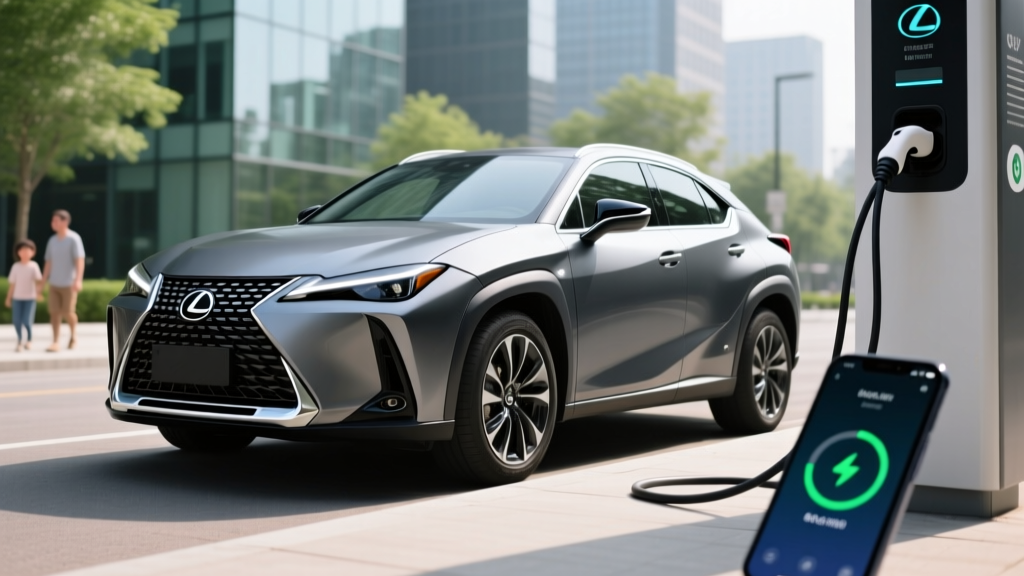
The Lexus UX 250h occupies a specific niche in the luxury subcompact crossover segment: it's a conventional hybrid (HEV) that prioritizes fuel efficiency and low-stress ownership over raw performance or plug-in capability. For 2026, the UX 250h continues as Lexus's most affordable hybrid SUV, carrying forward a proven fourth-generation Toyota Hybrid System powertrain that has been refined across millions of vehicles. If you're cross-shopping the Lexus UX hybrid against plug-in hybrids or full EVs, this guide breaks down exactly what you get — and what you don't.
2026 Lexus UX 250h at a Glance
| Specification | Value |
|---|---|
| Powertrain | 2.0L inline-4 + 2 electric motors (e-CVT) |
| Combined Horsepower | 181 HP |
| Drivetrain | AWD (standard on all trims) |
| EPA Fuel Economy | 43 city / 41 highway / 42 combined MPG |
| Fuel Tank Capacity | 10.6 gallons |
| Total Range | ~445 miles |
| 0–60 mph | 8.0 seconds |
| Cargo Volume (rear seats up) | 17.1 cu ft |
| Hybrid Battery Type | Nickel-Metal Hydride (NiMH) |
| Base MSRP (UX 250h) | $37,490 |
| Base MSRP (UX 250h F SPORT Handling) | $42,690 |
| Hybrid Battery Warranty | 10 years / 150,000 miles |
| Powertrain Warranty | 6 years / 70,000 miles |
Fuel Economy: EPA Numbers and Real-World MPG
The 2026 Lexus UX 250h carries an EPA rating of 43 MPG city, 41 MPG highway, and 42 MPG combined, according to fueleconomy.gov. That places it among the most efficient luxury crossovers available, rivaling the Toyota Prius and exceeding nearly every non-hybrid competitor in this segment.
| Driving Condition | EPA Rating | Real-World Expectation |
|---|---|---|
| City | 43 MPG | 44–48 MPG (hybrids excel in stop-and-go) |
| Highway (70 mph) | 41 MPG | 38–40 MPG (aerodynamic drag, less regen opportunity) |
| Combined | 42 MPG | 40–44 MPG depending on driving mix |
| Cold Weather (below 32°F) | N/A | 35–38 MPG (engine runs more for cabin heat) |
A key advantage of conventional hybrids like the UX 250h is that they frequently exceed their EPA city rating in real-world driving. The regenerative braking system recaptures energy during deceleration, and the engine shuts off at stops — both of which benefit urban commuters disproportionately. Highway driving, by contrast, relies more on the gasoline engine at sustained speeds, which is why the highway rating dips slightly below the city figure. This is the opposite of what you see in conventional gas cars.
With the 10.6-gallon fuel tank, expect a real-world range of approximately 420–460 miles before refueling, depending on your driving profile. Cold weather will reduce efficiency by 8–12% due to increased engine operation for cabin heating and reduced battery efficiency at low temperatures.
How the UX 250h Hybrid Powertrain Works
The UX 250h pairs a 2.0-liter four-cylinder Atkinson-cycle gasoline engine with two electric motor-generators through an electronically controlled continuously variable transmission (e-CVT). One motor primarily drives the front wheels and generates electricity under braking; the second motor powers the rear axle, providing standard all-wheel drive without a mechanical driveshaft.
The combined system output is 181 horsepower. Acceleration to 60 mph takes approximately 8.0 seconds — adequate for daily commuting and highway merging, but noticeably slower than turbocharged competitors like the BMW X1 or the fully electric Lexus RZ 450e. The e-CVT delivers smooth, stepless acceleration without the rubber-band effect that older CVTs exhibited, and the transition between electric and gas power is nearly imperceptible from the driver's seat.
Critically, the UX 250h is a conventional hybrid (HEV), not a plug-in hybrid (PHEV). It has no charging port, no electric-only driving range, and no external charging capability. The small hybrid battery recharges exclusively through regenerative braking and the gasoline engine. This is by design: it eliminates any need for charging infrastructure while still delivering significant fuel savings over a gas-only vehicle.
HEV vs PHEV vs EV: Which Powertrain Fits You?
| Factor | Lexus UX 250h (HEV) | Typical PHEV (e.g., Toyota RAV4 Prime) | Full EV (e.g., Lexus RZ 450e) |
|---|---|---|---|
| Plug-in Required? | No | Yes (optional but recommended) | Yes (mandatory) |
| Electric-Only Range | None | 25–42 miles | 220–300+ miles |
| Total Range | ~445 miles | 500–600+ miles | 220–300+ miles |
| Home Charging Needed? | No | Recommended (Level 2) | Yes (Level 2 strongly recommended) |
| Federal Tax Credit | None | Up to $7,500 (if eligible) | Up to $7,500 (if eligible) |
| Best For | Apartment dwellers, no home charging | Short commutes + road trips | Home chargers, daily commuting |
| Upfront Cost | Lowest | Moderate premium | Highest |
The UX 250h is the right call if you lack reliable access to a charging outlet — whether you live in an apartment, park on the street, or simply don't want to manage charging routines. You get roughly 40% better fuel economy than a gas-only subcompact SUV with zero behavioral change. If you have a garage and a short commute, a PHEV like the RAV4 Prime or Hyundai Tucson PHEV lets you drive 30+ miles on electricity before the engine kicks in, which can cut fuel costs dramatically. A full EV like the Lexus RZ 450e eliminates gasoline entirely but requires a committed home charging setup and acceptance of ~220 miles of EPA range.
Pricing, Trims, and Tax Credit Eligibility
The 2026 Lexus UX 250h starts at $37,490 (including destination) for the base trim, which includes AWD, the Lexus Safety System+ 3.0 suite, a 12.3-inch infotainment display, wireless Apple CarPlay and Android Auto, and heated front seats. The F SPORT Handling trim adds a sport-tuned suspension, 19-inch wheels, and upgraded interior materials at $42,690. A fully loaded Premium trim with navigation, panoramic moonroof, and Mark Levinson audio can approach $46,000.
Federal Tax Credit: Does the UX 250h Qualify?
No. The Lexus UX 250h is a conventional hybrid (HEV), not a plug-in vehicle. Under IRS §30D rules, the federal clean vehicle credit of up to $7,500 applies only to battery electric vehicles (BEVs) and plug-in hybrids (PHEVs) that meet battery capacity, critical-mineral sourcing, MSRP cap, and buyer income requirements. Conventional hybrids do not qualify for any federal purchase credit.
Some states offer separate incentives for hybrid vehicles, though these are increasingly rare. Check your state's energy office or department of environmental quality for current programs.
While the lack of a federal tax credit is a disadvantage versus PHEVs and EVs on paper, the UX 250h's lower base price partially offsets this. A $37,490 hybrid with no charging requirements often results in a lower total cost of ownership than a $47,000 PHEV that needs a $1,200 Level 2 home charger installation — especially for buyers who drive moderate annual miles.
Reliability and Hybrid Battery Longevity
Toyota and Lexus hybrid systems are among the most thoroughly proven in the automotive industry. The UX 250h's fourth-generation hybrid architecture shares core components with the Toyota Prius, RAV4 Hybrid, and Camry Hybrid — platforms that collectively have accumulated billions of real-world miles. Lexus consistently ranks at or near the top of J.D. Power dependability studies, and the UX has not been subject to any major hybrid-system recalls.
The hybrid battery pack in the UX 250h uses nickel-metal hydride (NiMH) chemistry rather than the lithium-ion packs found in most EVs and PHEVs. NiMH is a mature technology with well-understood degradation characteristics. Toyota/Lexus hybrid batteries routinely last 150,000–200,000+ miles before significant capacity loss, and many original Prius batteries from the mid-2000s remain in service past 250,000 miles.
| Warranty Coverage | Duration |
|---|---|
| Hybrid Battery | 10 years / 150,000 miles |
| Hybrid System Components | 8 years / 100,000 miles |
| Powertrain | 6 years / 70,000 miles |
| Basic (bumper-to-bumper) | 4 years / 50,000 miles |
| Corrosion Perforation | 6 years / unlimited miles |
Should the hybrid battery require replacement outside of warranty, expect a cost of approximately $3,000–$4,500 at a Lexus dealer for a new OEM pack. Refurbished and aftermarket options are available for $1,500–$2,500. This is substantially less than EV traction battery replacements, which can exceed $10,000–$15,000, and the NiMH chemistry's gradual degradation curve means you'll typically notice a slow efficiency decline rather than a sudden failure.
Pros, Cons, and the Ownership Verdict
Pros
- 42 MPG combined with no plug-in requirement — works for any living situation
- Standard AWD across all trims
- Lexus Safety System+ 3.0 included at base price
- 10-year / 150,000-mile hybrid battery warranty
- Lowest entry price in the Lexus SUV lineup
- Proven hybrid reliability with minimal maintenance costs
Cons
- 17.1 cu ft cargo space is tight for the segment
- 8.0-second 0–60 time trails turbocharged rivals
- No federal tax credit (HEV, not PHEV)
- Rear-seat legroom is cramped for taller passengers
- No plug-in or electric-only driving option available
- NiMH battery is older chemistry (proven but less energy-dense)
The UX 250h makes the most sense for urban and suburban buyers who want luxury-brand build quality, standard AWD, and outstanding fuel economy without the complexity of plug-in charging. It is not the right vehicle if you need maximum cargo space, spirited acceleration, or the ability to drive on electricity alone. Buyers in that camp should look at the Lexus NX 350h (larger, similar efficiency), the NX 450h+ (plug-in hybrid), or the RZ 450e (full EV).
Frequently Asked Questions
How many MPG does the Lexus UX hybrid get?
The 2026 Lexus UX 250h is EPA-rated at 43 MPG city, 41 MPG highway, and 42 MPG combined. In real-world driving, city commuters frequently see 44–48 MPG thanks to regenerative braking, while sustained highway driving at 70+ mph typically returns 38–40 MPG. Cold weather can reduce efficiency to 35–38 MPG due to increased engine operation for cabin heating.
Does the Lexus UX hybrid need to be plugged in?
No. The UX 250h is a conventional hybrid (HEV), not a plug-in hybrid. It has no charging port. The hybrid battery recharges automatically through regenerative braking and the gasoline engine. You simply fill it with gas and drive — the hybrid system operates entirely in the background.
How far can the Lexus UX 250h go on a full tank?
With its 10.6-gallon fuel tank and 42 MPG combined rating, the UX 250h delivers approximately 445 miles of total range. Real-world range varies from about 420 miles (mostly highway or cold-weather driving) to 460+ miles (city-dominant commuting in mild weather).
Is the Lexus UX hybrid reliable?
Yes. The UX 250h uses Toyota's fourth-generation hybrid system, which powers millions of vehicles globally and has an extensive track record for longevity. Lexus ranks among the top brands in J.D. Power and Consumer Reports dependability rankings. The hybrid battery is warranted for 10 years or 150,000 miles and commonly lasts 150,000–200,000+ miles before significant degradation.
What does a Lexus UX hybrid battery replacement cost?
A new OEM hybrid battery replacement at a Lexus dealer typically costs $3,000–$4,500 including labor. Refurbished or third-party replacement packs are available for $1,500–$2,500. Given the 10-year/150,000-mile warranty and the proven longevity of Toyota/Lexus NiMH hybrid batteries, most owners will never need a replacement during their ownership period.
Does the Lexus UX hybrid qualify for a tax credit?
No. Under current IRS §30D rules, the federal clean vehicle credit applies only to battery electric vehicles and plug-in hybrids that meet specific battery sourcing, MSRP, and buyer income requirements. The UX 250h, as a conventional hybrid, does not qualify for the federal credit. Check your state's energy agency for any local hybrid incentives, though these have become uncommon.
Should I buy the UX 250h hybrid or the Lexus RZ electric?
Choose the UX 250h if you lack home charging access, regularly take road trips exceeding 300 miles, or want the lowest purchase price in the Lexus SUV lineup. Choose the RZ 450e if you can install a Level 2 home charger, your daily driving stays under 200 miles, and you want zero tailpipe emissions with lower per-mile fuel costs. The RZ has a higher MSRP but may qualify for up to $7,500 in federal tax credits, which narrows the price gap.