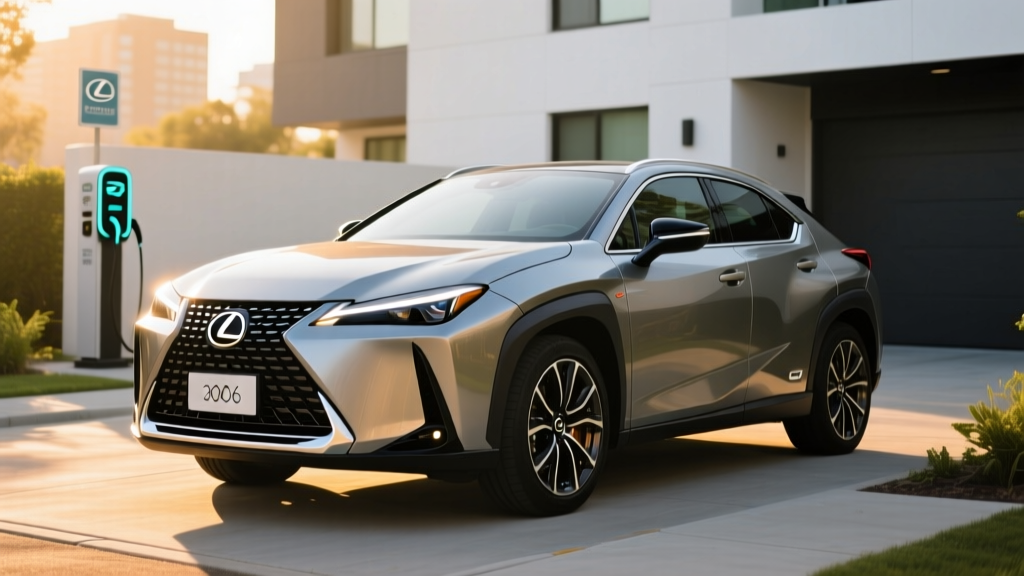
The Lexus UX 300h occupies a specific niche in the luxury subcompact crossover segment: a conventional hybrid (HEV) that prioritizes fuel efficiency and refinement without requiring a plug. For buyers who want Lexus build quality and hybrid efficiency but lack access to home or workplace charging, the UX 300h eliminates the complexity of a plug-in hybrid or full battery-electric vehicle while still delivering meaningful fuel savings over a gas-only competitor.
This guide covers the 2026 Lexus UX 300h's powertrain, real-world MPG, battery longevity, pricing, and where it fits against PHEV and EV alternatives.
HEV vs PHEV: What the UX 300h Actually Is
Before examining specs, it's essential to clarify what the UX 300h is — and isn't. The UX 300h is a conventional hybrid electric vehicle (HEV). It pairs a gasoline engine with an electric motor and a small battery that recharges through regenerative braking and the engine. You never plug it in. It cannot drive on electric power alone for meaningful distances.
This is fundamentally different from a plug-in hybrid (PHEV) like the Toyota RAV4 Prime or Lexus NX 450h+, which carries a larger battery (typically 14–18 kWh), offers 30–40 miles of electric-only driving, and must be plugged in to realize its full efficiency potential.
HEV vs PHEV at a Glance
| Feature | HEV (UX 300h) | PHEV (e.g., NX 450h+) |
|---|---|---|
| Plug-in required? | No | Yes, for EV range |
| Electric-only range | ~1 mi at low speed | 30–40 mi |
| Battery capacity | ~1.4 kWh | 18.1 kWh |
| Federal tax credit | No (§30D excludes HEVs) | Up to $7,500 (eligibility varies) |
| Best for | No plug-in access; city driving | Home charging; short commutes |
Powertrain and Performance Specs
The 2026 UX 300h uses Lexus's fifth-generation hybrid system, pairing a 2.0-liter inline-four Atkinson-cycle engine with two electric motor-generators and an electronically controlled CVT (eCVT). All-wheel drive (AWD) adds a rear-mounted electric motor.
| Spec | FWD | AWD |
|---|---|---|
| Combined horsepower | 196 hp | 196 hp |
| Engine | 2.0L I4 Atkinson | 2.0L I4 Atkinson |
| Electric motors | 2 (front) | 3 (front + rear) |
| 0–60 mph | ~7.8 sec | ~7.4 sec |
| Drivetrain | FWD | AWD (E-motor rear) |
| Transmission | eCVT | eCVT |
| Hybrid battery | ~1.4 kWh NiMH | ~1.4 kWh NiMH |
| Towing capacity | Not rated | Not rated |
The 196 hp combined output is adequate for city merging and highway cruising, though it won't feel sporty. The AWD system's rear electric motor engages automatically under acceleration or low-traction conditions — there is no mechanical driveshaft connecting the front and rear axles. This keeps weight down and packaging efficient.
Fuel Economy: EPA Ratings and Real-World MPG
Fuel efficiency is the UX 300h's primary selling point. Here is how the EPA rates the 2026 model, based on data from fueleconomy.gov:
| Drivetrain | City | Highway | Combined |
|---|---|---|---|
| FWD | 43 MPG | 41 MPG | 42 MPG |
| AWD | 41 MPG | 38 MPG | 40 MPG |
Real-World MPG vs. EPA Sticker
Toyota/Lexus hybrids historically exceed their EPA city rating in real-world stop-and-go driving because regenerative braking recaptures energy that gas-only vehicles waste as heat. Owners frequently report 44–47 MPG in city-heavy commutes with the UX 300h FWD.
Highway driving tells a different story. At sustained 70–80 mph speeds, the engine runs more often and aerodynamic drag dominates. Expect 36–39 MPG on the highway with the AWD model, slightly below the EPA sticker. Cold weather (below 35°F) can reduce fuel economy by 5–10% as the engine runs longer to heat the cabin and warm the catalytic converter.
For comparison, a similarly sized luxury subcompact crossover with a conventional gas powertrain (e.g., BMW X1 xDrive28i) achieves roughly 28 MPG combined — making the UX 300h approximately 40% more efficient in mixed driving.
Reliability and Hybrid Battery Longevity
Hybrid battery lifespan is consistently the top concern for first-time hybrid buyers. The UX 300h's nickel-metal hydride (NiMH) battery pack is small (~1.4 kWh) and operates within a narrow state-of-charge window managed by the hybrid control system. This shallow cycling dramatically extends cell life compared to full EVs that regularly cycle between 10% and 90%.
Hybrid Battery Warranty
Lexus covers the UX 300h hybrid battery for 10 years or 150,000 miles (whichever comes first) under the Hybrid System Warranty. This is in addition to the standard 4-year/50,000-mile basic warranty and 6-year/70,000-mile powertrain coverage.
Based on long-term data from Toyota/Lexus hybrid vehicles (Prius, Camry Hybrid, RX Hybrid), hybrid battery failure before 150,000 miles is uncommon. Many units exceed 200,000 miles without replacement.
If the hybrid battery does require replacement out of warranty, expect a cost between $2,500 and $4,000 for a new OEM pack, depending on the dealership and region. Refurbished or reconditioned packs are available from third-party suppliers for $1,200–$2,000, though these carry shorter warranties.
The broader powertrain — the 2.0L Atkinson-cycle engine, eCVT, and electric motor-generators — is proven technology shared across Toyota's hybrid lineup. Lexus consistently ranks at or near the top of J.D. Power's Vehicle Dependability Study, and the UX 300h benefits from that track record.
Pricing, Trims, and Tax Credit Eligibility
The 2026 Lexus UX 300h is available in several trims. Pricing starts in the mid-$37,000s for the base FWD model and climbs to the mid-$40,000s for a fully equipped AWD variant.
| Trim | MSRP (est.) |
|---|---|
| UX 300h FWD | $37,750 |
| UX 300h AWD | $39,150 |
| UX 300h Premium AWD | $41,500 |
| UX 300h F SPORT Handling AWD | $43,900 |
Federal Tax Credit: Not Eligible
The UX 300h is a conventional hybrid (HEV), which means it does not qualify for the federal §30D Clean Vehicle Credit. That credit — up to $7,500 — is available only for plug-in electric vehicles (BEVs and PHEVs) that meet battery sourcing, MSRP, and buyer income requirements as outlined by the IRS.
Some states offer rebates or reduced registration fees for hybrids, but these vary by jurisdiction. Check your state's energy office or department of environmental quality for current programs.
Hybrid vs PHEV vs EV: Which Powertrain Fits You?
The UX 300h is one option among three electrified paths. Here's a practical decision framework:
Choose the UX 300h (HEV) if:
- You don't have access to home or workplace charging (apartment, street parking)
- Your commute is city-heavy with frequent stops where regenerative braking excels
- You want lower fuel costs without changing any habits — just fill up less often
- You plan to keep the vehicle 8+ years and value proven hybrid reliability
Choose a PHEV (e.g., Lexus NX 450h+) if:
- You can install a Level 2 home charger and your daily commute is under 35 miles
- You want electric-only driving most days but need gas flexibility for road trips
- You may qualify for the $7,500 federal tax credit (check IRS eligibility rules)
Choose a full EV (e.g., Tesla Model Y, Hyundai Ioniq 5) if:
- You have reliable home Level 2 charging
- Your daily driving is under 250 miles and you road-trip infrequently
- You want zero tailpipe emissions and the lowest per-mile fuel cost
- You want the $7,500 federal credit and potential state rebates
Pros and Cons of the UX 300h
Pros
- 42–43 MPG combined (FWD) with real-world city figures often higher
- No plug-in required — zero behavior change
- 10-year/150,000-mile hybrid battery warranty
- Lexus build quality and resale value
- Standard Lexus Safety System+ 3.0 (adaptive cruise, lane-keeping, pre-collision)
- AWD available without significant MPG penalty
Cons
- Modest 196 hp — not a performance-oriented crossover
- Compact cargo area (~21.7 cu ft behind rear seats)
- No federal tax credit
- Infotainment learning curve (touchpad in earlier models; 2026 uses touchscreen)
- Rear seat space is tight for taller passengers
- Not rated for towing
5-Year Ownership Cost Snapshot
Here's how the UX 300h AWD stacks up over five years and 75,000 miles compared to a gas-only luxury subcompact crossover averaging 28 MPG combined, assuming $3.50/gallon regular unleaded:
| Cost Factor | UX 300h AWD (40 MPG) | Gas Competitor (28 MPG) |
|---|---|---|
| Total fuel consumed | 1,875 gal | 2,679 gal |
| Fuel cost (5 years) | $6,563 | $9,375 |
| Estimated maintenance | $2,800 | $3,400 |
| Total fuel + maintenance | $9,363 | $12,775 |
The UX 300h saves roughly $3,400 in fuel and maintenance over five years. Factor in Lexus's strong resale value (typically retaining 55–60% of MSRP at five years for hybrid models), and the total cost of ownership becomes competitive with gas rivals despite the lack of a federal tax credit.
Frequently Asked Questions
How many MPG does the Lexus UX 300h hybrid get?
The 2026 UX 300h FWD is EPA-rated at 43 city / 41 highway / 42 combined MPG. The AWD model drops slightly to 41 city / 38 highway / 40 combined. Real-world city driving often exceeds the EPA city figure, while sustained highway speeds above 70 mph may return 36–39 MPG.
Does the UX 300h need to be plugged in?
No. The UX 300h is a conventional hybrid (HEV). Its small battery recharges through regenerative braking and the gasoline engine. You simply fill it with gas like any other vehicle.
Is the Lexus UX 300h hybrid reliable?
Lexus's hybrid system has over two decades of proven reliability across millions of vehicles. The hybrid battery is warrantied for 10 years or 150,000 miles, and real-world data shows many Toyota/Lexus hybrid batteries lasting well beyond 200,000 miles without replacement.
What does a Lexus hybrid battery replacement cost?
If replacement is needed outside the 10-year/150,000-mile warranty, expect $2,500–$4,000 for a new OEM battery pack at a Lexus dealership. Refurbished packs from third-party suppliers cost $1,200–$2,000.
Does the Lexus UX 300h qualify for a tax credit?
No. The federal §30D Clean Vehicle Credit applies only to plug-in electric vehicles (BEVs and PHEVs). As a conventional hybrid, the UX 300h is not eligible. Some states may offer separate hybrid incentives — check your local programs.
How does the UX 300h compare to a full EV?
A full EV like the Hyundai Ioniq 5 or Tesla Model Y offers lower per-mile fuel costs (electricity vs. gas), zero tailpipe emissions, and federal tax credit eligibility. However, EVs require home charging access, cost more upfront, and demand route planning on road trips. The UX 300h trades those benefits for simplicity — no plug, no range anxiety, and a lower purchase price.
Can the UX 300h drive on electric power alone?
Only at very low speeds (under ~25 mph) for roughly one mile, such as creeping through a parking lot. The battery is too small to sustain electric-only driving at any meaningful distance or speed. The engine and motor work together seamlessly during normal driving.