Quick Verdict: The Efficiency-First Luxury Subcompact
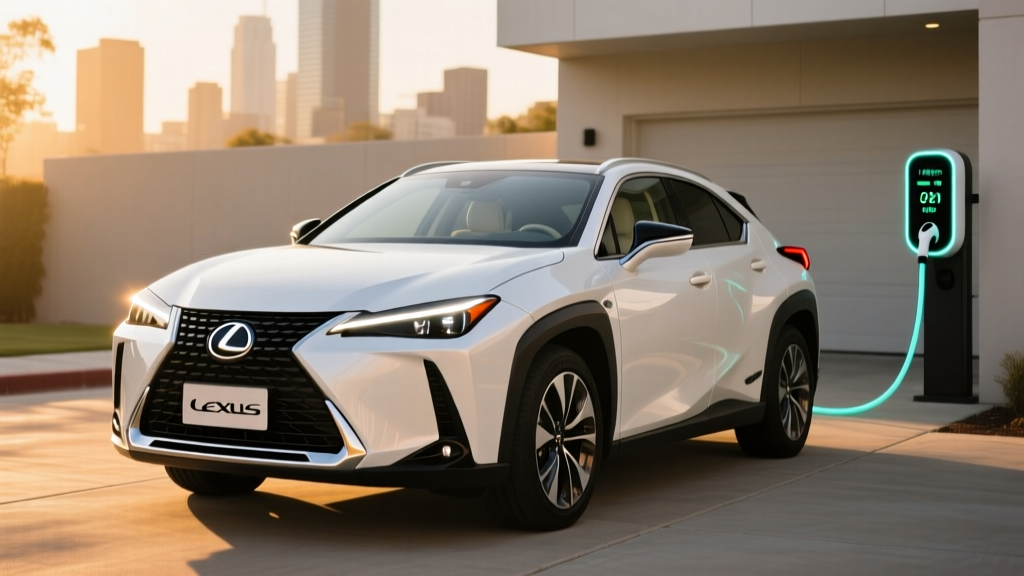
The 2026 Lexus UX 250h hybrid occupies a specific niche: a luxury-badged subcompact crossover that prioritizes fuel economy and urban drivability over outright performance or cargo volume. With an EPA-estimated 42 MPG combined, standard all-wheel drive, and a starting MSRP near $38,000, it appeals to buyers who want premium materials and Toyota-proven hybrid reliability without stepping into full electric-vehicle territory. It is a conventional hybrid (HEV), not a plug-in — meaning no charging cable, no electric-only range, and no plug-in tax credit. That simplicity is both its greatest strength and its main limitation.
| Attribute | Specification |
|---|---|
| Powertrain | 2.0L 4-cyl Atkinson-cycle + 2 electric motors (AWD) |
| Combined Horsepower | 181 hp (net system) |
| Transmission | ECVT (electronically controlled CVT) |
| EPA MPG (City / Hwy / Combined) | 43 / 41 / 42 |
| Fuel Tank | 10.6 gallons |
| Total Range | ~445 miles |
| 0–60 mph | ~8.0 seconds |
| Drivetrain | AWD (standard on all trims) |
| Hybrid Battery | Nickel-metal hydride (NiMH), ~1.4 kWh |
| Cargo Volume | 17.1 cu ft (rear seats up) |
| Base MSRP | ~$38,150 (UX 250h Premium) |
| Battery Warranty | 10 years / 150,000 miles |
Fuel Economy: EPA Numbers vs. Real-World MPG
The 2026 Lexus UX 250h carries an EPA-estimated 43 city / 41 highway / 42 combined MPG. These figures place it among the most efficient luxury crossovers on the market, rivaling dedicated hybrids at non-luxury price points.
| Driving Condition | EPA Estimate | Real-World Expectation |
|---|---|---|
| City | 43 MPG | 44–47 MPG (hybrids excel in stop-and-go) |
| Highway | 41 MPG | 38–41 MPG (aerodynamic drag at 70+ mph) |
| Combined | 42 MPG | 40–44 MPG (depends on driving mix) |
| Cold Weather (below 32°F) | — | 36–39 MPG (engine runs more for cabin heat) |
Toyota's hybrid system recovers braking energy and shuts off the gasoline engine at low loads, which is why real-world city driving often exceeds the EPA city number. Owners who do predominantly urban commuting at moderate speeds regularly report 45+ MPG on enthusiast forums. Highway efficiency is less impressive because the 2.0L Atkinson-cycle engine must work continuously at sustained speeds, and the CVT keeps revs in an efficient but audible band during hard acceleration or steep grades.
Cold weather reduces fuel economy by roughly 8–12%. The gasoline engine runs more frequently to provide cabin heat and maintain catalyst temperature, and winter fuel blends carry slightly lower energy density. In sub-freezing testing, expect combined figures in the mid-to-upper 30s.
Powertrain Deep Dive: How the Hybrid System Works
The UX 250h uses Toyota's fourth-generation hybrid architecture. A 2.0-liter four-cylinder engine operating on the Atkinson cycle (which trades peak power for thermal efficiency) pairs with two motor-generators and an electronically controlled CVT. The front axle is driven by the primary electric motor and the gas engine through a planetary gearset. A second, smaller electric motor on the rear axle provides all-wheel-drive traction when slip is detected or during hard acceleration.
Total system output is 181 net horsepower. This is adequate for merging and city driving but not brisk by luxury-segment standards — the 0–60 mph time of approximately 8.0 seconds trails competitors like the BMW X1 or Audi Q3. The ECVT delivers seamless, shift-free acceleration, though it produces the characteristic "drone" under sustained hard throttle that some buyers find unrefined.
Drive modes (Eco, Normal, Sport) adjust throttle mapping, steering weight, and climate-control behavior. Eco mode aggressively favors electric-motor-only operation at low speeds, which is where the UX 250h delivers its best efficiency gains.
Hybrid vs. Plug-In Hybrid vs. Full EV — Which Is Right for You?
The UX 250h is a conventional hybrid (HEV). It has no plug, no electric-only driving mode, and a very small battery (~1.4 kWh) that exists only to buffer energy between the engine, motors, and regenerative braking. This is a deliberate engineering choice: no charging infrastructure required, no range-anxiety calculation, and lower upfront cost than a PHEV or BEV.
| Factor | HEV (UX 250h) | PHEV (e.g., RAV4 Prime) | Full EV (e.g., Tesla Model Y) |
|---|---|---|---|
| Plug-in Required? | No | Yes (for EV range) | Yes |
| Electric-Only Range | None (EV assist only) | 25–42 miles typical | 250–330 miles |
| Fueling / Charging | Gas station only | Gas + Level 1/2 charging | Level 2 + DC fast charging |
| Federal Tax Credit (§30D) | Not eligible | Up to $7,500 (if sourcing rules met) | Up to $7,500 (if sourcing rules met) |
| Upfront Cost Premium | Low (~$1,500 over gas equivalent) | Moderate ($5,000–$8,000) | High ($8,000–$15,000) |
| Best For | No home charging, long commutes | Short daily commute + home charging | Home charging + mostly under 250 mi/day |
Choose the UX 250h (HEV) if: You lack access to home or workplace charging, you want a luxury badge with minimal fuel cost, and you don't want to think about plugging in. The HEV eliminates the infrastructure variable entirely.
Consider a PHEV if: You have a garage or driveway where you can install a Level 2 charger and your daily commute is under 35 miles. A PHEV like the Toyota RAV4 Prime or Lexus NX 450h+ lets you drive most weekdays on electricity alone while retaining a gas engine for longer trips.
Consider a full EV if: You have reliable home charging, your daily driving is well under 250 miles, and you want to eliminate gasoline purchases entirely. Models like the Tesla Model Y, Hyundai Ioniq 5, or BMW iX offer more cargo space, faster acceleration, and lower per-mile energy costs — at a higher purchase price and with cold-weather range trade-offs.
Pricing, Trims, and Tax Credit Eligibility
The 2026 Lexus UX 250h is offered in several trims, with pricing starting at approximately $38,150 for the Premium trim (including destination charge). Higher trims — such as the F SPORT Handling and Luxury — push the MSRP toward $44,000–$46,000 when equipped with options like the Mark Levinson audio system, head-up display, and panoramic moonroof.
Federal Tax Credit (§30D) Status: The Lexus UX 250h is a conventional hybrid (HEV). It does not qualify for the IRS §30D New Clean Vehicle Credit, which applies only to plug-in electric vehicles (PHEVs and BEVs) meeting battery-sourcing, MSRP-cap, and buyer-income requirements. There is currently no federal tax credit for conventional hybrids.
- §30D credit: Not eligible (HEV, not plug-in)
- State/local incentives: Some states offer rebates for hybrids — check your state energy office or AFDC state incentive database
- Insurance discounts: Some carriers offer small "green vehicle" discounts for hybrids
While the absence of a federal credit is a disadvantage versus plug-in competitors, the UX 250h's lower base price and strong residual values partially offset this. Lexus vehicles consistently rank at or near the top of resale-value retention in their segments, and the UX 250h's fuel savings over a gas-only subcompact crossover (roughly $600–$900 per year at 15,000 miles, depending on local fuel prices) add up meaningfully over a five-year ownership period.
Reliability and Battery Longevity
Toyota and Lexus have built more than 25 million hybrid vehicles globally since the Prius launched in 1997. The UX 250h benefits from this institutional knowledge. Lexus consistently ranks in the top three brands in J.D. Power Vehicle Dependability Studies, and the hybrid powertrain is one of the most thoroughly proven systems in the automotive industry.
| Item | Detail |
|---|---|
| Hybrid Battery Warranty | 10 years / 150,000 miles (whichever comes first) |
| Hybrid System Components Warranty | 8 years / 100,000 miles (inverter, motors, ECU) |
| Battery Chemistry | Nickel-metal hydride (NiMH) — proven, lower energy density than lithium but extremely durable |
| Expected Battery Lifespan | 150,000–200,000+ miles with normal use |
| Replacement Cost (out of warranty) | $2,500–$4,000 (OEM battery pack, installed) |
| Refurbished / Aftermarket Options | $1,200–$2,200 (available from third-party suppliers) |
The NiMH battery in the UX 250h is small (~1.4 kWh) and operates within a conservative state-of-charge window managed by the hybrid control system. Unlike large lithium-ion packs in EVs, this battery is not subjected to deep discharge cycles or DC fast-charging stress, which contributes to its exceptional longevity. Real-world failure rates for Toyota/Lexus hybrid batteries are well below 5% within the warranty period, and many original Prius batteries have exceeded 200,000 miles.
If replacement is needed outside warranty, the cost is far lower than an EV traction battery. An OEM NiMH pack for the UX 250h runs roughly $2,500–$4,000 installed at a Lexus dealer, with refurbished options available for under $2,200. This is a fraction of the $10,000–$20,000 that an EV battery replacement can command.
Interior, Technology, and Daily Usability
The UX 250h's cabin reflects Lexus's premium positioning: soft-touch materials, standard synthetic leather (NuLuxe) with genuine leather available on higher trims, and a quiet ride at city speeds. The 12.3-inch touchscreen running the latest Lexus Interface infotainment system supports wireless Apple CarPlay and Android Auto, over-the-air updates, and the "Hey Lexus" voice assistant.
The Lexus Safety System+ 3.0 suite is standard across all trims, including:
- Pre-Collision System with pedestrian detection
- Lane Departure Alert with Steering Assist
- Dynamic Radar Cruise Control (full-speed adaptive cruise)
- Lane Tracing Assist (centering in marked lanes)
- Road Sign Assist
- Automatic High Beams
This is a SAE Level 2 driver-assistance system. The driver must remain fully engaged, with hands on the wheel and eyes on the road at all times. It does not provide autonomous or self-driving capability.
The UX 250h's main compromise is cargo space. At 17.1 cubic feet behind the rear seats (and roughly 36 cubic feet with the 60/40 split rear seats folded), it trails competitors like the BMW X1 (27 cu ft) and the Audi Q3 (23.7 cu ft). The hybrid battery packaging slightly reduces under-floor storage compared to a gas-only platform. For couples or single professionals without frequent hauling needs, this is manageable; for families needing stroller space, it is a genuine limitation.
Pros
- 42 MPG combined — best in luxury subcompact class
- Standard AWD — no fuel-economy penalty vs. FWD
- Proven Toyota hybrid reliability, 10-year battery warranty
- Quiet, refined city driving experience
- Strong Lexus resale value
- No plug-in required — works anywhere gas is sold
Cons
- Limited cargo volume (17.1 cu ft)
- Modest acceleration (8.0 sec 0–60)
- CVT drone under hard acceleration
- No federal tax credit (HEV, not PHEV)
- Rear seat space is tight for taller passengers
- Premium fuel recommended for best performance
Who Should Buy the Lexus UX 250h Hybrid?
The UX 250h is the right choice for a buyer who:
- Wants a luxury-badged daily driver with exceptional fuel economy
- Lives in an apartment or area where home EV charging is impractical
- Prioritizes reliability and low maintenance over acceleration and cargo space
- Commutes in mixed city/highway driving and wants to minimize fuel stops
- Values Lexus dealership service and strong resale value
It is the wrong choice if you need maximum cargo versatility (consider the Lexus NX 350h or RAV4 Hybrid), if you want plug-in electric driving (look at the Lexus NX 450h+), or if acceleration and driving dynamics are top priorities (the BMW X1 xDrive28i or Genesis GV70 will serve you better, at the cost of higher fuel bills).
Frequently Asked Questions
How many MPG does the Lexus UX 250h hybrid get?
The 2026 Lexus UX 250h is EPA-rated at 43 city / 41 highway / 42 combined MPG. In real-world city driving, many owners report 44–47 MPG thanks to regenerative braking and frequent electric-motor-only operation at low speeds. Highway MPG tends to match or fall slightly below the EPA estimate at sustained speeds above 70 mph.
Does the Lexus UX 250h need to be plugged in?
No. The UX 250h is a conventional hybrid (HEV), not a plug-in hybrid. Its small battery recharges through regenerative braking and the gasoline engine. You fuel it at any gas station — no charging cable or outlet is needed.
Does the UX 250h qualify for any federal tax credit?
No. The IRS §30D New Clean Vehicle Credit applies only to plug-in electric vehicles (PHEVs and BEVs) that meet battery-sourcing, MSRP, and income requirements. The UX 250h, as a conventional hybrid, is not eligible. Some states may offer small incentives for hybrid purchases — check your state's energy office.
How long will the hybrid battery last and what does replacement cost?
Lexus covers the hybrid battery for 10 years or 150,000 miles. Toyota/Lexus NiMH hybrid batteries have demonstrated exceptional longevity, with many exceeding 200,000 miles. If replacement is needed out of warranty, expect to pay $2,500–$4,000 for an OEM pack installed, or $1,200–$2,200 for a refurbished unit.
Is the UX 250h good in snow and rain?
Yes. The standard electronic AWD system sends power to the rear axle when front-wheel slip is detected, providing confident traction in rain and light snow. Combined with the low center of gravity from the hybrid battery placement, the UX 250h handles winter conditions well for a subcompact crossover. Winter tires further improve cold-weather grip.
How does the UX 250h compare to the Lexus NX 350h?
The NX 350h is a larger, more powerful hybrid crossover (240 hp, EPA ~39 MPG combined) with significantly more cargo room (22.7 cu ft) and a higher starting price (~$43,000). If you need rear-seat space and cargo versatility, the NX 350h is the better pick. If fuel economy and a lower price point are priorities, the UX 250h wins.
What is the total driving range on a full tank?
With a 10.6-gallon fuel tank and 42 MPG combined, the UX 250h delivers approximately 445 miles of total range. In city-heavy driving where real-world MPG can reach 45+, range can extend to nearly 480 miles between fill-ups.