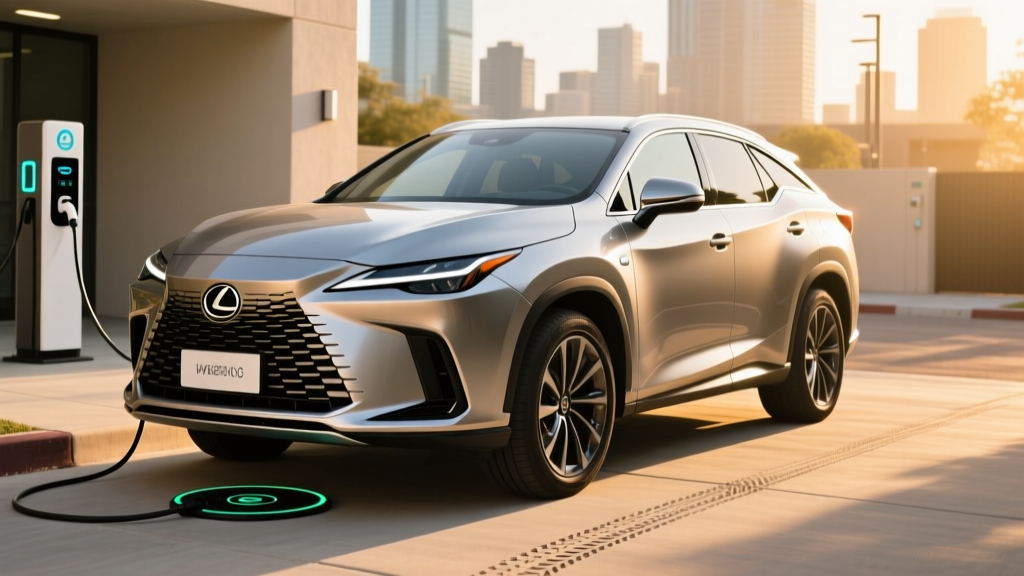
Quick Verdict: The 2026 Lexus TX Hybrid is a three-row luxury SUV that prioritizes fuel-sipping refinement over plug-in electrification. Available as the TX 350h (33 MPG combined) or the punchier TX 500h F Sport (27 MPG combined), neither variant is a plug-in — there is no PHEV TX in the 2026 lineup. If you need three rows, premium comfort, and class-leading MPG without ever plugging in, the TX Hybrid is a compelling choice. If you want electric-only commuting, you'll need to look at a PHEV or a full BEV.
TX 350h vs TX 500h: Which Lexus TX Hybrid Fits You?
Lexus offers two distinct hybrid powertrains for the 2026 TX, and they serve very different buyers. The TX 350h is the efficiency play; the TX 500h F Sport is the performance hybrid. Both are conventional hybrids (HEVs), meaning the battery charges through regenerative braking and the gasoline engine — you never plug them in.
HEV vs PHEV — Where the TX Fits: A conventional hybrid like the TX 350h uses a small battery (roughly 1.5–2 kWh) to assist the gas engine, recover braking energy, and enable brief electric-only movement at low speeds. A plug-in hybrid (PHEV) carries a much larger battery (typically 15–25 kWh) that delivers 25–45 miles of true electric-only driving before the gas engine takes over. The TX is strictly HEV. If you want a Lexus PHEV with plug-in electric range, the closest current option is the Lexus NX 450h+ (37 miles EV range) or the Lexus RZ (a full BEV).
| Spec | TX 350h (AWD) | TX 500h F Sport (AWD) |
|---|---|---|
| Powertrain | 2.4L turbo 4-cyl + hybrid system | 2.4L turbo 4-cyl + DIRECT4 hybrid |
| Combined Horsepower | 366 hp | 366 hp |
| Combined Torque | 406 lb-ft | 406 lb-ft |
| Transmission | 6-speed automatic | 6-speed automatic |
| Drivetrain | AWD (eAxle rear) | AWD (DIRECT4 eAxle) |
| 0–60 mph | ~6.5 sec (est.) | ~5.9 sec (est.) |
| Towing Capacity | 5,000 lbs | 5,000 lbs |
| Hybrid Battery | ~1.5 kWh NiMH/Li-ion | ~1.5 kWh NiMH/Li-ion |
| Plug-In Capable? | No (HEV) | No (HEV) |
The TX 500h's DIRECT4 all-wheel-drive system actively balances torque between front and rear eAxles, giving it sharper cornering and launch behavior than the 350h's simpler eAxle setup. In practice, the 500h feels noticeably quicker off the line and more planted through sweepers, at the cost of roughly 6 MPG combined.
EPA MPG and Real-World Fuel Economy
| Model | City MPG | Highway MPG | Combined MPG |
|---|---|---|---|
| TX 350h AWD | 35 | 31 | 33 |
| TX 500h F Sport AWD | 27 | 28 | 27 |
| TX 350 (Gas AWD baseline) | 20 | 26 | 22 |
Source: fueleconomy.gov — EPA estimates. Your mileage will vary with driving style, climate, and terrain.
Real-World MPG — What to Actually Expect:
- TX 350h city driving: Toyota/Lexus hybrids routinely exceed their EPA city rating in stop-and-go traffic, where regenerative braking recovers the most energy. Expect 34–37 MPG in suburban and urban commutes.
- TX 350h highway driving: At sustained 70–80 mph, the electric motor contributes less. Expect 28–31 MPG on long interstate trips. The 33 MPG combined EPA figure is realistic for mixed driving.
- TX 500h F Sport: The performance-tuned hybrid system and stickier tires reduce efficiency. Expect 25–28 MPG in mixed real-world use. Aggressive driving will push it toward 23.
- Cold weather: Hybrids lose 5–10% efficiency below freezing because the engine runs more frequently to provide cabin heat and maintain battery temperature. A TX 350h that gets 33 MPG in July may deliver 29–30 MPG in a Minnesota January.
Compared to the gas-only TX 350 AWD (22 MPG combined), the TX 350h saves roughly 5 gallons per 1,000 miles. At $3.50/gallon, that's about $175 saved per 10,000 miles, or roughly $875 annually for an average driver. The hybrid premium over a comparably equipped gas TX 350 is typically $1,500–$2,500, meaning the fuel savings pay back the hybrid upcharge in roughly 2–3 years.
Pricing, Trims, and Tax Credit Eligibility
| Trim | Estimated MSRP |
|---|---|
| TX 350h Premium | $62,500 |
| TX 350h Luxury | $68,000 |
| TX 500h F Sport Premium | $70,500 |
| TX 500h F Sport Luxury | $76,000 |
Pricing reflects estimated 2026 MSRP including destination. Final pricing confirmed at launch.
Does the Lexus TX Hybrid Qualify for a Federal Tax Credit?
- No federal §30D credit. The IRS §30D clean vehicle credit applies only to plug-in electric vehicles (BEVs and PHEVs) with sufficient battery capacity. The TX 350h and TX 500h are conventional hybrids with no plug — they do not qualify for the $7,500 federal EV credit.
- No federal used-vehicle credit (§25E). Same reason — requires plug-in capability.
- State incentives may apply. Some states offer rebates or HOV-lane access for hybrids. Check your state's energy office or AFDC state incentive database for current programs.
- Consult a tax professional for personalized advice on any credits or deductions available in your jurisdiction.
Hybrid Battery Warranty, Reliability, and Replacement Cost
Lexus (and parent company Toyota) has the longest track record in hybrid technology of any automaker — the Prius debuted in 1997, and the RX Hybrid has been on sale since 2005. That institutional knowledge translates directly to the TX Hybrid's powertrain.
2026 Lexus TX Hybrid Battery Warranty:
- Hybrid Battery: 10 years / 150,000 miles (whichever comes first) — covers the hybrid traction battery against defects and excessive capacity loss.
- Hybrid System Components: 8 years / 100,000 miles — covers the inverter, electric motor/generators, and associated control electronics.
- Lexus Basic Warranty: 4 years / 50,000 miles.
- Powertrain Warranty: 6 years / 70,000 miles.
How long will the hybrid battery actually last? Based on data from millions of Toyota/Lexus hybrids on the road, the hybrid battery pack in the TX should last the life of the vehicle under normal use. Toyota's hybrid batteries are designed with conservative charge/discharge windows — they never fully charge or fully deplete, which dramatically reduces degradation. Failures before 150,000 miles are rare.
Battery replacement cost: If the hybrid battery does need replacement out of warranty, expect $2,500–$4,500 for a refurbished or new unit installed at a Lexus dealer. Independent hybrid specialists can sometimes source refurbished packs for $1,500–$2,500. This is far less than a full BEV battery replacement ($10,000–$20,000+) because the TX's hybrid battery is small (~1.5 kWh vs 75–100+ kWh in a BEV).
Overall reliability: Lexus consistently ranks at or near the top of J.D. Power Vehicle Dependability Studies and Consumer Reports reliability surveys. The TX shares its TNGA-K platform and hybrid powertrain architecture with proven models like the Grand Highlander Hybrid. Early TX reliability has been strong, with no widespread powertrain complaints reported through 2025.
Hybrid vs PHEV vs Full EV — Which Fits Your Lifestyle?
Choosing between a conventional hybrid (HEV), plug-in hybrid (PHEV), and battery-electric vehicle (BEV) comes down to three factors: charging access, daily driving distance, and trip patterns.
Choose the Lexus TX Hybrid (HEV) if:
- You lack reliable access to home or workplace charging (apartment, street parking, no garage outlet).
- You take frequent long road trips and don't want to plan around DC fast-charging stops.
- You want three rows, premium comfort, and 30+ MPG without any behavior change.
- You plan to keep the vehicle 8–12 years and want minimal long-term risk.
Choose a PHEV (like a Volvo XC90 Recharge or BMW X5 xDrive50e) if:
- You can install a Level 2 home charger and your daily commute is under 30–40 miles.
- You want electric-only daily driving but also need gas flexibility for weekend road trips.
- You want to qualify for the $7,500 federal tax credit (subject to IRS §30D eligibility rules on income, MSRP caps, and battery sourcing).
Choose a full BEV (like a Rivian R1S, Tesla Model X, or Kia EV9) if:
- You have home Level 2 charging and your daily driving is under 250 miles.
- You want the lowest per-mile fuel cost (~$0.04–$0.06/mile on home electricity vs ~$0.15/mile on gas at 33 MPG).
- You want zero tailpipe emissions and minimal scheduled maintenance (no oil changes, no transmission fluid).
Interior, Cargo, and Three-Row Practicality
The TX is Lexus's answer to the growing demand for three-row luxury crossovers that actually accommodate adults in the third row. Built on the extended TNGA-K platform (shared with the Toyota Grand Highlander), it offers:
- Seating: 7-passenger (bench second row) or 6-passenger (captain's chairs) configurations.
- Cargo behind 3rd row: ~20 cu ft — enough for a few carry-on bags or a week of groceries.
- Cargo behind 2nd row: ~57 cu ft with the third row folded.
- Maximum cargo (all rows folded): ~97 cu ft.
- Infotainment: 14-inch touchscreen with wireless Apple CarPlay and Android Auto, available Mark Levinson 21-speaker audio.
- Driver assistance: Lexus Safety System+ 3.0 — includes adaptive cruise control, lane tracing assist, pre-collision system with pedestrian detection, and blind-spot monitoring. This is an SAE Level 2 system requiring full driver engagement at all times.
The hybrid powertrain adds no cargo penalty — the battery pack is mounted under the rear seats, preserving the same interior volume as the gas-only TX 350. There is no frunk (front trunk); the engine bay is fully occupied by the turbocharged four-cylinder and hybrid motor/generators.
Pros and Cons
Pros
- Class-leading 33 MPG combined (TX 350h) for a three-row luxury SUV
- Genuine adult-sized third row — rare in the luxury midsize segment
- Proven Toyota/Lexus hybrid reliability with 10-year battery warranty
- No charging infrastructure needed — fuel at any gas station
- Quiet, refined cabin with premium materials and available Mark Levinson audio
- 5,000-lb towing capacity on both hybrid trims
Cons
- No PHEV option — no electric-only range, no federal tax credit eligibility
- TX 500h F Sport drops to 27 MPG combined, eroding the hybrid advantage
- Starting price above $62,000 — steep entry for a hybrid without credit offsets
- Hybrid battery is small — no meaningful electric-only driving at highway speeds
- Third-row cargo space is tight (20 cu ft) compared to full-size SUVs
- No DC fast charging capability (not applicable — HEV only)
Frequently Asked Questions
How many MPG does the Lexus TX Hybrid get?
The TX 350h achieves an EPA-estimated 35 city / 31 highway / 33 combined MPG. The TX 500h F Sport is rated at 27 city / 28 highway / 27 combined. In real-world city driving, TX 350h owners often see 34–37 MPG thanks to the hybrid system's regenerative braking efficiency in stop-and-go traffic.
Is the Lexus TX Hybrid a plug-in?
No. Both the TX 350h and TX 500h are conventional hybrids (HEVs). They charge their small hybrid battery through regenerative braking and the gasoline engine. You never plug them in. There is no PHEV variant of the TX as of the 2026 model year.
How far can the Lexus TX Hybrid drive on electric only?
The TX Hybrid can travel roughly 1 mile or less on electric power alone at very low speeds (under 25 mph) in ideal conditions. This is typical of conventional hybrids — the electric motor's primary role is to assist the gas engine during acceleration and to recover energy during braking, not to provide meaningful all-electric range. For 30+ miles of electric-only driving, you would need a PHEV or a full BEV.
Is the Lexus TX Hybrid reliable?
Yes. Lexus and Toyota have built millions of hybrids since 1997, and their hybrid powertrains are among the most proven in the industry. The TX's hybrid system is covered by a 10-year/150,000-mile battery warranty and an 8-year/100,000-mile hybrid component warranty. Independent reliability data from J.D. Power and Consumer Reports consistently places Lexus at or near the top of brand rankings.
What does it cost to replace the Lexus TX Hybrid battery?
Out-of-warranty hybrid battery replacement for the TX is estimated at $2,500–$4,500 at a Lexus dealer. Because the hybrid battery is small (~1.5 kWh), replacement costs are a fraction of what a full EV battery swap would cost. In practice, Toyota/Lexus hybrid batteries routinely last 150,000+ miles without needing replacement.
Does the Lexus TX Hybrid qualify for any tax credits?
The TX Hybrid does not qualify for the federal §30D clean vehicle tax credit (up to $7,500) because it is not a plug-in vehicle. The IRS requires that qualifying vehicles have a plug-in capability and minimum battery capacity. Some states may offer separate incentives for hybrid vehicles — check your local programs. Always consult a tax professional for personalized eligibility guidance.
How does the TX Hybrid compare to the Toyota Grand Highlander Hybrid?
Both share the TNGA-K platform and a similar hybrid powertrain. The Grand Highlander Hybrid MAX (362 hp) is the TX 350h's corporate cousin, with similar MPG (roughly 27–34 combined depending on trim). The TX differentiates with Lexus-level cabin materials, standard luxury features, available Mark Levinson audio, and a more refined ride. Expect to pay $8,000–$15,000 more for the TX over a comparably equipped Grand Highlander Hybrid.
Should I buy the TX 350h or the TX 500h F Sport?
If fuel economy is your priority, the TX 350h (33 MPG combined) is the clear winner — you'll save roughly $600–$800 per year in fuel over the 500h. If you value sharper acceleration (~0.6 seconds quicker to 60 mph), the DIRECT4 torque-vectoring AWD system, and sportier styling, the TX 500h F Sport delivers at the cost of 6 MPG. For most three-row luxury SUV buyers, the 350h is the smarter financial choice.