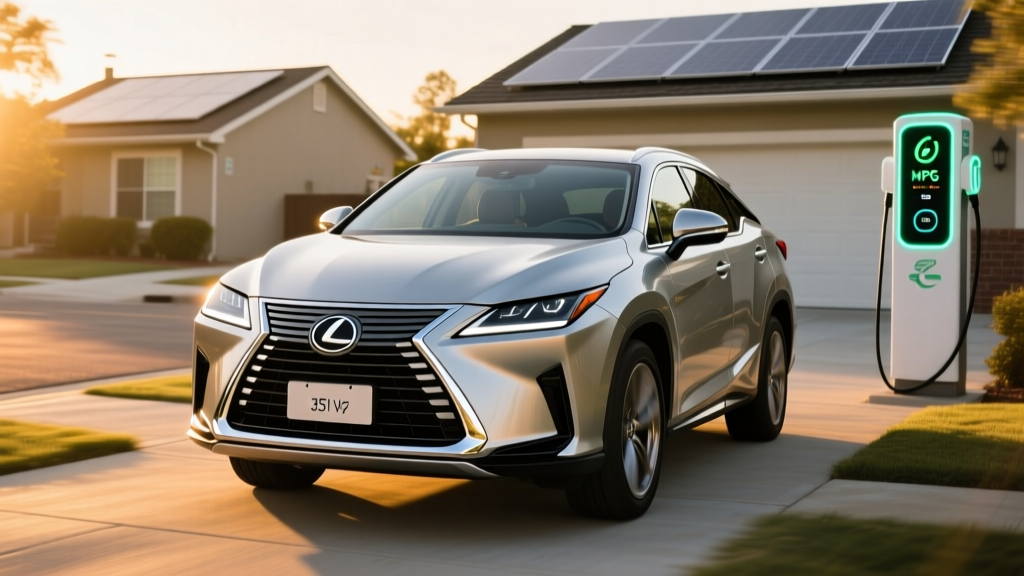
The Lexus RX has anchored the luxury midsize SUV segment for over two decades, and the current-generation RX 350h hybrid represents the volume play in the lineup. It doesn't demand a plug, doesn't require behavioral changes from the driver, and delivers the kind of fuel economy that makes a 5,000-pound luxury crossover feel almost guilt-free around town. For 2026, the RX 350h continues with the proven 2.5-liter four-cylinder hybrid powertrain, standard all-wheel drive, and a starting price that undercuts its non-hybrid sibling while delivering superior city efficiency.
If you're cross-shopping the RX 350h against the plug-in hybrid RX 500h+ or a full battery-electric SUV, this guide breaks down exactly what you're getting — mile-per-gallon by mile-per-gallon — and where the 350h fits in the broader electrification landscape.
2026 Lexus RX 350h Powertrain and Performance
The RX 350h pairs a 2.5-liter Atkinson-cycle inline-four engine with two electric motor-generators and a 1.1 kWh nickel-metal hydride (NiMH) traction battery, routed through Lexus's e-CVT (electronically controlled continuously variable transmission). The result is a combined system output of 246 horsepower and standard electronic all-wheel drive (eAWD), where a rear-mounted electric motor provides torque to the rear axle without a mechanical driveshaft.
| Specification | Value |
|---|---|
| Powertrain | 2.5L I4 hybrid + eAWD |
| Combined Horsepower | 246 hp |
| Engine Output | 189 hp / 158 lb-ft |
| Front Motor | 134 hp |
| Rear Motor (eAWD) | 40 hp |
| Transmission | e-CVT |
| Traction Battery | 1.1 kWh NiMH |
| 0-60 mph | 7.4 seconds (est.) |
| Towing Capacity | 3,500 lbs |
| Cargo Volume (behind 2nd row) | 29.6 cu ft |
The eAWD system is worth a closer look. Unlike mechanical AWD systems that sap efficiency through parasitic drivetrain losses, the RX 350h's rear motor only engages when the system detects slip, heavy acceleration, or cornering load. Under steady highway cruising, it operates essentially as a front-wheel-drive hybrid — which is part of why its highway numbers stay competitive despite the AWD hardware.
The 0-60 time of roughly 7.4 seconds won't embarrass anyone at a merge ramp, but this is a comfort-tuned luxury cruiser, not a performance SUV. Throttle response off the line is immediate thanks to electric motor torque, but the e-CVT's characteristic drone under hard acceleration reminds you that efficiency, not urgency, is the priority here.
Fuel Economy: EPA Ratings and Real-World MPG
This is where the RX 350h earns its keep. The EPA rates the 2026 RX 350h at:
| Driving Cycle | MPG |
|---|---|
| City | 37 MPG |
| Highway | 34 MPG |
| Combined | 36 MPG |
Source: EPA Fuel Economy
For context, the non-hybrid RX 350 (turbocharged 2.4L, 275 hp) returns 24 MPG combined with AWD. That's a 12 MPG gap — or roughly 33% better fuel economy — in favor of the hybrid, despite the 350h producing only 29 fewer horsepower.
Real-World MPG: What Owners Actually See
Hybrid powertrains are one of the few vehicle types where real-world fuel economy often exceeds the EPA combined number in everyday driving. The reason is simple: city driving with frequent stops maximizes regenerative braking and electric-motor assist, which is exactly where hybrids thrive. Many RX 350h owners report 37-40 MPG in suburban and city commuting, particularly in mild weather where climate control demands are low.
Highway driving tells a different story. At sustained 75-80 mph speeds, the electric motor contributes less and aerodynamic drag dominates. Expect 30-32 MPG on long interstate runs. Cold weather (below 30°F) will reduce fuel economy by roughly 8-12% as the engine runs more frequently to maintain cabin heat and the battery's charge/discharge efficiency drops.
RX 350h (HEV) vs. RX 500h+ (PHEV): Which RX Hybrid Fits You?
Lexus offers two electrified RX variants, and confusing them is easy if you're not careful. Here's the critical distinction:
RX 350h — Conventional Hybrid (HEV)
- No plug required. The 1.1 kWh battery charges through regenerative braking and the engine.
- No electric-only driving range to speak of (under 1 mile at very low speeds).
- 36 MPG combined regardless of whether you "charge" it — because you don't.
- Lower starting price, simpler ownership.
RX 500h+ — Plug-In Hybrid (PHEV)
- Plugs in. 18.1 kWh lithium-ion battery charges via Level 1 or Level 2 AC charging.
- ~37 miles of electric-only range before the gas engine engages.
- 35 MPG combined once the battery is depleted (gas-only operation).
- Higher price; eligible for partial federal tax credit.
The RX 500h+ (formerly branded RX 450h+ in earlier model years) uses a larger lithium-ion battery and more powerful electric motors, producing 302 combined horsepower. It charges via a J1772 connector at up to 6.6 kW on Level 2, taking roughly 2.5 hours from empty to full. It does not support DC fast charging — a limitation common among PHEVs due to their smaller battery packs.
| Attribute | RX 350h (HEV) | RX 500h+ (PHEV) |
|---|---|---|
| Type | Conventional Hybrid | Plug-In Hybrid |
| Battery | 1.1 kWh NiMH | 18.1 kWh Li-ion |
| Plug-In Charging | No | Yes (Level 1/2, 6.6 kW max) |
| Electric-Only Range | N/A | ~37 miles |
| Combined HP | 246 hp | 302 hp |
| Combined MPG (gas) | 36 MPG | 35 MPG |
| 0-60 mph | 7.4 sec | 6.2 sec |
| Starting MSRP (2026) | $52,710 | $65,660 |
| Federal Tax Credit | Not eligible | Up to $3,750* |
*Tax credit amount depends on critical mineral and battery component sourcing requirements under IRS §30D. See IRS.gov for current eligibility rules, income caps, and MSRP limits.
Pricing, Trims, and Tax Credit Eligibility
The 2026 Lexus RX 350h is available in four trims, all with standard eAWD:
- Premium: $52,710 — includes 14-inch touchscreen, wireless Apple CarPlay/Android Auto, Lexus Safety System+ 3.0, heated front seats, power liftgate
- Premium+: $55,210 — adds panoramic roof, ventilated front seats, head-up display, 21-inch wheels
- Luxury: $59,210 — adds semi-aniline leather, heated rear seats, adaptive variable suspension, Mark Levinson audio
- F SPORT Handling: $57,710 — sport-tuned suspension, F SPORT exterior/interior trim, 21-inch alloy wheels
Tax Credit Situation for the RX 350h
The conventional RX 350h hybrid does not qualify for the federal §30D Clean Vehicle Credit. That credit is reserved for plug-in electric vehicles (BEVs and PHEVs) with battery capacities of at least 7 kWh. The 350h's 1.1 kWh NiMH pack falls far short of that threshold.
If a federal incentive is a deciding factor, you'd need to look at the RX 500h+ PHEV (up to $3,750 credit, subject to sourcing requirements and income limits) or a fully electric competitor like the BMW iX or Cadillac Lyriq. However, the RX 350h's lower purchase price — roughly $13,000 less than the 500h+ — means the hybrid's break-even point through fuel savings alone is quite short for most buyers.
Battery Warranty, Reliability, and Replacement Cost
Hybrid Battery Warranty
Duration: 10 years / 150,000 miles (whichever comes first)
Coverage: Defects and capacity loss below a defined threshold
Transferable: Yes, to subsequent owners
Additional: Hybrid system components (inverter, motor-generators, control unit) covered under the same 10yr/150k warranty
Lexus (and parent company Toyota) has the deepest track record in hybrid technology of any automaker. The Prius debuted in 1997, and Lexus has been building hybrid RX models since the RX 400h in 2005. The current NiMH battery pack in the RX 350h is a mature, well-understood technology — NiMH cells degrade more slowly and tolerate wider temperature ranges than lithium-ion, at the cost of lower energy density (which doesn't matter in a 1.1 kWh conventional hybrid pack).
How Long Will the Battery Last?
Based on two decades of Toyota/Lexus hybrid data, the RX 350h's hybrid battery should comfortably last 150,000-200,000+ miles under normal use. NiMH packs in the RX 400h and RX 450h from the 2006-2015 era are still running on original batteries in many cases. The primary failure mode is gradual capacity loss from repeated heat cycling, but Lexus's battery thermal management system (which uses cabin air to cool the pack) has proven effective over hundreds of thousands of real-world units.
Battery Replacement Cost
If you do need to replace the hybrid battery out of warranty (likely 15+ years from now), expect:
- New OEM battery: $3,000–$4,500 (parts + labor at a Lexus dealer)
- Refurbished/remanufactured battery: $1,500–$2,500
- Individual cell replacement (independent hybrid specialist): $800–$1,500
For context, this is dramatically less expensive than a full EV battery replacement (typically $10,000–$20,000+), because the RX 350h's pack stores just 1.1 kWh of energy. It's also a cost you'll likely never face during typical ownership.
Lexus's reliability ratings remain among the industry's best. The brand consistently ranks at or near the top in IIHS safety evaluations and J.D. Power dependability studies. The RX itself earned IIHS Top Safety Pick status in prior model years with the current generation.
Driving Experience and Daily Ownership
The RX 350h's driving character is defined by quietness and composure rather than engagement. The cabin is well-isolated from road and wind noise, the suspension absorbs most pavement imperfections without drama, and the hybrid system transitions between electric and gas operation almost imperceptibly at low speeds.
Where you'll notice the hybrid system most is in stop-and-go traffic. The engine shuts off at stops and during low-speed coasting, and the electric motor provides smooth, silent takeoffs up to roughly 25 mph before the gas engine seamlessly engages. This is the exact scenario where the non-hybrid RX 350 sips fuel at its worst rate (low 20s MPG), while the 350h is at its most efficient (high 30s).
The Lexus Safety System+ 3.0 suite comes standard and includes:
- Pre-Collision System with pedestrian detection
- Lane Departure Alert with Steering Assist
- Lane Tracing Assist (centering in marked lanes)
- Dynamic Radar Cruise Control (full stop-and-go adaptive cruise)
- Road Sign Assist
This is an SAE Level 2 driver-assistance system. It does not make the RX 350h self-driving. You must keep your hands on the wheel and eyes on the road at all times. The system is competent for highway cruising and traffic-jam assist, but it will disengage if it detects driver inattention.
Who Should Buy the RX 350h — and Who Shouldn't
Choose the RX 350h If:
- You want luxury-SUV comfort with 36+ MPG and no lifestyle changes
- You don't have access to home or workplace charging (no plug needed)
- You primarily drive in city/suburban traffic where hybrid efficiency peaks
- You value proven reliability and a 10-year hybrid battery warranty
- You want AWD capability without the fuel-economy penalty
Choose the RX 500h+ (PHEV) Instead If:
- You can charge at home and your daily commute is under 37 miles
- You want to drive mostly electric on weekdays and take gas-powered road trips
- You want the $3,750 federal tax credit (verify eligibility on IRS.gov)
Choose a Full BEV Instead If:
- You want zero tailpipe emissions and access to the full $7,500 federal credit
- You have reliable home Level 2 charging and rarely drive beyond 250 miles in a day
- You want minimal moving parts and no gasoline expenses
Pros
- 37 MPG city is exceptional for a luxury AWD SUV
- No plug required — zero infrastructure needs
- Proven, mature hybrid technology with outstanding reliability record
- 10-year / 150,000-mile hybrid battery warranty
- Standard eAWD with no fuel-economy penalty vs. FWD
- Quiet, refined cabin with latest Lexus infotainment
Cons
- No federal tax credit eligibility
- e-CVT drone under hard acceleration
- 246 hp is adequate, not quick, for a $52K+ SUV
- Highway MPG drops to low 30s at sustained 75+ mph
- Rear cargo space (29.6 cu ft) trails some rivals
- Premium fuel recommended for optimal performance
Frequently Asked Questions
How many MPG does the 2026 Lexus RX 350h hybrid get?
The EPA rates the RX 350h at 37 MPG city, 34 MPG highway, and 36 MPG combined. In real-world city and suburban driving, many owners see 37-40 MPG. Highway-only driving at 75+ mph typically yields 30-32 MPG.
Does the RX 350h need to be plugged in?
No. The RX 350h is a conventional hybrid (HEV), not a plug-in hybrid. Its small 1.1 kWh battery charges through regenerative braking and the gasoline engine. You simply fill it with gas like any other car and enjoy better fuel economy — no charger, no cord, no behavioral change.
How far can the RX 500h+ PHEV go on electric only?
The plug-in RX 500h+ offers approximately 37 miles of electric-only range on a full charge, enough for most daily commutes. Once the battery is depleted, it operates as a conventional hybrid at 35 MPG combined.
Is the RX 350h hybrid reliable?
Yes. Lexus and Toyota have built millions of hybrids since 1997, and the RX hybrid lineage stretches back to 2005. The NiMH battery pack is among the most durable in the industry, typically lasting 150,000-200,000+ miles. The hybrid system carries a 10-year/150,000-mile warranty.
What does it cost to replace the RX 350h hybrid battery?
A new OEM replacement battery runs $3,000-$4,500 installed at a dealer. Refurbished options range from $1,500-$2,500. Given the proven longevity of Lexus NiMH packs, most owners will never need a replacement during typical ownership.
Does the RX 350h qualify for any tax credit?
No. The federal §30D Clean Vehicle Credit requires a battery capacity of at least 7 kWh, and the RX 350h's 1.1 kWh pack doesn't qualify. The plug-in RX 500h+ may qualify for up to $3,750, depending on battery sourcing requirements and buyer income limits. Check IRS.gov for current rules.
Hybrid vs. PHEV vs. EV — which RX is right for me?
If you can't charge at home or work, the RX 350h (HEV) is the clear choice — it requires zero infrastructure and delivers strong MPG everywhere. If you can charge at home and commute under 37 miles daily, the RX 500h+ (PHEV) lets you drive electric most weekdays while keeping gas flexibility for road trips. If you want zero emissions, have reliable Level 2 home charging, and don't regularly exceed 250 miles in a day, a full EV competitor may make more financial sense with the $7,500 federal credit.